




Crimson Desert runs better on Intel Arc GPUs at Ultra than Medium — and XeSS 3.0 makes things worse

The recent launch of Crimson Desert brought with it a notable hurdle for Intel GPU owners: an outright hardware block. Developer Pearl Abyss initially disabled the game on Arc systems, advising users to simply refund the title. This led to a public exchange between the two companies, with Intel stating that it had offered engineering support for years.
Following community pushback, recent driver updates and game patches have brought Intel GPUs back into compatibility.
To see exactly where the hardware optimization stands today, YouTube channel Tech Guy Beau recently tested the game on the new Intel Arc Pro B70 workstation GPU. Paired with an AMD Ryzen 9 7945HX3D and 64 GB of RAM, the benchmark data reveals a playable experience, though some unusual workarounds are currently required.
Intel Arc Pro B70 Crimson Desert benchmarks: Ultra settings fix visual bugs but XeSS 3.0 remains broken
Crimson Desert on the Arc B70 currently operates on inverted logic. Running the game on Medium or High introduces severe shadow flickering and visual artifacting.
The solution, as the YouTuber showcased in their video, appears to be pushing the preset to Ultra or Cinematic. Counterintuitively, forcing the GPU to render at maximum graphical fidelity completely eliminates the texture scaling issues, resulting in a clean, artifact-free image.
However, at 1440p native resolution with Ultra settings, the Intel Arc Pro B70 delivered strong raw performance, with clean visuals and no visual bugs.
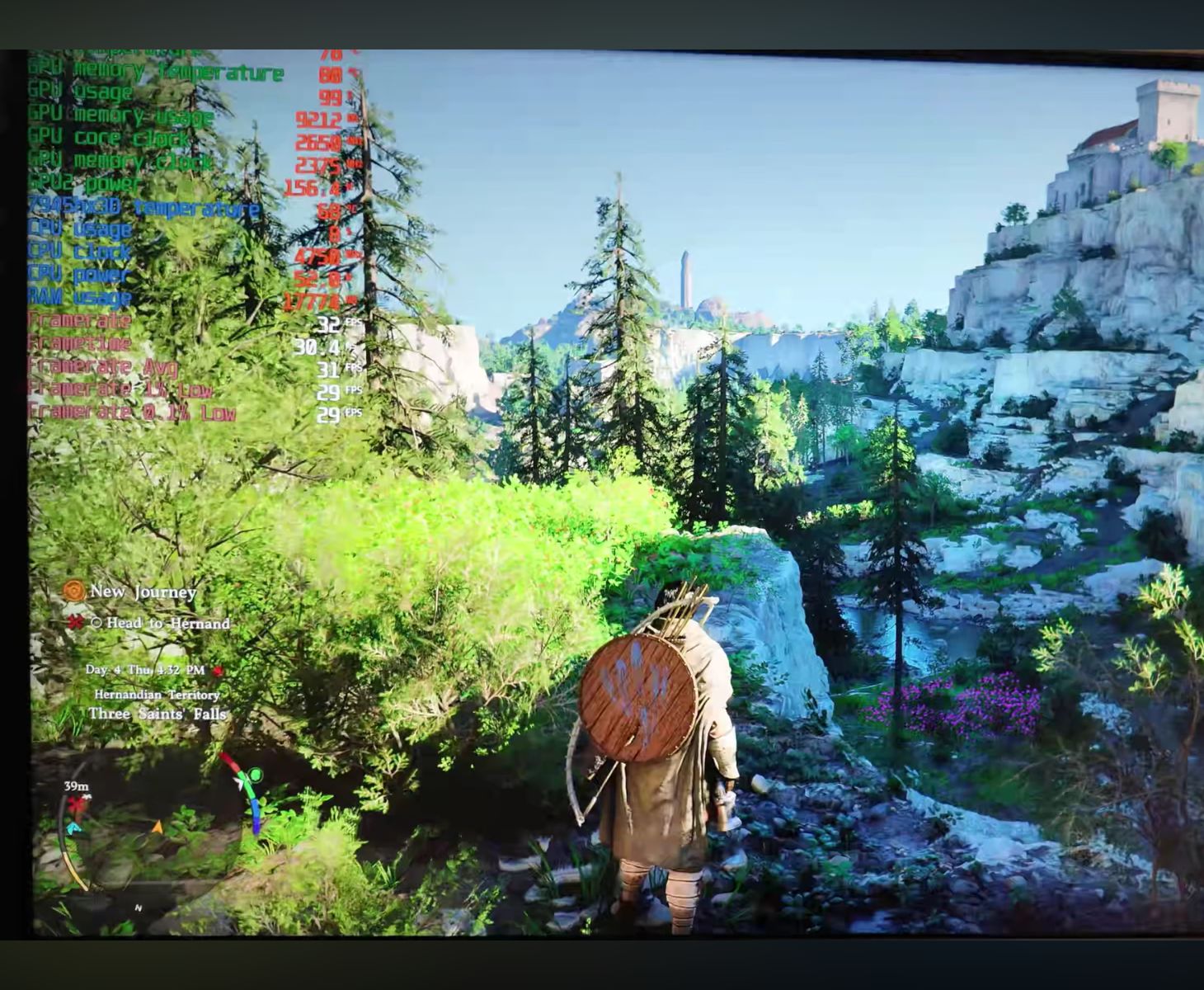
While recent patches have technically introduced Intel's native XeSS 3.0 upscaling to the game, the video shows that it is currently unusable. Activating XeSS results in a heavily pixelated and degraded image. AMD's FSR implementation, however, is functioning properly as a stopgap.
In terms of frame rates, at 1440p scaled resolution with Cinematic settings and FSR Quality, the GPU maintains a stable, near-60 FPS experience. The 1% lows consistently hover around 40 FPS, which should help minimize severe micro-stuttering during combat.
At 4K native resolution with Ultra or Cinematic settings, the frame rate drops to a locked 30 FPS, similar to the high graphics or quality modes found on current-generation consoles. For a 60 FPS experience at 4K, aggressive scaling using FSR Performance is required.
Crimson Desert joins Starfield in Intel Arc's troubled game compatibility history
That said, buyers who discovered their hardware was blocked after purchasing the game were understandably frustrated. The subsequent update that restored compatibility also introduced its own issues, with textures only rendering correctly at maximum settings.

A comparable situation occurred a few years ago with Bethesda's Starfield. At launch, the game was effectively unplayable on Intel Arc GPUs, suffering from frequent crashes, missing textures, and poor performance. However, unlike Crimson Desert, this was less about a developer lockout and more a reflection of Intel's less established graphics drivers at the time, which required weeks of emergency updates from Intel to bring the game to a working state.
While Intel's hardware struggles often represent the most visible end of this spectrum, it is worth noting that optimization issues are not exclusive to Intel. Both AMD and Nvidia have faced similar compatibility challenges with many different games over the years.
Source(s)
 Add as a preferred source on Google


