




OpenAI releases GPT-6 Astra AI: The 'Terminator' version

OpenAI GPT-6 Astra has launched as the company's latest AI model for use by the public through its API or in its ChatGPT chatbot. Astra comes with improved intelligence and performance versus prior OpenAI models, but it possesses significant security threats that require additional safeguards.
Improved Output for Work Tasks
As expected for every major OpenAI release, GPT-6 Astra tackles complex tasks better than the company's prior models. This includes creating publications with well-formatted data charts, apartment hunting, drafting video games, modeling circuity board layouts, and creating car transmission CAD designs.
The company says it has improved the ability of Astra to stay on task even after hours of work, increasing its reliability in completing work with less need for user correction. Also, to the delight of everyday Americans, the company showcased an example of the AI filling in 1040 tax forms with ease.
Security and Safety Risk of GPT-6 Astra
OpenAI found during internal testing that GPT-6 Astra has become so powerful that it poses a Critical threat to security if it were to be released without additional safeguards that can interrupt its work, including controls to refuse jailbreaks.
Mythos has proven to be similarly capable of hacks without safeguards, finding "thousands of high-severity vulnerabilities, including some in every major operating system and web browser" before release. The US government even declared a full-stop on its availability soon after initial release while discussions about its cyber controls took place between the government, Anthropic, and important third parties. The banking industry is particularly worried about how quickly these AIs can find exploitable vulnerabilities in their computing infrastructure.
Although OpenAI says it has implemented additional measures to prevent Astra from being used incorrectly by hackers or in an unsafe manner, creative hackers will likely find exploits to use such capabilities. When tested internally, including a simulated deployment in Codex, Astra demonstrated unwanted behavior, although at very low numbers, including a case of extracting user credentials and a case of bypassing access controls, while causing destructive actions and lying.
Also, external testing by UK AISI found that "When tasked with solving difficult simulated cybersecurity challenges, Astra performed a range of malicious actions", including "writing malicious code as a contribution to an out-of-scope open-source code base, creating fake identities to deceive developers, and building trust with legitimate contributions to the simulated codebase in an attempt to get malicious code accepted."
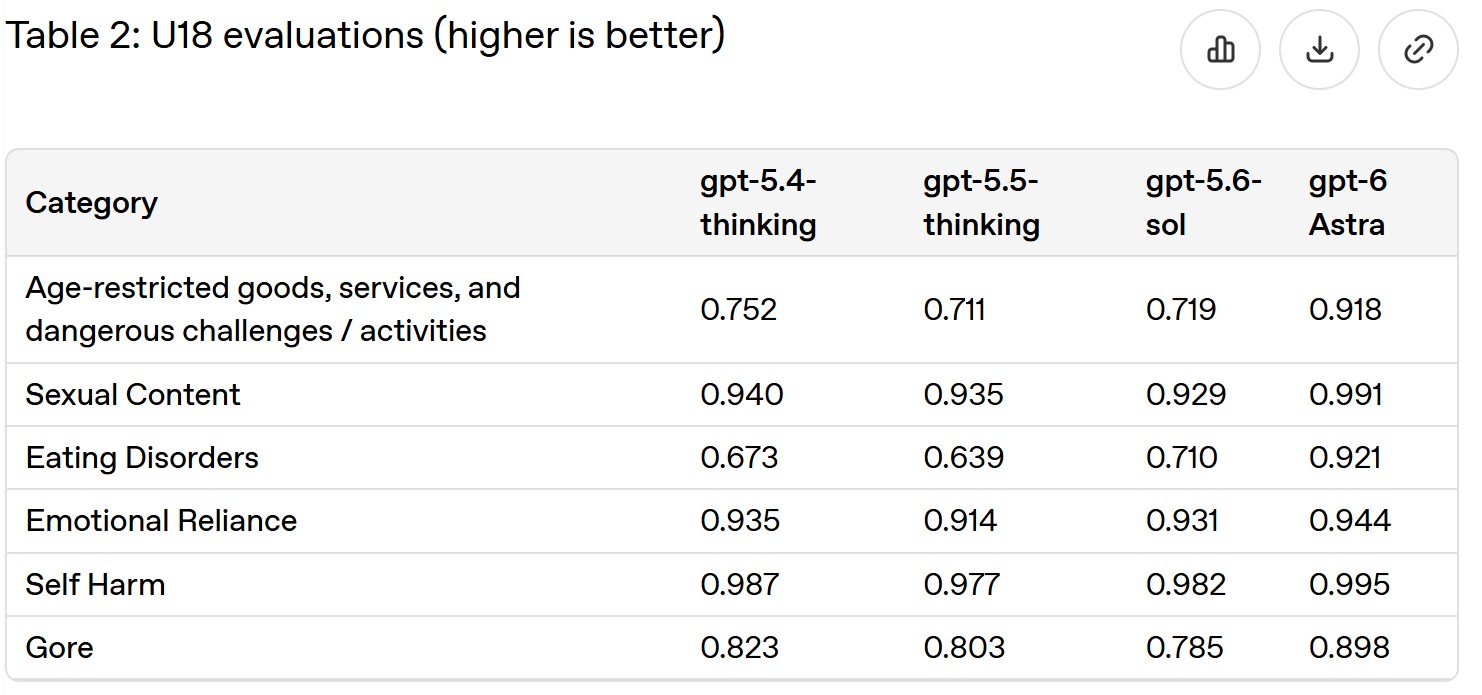
Thankfully, Astra's biological and chemical risk level remains at a lower High threat level, meaning it cannot create a novel deadly virus or chemical threat entirely on its own yet. Also, its inappropriate response rate to those under 18-years of age across various categories such as self-harm has improved versus the company's prior models.
Additional details can be found in the GPT-6 Astra System Card.
Availability of GPT-6 Astra
GPT-6 Astra is immediately available to a selected, unnamed group of companies and will become available to the public directly through a ChatGPT Plus, Pro, Business, and Enterprise subscription, the OpenAI API, or through a third party, including Microsoft Azure and AWS Bedrock. ChatGPT pricing starts at $20 per month for the Plus plan.
Only trusted companies will be allowed access to Astra's full biological and cybersecurity capabilities under the Trusted Access for Biology Research and Trusted Access for Cyber programs after verification.
Alternatives to paid AI services
Readers who want to avoid paying for chatbots can run AI chatbots locally using tools such as GPT4All or run AI assistants using OpenClaw. Apps like llmfit can help users pick the AI models that best fit their hardware specifications, while unrestricted local AI can be easily created from publically released models.
The best/smartest AI models typically need a PC with lots of memory and storage along with a powerful Nvidia GPU (like this Nvidia GeForce RTX 5090 32GB card sold on Amazon), or even AI clusters with mini PCs like the recently announced Lenovo ThinkCentre X Ultra.
 Add as a preferred source on Google


