




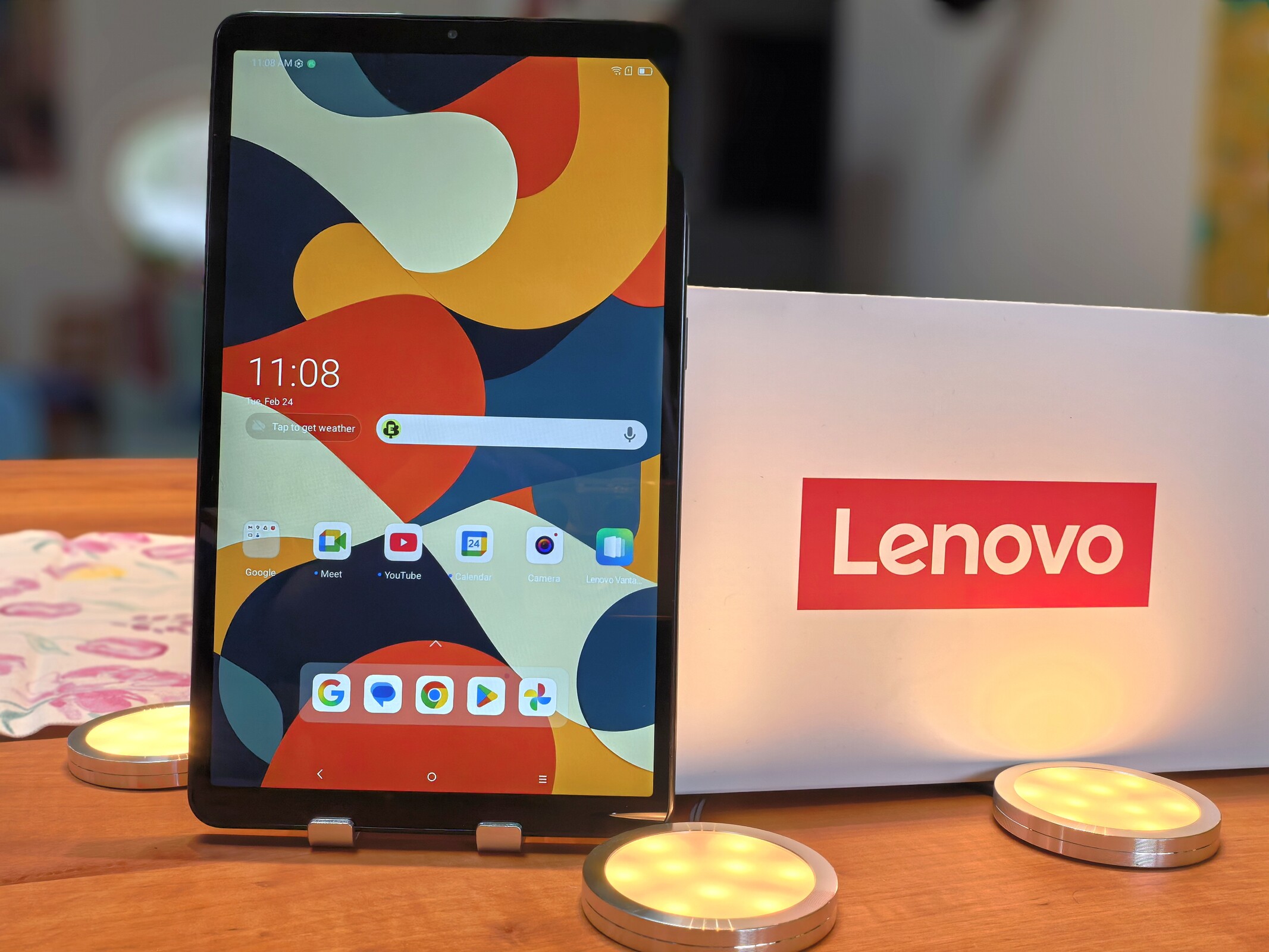
Verdict on the Lenovo Tab K9
The Lenovo Tab K9 is an entry-level Android tablet, so you should keep your expectations in check. Lenovo includes a charger and largely dispenses with any third-party software. For a price between €120 and €150, you get satellite positioning, an analog audio port and an optional LTE module, which further increases mobility.
Updates will only be available until mid-2027 and Android 16 is no longer planned. Of course, it could still come, but there is no promise.
The Helio G85 is no longer really future-proof and is already only capable of jerky operation. The tablet is sufficient for simple tasks, but you shouldn't expect more from it.
The battery life is suitable for everyday use, but is below average overall, the memory is limited and quite slow. and the speakers are not really convincing.
The low screen resolution is also a weak point, but for well under €200, you probably have to live with that in a tablet.
If you are just looking for an inexpensive tablet for simple tasks, the Lenovo Tab K9 offers a lot of features for the money.
Pros
Cons
Price and availability
The tablet is available online from many retailers for between €130 and €150. You should pay attention to whether you buy the version with cellular connectivity or not.
The LTE model of the Tab K9 currently costs €148 at Amazon.de. The Tab K9 is not available in the US, but you can get the Lenovo Tab One and Tab K11 directly from Lenovo.com

- $149.99Lenovo Tab K9 Tablet - MediaTek Helio G85, 4GB RAM, 64 GB Storage, 8.7" HD, Android 14 - Luna Grey (TB305FU)
- $149.99Lenovo Tab K9 TB305FU Tablet - 8.7" HD - MediaTek Helio G85 Octa-core - 4 GB - 64 GB Storage - Android 14 - Luna Gray
- $89.99Lenovo Tab One / K9 Tablet - MediaTek Helio G85 / 4GB RAM / 64 GB Storage / 8.7" / Android 14 / Luna Grey (TB305FU) (Renewed)
Table of Contents
- Verdict on the Lenovo Tab K9
- Specifications
- Build and equipment: Recycled chassis
- Communication and operation: Tab K9 with LTE and satellite positioning
- Software and sustainability: Hardly any updates
- Cameras: Low resolution selfies and images that lack detail
- Display: Low pixel density but no PWM
- Performance, emissions, and battery life: A rather leisurely tablet
- Notebookcheck's overall impressions of the Lenovo Tab K9
- Potential alternatives in comparison
Specifications
Build and equipment: Recycled chassis
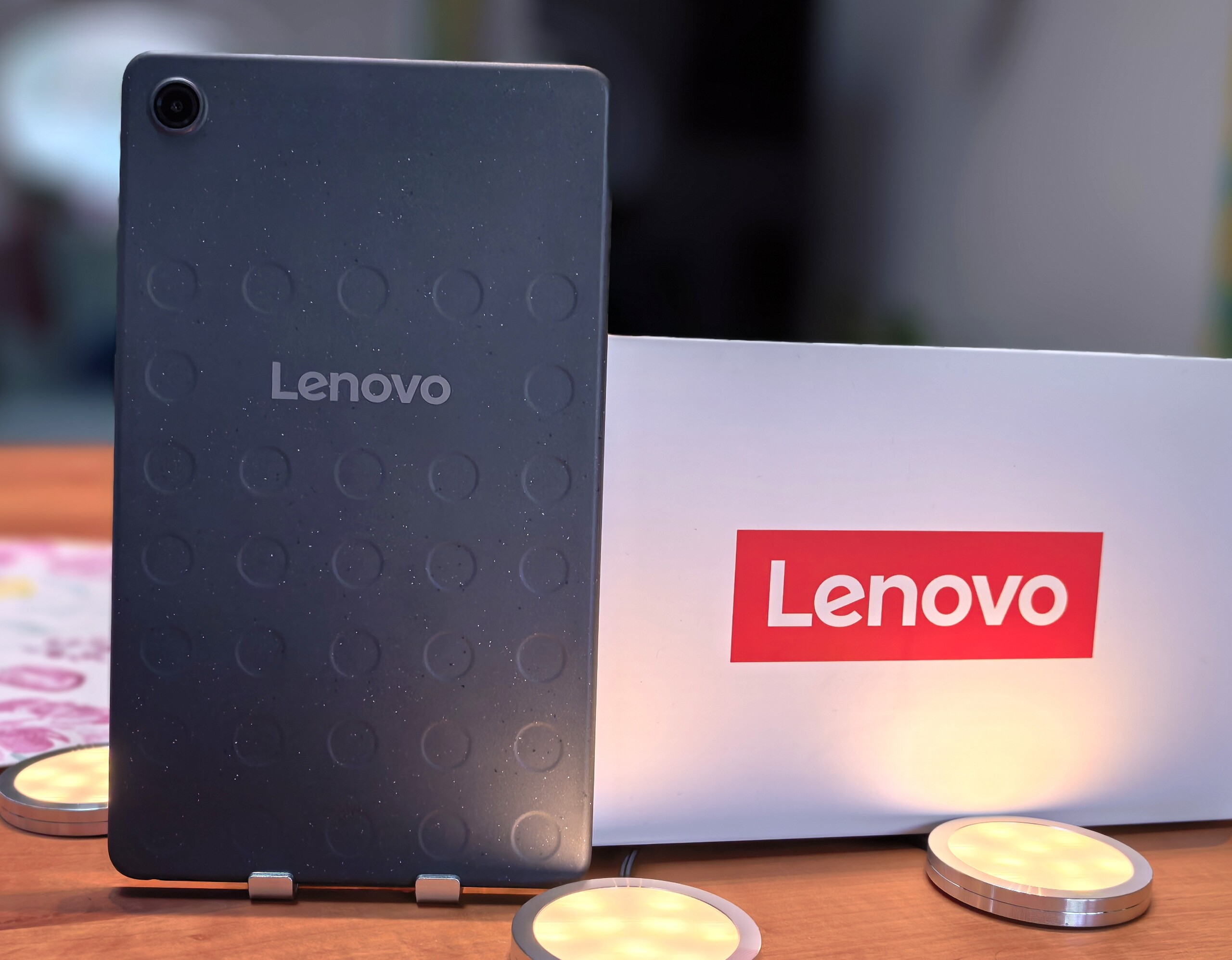
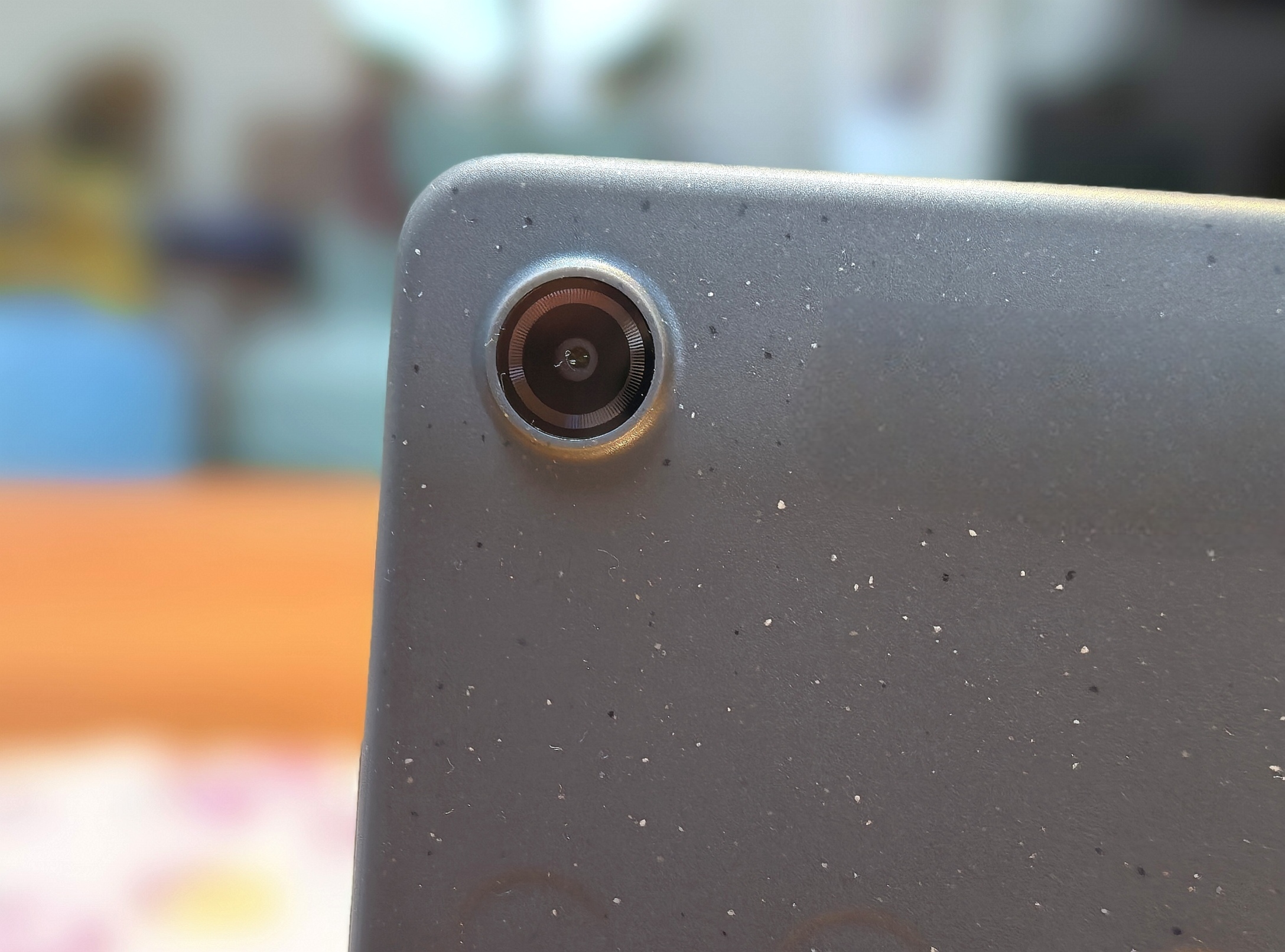
The Lenovo Tab K9 is available in business-compatible gray. It has small speckles of differently-colored plastic, which is due to the fact that Lenovo uses 35% recycled material here. Together with the circular pattern on the back, this creates an interesting look reminiscent of terrazzo flooring.
The tablet has a high-quality feel and can be twisted a little with force but overall, it has a clean finish and is stable. it weighs 320 g and is therefore quite light.
The Tab K9 is also compact, so even children or those with smaller hands can use it easily.
Our test device features a 3.5 mm audio jack, satellite positioning, and microSD port, which are unusually good for the price range.
The microSD slot can also read and write to our Angelbird V60 reference card pretty fast.
| SD Card Reader - average JPG Copy Test (av. of 3 runs) | |
| Lenovo Tab One (Angelbird V60) | |
| Lenovo Tab K9 (Angelbird V60) | |
| Average of class Tablet (10.2 - 79.2, n=45, last 2 years) | |
| Xiaomi Redmi Pad SE 8.7 inches (Angelbird V60) | |
Cross Platform Disk Test (CPDT)
Communication and operation: Tab K9 with LTE and satellite positioning
You have to make do with maximum Wi-Fi data rates of just up to 370 MBit/s — faster throughput is only seen in the mid-range tablet class.
Our test device also comes with a cellular module that supports LTE with important cellular frequencies so the tablet can also be used for mobile internet when traveling. However, in spot checks during our test, the reception was a little shaky from time to time.
The Lenovo Tab K9 does not have a fingerprint sensor, you can only use 2D facial recognition via the front camera. This works reliably but is not completely secure, so it is better not to save sensitive company data on the tablet.
The touchscreen works reliably but is somewhat sluggish with a maximum refresh rate of 60 Hz. The processor often seems overloaded, which can lead to jerks and stutters when typing.
| Networking | |
| Lenovo Tab K9 | |
| iperf3 transmit AXE11000 | |
| iperf3 receive AXE11000 | |
| Lenovo Tab One | |
| iperf3 transmit AXE11000 | |
| iperf3 receive AXE11000 | |
| Xiaomi Redmi Pad SE 8.7 inches | |
| iperf3 transmit AXE11000 | |
| iperf3 receive AXE11000 | |
| Xiaomi Redmi K Pad | |
| iperf3 transmit AXE11000 | |
| iperf3 receive AXE11000 | |
| Average 802.11 a/b/g/n/ac | |
| iperf3 transmit AXE11000 | |
| iperf3 receive AXE11000 | |
| Average of class Tablet | |
| iperf3 transmit AXE11000 | |
| iperf3 receive AXE11000 | |
Software and sustainability: Hardly any updates
Android 15 comes pre-installed on our test device. The Lenovo Tab K9 comes with clean software with very few third-party apps. Updates will be available until mid-2027; a new Android version is no longer planned.
The fact that recycled plastic is used for the back is a good thing. The packaging is also plastic-free, but our unit came completely shrink-wrapped in plastic film.
This could also have happened at the importer or retailer, but it is certainly annoying from a sustainability perspective.
Cameras: Low resolution selfies and images that lack detail

The front camera of the Lenovo Tab K9 only has a resolution of 2 MP and should therefore only be used for selfies in an emergency. The quality leaves a lot to be desired.
The camera can be used for video calls, but don't expect the image quality to be very high.
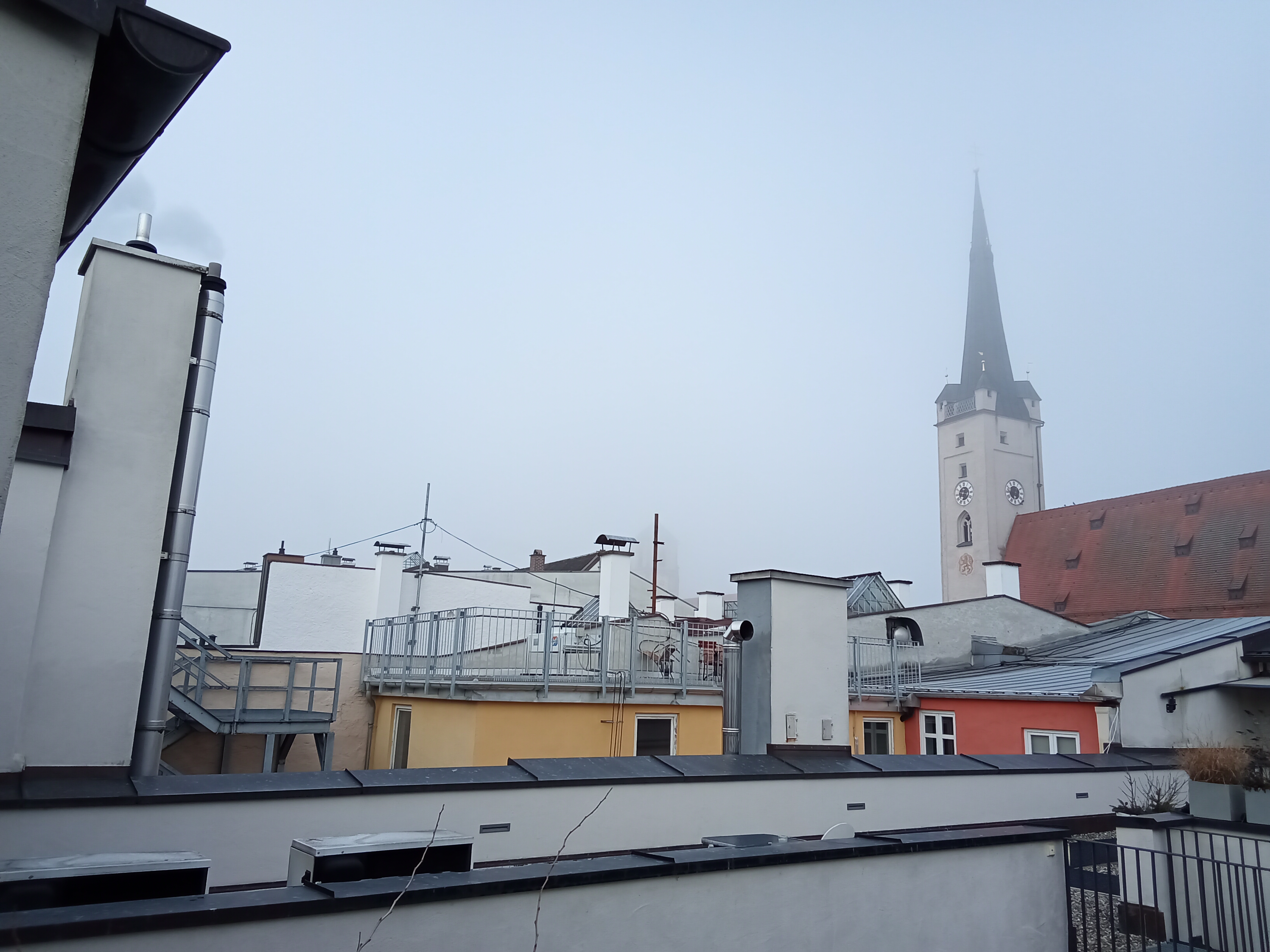
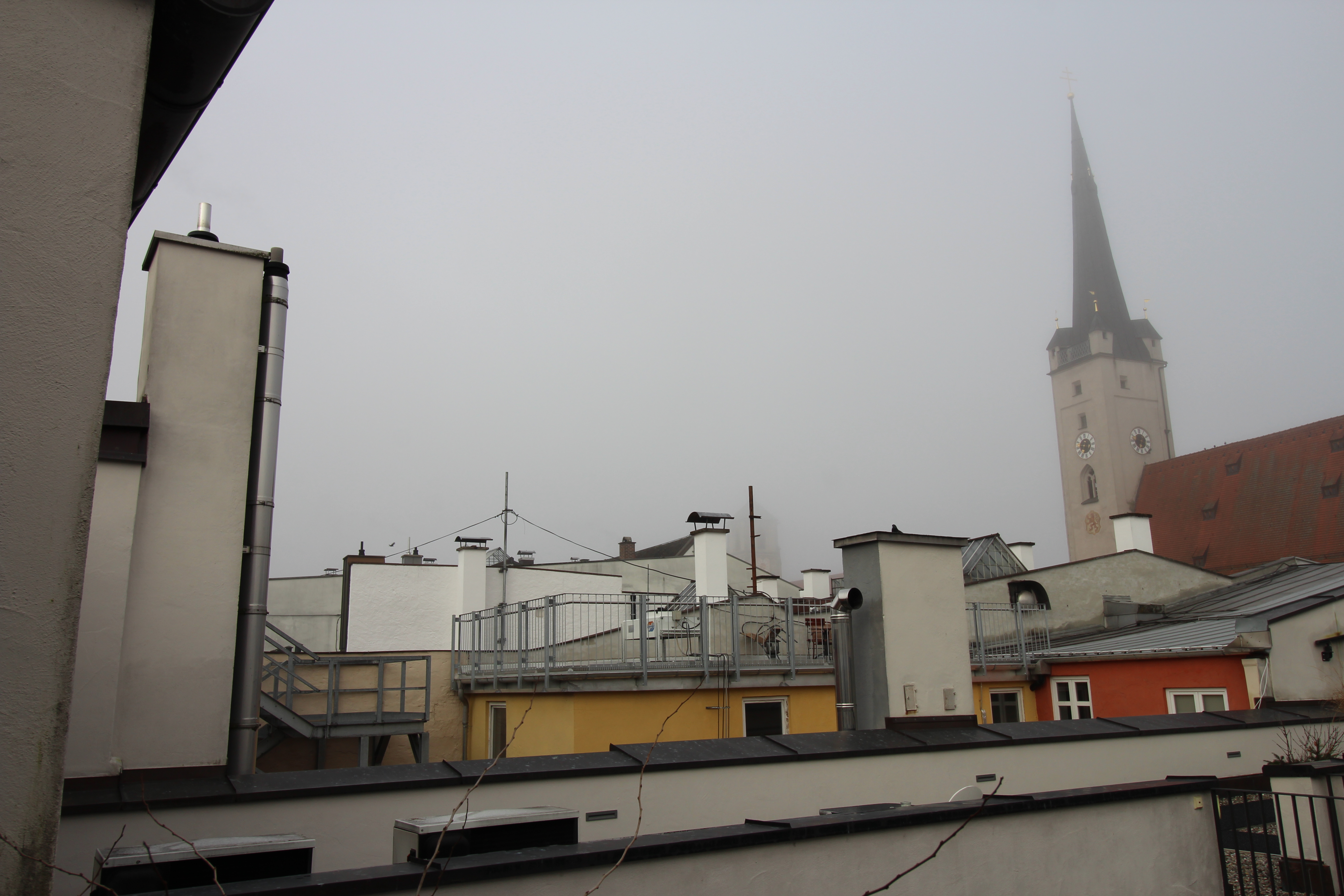
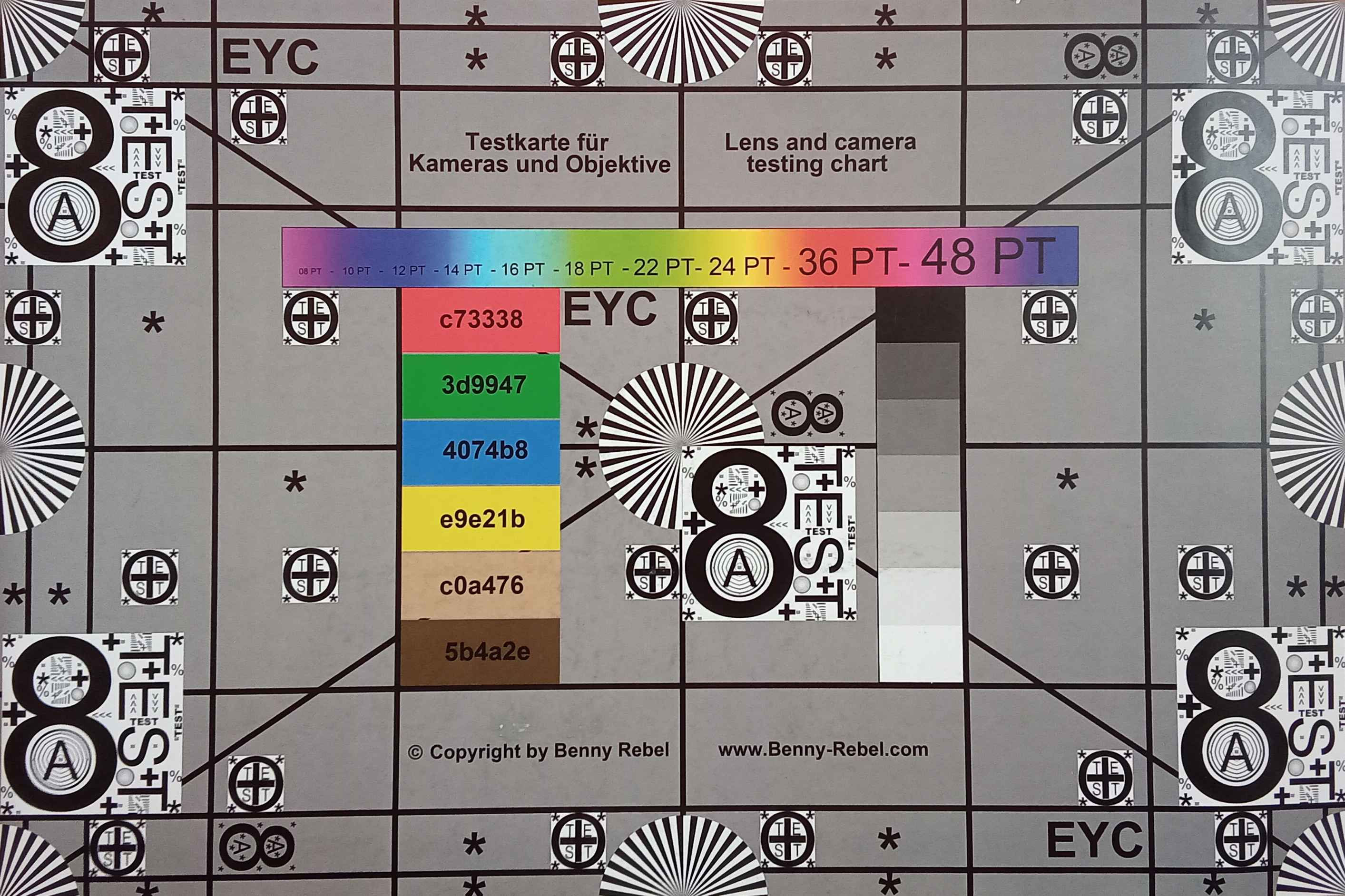
The main camera on the back has an 8 MP resolution and occasionally, a somewhat slow autofocus.
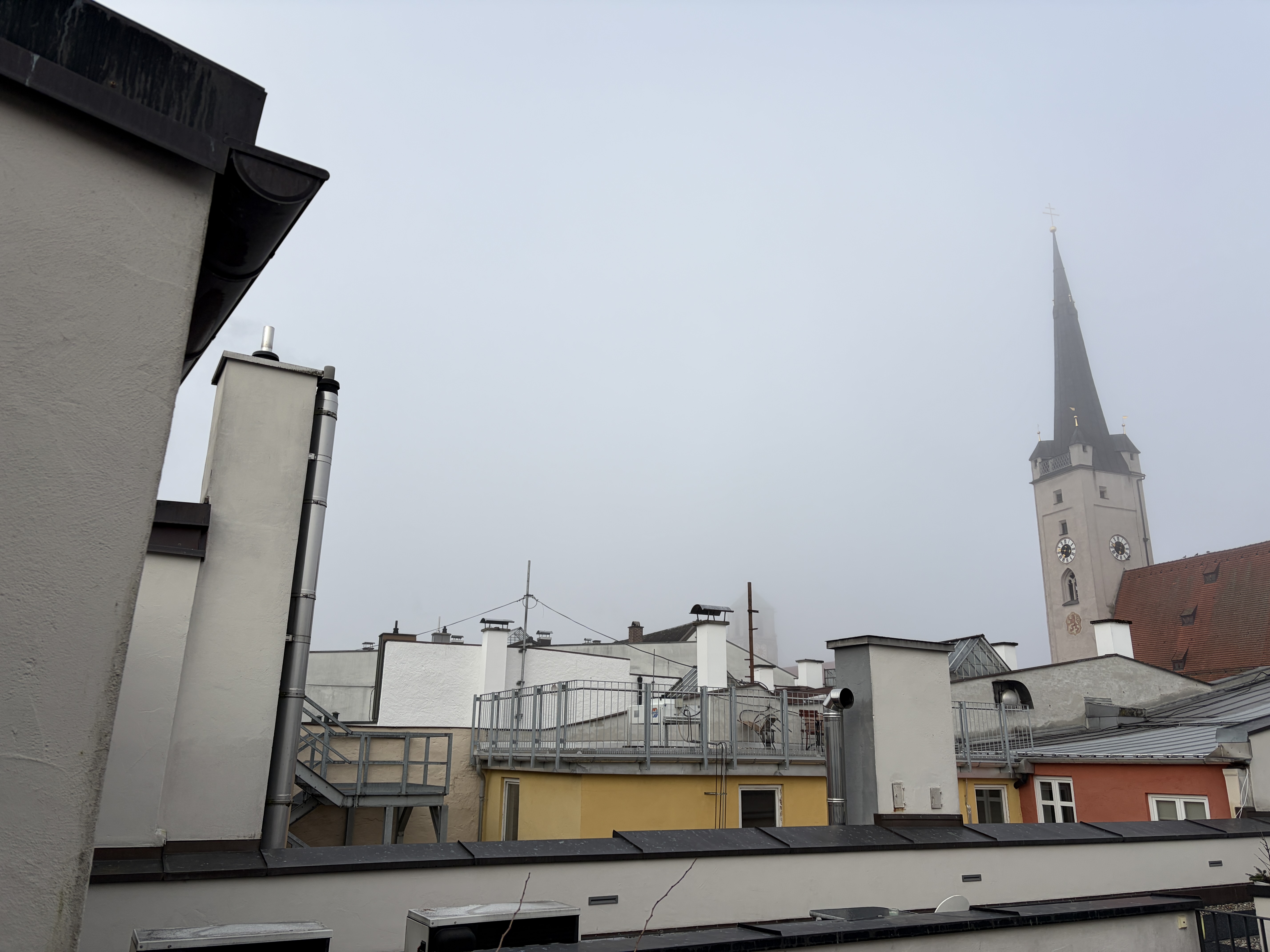
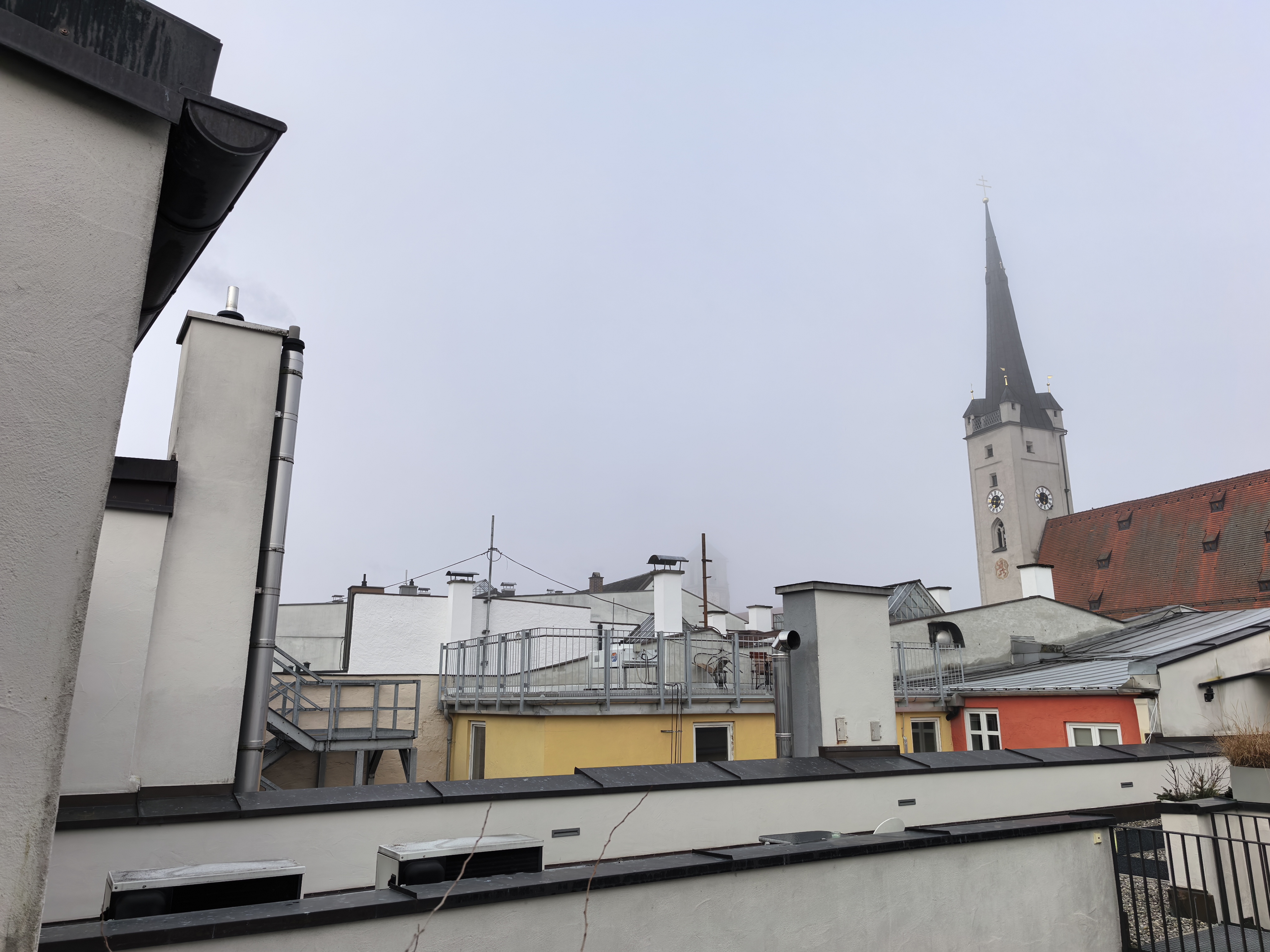
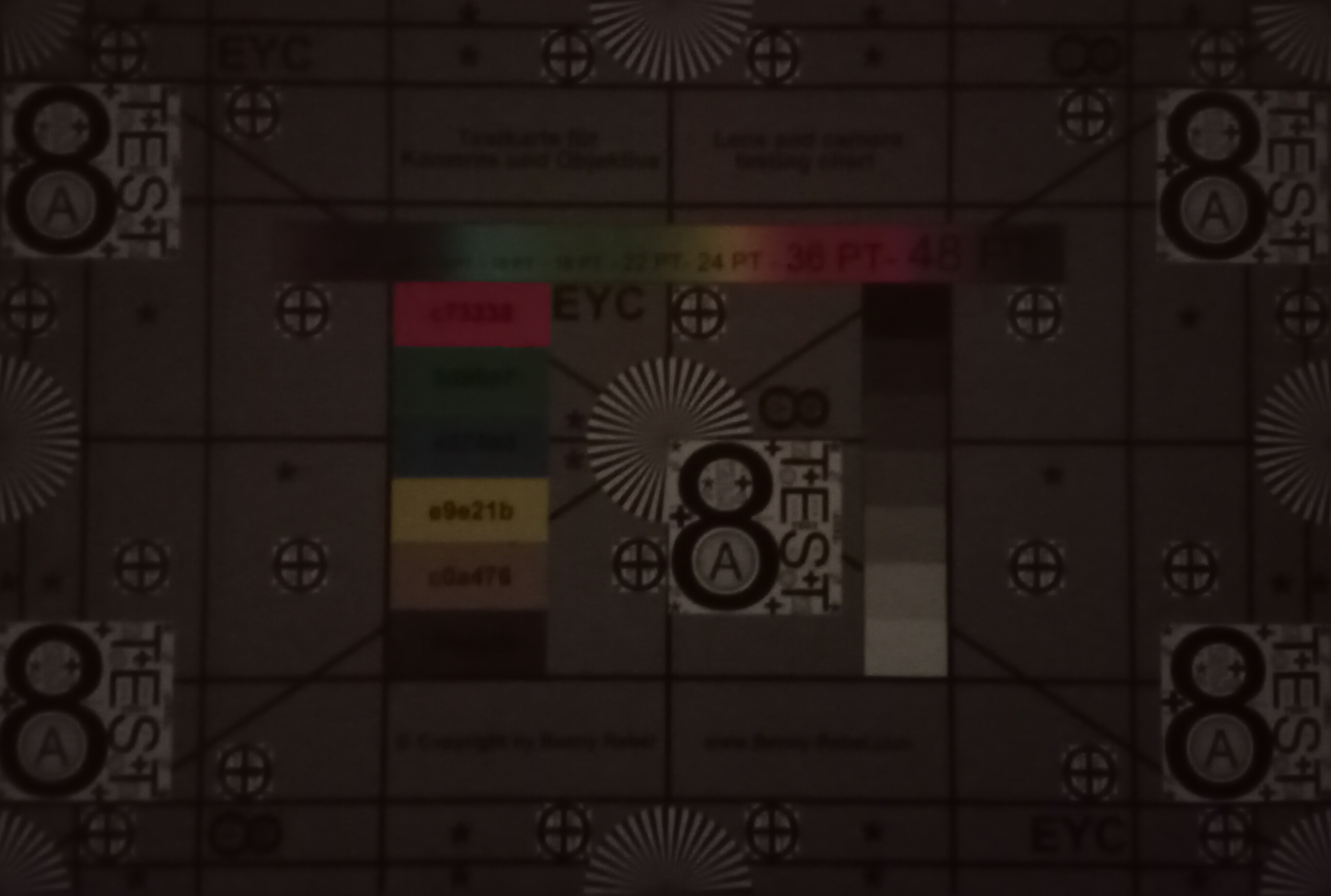
You should not expect much detail in the pictures, and the dynamic range in bright or dark areas is only moderate. The camera is sufficient for scanning QR or barcodes, however.
Image comparison
Choose a scene and navigate within the first image. One click changes the position on touchscreens. One click on the zoomed-in image opens the original in a new window. The first image shows the scaled photograph of the test device.
Hauptkamera PflanzeHauptkamera UmgebungHauptkamera Low Light












Display: Low pixel density but no PWM
The Tab K9's 8.7-inch display has a fairly low pixel density, so the image often looks a little blurred. The tablet struggles with a maximum brightness of around 400 cd/m² outdoors, and you shouldn't expect great brightness for HDR content.
However, the display is still OK for its price range. It offers reasonably accurate color reproduction and does without PWM flickering.
| |||||||||||||||||||||||||
Brightness Distribution: 87 %
Center on Battery: 410 cd/m²
Contrast: 1414:1 (Black: 0.29 cd/m²)
| Lenovo Tab K9 IPS, 1340x800, 8.7" | Lenovo Tab One TFT LCD (IPS), 1340x800, 8.7" | Xiaomi Redmi Pad SE 8.7 inches IPS, 1340x800, 8.7" | Xiaomi Redmi K Pad LCD, 3008x1880, 8.8" | |
|---|---|---|---|---|
| Screen | 7% | 4% | 22% | |
| Brightness middle (cd/m²) | 410 | 407 -1% | 499 22% | 743 81% |
| Brightness (cd/m²) | 380 | 379 0% | 479 26% | 721 90% |
| Brightness Distribution (%) | 87 | 88 1% | 90 3% | 94 8% |
| Black Level * (cd/m²) | 0.29 | 0.24 17% | 0.37 -28% | 0.5 -72% |
| Contrast (:1) | 1414 | 1696 20% | 1349 -5% | 1486 5% |
| Colorchecker dE 2000 * | 2.36 | 3.68 | 1.61 | |
| Colorchecker dE 2000 max. * | 7.77 | 6.82 | 3.82 | |
| Greyscale dE 2000 * | 2.4 | 1.9 | 2.9 | |
| Gamma | 1.988 111% | 2.184 101% | 2.232 99% | |
| CCT | 6876 95% | 6787 96% | 6864 95% |
* ... smaller is better
| Display / APL18 Peak Brightness | |
| Lenovo Tab K9 | |
| Display / HDR Peak Brightness | |
| Lenovo Tab K9 | |
Screen Flickering / PWM (Pulse-Width Modulation)
| Screen flickering / PWM not detected | 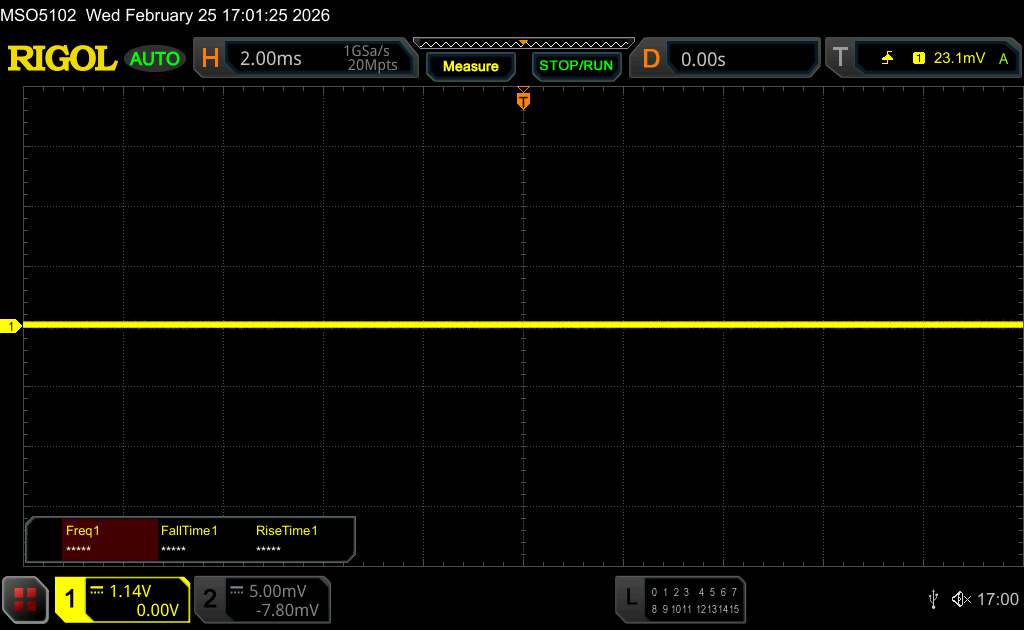 | ||
In comparison: 52 % of all tested devices do not use PWM to dim the display. If PWM was detected, an average of 7594 (minimum: 5 - maximum: 343500) Hz was measured. | |||
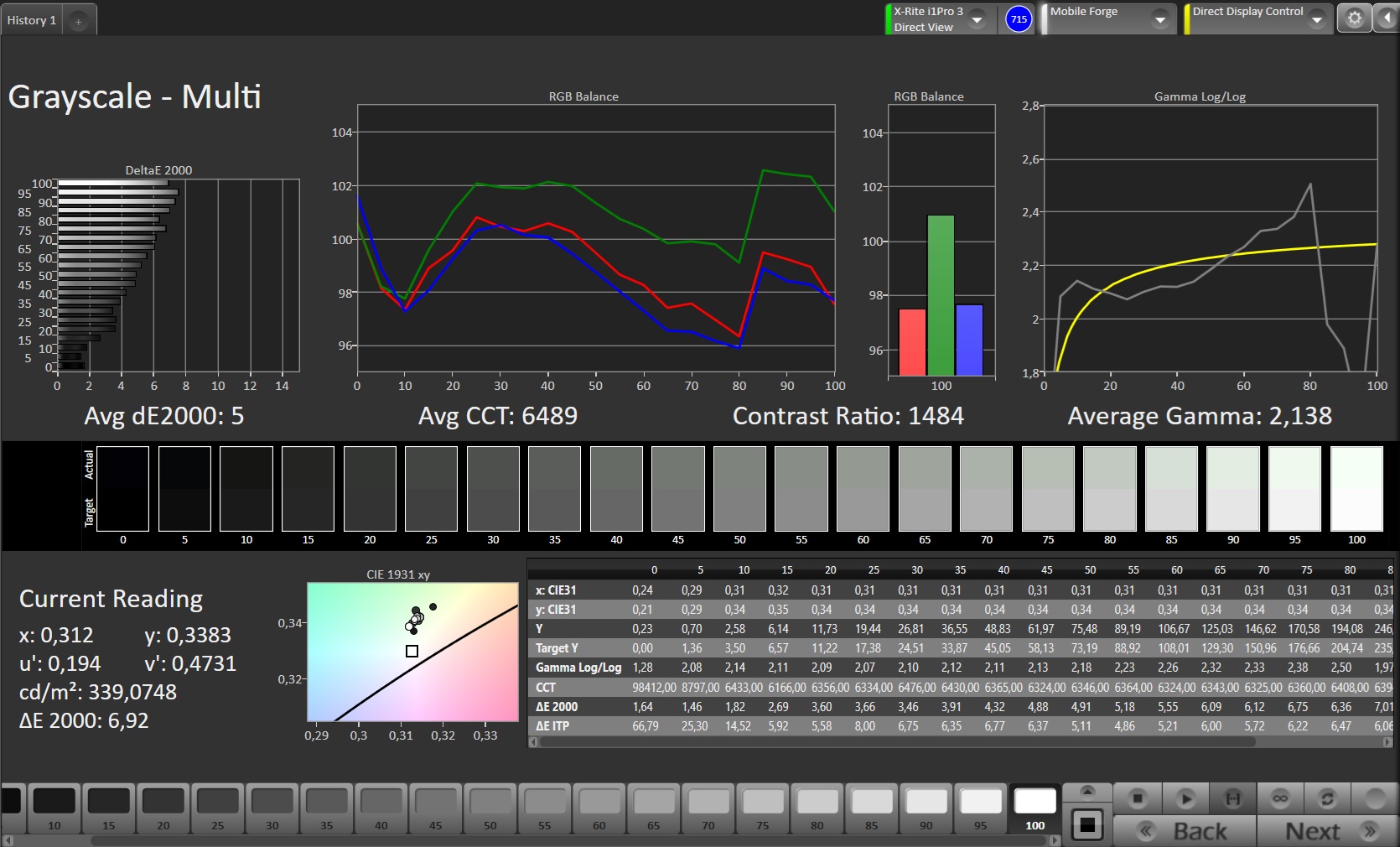
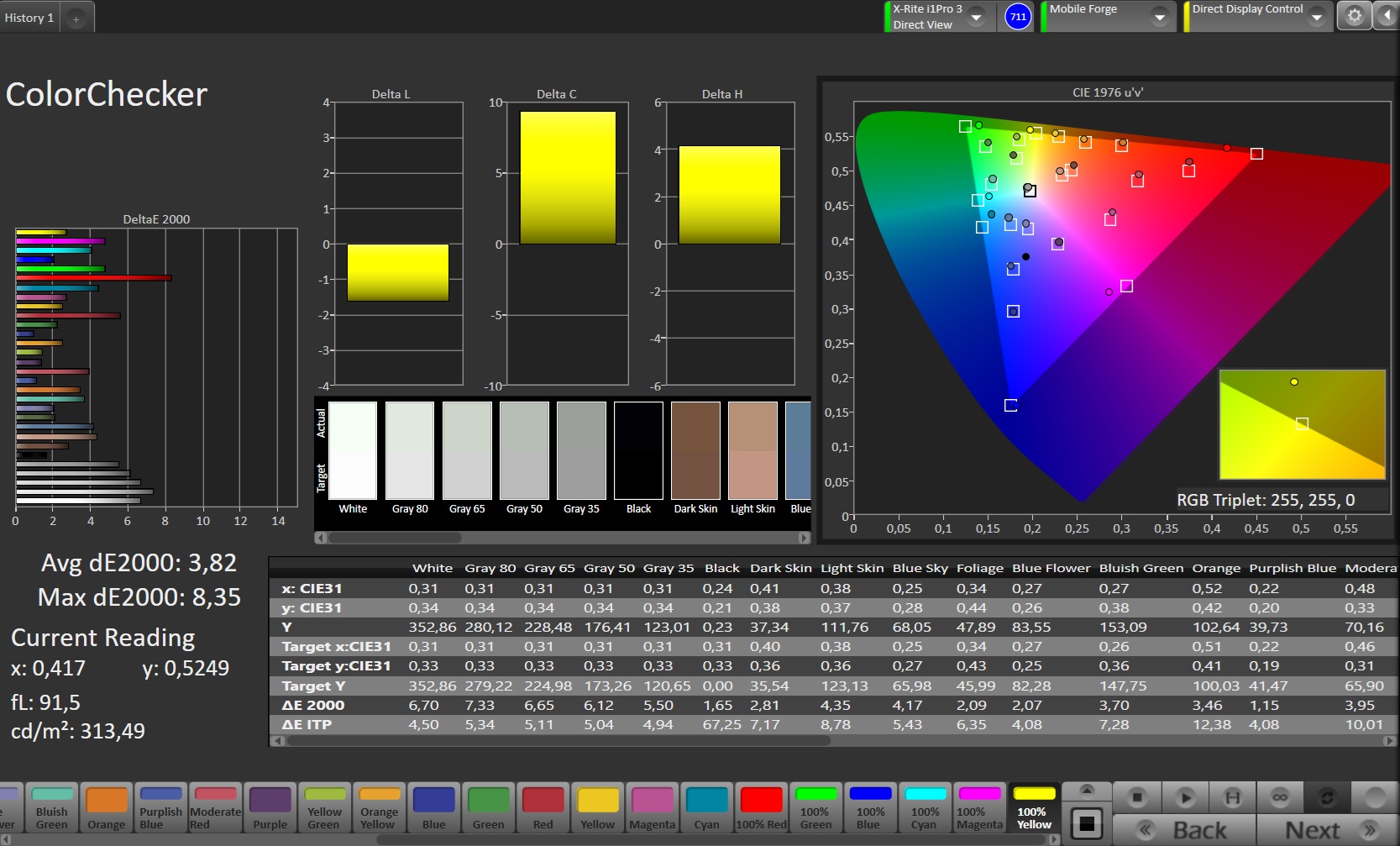
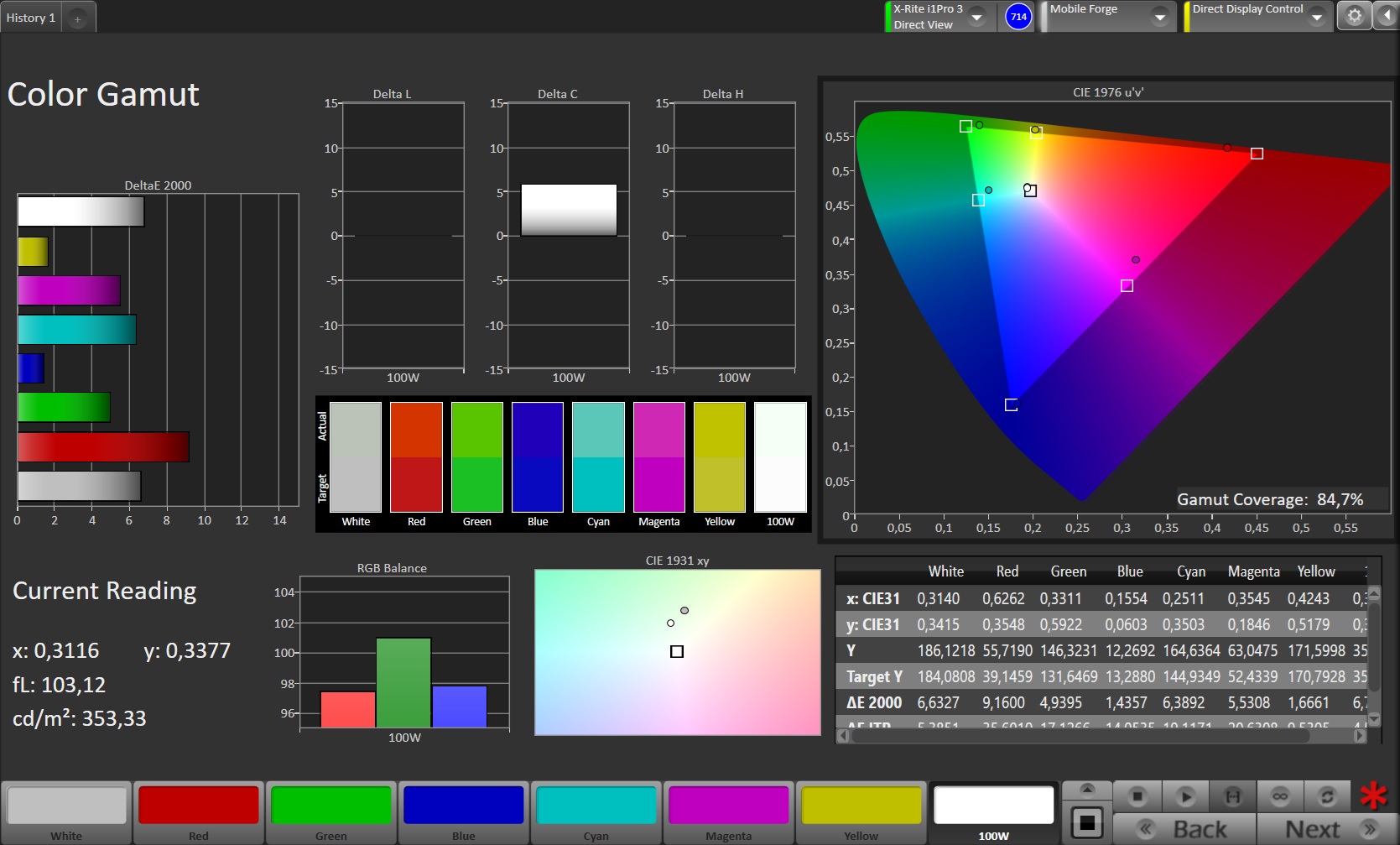
Display Response Times
| ↔ Response Time Black to White | ||
|---|---|---|
| 32.6 ms ... rise ↗ and fall ↘ combined | ↗ 14.6 ms rise | 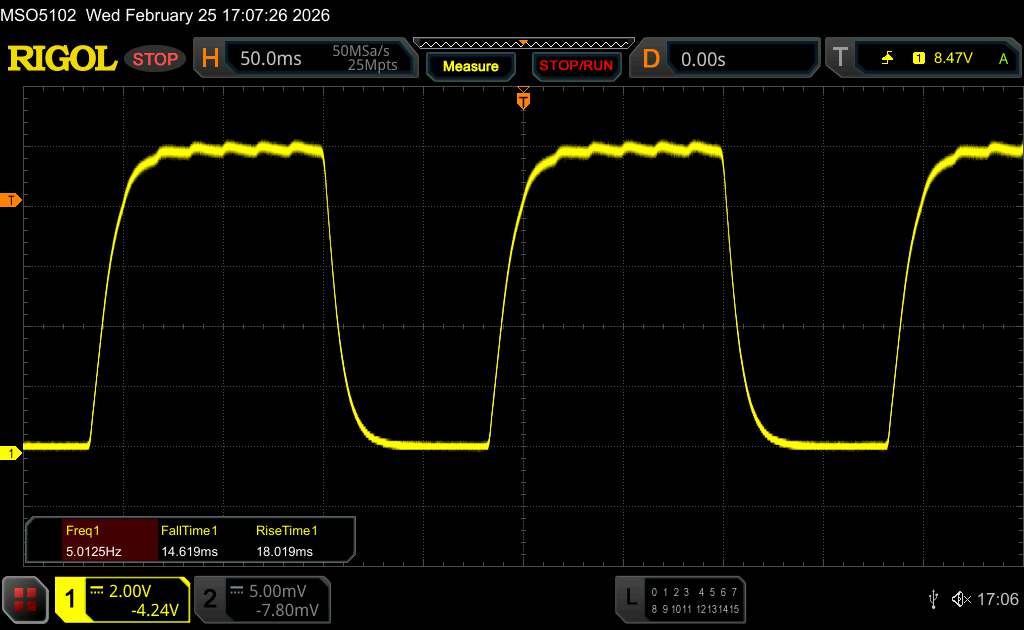 |
| ↘ 18 ms fall | ||
| The screen shows slow response rates in our tests and will be unsatisfactory for gamers. In comparison, all tested devices range from 0.1 (minimum) to 240 (maximum) ms. » 88 % of all devices are better. This means that the measured response time is worse than the average of all tested devices (19.6 ms). | ||
| ↔ Response Time 50% Grey to 80% Grey | ||
| 45.2 ms ... rise ↗ and fall ↘ combined | ↗ 24.2 ms rise | 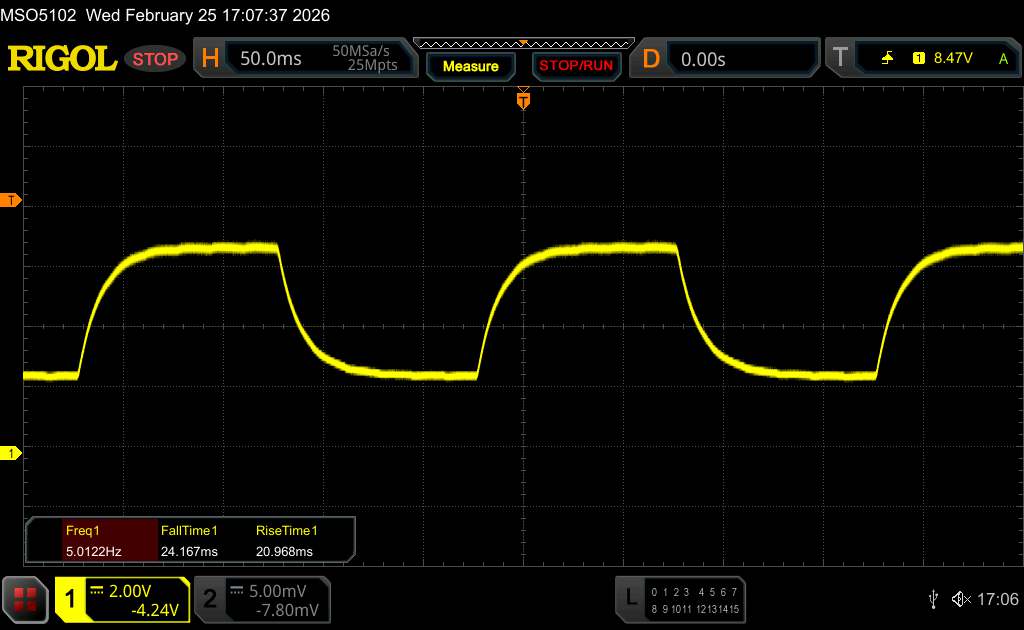 |
| ↘ 21 ms fall | ||
| The screen shows slow response rates in our tests and will be unsatisfactory for gamers. In comparison, all tested devices range from 0.13 (minimum) to 636 (maximum) ms. » 78 % of all devices are better. This means that the measured response time is worse than the average of all tested devices (30.7 ms). | ||
Performance, emissions, and battery life: A rather leisurely tablet
The SoC, a MediaTek Helio G85, was introduced six years ago and is therefore no longer up to date, especially as it was only intended for the mid-range at the time. This means you have to make do with very little performance and may have to put up with occasional stutters in everyday use. The eMMC storage is also quite slow.
We did not measure any strong heating on the casing, even after prolonged load. The tablet also shows no noticeable throttling in the 3DMark stress tests.
The Lenovo Tab K9 has two full-fledged speakers and can therefore produce stereo sound. The sound is OK, but not really full due to the lack of bass.
You can connect external speakers or headphones via a 3.5 mm jack or via Bluetooth 5.3, with many audio codecs to choose from.
We measured just over 14 hours of battery life in our WLAN test. This is OK, as the battery only has a capacity of 5,100 mAh.
Other tablets, even in this price range, sometimes tend to offer significantly longer run times. Charging takes just under 2 hours with the included power adapter.
| Jetstream 2 - 2.0 Total | |
| Average of class Tablet (48 - 420, n=54, last 2 years) | |
| Lenovo Tab K9 | |
| Xiaomi Redmi Pad SE 8.7 inches | |
| Average Mediatek Helio G85 (29.2 - 61.3, n=9) | |
| Lenovo Tab K9 | Lenovo Tab One | Xiaomi Redmi Pad SE 8.7 inches | Xiaomi Redmi K Pad | Average 64 GB eMMC Flash | Average of class Tablet | |
|---|---|---|---|---|---|---|
| AndroBench 3-5 | -2% | -8% | 454% | -33% | 423% | |
| Sequential Read 256KB (MB/s) | 302.3 | 298.43 -1% | 289 -4% | 3448.34 1041% | 278 ? -8% | 2117 ? 600% |
| Sequential Write 256KB (MB/s) | 207.2 | 199.25 -4% | 263.6 27% | 1494.45 621% | 178.6 ? -14% | 1691 ? 716% |
| Random Read 4KB (MB/s) | 100.1 | 98.38 -2% | 71.1 -29% | 309.61 209% | 60.9 ? -39% | 280 ? 180% |
| Random Write 4KB (MB/s) | 110.5 | 108.67 -2% | 82.7 -25% | 49.93 -55% | 34.2 ? -69% | 327 ? 196% |
(±) The maximum temperature on the upper side is 44.2 °C / 112 F, compared to the average of 33.7 °C / 93 F, ranging from 20.7 to 53.2 °C for the class Tablet.
(±) The bottom heats up to a maximum of 42.1 °C / 108 F, compared to the average of 33.2 °C / 92 F
(+) In idle usage, the average temperature for the upper side is 26.9 °C / 80 F, compared to the device average of 30 °C / 86 F.
3DMark Stress Tests
| 3DMark | |
| Wild Life Stress Test Stability | |
| Lenovo Tab One | |
| Xiaomi Redmi Pad SE 8.7 inches | |
| Lenovo Tab K9 | |
| Xiaomi Redmi K Pad | |
| Wild Life Extreme Stress Test | |
| Xiaomi Redmi K Pad | |
| Xiaomi Redmi Pad SE 8.7 inches | |
| Lenovo Tab One | |
| Lenovo Tab K9 | |
| Solar Bay Stress Test Stability | |
| Xiaomi Redmi K Pad | |
| Steel Nomad Light Stress Test Stability | |
| Xiaomi Redmi K Pad | |
Lenovo Tab K9 audio analysis
(±) | speaker loudness is average but good (81.5 dB)
Bass 100 - 315 Hz
(-) | nearly no bass - on average 22.3% lower than median
(±) | linearity of bass is average (14.3% delta to prev. frequency)
Mids 400 - 2000 Hz
(±) | higher mids - on average 5.9% higher than median
(±) | linearity of mids is average (7.7% delta to prev. frequency)
Highs 2 - 16 kHz
(±) | higher highs - on average 7.1% higher than median
(±) | linearity of highs is average (10.3% delta to prev. frequency)
Overall 100 - 16.000 Hz
(±) | linearity of overall sound is average (26.8% difference to median)
Compared to same class
» 83% of all tested devices in this class were better, 4% similar, 13% worse
» The best had a delta of 7%, average was 21%, worst was 130%
Compared to all devices tested
» 82% of all tested devices were better, 4% similar, 14% worse
» The best had a delta of 4%, average was 23%, worst was 136%
Xiaomi Redmi K Pad audio analysis
(+) | speakers can play relatively loud (84.6 dB)
Bass 100 - 315 Hz
(±) | reduced bass - on average 13.8% lower than median
(±) | linearity of bass is average (12.6% delta to prev. frequency)
Mids 400 - 2000 Hz
(±) | higher mids - on average 5.2% higher than median
(+) | mids are linear (4.9% delta to prev. frequency)
Highs 2 - 16 kHz
(+) | balanced highs - only 2.6% away from median
(+) | highs are linear (3.3% delta to prev. frequency)
Overall 100 - 16.000 Hz
(+) | overall sound is linear (13.5% difference to median)
Compared to same class
» 25% of all tested devices in this class were better, 4% similar, 70% worse
» The best had a delta of 7%, average was 21%, worst was 130%
Compared to all devices tested
» 15% of all tested devices were better, 4% similar, 82% worse
» The best had a delta of 4%, average was 23%, worst was 136%
| Lenovo Tab K9 5100 mAh | Lenovo Tab One 5100 mAh | Xiaomi Redmi Pad SE 8.7 inches 6650 mAh | Xiaomi Redmi K Pad 7500 mAh | |
|---|---|---|---|---|
| Battery runtime | 3% | 20% | 42% | |
| Reader / Idle (h) | 34.2 | 37.6 10% | 37.3 9% | |
| WiFi v1.3 (h) | 14.1 | 13.9 -1% | 20.4 45% | 20 42% |
| Load (h) | 4.7 | 4.7 0% | 5 6% | |
| H.264 (h) | 16.3 | 21.1 |
Notebookcheck's overall impressions of the Lenovo Tab K9
The Lenovo Tab K9 is a solid entry-level tablet that has some special features in its price range including LTE, satellite positioning, and a power adapter.
However, the Lenovo Tab One offers a near-identical experience and feature set, especially if you can get it for a lower price.
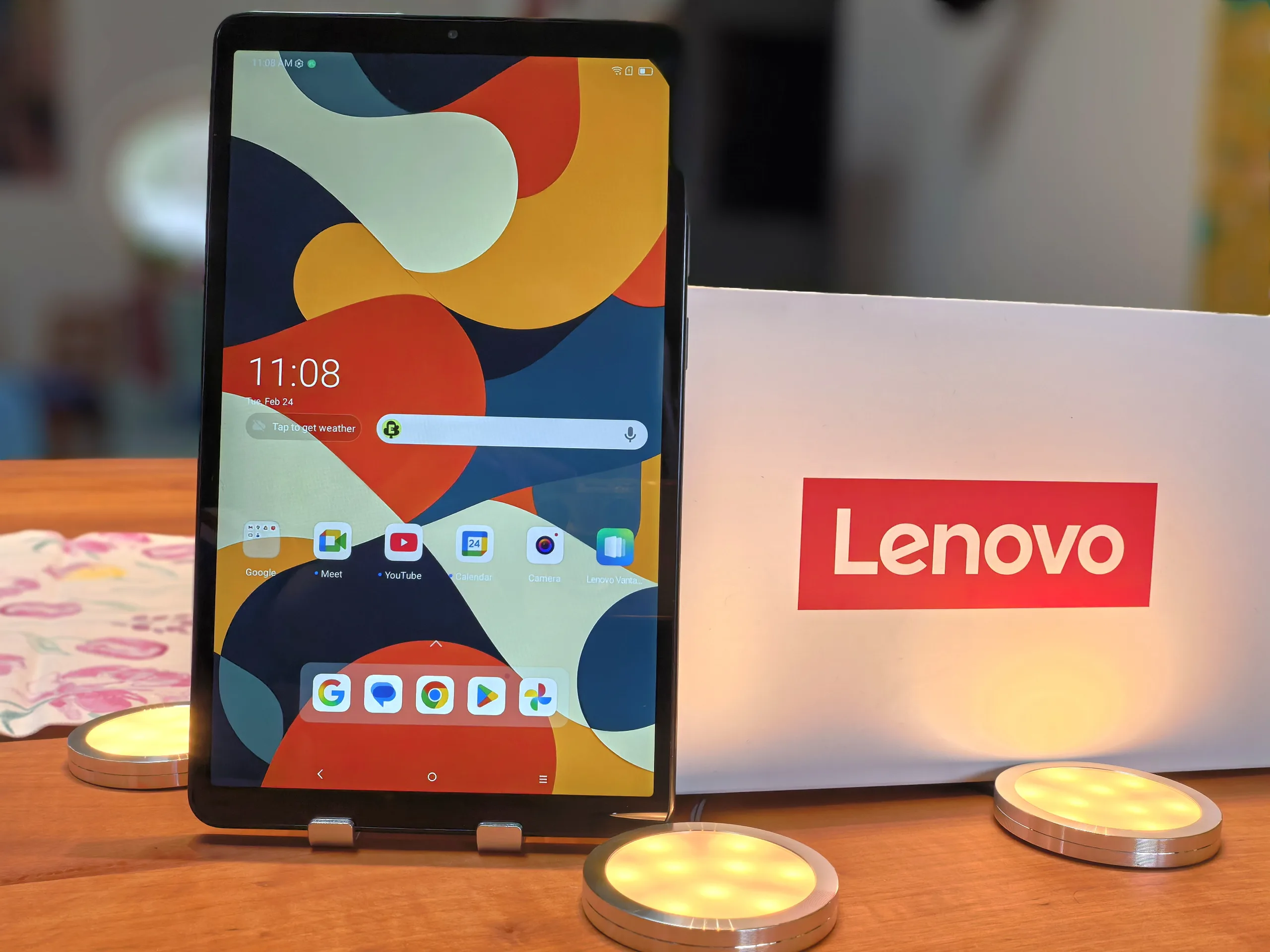
Lenovo Tab K9
- 02/25/2026 v8
Florian Schmitt
 Total Sustainability Score:
 Potential alternatives in comparison
Image | Model / Review | Price | Weight | Drive | Display |
|---|---|---|---|---|---|
1. 76.7%  | Lenovo Tab K9 Mediatek Helio G85 ⎘ ARM Mali-G52 MP2 ⎘ 4 GB Memory, 64 GB eMMC | List Price: 150€ | 320 g | 64 GB eMMC Flash | 8.70" 1340x800 179 PPI IPS |
2. 77.4%  | Lenovo Tab One Mediatek Helio G85 ⎘ ARM Mali-G52 MP2 ⎘ 4 GB Memory, 64 GB eMMC | List Price: 100€ | 320 g | 64 GB eMMC Flash | 8.70" 1340x800 179 PPI TFT LCD (IPS) |
3. 76.8%  | Xiaomi Redmi Pad SE 8.7 inches Mediatek Helio G85 ⎘ ARM Mali-G52 MP2 ⎘ 4 GB Memory, 64 GB eMMC | List Price: 150€ | 373 g | 64 GB eMMC Flash | 8.70" 1340x800 179 PPI IPS |
4. 90.2%  | Xiaomi Redmi K Pad Mediatek Dimensity 9400+ ⎘ ARM Immortalis-G925 MC12 ⎘ 16 GB Memory, 512 GB UFS 4.x | Amazon: 1. $199.50 Xiaomi Redmi Pad 2 Only WiFi... 2. $249.50 XIAOMI Redmi Pad 2 PRO Only ... 3. $289.75 XIAOMI Redmi Pad 2 PRO Only ... List Price: 330€ | 326 g | 512 GB UFS 4.0 Flash | 8.80" 3008x1880 403 PPI LCD |
Transparency
The selection of devices to be reviewed is made by our editorial team. The test sample was freely purchased by the author at his/her own expense. The lender had no influence on this review, nor did the manufacturer receive a copy of this review before publication. There was no obligation to publish this review. As an independent media company, Notebookcheck is not subjected to the authority of manufacturers, retailers or publishers.
This is how Notebookcheck is testing
Every year, Notebookcheck independently reviews hundreds of laptops and smartphones using standardized procedures to ensure that all results are comparable. We have continuously developed our test methods for around 20 years and set industry standards in the process. In our test labs, high-quality measuring equipment is utilized by experienced technicians and editors. These tests involve a multi-stage validation process. Our complex rating system is based on hundreds of well-founded measurements and benchmarks, which maintains objectivity. Further information on our test methods can be found here.
 Add as a preferred source on Google


