


Verdict - Xiaomi Redmi Note 17 5G
In our review, the Xiaomi Redmi Note 17 5G left us feeling conflicted. Although the mid-range smartphone blew us away with over 21 hours of outstanding battery life in our Wi-Fi test, this advantage comes at the cost of numerous compromises compared to its predecessor. Xiaomi has cut corners not only on the processor and RAM, but also on the camera setup, speakers, and display. We are particularly frustrated by the removal of the ultra-wide-angle camera and stereo speakers, as well as the significantly lower screen brightness. Furthermore, the device suffers from a sluggish system, limited multitasking capabilities, and connectivity features that feel outdated.
The Redmi Note 17 5G certainly gets several things right: the build quality is solid, the AMOLED display is responsible for precise color reproduction, and the main camera delivers decent results in daylight. Long-term software support as well as a microSD card slot are also worthwhile plus points.
However, the primary selling point remains the 7,700 mAh battery. That said, Xiaomi has not fully leveraged its potential, given the device's relatively high power consumption. Despite having nearly 40 percent more capacity, battery life during Wi-Fi use has increased by only about 11 percent compared to the Redmi Note 15 5G.
Pros
Cons
Price and availability
The Redmi Note 17 5G can currently be purchased on Amazon UK.
It is available in the following storage configurations (RRP):
- 6 / 128 GB: £299
- 6 / 256 GB: £359
Table of Contents
- Verdict - Xiaomi Redmi Note 17 5G
- Specifications: Xiaomi Redmi Note 17 5G
- Case - A robust smartphone
- Features - Several cutbacks for the Redmi Note 17 5G
- Software - The Redmi Note 17 comes with stripped-down HyperOS
- Communication and GNSS - A phone with slow Wi-Fi 5
- Telephone functions and voice quality
- Cameras - A smaller sensor and one less lens
- Accessories and warranty - Phone case included
- Input devices and operation - Optical fingerprint sensor included
- Display - Darker than the predecessor
- Performance - Xiaomi has gone with the Snapdragon 4 Gen 4
- Emissions - Only one speaker
- Battery life - The battery has grown to an enormous 7,700 mAh
- Notebookcheck overall rating
- Possible alternatives compared
With the Redmi Note 17 5G, Xiaomi is launching the next generation of its popular mid-range series. Compared to the Redmi Note 15 5G, the manufacturer has significantly boosted the battery capacity but cut costs elsewhere.
A less powerful processor, a pared-down camera setup, and less RAM in the 256 GB version raise the question of whether this successor is actually the better choice.
Specifications: Xiaomi Redmi Note 17 5G
Case - A robust smartphone
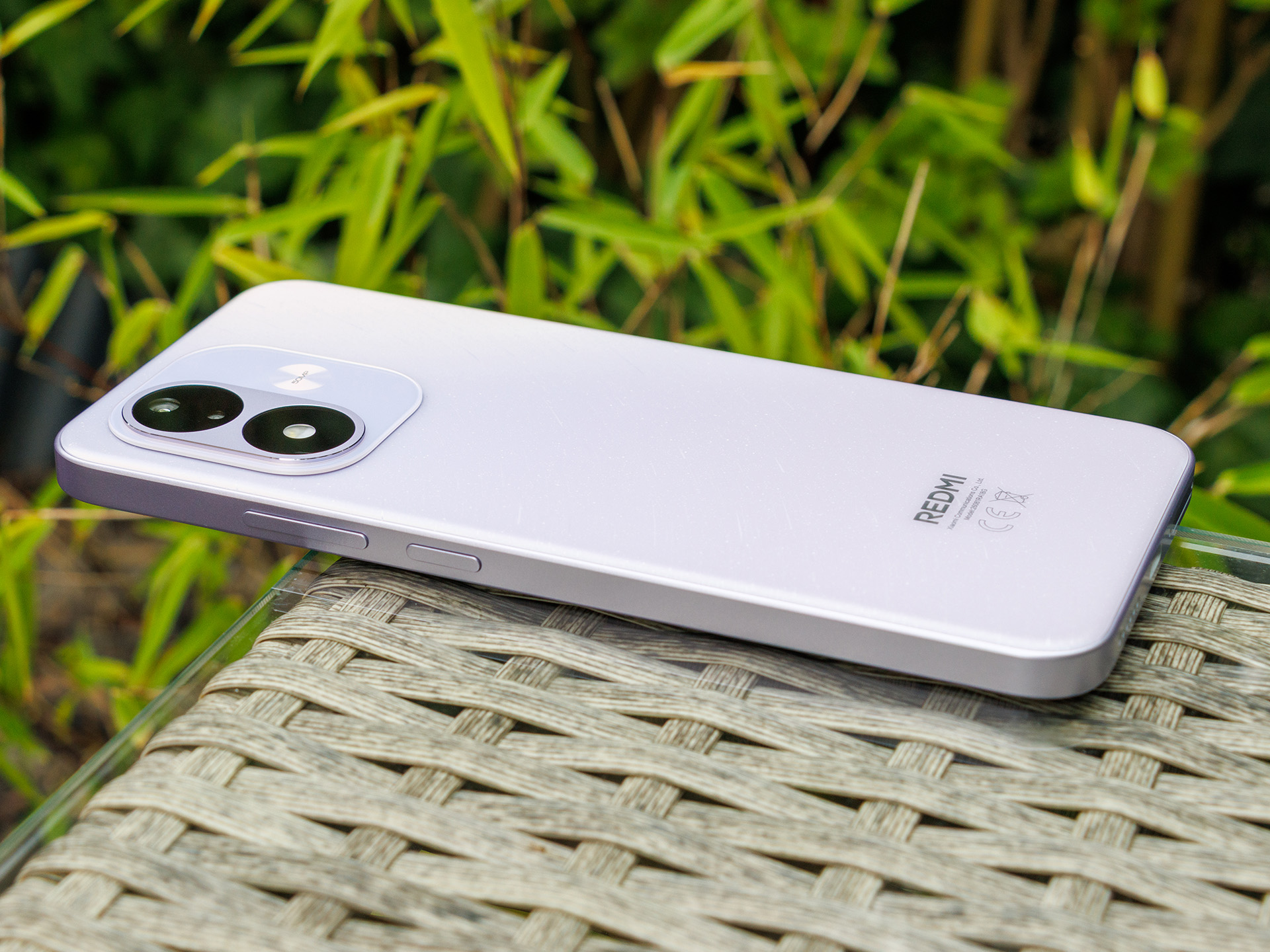
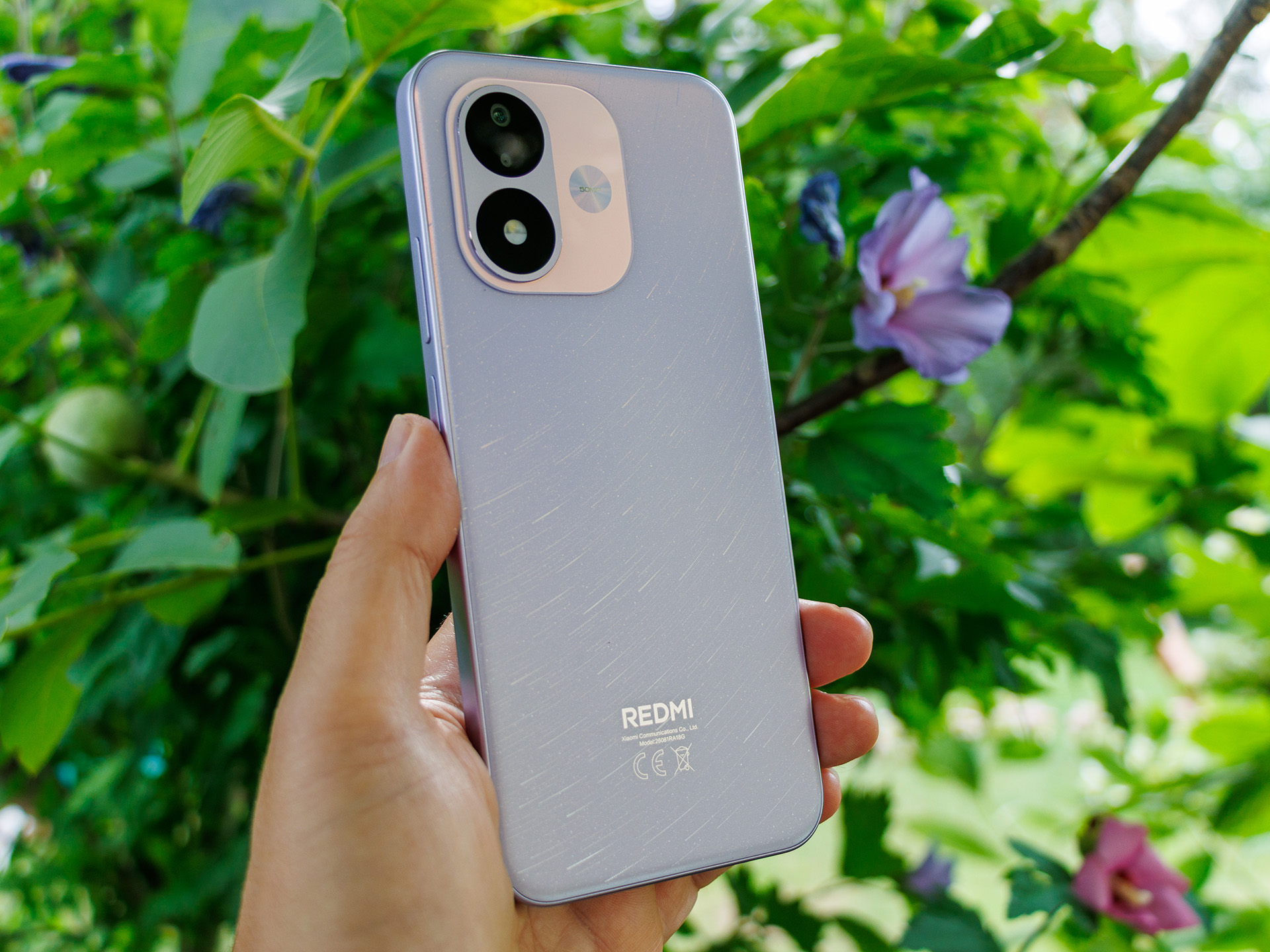
The Xiaomi Redmi Note 17 5G is available in Celestial Purple, Sky Teal, and Black. It is praised for its high-level durability, with Xiaomi mentioning, among other things, that it has undergone over 28,000 drop tests from a "low height," although no further details are provided. Additionally, it carries an IP65 rating.
At 225 grams, the Redmi Note 17 is not exactly lightweight, and it is also quite large. It features an attractive design with tight, uniform panel gaps; however, it emits an audible creak when subjected to torsional stress.


Features - Several cutbacks for the Redmi Note 17 5G
Xiaomi is focused on a different approach with the Redmi Note 17 5G, and compared to its predecessor, a variety of cuts have been made. This applies to the SoC, the cameras, the RAM, and the speakers.
Furthermore, the feature set feels somewhat dated, with a virtual proximity sensor, older Bluetooth 5.1, and Wi-Fi 5. However, on the positive side, the device still includes an IR blaster and microSD support.
microSD Card Reader
The microSD card reader housed inside the Redmi Note 17 5G is quite fast and also supports the exFAT file system.
| SD Card Reader - average JPG Copy Test (av. of 3 runs) | |
| Average of class Smartphone (5.72 - 58.9, n=51, last 2 years) | |
| Motorola Moto G87 (Angelbird V60) | |
| Xiaomi Redmi Note 17 5G (Angelbird AV Pro V60) | |
Cross Platform Disk Test (CPDT)
Software - The Redmi Note 17 comes with stripped-down HyperOS
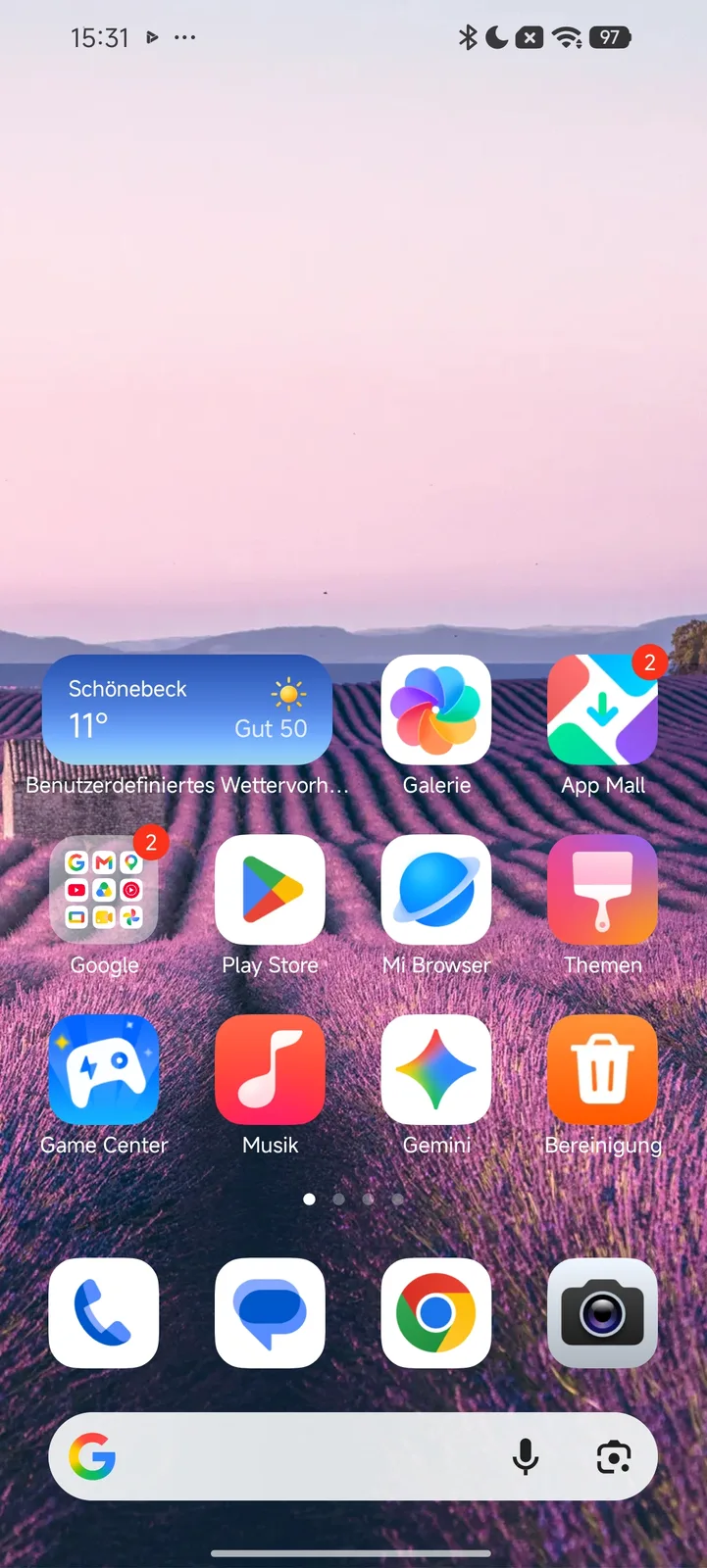
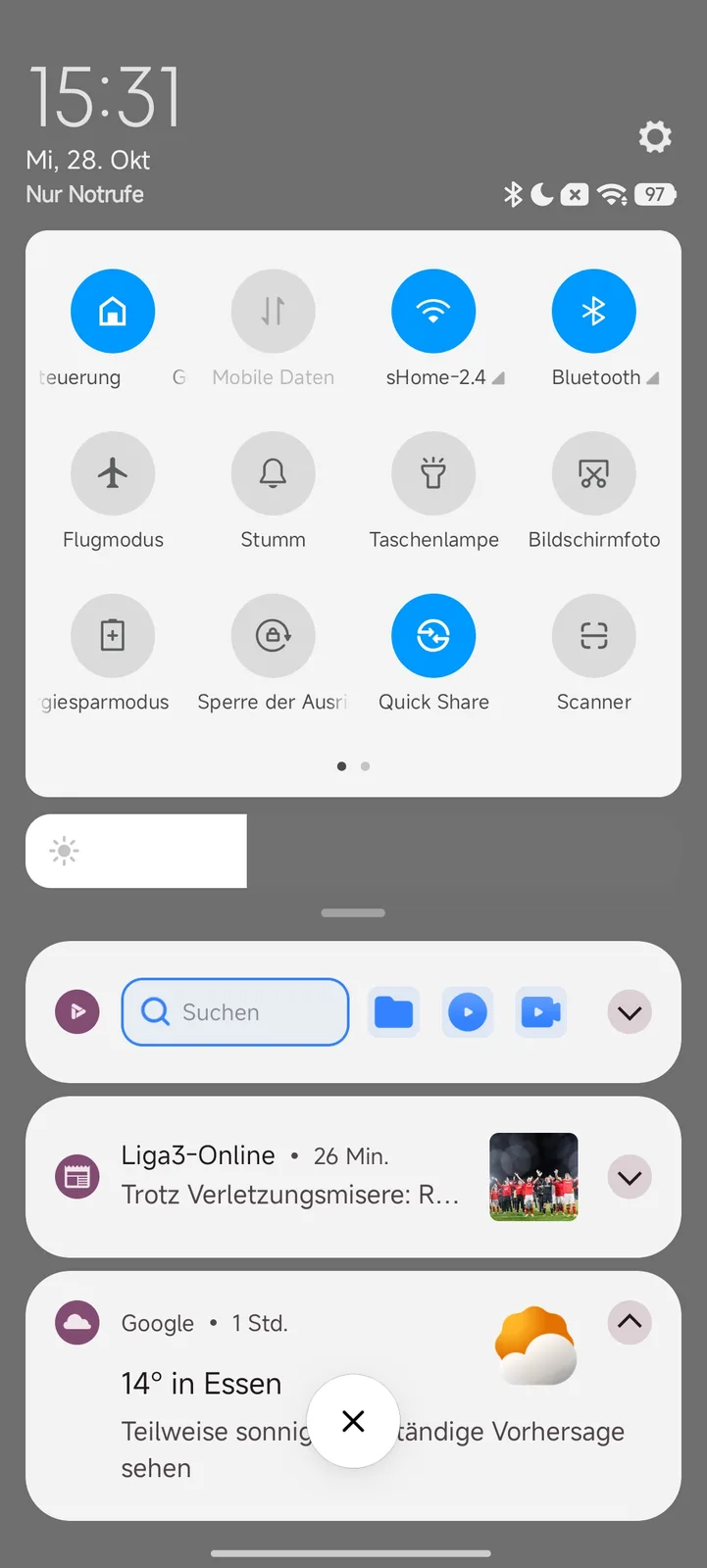
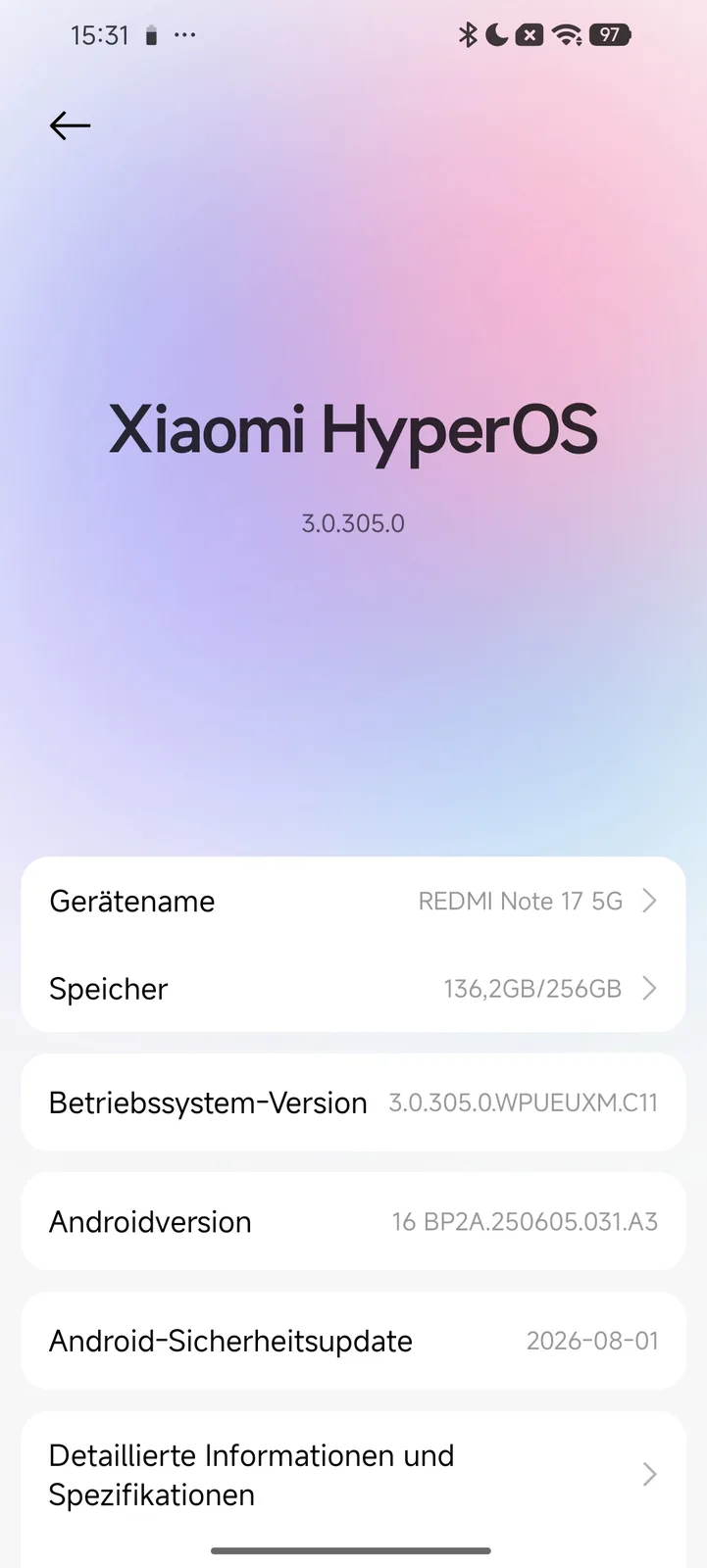
The Redmi Note 17 5G comes with Android 16 and HyperOS 3.0 pre-installed, and Xiaomi promises four major Android version updates—up to Android 20—as well as security updates, to be released quarterly, through the end of August 2032.
Unfortunately, a significant amount of advertising is integrated into the system. Read our article to discover how this can be disabled. Xiaomi is also quite liberal when it comes to including third-party apps, though these can be uninstalled.
The weak SoC also has consequences for the operating system, as the device runs a stripped-down version of HyperOS. This affects not only the range of available features but also the graphical presentation. Multitasking is not supported, floating windows cannot be used, and HyperAI is completely absent.
Sustainability
Xiaomi hasn't provided a specific carbon footprint or recycling content figure for its Redmi Note 17 5G. In accordance with EU regulations, the company is required to make spare parts available. Xiaomi offers no specific information regarding user-performed repairs, and spare parts cannot (yet) be ordered—though this is expected to become a possibility in the near future.
Communication and GNSS - A phone with slow Wi-Fi 5
The Redmi Note 17 5G supports every modern mobile network standard, with a decent range of frequency bands, and the reception is good in metropolitan areas.
The inclusion of only standard Wi-Fi AC is not particularly up-to-date, and the speeds could also be better. At the very least, the connection remains stable.
| Networking | |
| Xiaomi Redmi Note 17 5G | |
| iperf3 transmit Wi-Fi6/7 RT-BE96U | |
| iperf3 receive Wi-Fi6/7 RT-BE96U | |
| Xiaomi Poco X8 | |
| iperf3 transmit Wi-Fi6/7 RT-BE96U | |
| iperf3 receive Wi-Fi6/7 RT-BE96U | |
| Motorola Moto G87 | |
| iperf3 transmit AXE11000 6GHz | |
| iperf3 receive AXE11000 6GHz | |
| Samsung Galaxy A37 5G | |
| iperf3 transmit Wi-Fi6/7 RT-BE96U | |
| iperf3 receive Wi-Fi6/7 RT-BE96U | |
| Realme 16 Pro | |
| iperf3 receive RT-BE96U WiFi7 | |
| iperf3 transmit RT-BE96U WiFi7 | |
| Average 802.11 a/b/g/n/ac | |
| iperf3 transmit AXE11000 6GHz | |
| iperf3 receive AXE11000 6GHz | |
| iperf3 transmit Wi-Fi6/7 RT-BE96U | |
| iperf3 receive Wi-Fi6/7 RT-BE96U | |
| iperf3 receive RT-BE96U WiFi7 | |
| iperf3 transmit RT-BE96U WiFi7 | |
| Average of class Smartphone | |
| iperf3 transmit AXE11000 6GHz | |
| iperf3 receive AXE11000 6GHz | |
| iperf3 transmit Wi-Fi6/7 RT-BE96U | |
| iperf3 receive Wi-Fi6/7 RT-BE96U | |
| iperf3 receive RT-BE96U WiFi7 | |
| iperf3 transmit RT-BE96U WiFi7 | |
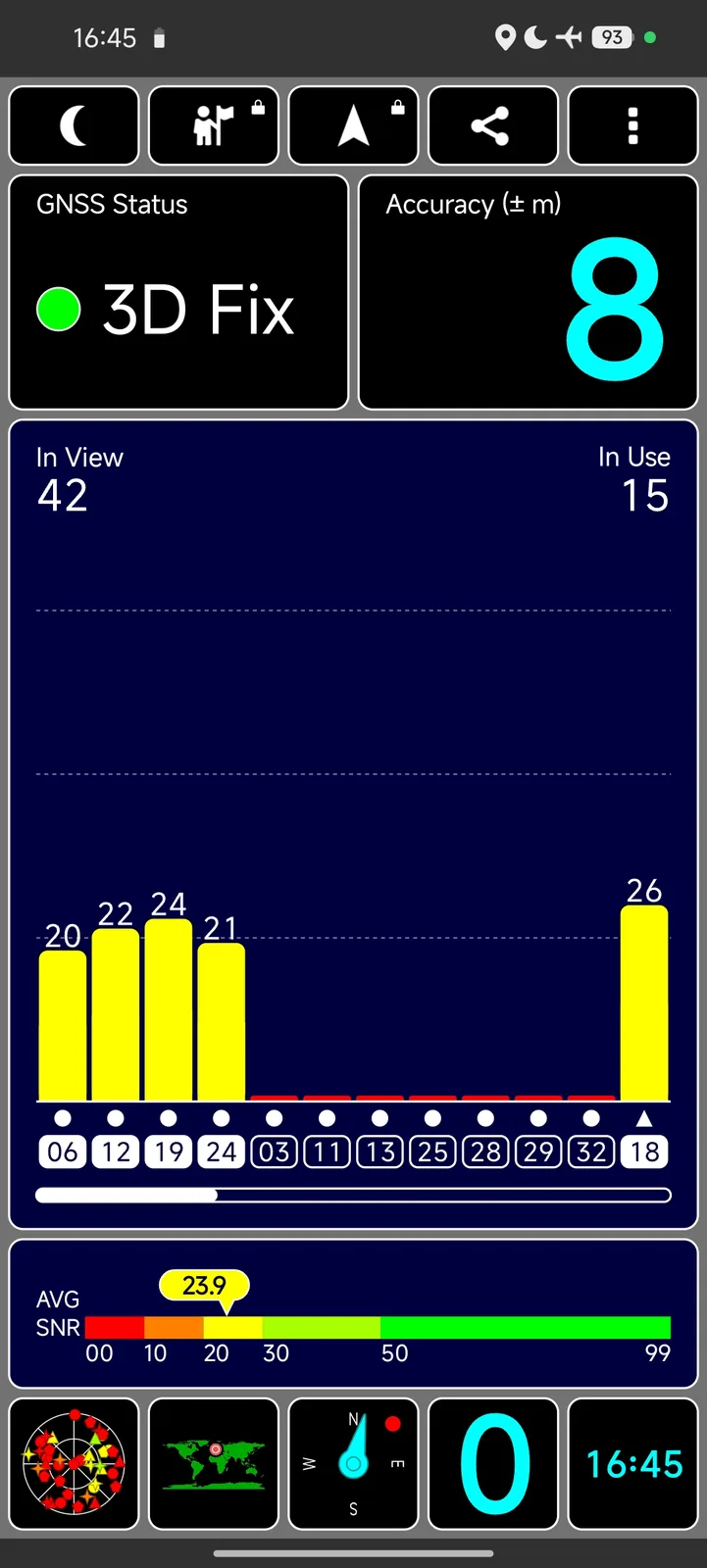
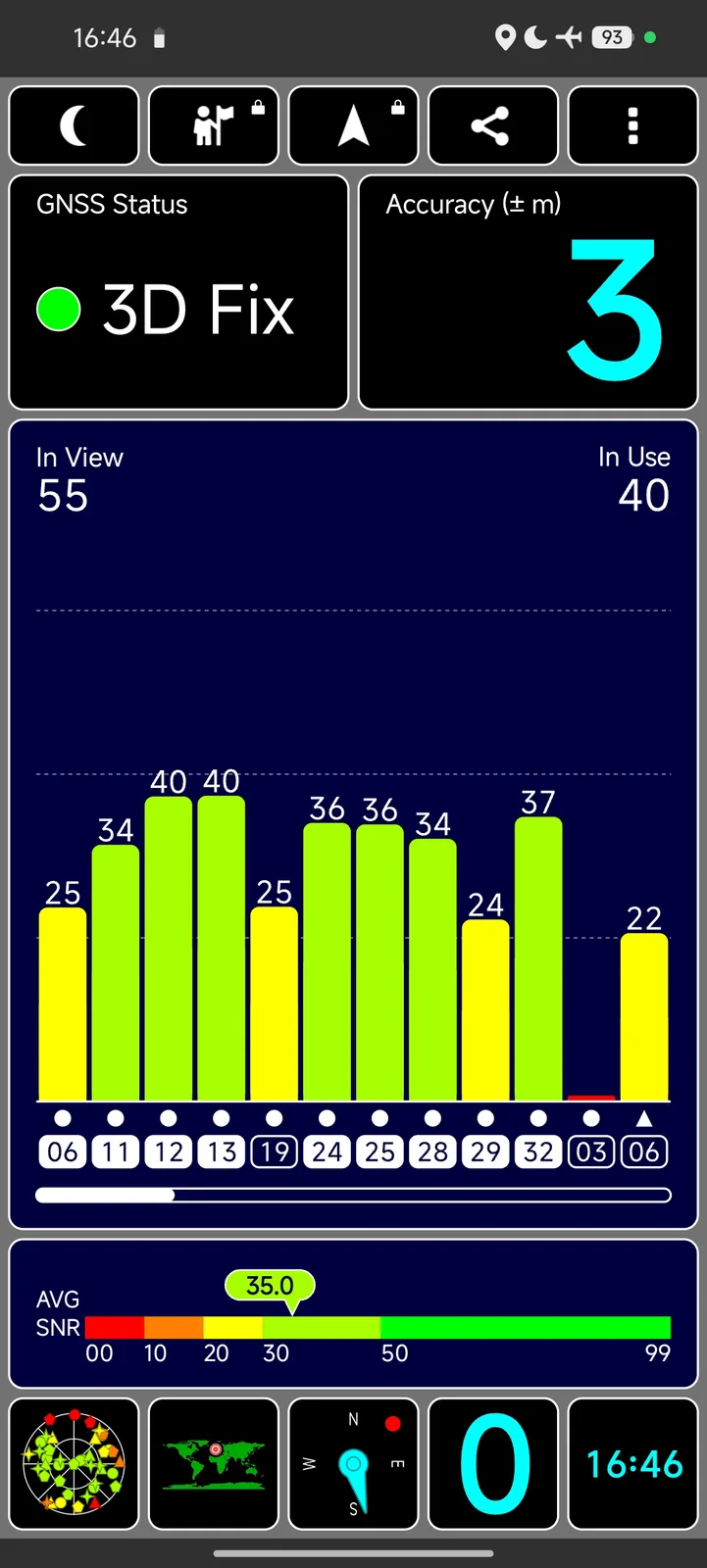
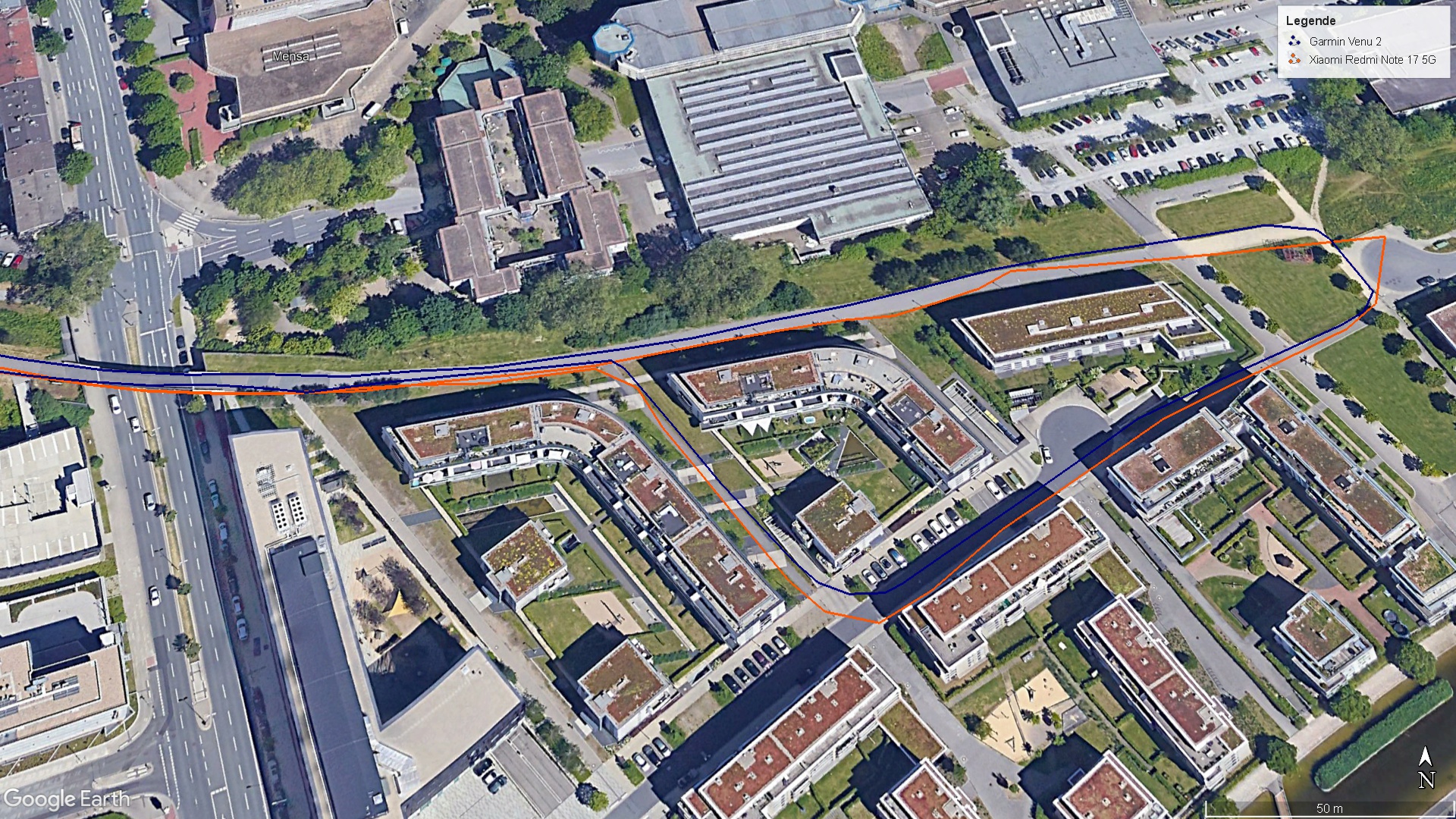
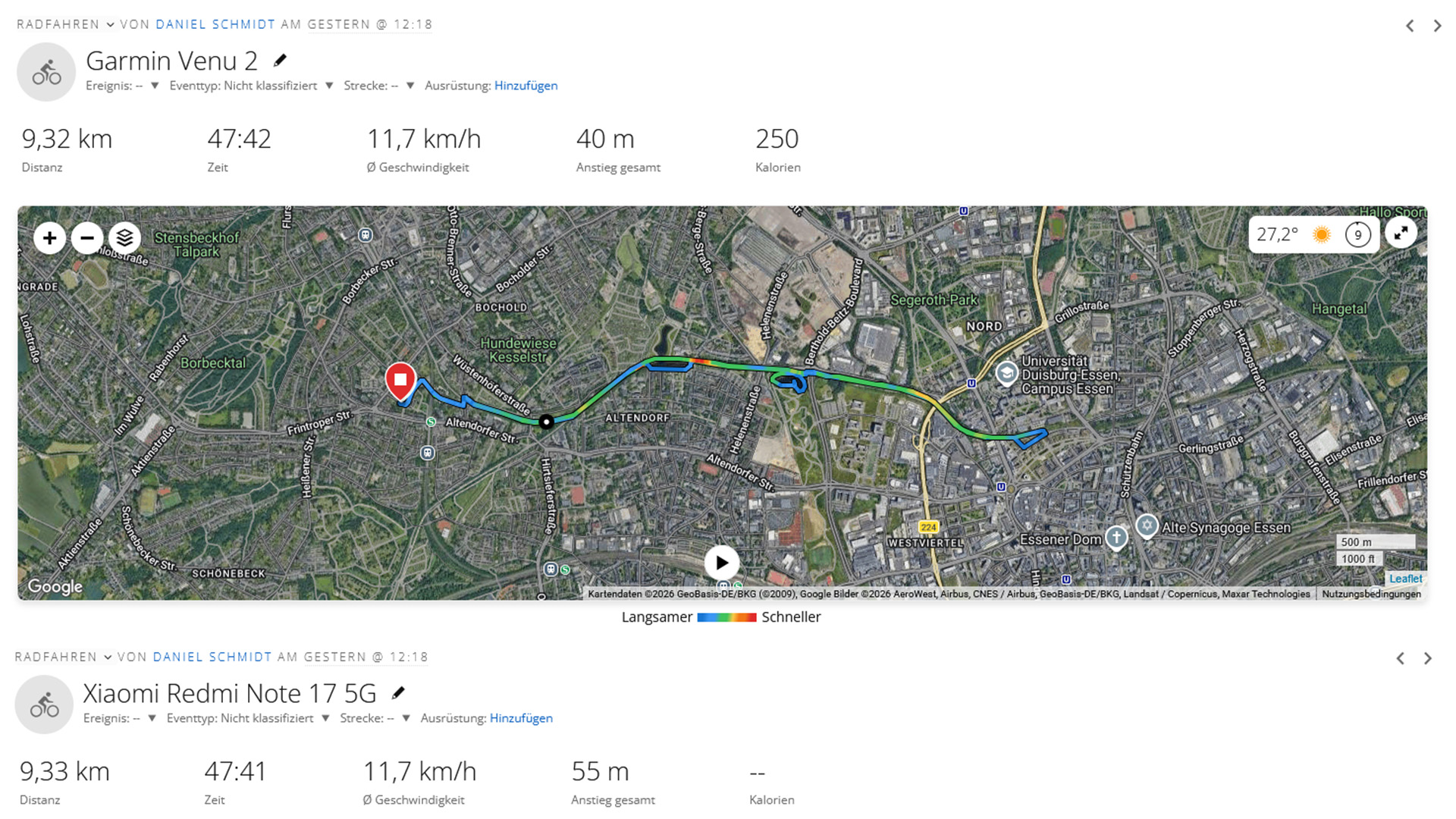
Despite using single-band GNSS, the device achieved a satellite fix very quickly with good precision, even indoors.
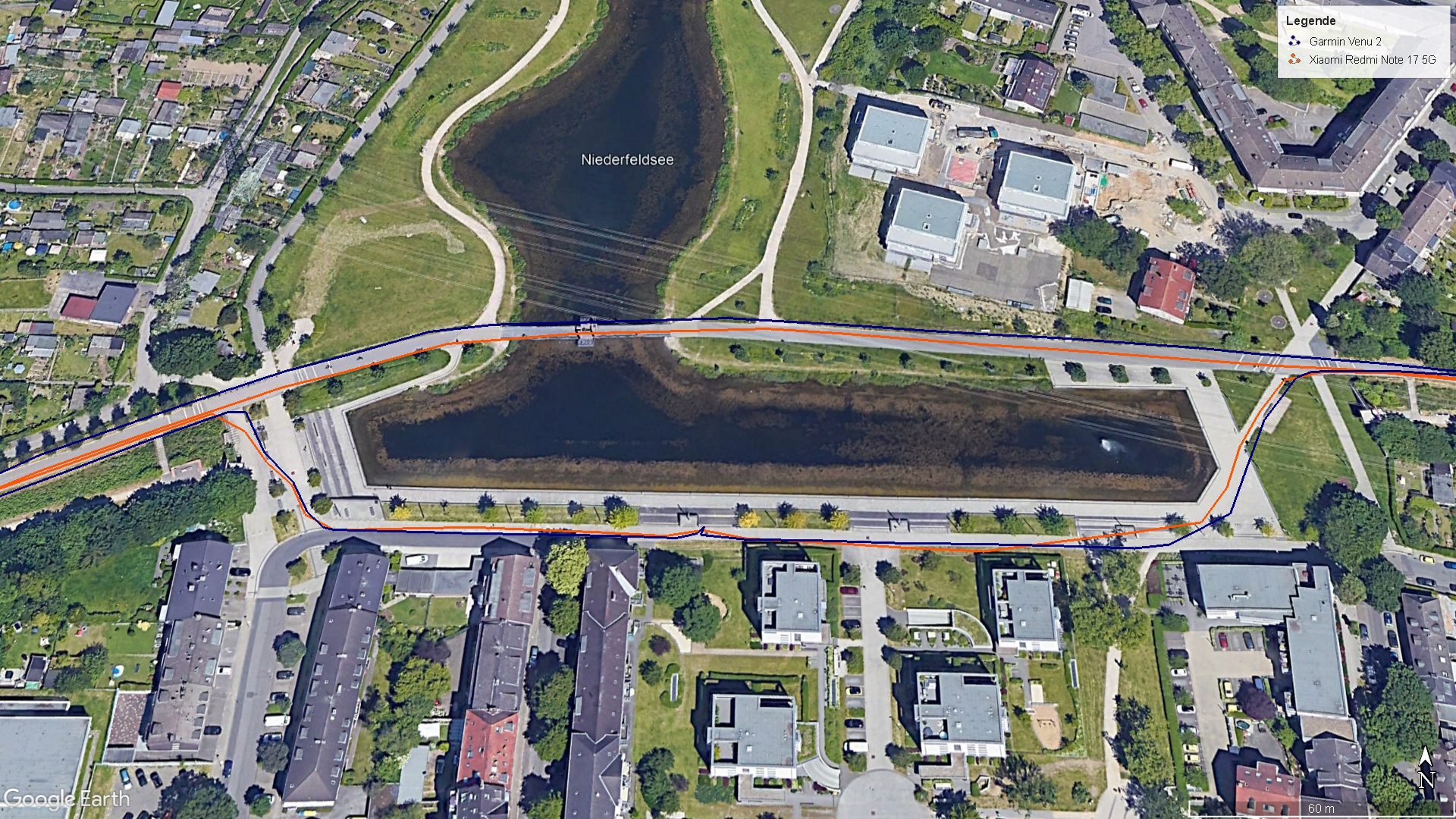
While there were some minor inaccuracies when recording a route during a bicycle ride, the performance remained sufficient for navigation purposes.
Telephone functions and voice quality
The Redmi Note 17 5G's call quality can best be described as functional. Although there is little background noise to speak of, the user’s voice sounds quite constrained and muffled. There is no ambient noise suppression.
The smartphone features a hybrid SIM slot, which means it can accommodate either two nano-SIM cards or one nano-SIM card plus a microSD card. It does not support an integrated eSIM.
Cameras - A smaller sensor and one less lens

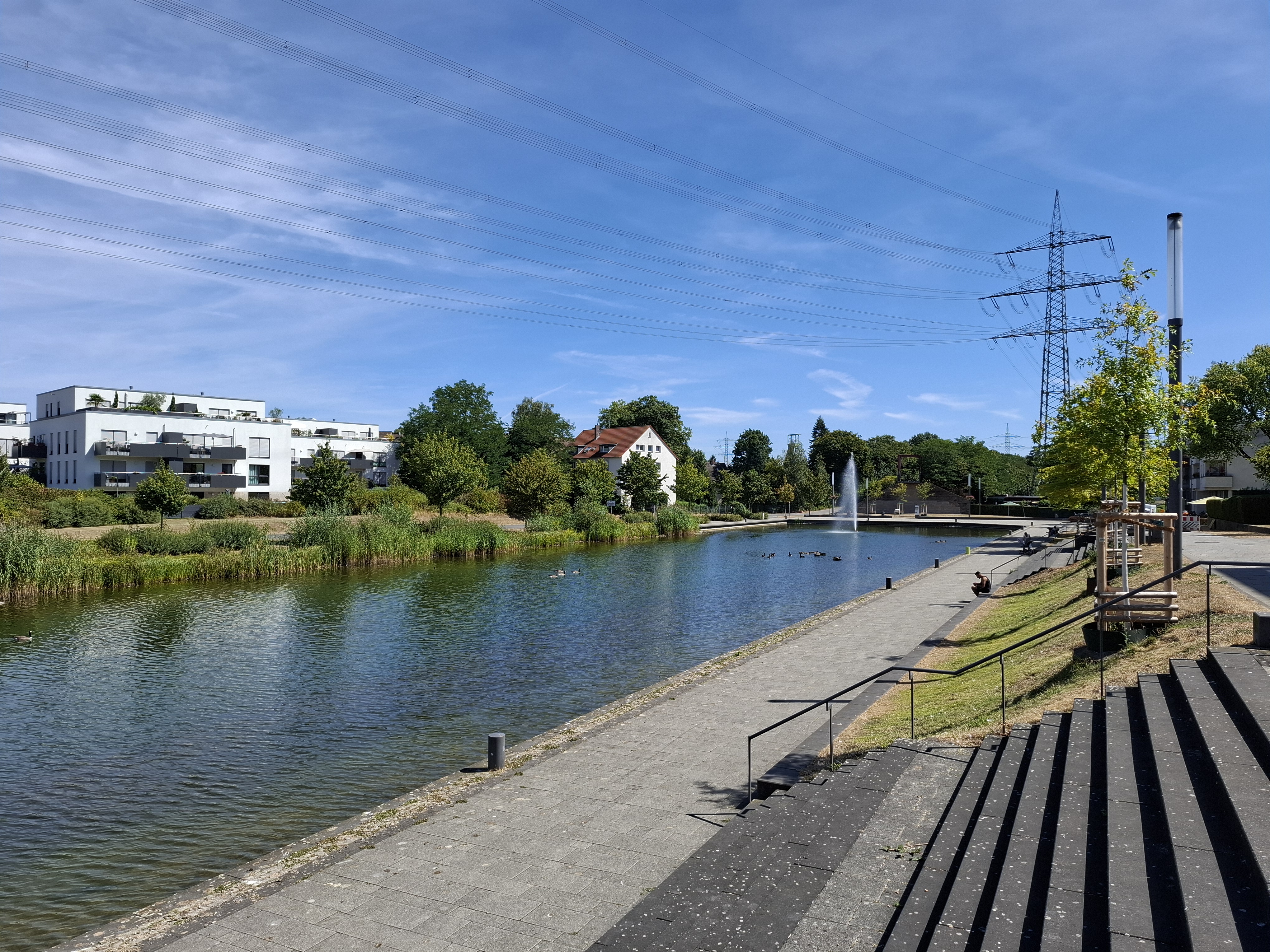
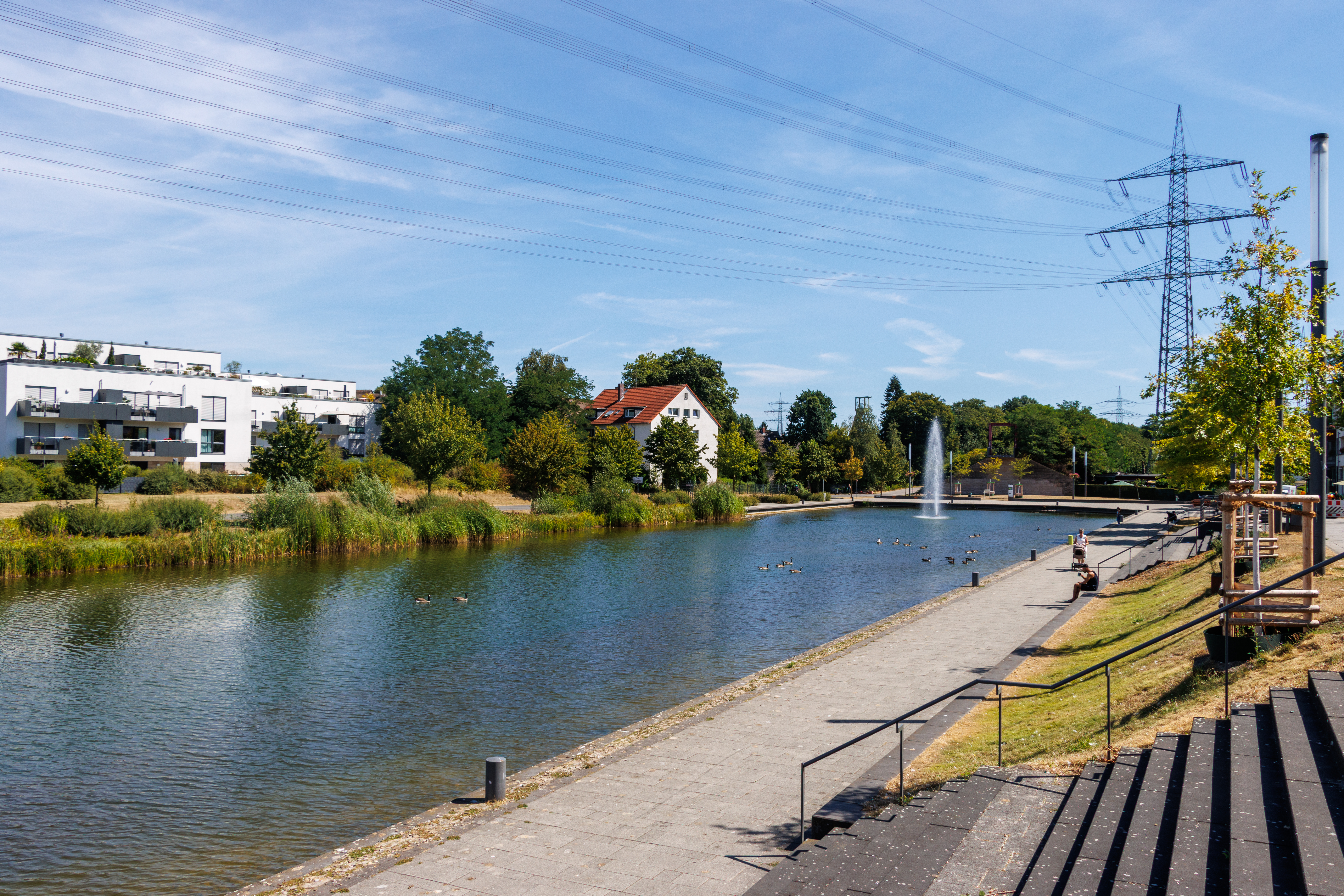
Xiaomi has significantly scaled back the camera setup compared to the predecessor. The main camera not only has a lower resolution, but it also uses a smaller sensor—the Samsung ISOCELL JN1. Furthermore, the ultra-wide-angle camera has been removed entirely and lacks a replacement.
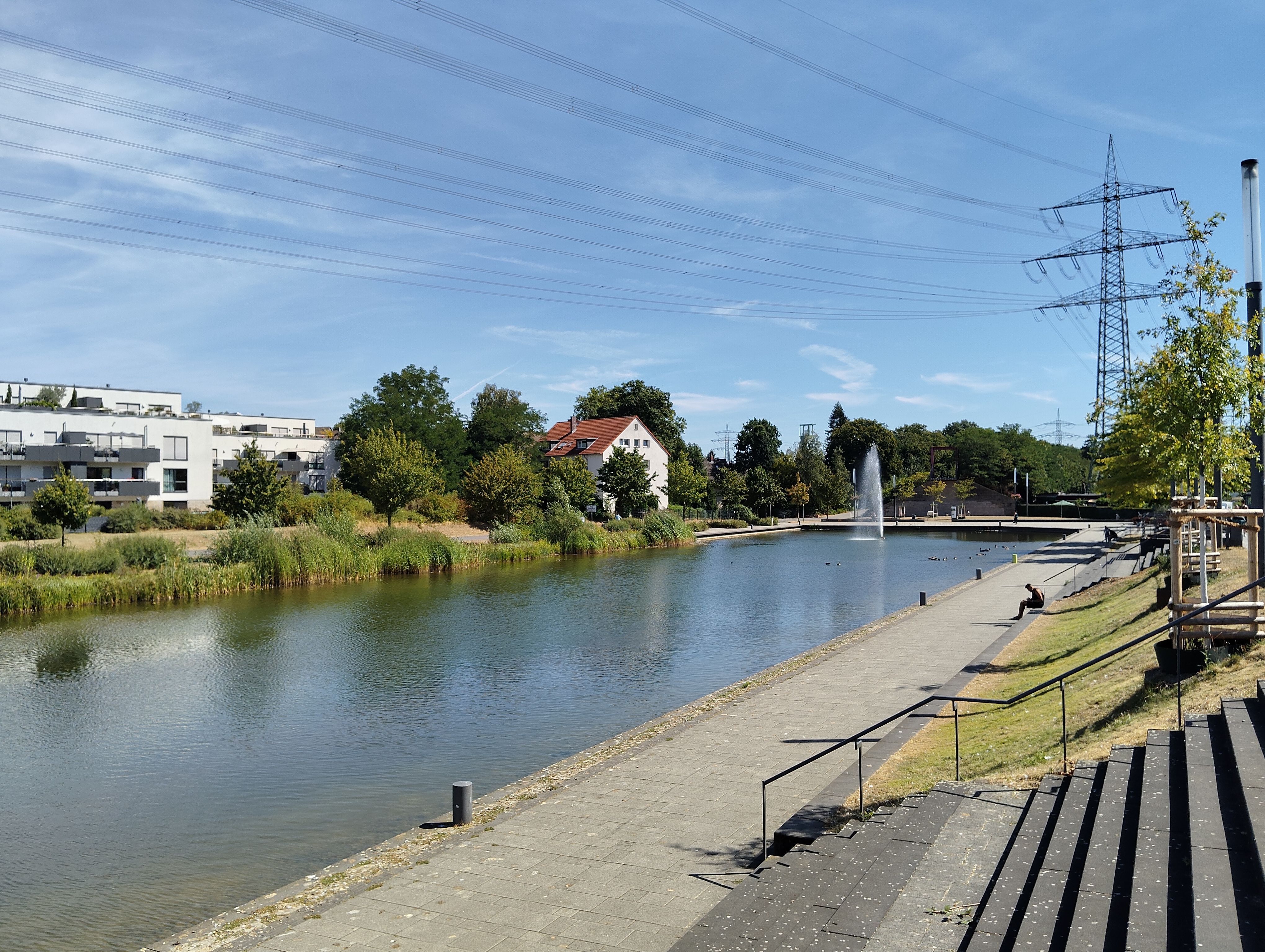
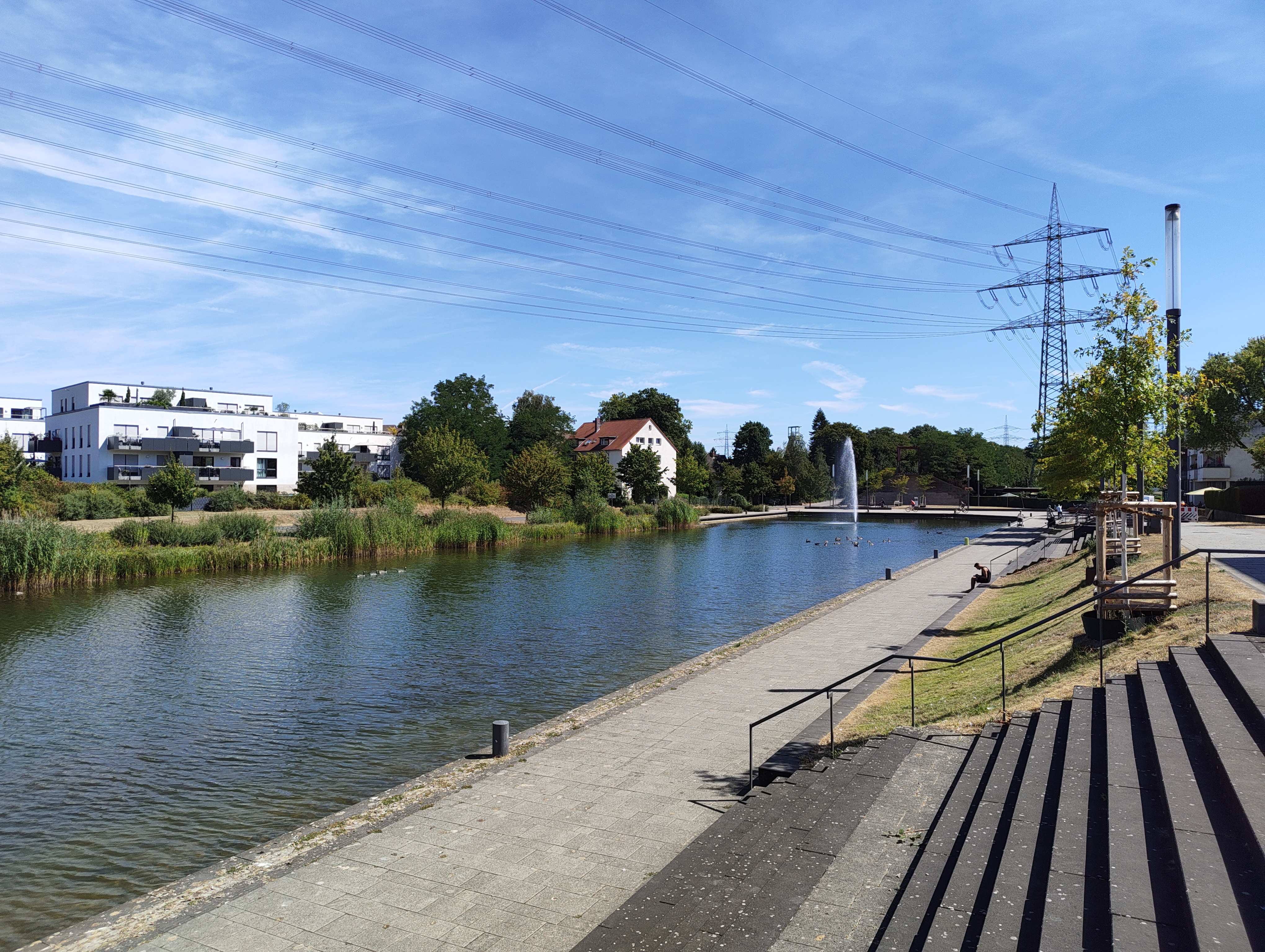
In daylight, the main camera is still capable of capturing quite appealing shots which feature consistent color reproduction and decent dynamic range. However, fine details are not always rendered clearly and, in some places, appear somewhat artificially sharpened. In low-light conditions, a significant amount of detail is lost, and dark areas of the image are almost entirely devoid of detail. The digital zoom is also underwhelming, and even at 5x magnification, there is noticeable blur, washed-out textures, and aggressive sharpening. Additionally, video recording is limited to a maximum of Full HD (30 fps).
Image comparison
Choose a scene and navigate within the first image. One click changes the position on touchscreens. One click on the zoomed-in image opens the original in a new window. The first image shows the scaled photograph of the test device.
Main cameraMain camera5-x zoomLow light

















Accessories and warranty - Phone case included
The box contents include a USB cable (Type-A to Type-C), a SIM tool, and a protective silicone case.
In Germany, the warranty period is 12 months, and this does not affect the manufacturer's warranty.
Input devices and operation - Optical fingerprint sensor included
In our tests, the Redmi Note 17 5G's capacitive touchscreen worked flawlessly, though the system occasionally felt sluggish. The physical buttons offer a crisp tactile response and feel high-quality.
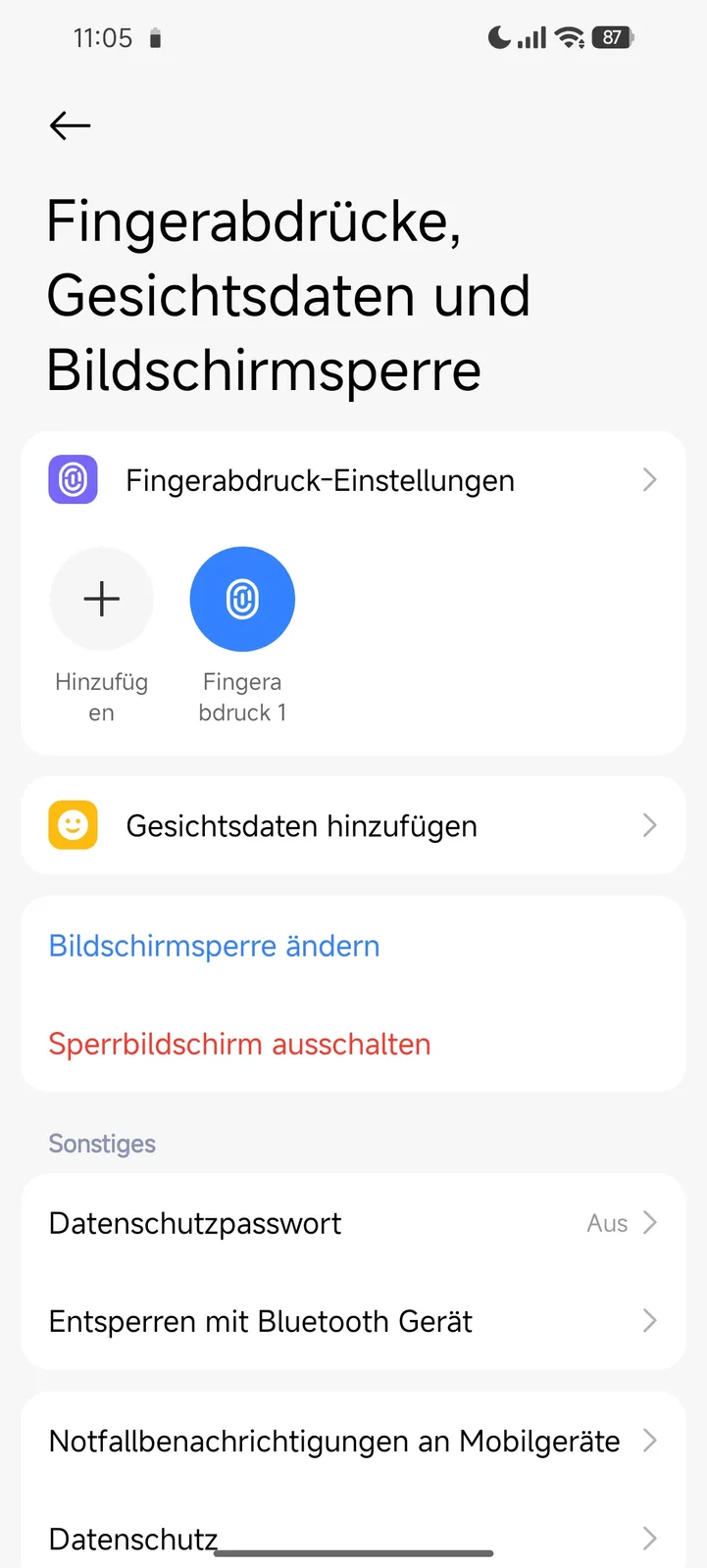
The optical in-display fingerprint sensor reliably recognizes a registered digit, but it is not particularly fast. The ERM vibration motor is capable of being quite powerful and is clearly audible, yet it always retains a somewhat "mushy" quality. Furthermore, the options for adjusting its settings are limited.



Display - Darker than the predecessor

Our measurements confirm what the spec sheet already hinted at: the Redmi Note 17 5G's peak brightness is significantly lower than its predecessor. In our practical APL18 test, it is roughly two-thirds lower. When adjusted manually, the display reaches a maximum of 670 cd/m².
Xiaomi promotes the AMOLED panel as featuring a 960 Hz PWM frequency and DC dimming at higher brightness levels. However, our measurements reveal a distinct low-frequency modulation of approximately 120 Hz, which persists across the entire brightness range. Additionally, the signal waveform exhibits multiple superimposed oscillations. Users sensitive to such issues should therefore be aware of potential problems.
| |||||||||||||||||||||||||
Brightness Distribution: 96 %
Center on Battery: 1121 cd/m²
Contrast: ∞:1 (Black: 0 cd/m²)
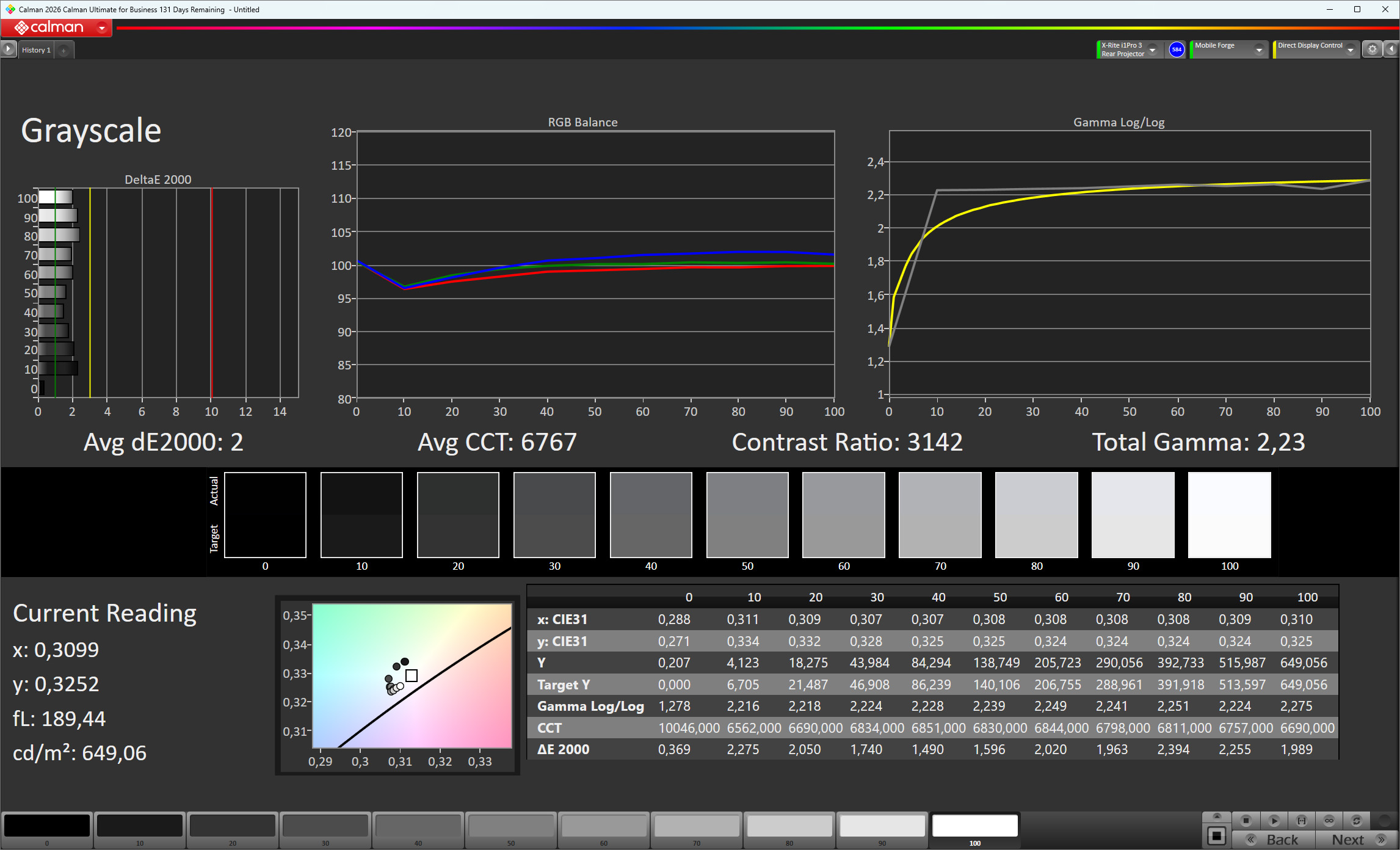
ΔE ColorChecker Calman: 1.4 | ∀{0.5-29.43 Ø4.68}
ΔE Greyscale Calman: 2 | ∀{0.09-98 Ø4.93}
99.1% sRGB (Calman 2D)
Gamma: 2.23
CCT: 6767 K
| Xiaomi Redmi Note 17 5G AMOLED, 2396x1080, 7" | Xiaomi Poco X8 AMOLED, 2772x1280, 6.8" | Motorola Moto G87 AMOLED, 2772x1272, 6.8" | Samsung Galaxy A37 5G Super AMOLED, 2340x1080, 6.7" | Realme 16 Pro AMOLED, 2772x1272, 6.8" | Xiaomi Redmi Note 15 5G AMOLED, 2392x1080, 6.8" | |
|---|---|---|---|---|---|---|
| Display | 186% | 122% | 24% | 34% | 140% | |
| APL18 Peak Brightness (cd/m²) | 1160 | 4009 246% | 3463 199% | 1839 59% | 1526 32% | 3430 196% |
| HDR Peak Brightness (cd/m²) | 1959 | 4421 126% | 2845 45% | 1752 -11% | 2648 35% | 3582 83% |
| Response Times | 16% | -126% | -28% | -228% | 4% | |
| Response Time Grey 50% / Grey 80% * (ms) | 1.07 ? | 0.8 ? 25% | 3.1 ? -190% | 1.57 ? -47% | 8.4 ? -685% | 0.99 ? 7% |
| Response Time Black / White * (ms) | 1 ? | 0.8 ? 20% | 3.1 ? -210% | 1.39 ? -39% | 1.2 ? -20% | 1.13 ? -13% |
| PWM Frequency (Hz) | 120 | 125.3 | 361.6 | 240 | 120 | 60 |
| PWM Amplitude * (%) | 16.67 | 16 4% | 13 22% | 16.58 1% | 13 22% | 13.61 18% |
| Screen | -65% | 11% | -75% | -1% | -3% | |
| Brightness middle (cd/m²) | 1121 | 1019 -9% | 1850 65% | 1127 1% | 1444 29% | 979 -13% |
| Brightness (cd/m²) | 1134 | 1028 -9% | 1813 60% | 1414 25% | 969 -15% | |
| Brightness Distribution (%) | 96 | 90 -6% | 96 0% | 96 0% | 95 -1% | |
| Black Level * (cd/m²) | ||||||
| Colorchecker dE 2000 * | 1.4 | 3.59 -156% | 1.21 14% | 2.6 -86% | 1.78 -27% | 1.3 7% |
| Colorchecker dE 2000 max. * | 2.3 | 6.86 -198% | 4.01 -74% | 5.3 -130% | 3.07 -33% | 2.6 -13% |
| Greyscale dE 2000 * | 2 | 2.2 -10% | 2 -0% | 3.7 -85% | 2 -0% | 1.6 20% |
| Gamma | 2.23 99% | 2.249 98% | 2.229 99% | 2.06 107% | 2.234 98% | 2.23 99% |
| CCT | 6767 96% | 6916 94% | 6439 101% | 6496 100% | 6806 96% | 6688 97% |
| Total Average (Program / Settings) | 46% /
3% | 2% /
-6% | -26% /
-37% | -65% /
-57% | 47% /
25% |
* ... smaller is better
Screen Flickering / PWM (Pulse-Width Modulation)
| Screen flickering / PWM detected | 120 Hz Amplitude: 16.67 % Secondary Frequency: 480 Hz | 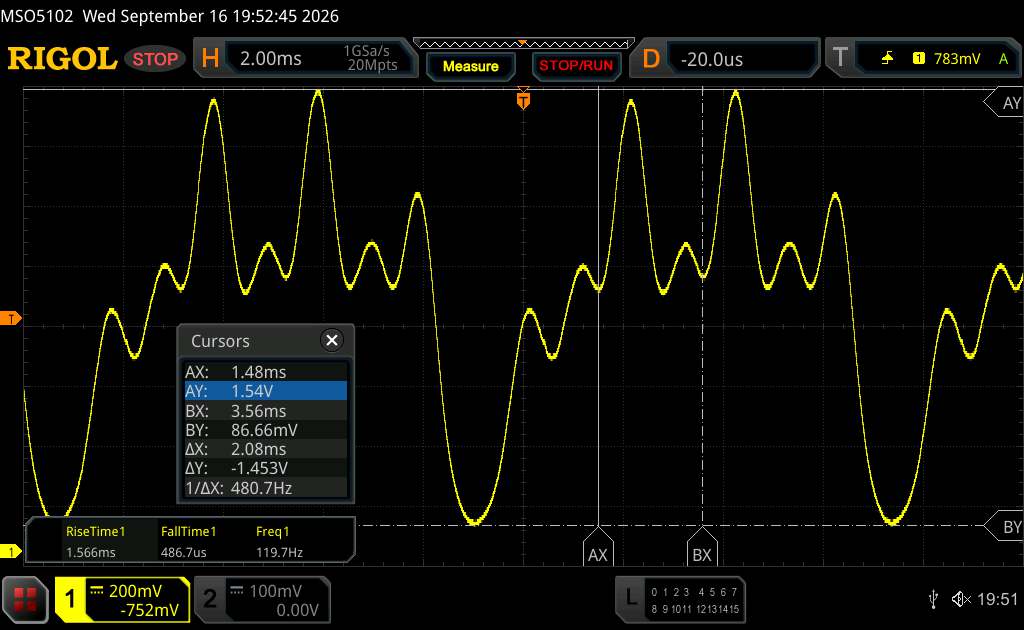 | |
The display backlight flickers at 120 Hz (worst case, e.g., utilizing PWM) . The frequency of 120 Hz is very low, so the flickering may cause eyestrain and headaches after extended use. In comparison: 52 % of all tested devices do not use PWM to dim the display. If PWM was detected, an average of 7570 (minimum: 5 - maximum: 343500) Hz was measured. | |||
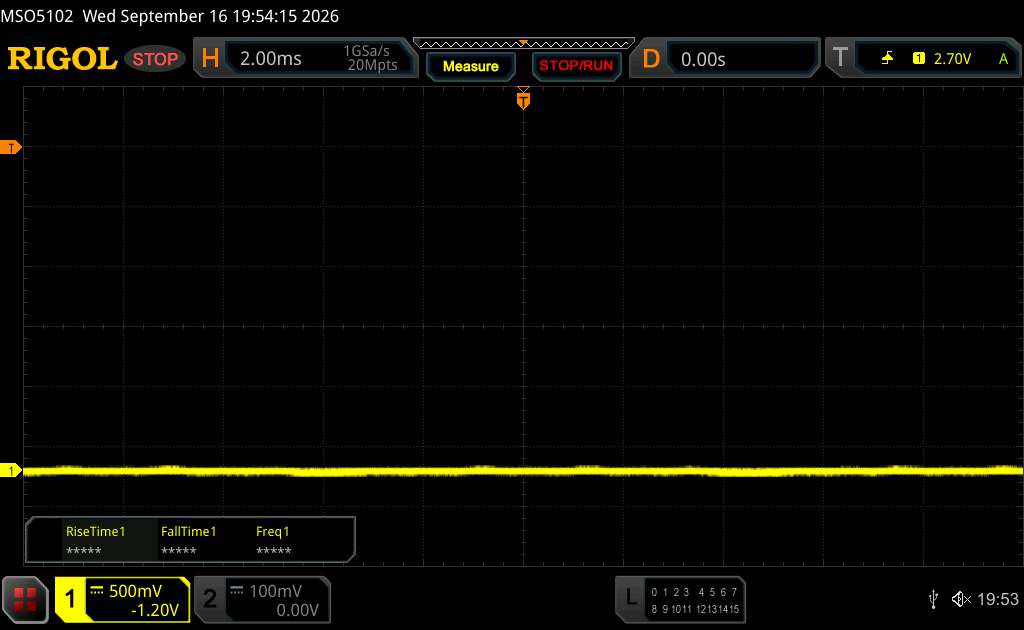
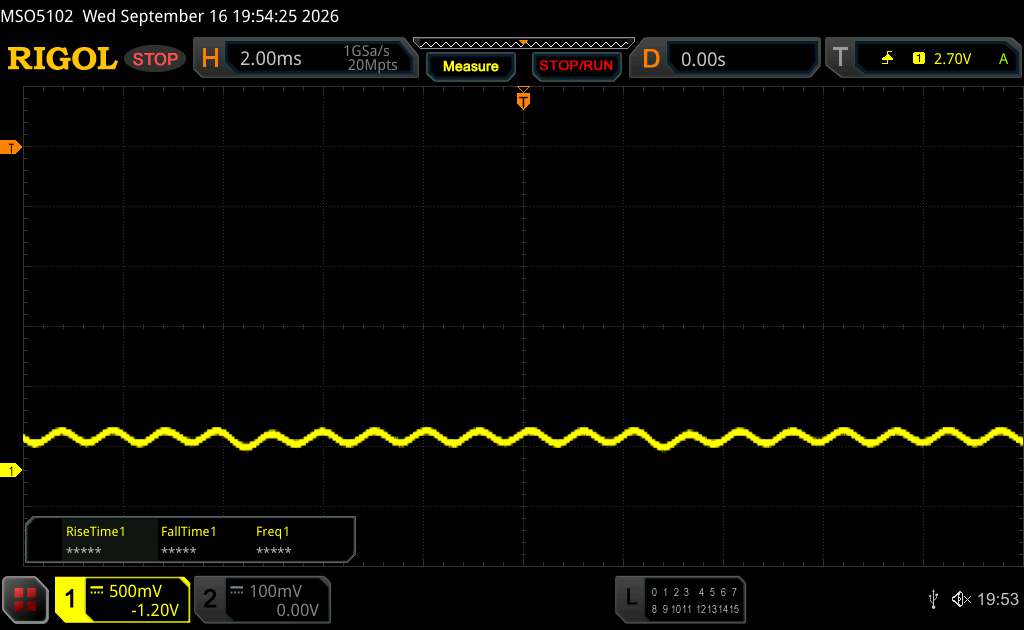
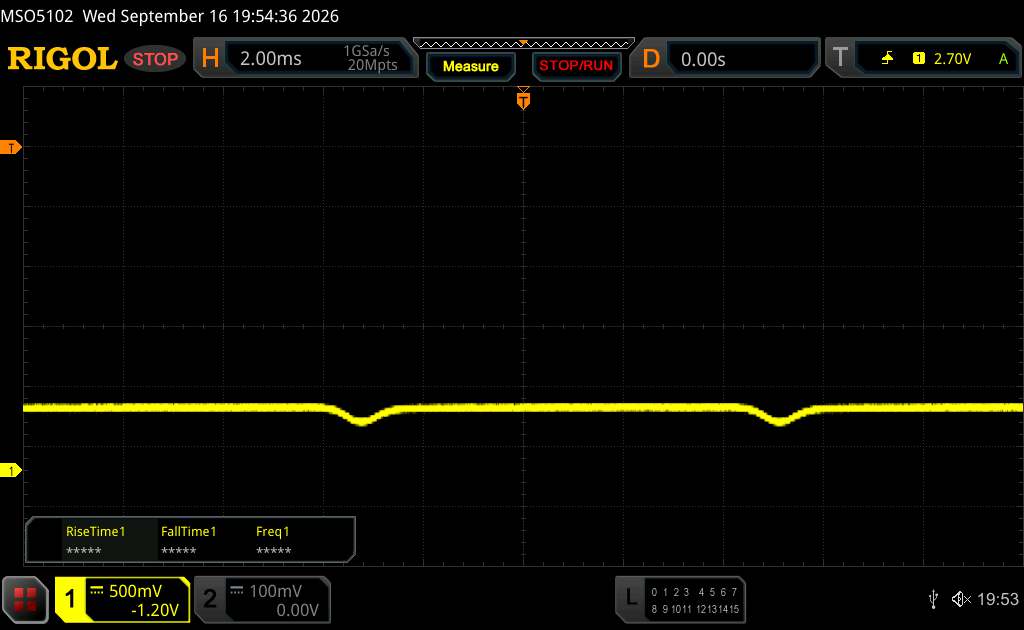
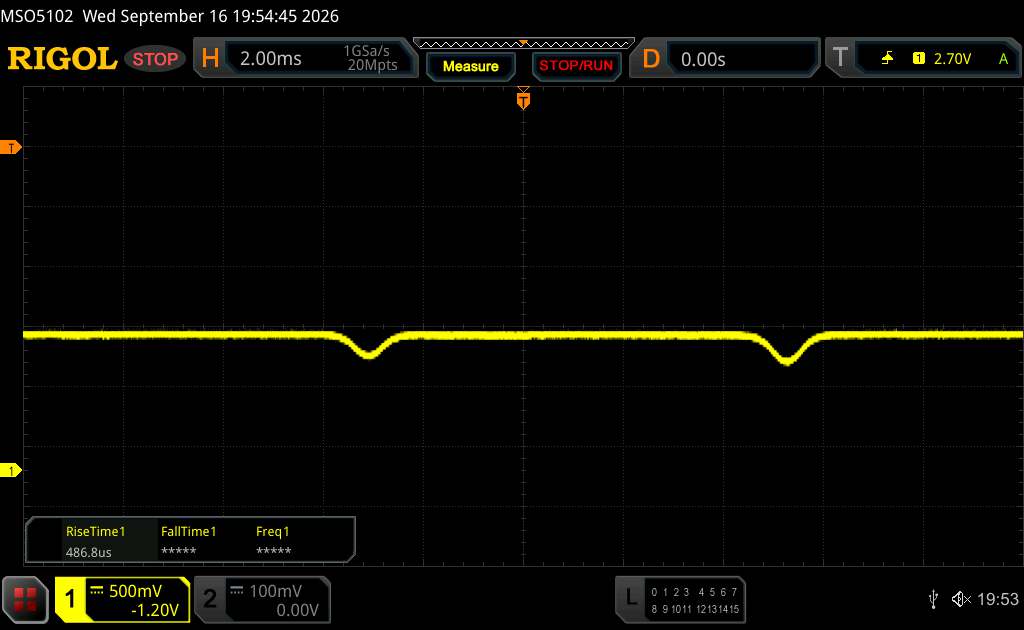
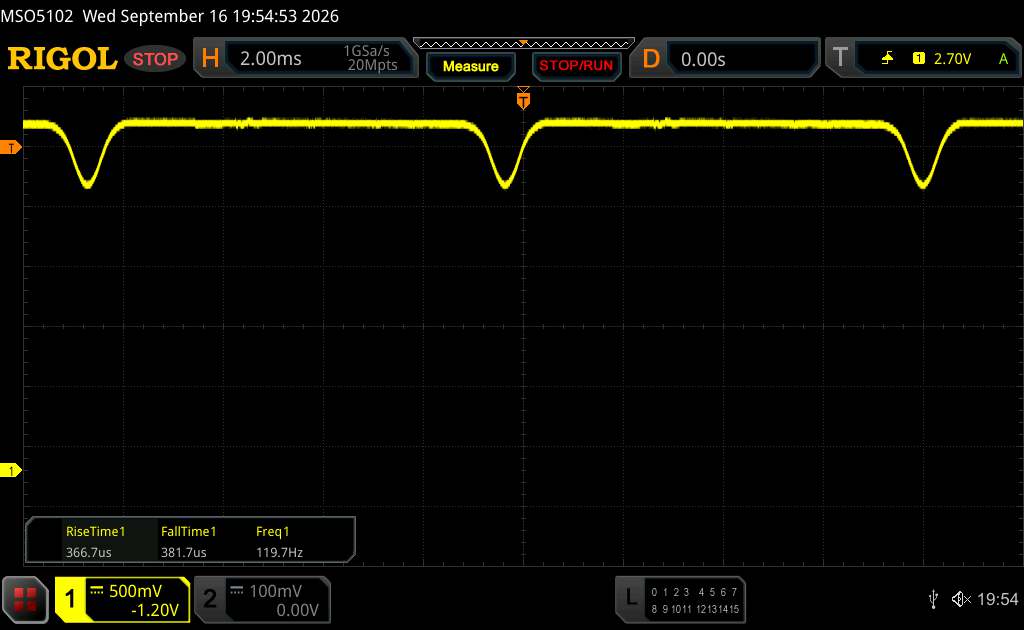
A series of measurements with a fixed zoom level and various brightness settings (Although the amplitude waveform appears flat at minimum brightness, this is due to the scaling. An enlarged version of the amplitude at minimum brightness is shown in the information box.)
While measurements taken with Calman demonstrate excellent color reproduction, the user interface often appears to display highly oversaturated colors during everyday use.


Display Response Times
| ↔ Response Time Black to White | ||
|---|---|---|
| 1 ms ... rise ↗ and fall ↘ combined | ↗ 0.5175 ms rise | 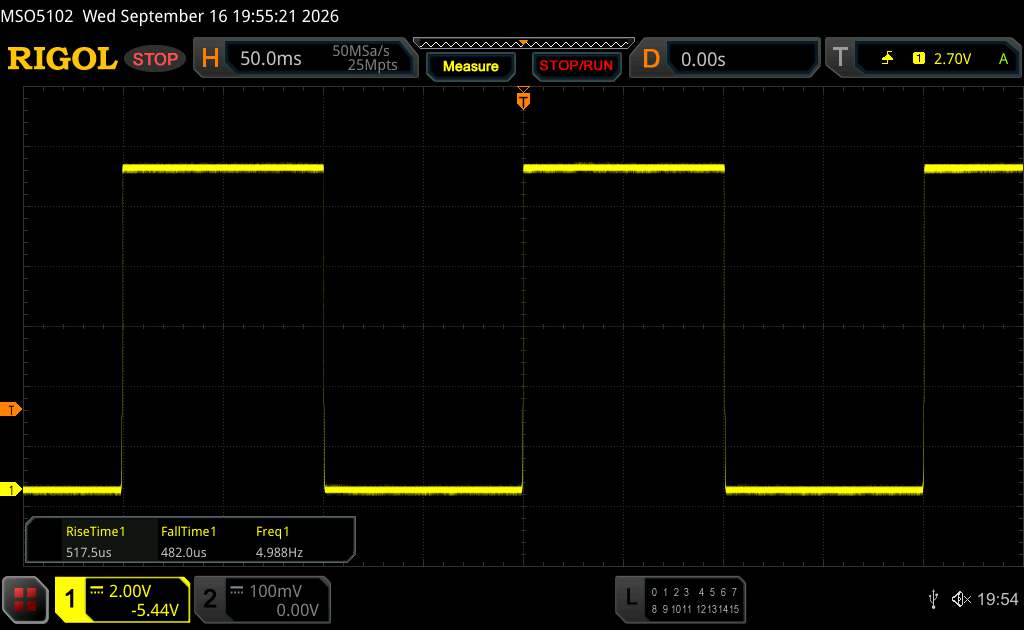 |
| ↘ 0.482 ms fall | ||
| The screen shows very fast response rates in our tests and should be very well suited for fast-paced gaming. In comparison, all tested devices range from 0.1 (minimum) to 240 (maximum) ms. » 4 % of all devices are better. This means that the measured response time is better than the average of all tested devices (19.6 ms). | ||
| ↔ Response Time 50% Grey to 80% Grey | ||
| 1.07 ms ... rise ↗ and fall ↘ combined | ↗ 0.5205 ms rise | 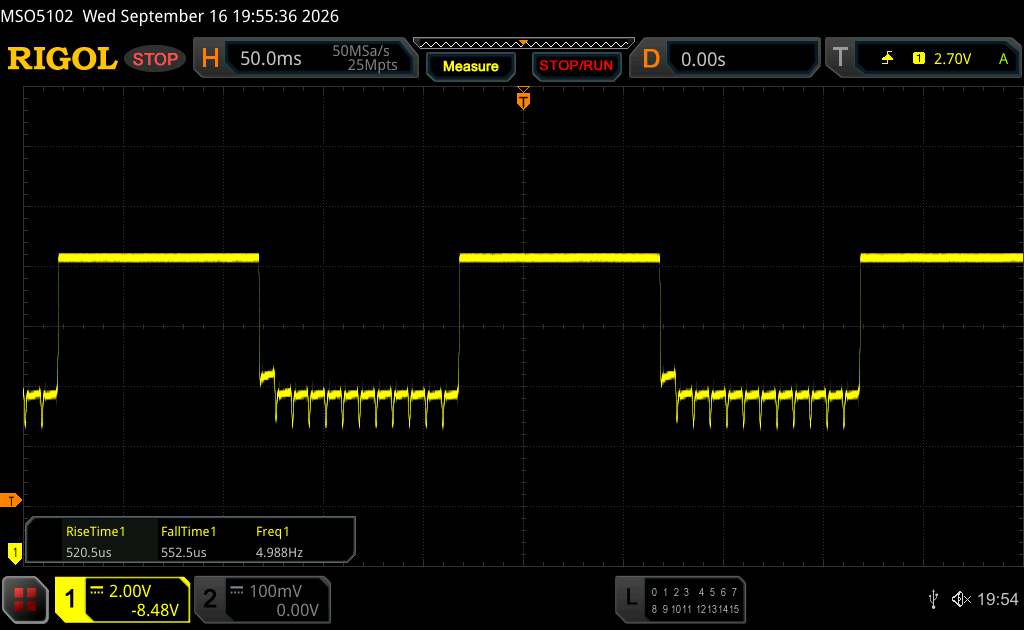 |
| ↘ 0.5525 ms fall | ||
| The screen shows very fast response rates in our tests and should be very well suited for fast-paced gaming. In comparison, all tested devices range from 0.13 (minimum) to 636 (maximum) ms. » 5 % of all devices are better. This means that the measured response time is better than the average of all tested devices (30.6 ms). | ||
In the autumn sunshine, the Redmi Note 17 5G generally remains easy to read, though it is also noticeably reflective. Furthermore, we wouldn't say its brightness reserves are particularly on the generous side.
Viewing angle stability is decent, but at very shallow viewing angles, the brightness simply decreases slightly, and a greenish tint becomes visible.


Performance - Xiaomi has gone with the Snapdragon 4 Gen 4
The Xiaomi Redmi Note 17 5G is powered by a Snapdragon 4 Gen 4 processor paired with 6 GB of LPDDR4x RAM. This SoC is a tier below the one found in the Note 15 5G, and the 8 GB of RAM option is no longer available.
In everyday use, occasional stutters are present, and launching more demanding apps can take a bit longer.
| PCMark for Android - Work 3.x | |
| Average of class Smartphone (4507 - 28557, n=122, last 2 years) | |
| Xiaomi Poco X8 | |
| Xiaomi Redmi Note 15 5G | |
| Xiaomi Redmi Note 17 5G | |
| Average Qualcomm Snapdragon 4 Gen 4 (n=1) | |
| Antutu v11 - Score | |
| Average of class Smartphone (519159 - 4450644, n=47, last 2 years) | |
| Xiaomi Redmi Note 15 5G | |
| Xiaomi Poco X8 | |
| Xiaomi Redmi Note 17 5G | |
| Average Qualcomm Snapdragon 4 Gen 4 (n=1) | |
| Antutu v12 - Score | |
| Average of class Smartphone (573642 - 4764073, n=11, last 2 years) | |
| Xiaomi Redmi Note 17 5G | |
| Average Qualcomm Snapdragon 4 Gen 4 (n=1) | |
| CrossMark - Overall | |
| Average of class Smartphone (376 - 2856, n=103, last 2 years) | |
| Xiaomi Poco X8 | |
| Xiaomi Redmi Note 15 5G | |
| Samsung Galaxy A37 5G | |
| Realme 16 Pro | |
| Motorola Moto G87 | |
| Xiaomi Redmi Note 17 5G | |
| UL Procyon AI Inference for Android - Overall Score NNAPI | |
| Average of class Smartphone (2895 - 66164, n=95, last 2 years) | |
| Xiaomi Redmi Note 15 5G | |
| Xiaomi Poco X8 | |
| Xiaomi Redmi Note 17 5G | |
| Average Qualcomm Snapdragon 4 Gen 4 (n=1) | |
| AImark - Score v3.x | |
| Average of class Smartphone (293 - 231543, n=63, last 2 years) | |
| Xiaomi Redmi Note 15 5G | |
| Xiaomi Poco X8 | |
| Xiaomi Redmi Note 17 5G | |
| Average Qualcomm Snapdragon 4 Gen 4 (n=1) | |
| AI Benchmark - Score V6 | |
| Average of class Smartphone (55.6 - 22780, n=74, last 2 years) | |
| Xiaomi Redmi Note 15 5G | |
| Xiaomi Poco X8 | |
| Xiaomi Redmi Note 17 5G | |
| Average Qualcomm Snapdragon 4 Gen 4 (n=1) | |
The device packs an Adreno 613 graphics chip, which is only really suitable for simple games and quickly finds its limits.
GFXBench (DX / GLBenchmark) 2.7: T-Rex Onscreen | 1920x1080 T-Rex Offscreen
GFXBench 3.0: on screen Manhattan Onscreen OGL | 1920x1080 1080p Manhattan Offscreen
GFXBench 3.1: on screen Manhattan ES 3.1 Onscreen | 1920x1080 Manhattan ES 3.1 Offscreen
GFXBench: on screen Car Chase Onscreen | 1920x1080 Car Chase Offscreen | on screen Aztec Ruins High Tier Onscreen | 2560x1440 Aztec Ruins High Tier Offscreen | on screen Aztec Ruins Normal Tier Onscreen | 1920x1080 Aztec Ruins Normal Tier Offscreen | 3840x2160 4K Aztec Ruins High Tier Offscreen
| 3DMark / Wild Life Extreme Unlimited | |
| Samsung Galaxy A37 5G | |
| Xiaomi Redmi Note 15 5G | |
| Xiaomi Poco X8 | |
| Motorola Moto G87 | |
| Xiaomi Redmi Note 17 5G | |
| 3DMark / Wild Life Extreme | |
| Samsung Galaxy A37 5G | |
| Realme 16 Pro | |
| Xiaomi Redmi Note 15 5G | |
| Xiaomi Poco X8 | |
| Motorola Moto G87 | |
| Xiaomi Redmi Note 17 5G (Press-Version) | |
| Xiaomi Redmi Note 17 5G (Play-Store-Version) | |
| 3DMark / Wild Life Unlimited Score | |
| Samsung Galaxy A37 5G | |
| Xiaomi Redmi Note 15 5G | |
| Realme 16 Pro | |
| Xiaomi Poco X8 | |
| Motorola Moto G87 | |
| Xiaomi Redmi Note 17 5G | |
| GFXBench (DX / GLBenchmark) 2.7 / T-Rex Onscreen | |
| Xiaomi Poco X8 | |
| Xiaomi Redmi Note 15 5G | |
| Xiaomi Redmi Note 17 5G | |
| GFXBench (DX / GLBenchmark) 2.7 / T-Rex Offscreen | |
| Xiaomi Redmi Note 15 5G | |
| Xiaomi Poco X8 | |
| Xiaomi Redmi Note 17 5G | |
| GFXBench 3.0 / Manhattan Onscreen OGL | |
| Xiaomi Redmi Note 15 5G | |
| Xiaomi Poco X8 | |
| Xiaomi Redmi Note 17 5G | |
| GFXBench 3.0 / 1080p Manhattan Offscreen | |
| Xiaomi Redmi Note 15 5G | |
| Xiaomi Poco X8 | |
| Xiaomi Redmi Note 17 5G | |
| GFXBench 3.1 / Manhattan ES 3.1 Onscreen | |
| Xiaomi Redmi Note 15 5G | |
| Xiaomi Poco X8 | |
| Xiaomi Redmi Note 17 5G | |
| GFXBench 3.1 / Manhattan ES 3.1 Offscreen | |
| Xiaomi Redmi Note 15 5G | |
| Xiaomi Poco X8 | |
| Xiaomi Redmi Note 17 5G | |
| GFXBench / Car Chase Onscreen | |
| Xiaomi Redmi Note 15 5G | |
| Xiaomi Poco X8 | |
| Xiaomi Redmi Note 17 5G | |
| GFXBench / Car Chase Offscreen | |
| Xiaomi Redmi Note 15 5G | |
| Xiaomi Poco X8 | |
| Xiaomi Redmi Note 17 5G | |
| GFXBench / Aztec Ruins High Tier Onscreen | |
| Samsung Galaxy A37 5G | |
| Realme 16 Pro | |
| Xiaomi Redmi Note 15 5G | |
| Xiaomi Poco X8 | |
| Motorola Moto G87 | |
| Xiaomi Redmi Note 17 5G | |
| GFXBench / Aztec Ruins High Tier Offscreen | |
| Samsung Galaxy A37 5G | |
| Xiaomi Redmi Note 15 5G | |
| Realme 16 Pro | |
| Xiaomi Poco X8 | |
| Motorola Moto G87 | |
| Xiaomi Redmi Note 17 5G | |
| GFXBench / Aztec Ruins Normal Tier Onscreen | |
| Samsung Galaxy A37 5G | |
| Realme 16 Pro | |
| Xiaomi Redmi Note 15 5G | |
| Xiaomi Poco X8 | |
| Motorola Moto G87 | |
| Xiaomi Redmi Note 17 5G | |
| GFXBench / Aztec Ruins Normal Tier Offscreen | |
| Samsung Galaxy A37 5G | |
| Xiaomi Redmi Note 15 5G | |
| Realme 16 Pro | |
| Xiaomi Poco X8 | |
| Motorola Moto G87 | |
| Xiaomi Redmi Note 17 5G | |
| GFXBench / 4K Aztec Ruins High Tier Offscreen | |
| Samsung Galaxy A37 5G | |
| Xiaomi Redmi Note 15 5G | |
| Realme 16 Pro (vulkan) | |
| Xiaomi Poco X8 | |
| Motorola Moto G87 | |
| Xiaomi Redmi Note 17 5G | |
| Jetstream 2 | |
| 2.0 Total | |
| Xiaomi Poco X8 (Chrome 155) | |
| Average of class Smartphone (63.9 - 423, n=110, last 2 years) | |
| Xiaomi Redmi Note 15 5G (Chrome 145) | |
| Average Qualcomm Snapdragon 4 Gen 4 (n=1) | |
| Xiaomi Redmi Note 17 5G (Chrome 153) | |
| Realme 16 Pro (Chrome 147) | |
| Motorola Moto G87 (Chrome 148) | |
| 2.2 Total | |
| Average of class Smartphone (2 - 480, n=104, last 2 years) | |
| Samsung Galaxy A37 5G (Chrome 149) | |
| Xiaomi Redmi Note 15 5G (Chrome 145) | |
| Xiaomi Poco X8 (Chrome 155) | |
| Xiaomi Redmi Note 17 5G (Chrome 153) | |
| Average Qualcomm Snapdragon 4 Gen 4 (n=1) | |
| Speedometer 2.0 - Result 2.0 | |
| Average of class Smartphone (49.3 - 733, n=69, last 2 years) | |
| Xiaomi Redmi Note 15 5G (Chrome 145) | |
| Xiaomi Redmi Note 17 5G (Chrome 153) | |
| Average Qualcomm Snapdragon 4 Gen 4 (n=1) | |
| Xiaomi Poco X8 (Chrome 155) | |
| Speedometer 3 - Score 3.0 | |
| Average of class Smartphone (3.06 - 56.5, n=77, last 2 years) | |
| Xiaomi Redmi Note 15 5G (Chrome 145) | |
| Xiaomi Redmi Note 17 5G (Chrome 153) | |
| Average Qualcomm Snapdragon 4 Gen 4 (n=1) | |
| Xiaomi Poco X8 (Chrome 155) | |
| WebXPRT 4 - Overall | |
| Average of class Smartphone (56 - 278, n=85, last 2 years) | |
| Xiaomi Redmi Note 15 5G (Chrome 145) | |
| Xiaomi Poco X8 (Chrome 155) | |
| Xiaomi Redmi Note 17 5G (Chrome 153) | |
| Average Qualcomm Snapdragon 4 Gen 4 (n=1) | |
| Octane V2 - Total Score | |
| Average of class Smartphone (6015 - 160221, n=124, last 2 years) | |
| Xiaomi Redmi Note 15 5G (Chrome 145) | |
| Xiaomi Poco X8 (Chrome 155) | |
| Xiaomi Redmi Note 17 5G | |
| Average Qualcomm Snapdragon 4 Gen 4 (n=1) | |
| Mozilla Kraken 1.1 - Total | |
| Xiaomi Redmi Note 17 5G | |
| Average Qualcomm Snapdragon 4 Gen 4 (n=1) | |
| Realme 16 Pro | |
| Xiaomi Redmi Note 15 5G (Chrome 145) | |
| Xiaomi Poco X8 (Chrome 155) | |
| Average of class Smartphone (216 - 2718, n=115, last 2 years) | |
* ... smaller is better
| Xiaomi Redmi Note 17 5G | Motorola Moto G87 | Samsung Galaxy A37 5G | Realme 16 Pro | Xiaomi Redmi Note 15 5G | Average 256 GB UFS 2.2 Flash | Average of class Smartphone | |
|---|---|---|---|---|---|---|---|
| AndroBench 3-5 | 20% | 66% | 116% | 23% | 11% | 113% | |
| Sequential Read 256KB (MB/s) | 1013.24 | 987.6 -3% | 1986.3 96% | 1836.83 81% | 911.87 -10% | 906 ? -11% | 2281 ? 125% |
| Sequential Write 256KB (MB/s) | 874.91 | 701.3 -20% | 1732.34 98% | 1723.54 97% | 867.34 -1% | 739 ? -16% | 1994 ? 128% |
| Random Read 4KB (MB/s) | 183.82 | 224.6 22% | 368.9 101% | 371.21 102% | 222.77 21% | 223 ? 21% | 321 ? 75% |
| Random Write 4KB (MB/s) | 166.22 | 302.6 82% | 115.25 -31% | 472.02 184% | 302.72 82% | 248 ? 49% | 372 ? 124% |
Emissions - Only one speaker
Temperature
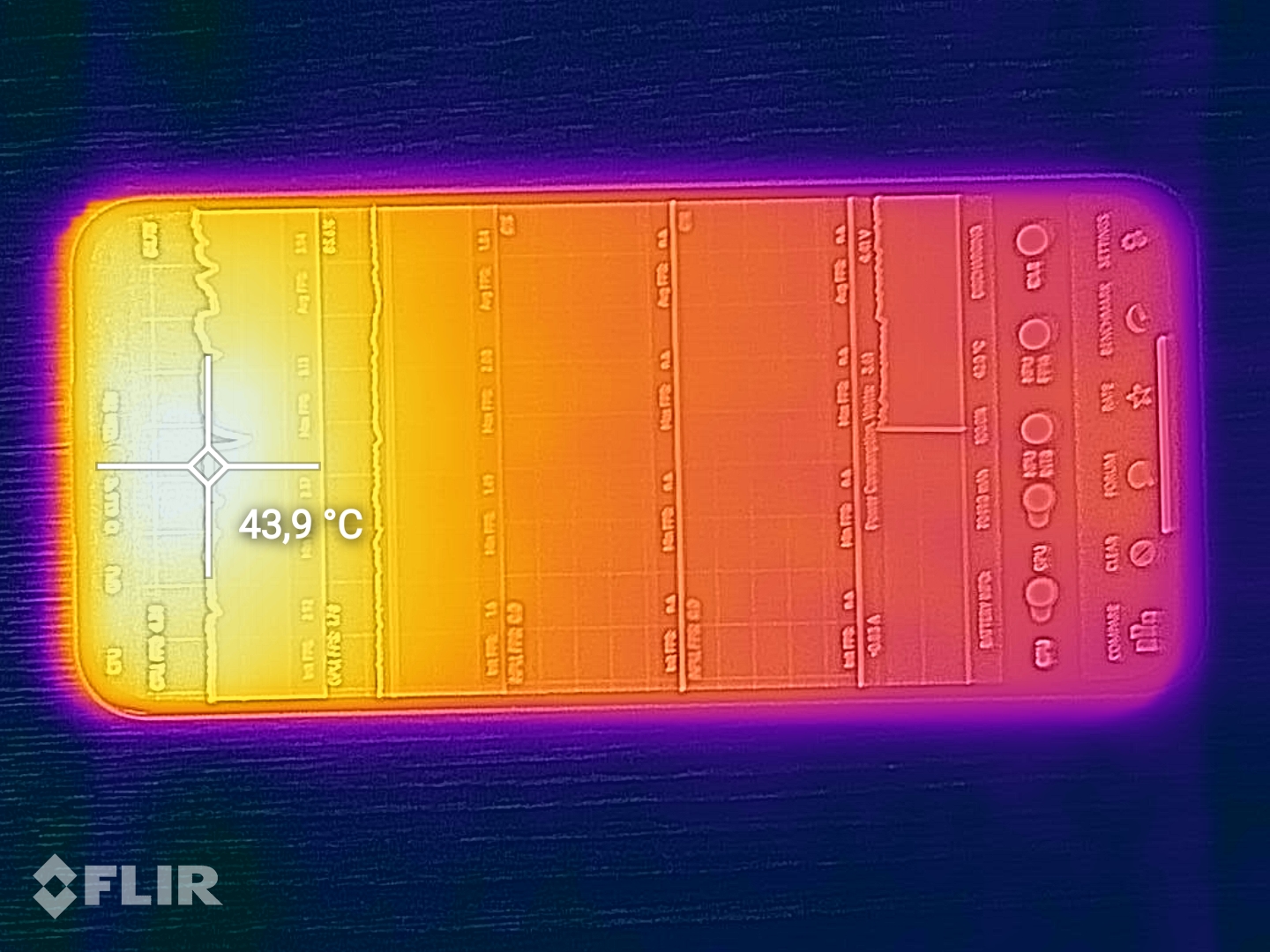
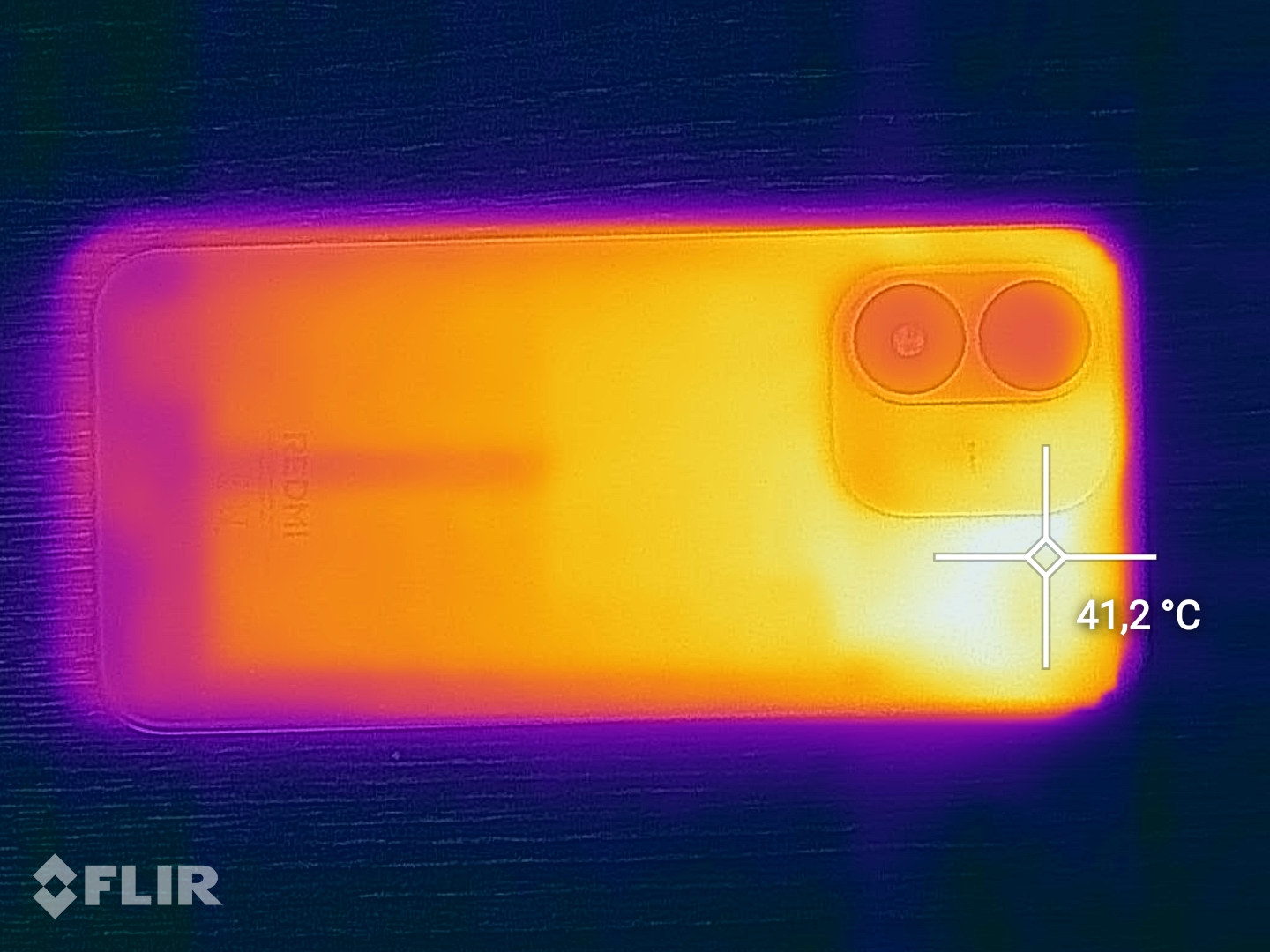
Under sustained load, surface temperatures reach up to 45.9 °C in some areas. Given the low power output, this is quite notable but remains harmless.
(-) The maximum temperature on the upper side is 45.9 °C / 115 F, compared to the average of 35.4 °C / 96 F, ranging from 21.9 to 247 °C for the class Smartphone.
(±) The bottom heats up to a maximum of 43.7 °C / 111 F, compared to the average of 34.1 °C / 93 F
(±) In idle usage, the average temperature for the upper side is 33.1 °C / 92 F, compared to the device average of 33 °C / 91 F.
3DMark Stress Tests
| 3DMark | |
| Wild Life Stress Test Stability | |
| Xiaomi Redmi Note 15 5G | |
| Samsung Galaxy A37 5G | |
| Xiaomi Redmi Note 17 5G | |
| Xiaomi Poco X8 | |
| Motorola Moto G87 | |
| Realme 16 Pro | |
| Wild Life Extreme Stress Test | |
| Realme 16 Pro | |
| Xiaomi Poco X8 | |
| Xiaomi Redmi Note 15 5G | |
| Xiaomi Redmi Note 17 5G | |
| Xiaomi Redmi Note 17 5G | |
| Samsung Galaxy A37 5G | |
| Motorola Moto G87 | |
| Steel Nomad Light Stress Test Stability | |
| Xiaomi Poco X8 | |
| Xiaomi Redmi Note 15 5G | |
| Samsung Galaxy A37 5G | |
Speakers
Xiaomi has removed one speaker. In our tests, the Redmi Note 17 5G's remaining mono driver achieves a high sound pressure level of up to 95.1 dB. In terms of sound quality, however, there is a clear emphasis on the upper mid-range and high frequencies, while low frequencies are barely perceptible. As a result, the audio output lacks balance and can sound somewhat shrill, especially at higher volumes. Nevertheless, the speaker is sufficient for occasional media playback.
Xiaomi Redmi Note 17 5G audio analysis
(+) | speakers can play relatively loud (95.1 dB)
Bass 100 - 315 Hz
(-) | nearly no bass - on average 20.3% lower than median
(+) | bass is linear (2.5% delta to prev. frequency)
Mids 400 - 2000 Hz
(±) | reduced mids - on average 7.5% lower than median
(+) | mids are linear (5% delta to prev. frequency)
Highs 2 - 16 kHz
(±) | higher highs - on average 5.7% higher than median
(+) | highs are linear (3.2% delta to prev. frequency)
Overall 100 - 16.000 Hz
(±) | linearity of overall sound is average (16.8% difference to median)
Compared to same class
» 9% of all tested devices in this class were better, 7% similar, 84% worse
» The best had a delta of 11%, average was 34%, worst was 136%
Compared to all devices tested
» 30% of all tested devices were better, 8% similar, 62% worse
» The best had a delta of 4%, average was 23%, worst was 136%
Samsung Galaxy A37 5G audio analysis
(+) | speakers can play relatively loud (90.8 dB)
Bass 100 - 315 Hz
(-) | nearly no bass - on average 24.1% lower than median
(±) | linearity of bass is average (7.1% delta to prev. frequency)
Mids 400 - 2000 Hz
(±) | reduced mids - on average 5.9% lower than median
(+) | mids are linear (4.8% delta to prev. frequency)
Highs 2 - 16 kHz
(+) | balanced highs - only 4.8% away from median
(+) | highs are linear (2.8% delta to prev. frequency)
Overall 100 - 16.000 Hz
(±) | linearity of overall sound is average (18.6% difference to median)
Compared to same class
» 22% of all tested devices in this class were better, 9% similar, 69% worse
» The best had a delta of 11%, average was 34%, worst was 136%
Compared to all devices tested
» 43% of all tested devices were better, 8% similar, 49% worse
» The best had a delta of 4%, average was 23%, worst was 136%
Battery life - The battery has grown to an enormous 7,700 mAh
Power consumption
The Redmi Note 17 5G's power consumption is surprisingly high, especially when idle.
| Off / Standby |   0.16 / 0.29 Watt |
| Idle |  1.55 / 3.29 / 3.4 Watt |
| Load |
5.01 / 6.11 Watt |
    
| |
Key:
min: ,
med: ,
max: Metrahit Energy | |
| Xiaomi Redmi Note 17 5G 7700 mAh | Xiaomi Poco X8 8340 mAh | Samsung Galaxy A37 5G 5000 mAh | Xiaomi Redmi Note 15 5G 5520 mAh | Average Qualcomm Snapdragon 4 Gen 4 | Average of class Smartphone | |
|---|---|---|---|---|---|---|
| Power Consumption | 14% | 44% | 25% | 0% | 8% | |
| Idle Minimum * (Watt) | 1.55 | 1.2 23% | 0.85 45% | 1.04 33% | 1.55 ? -0% | 0.903 ? 42% |
| Idle Average * (Watt) | 3.29 | 1.8 45% | 1.86 43% | 1.33 60% | 3.29 ? -0% | 1.48 ? 55% |
| Idle Maximum * (Watt) | 3.4 | 2.3 32% | 1.94 43% | 1.38 59% | 3.4 ? -0% | 1.685 ? 50% |
| Load Average * (Watt) | 5.01 | 4.8 4% | 4.05 19% | 5.01 ? -0% | 6.7 ? -34% | |
| Load Maximum * (Watt) | 6.11 | 8.1 -33% | 8.98 -47% | 6.11 ? -0% | 10.6 ? -73% |
* ... smaller is better
Power consumption: Geekbench (150 cd/m²)
Power consumption: GFXbench (150 cd/m²)
Battery runtimes
With a Wi-Fi test runtime of 21 hours and 8 minutes, the Redmi Note 17 5G delivers outstanding performance, surpassing its predecessor by a good two hours. However, given that the battery capacity has increased by nearly 40 percent, this approximate 11 percent gain is relatively modest.
| Battery runtime - WiFi v1.3 | |
| Xiaomi Redmi Note 17 5G | |
| Xiaomi Poco X8 | |
| Motorola Moto G87 | |
| Samsung Galaxy A37 5G | |
| Realme 16 Pro | |
| Xiaomi Redmi Note 15 5G | |
Notebookcheck overall rating
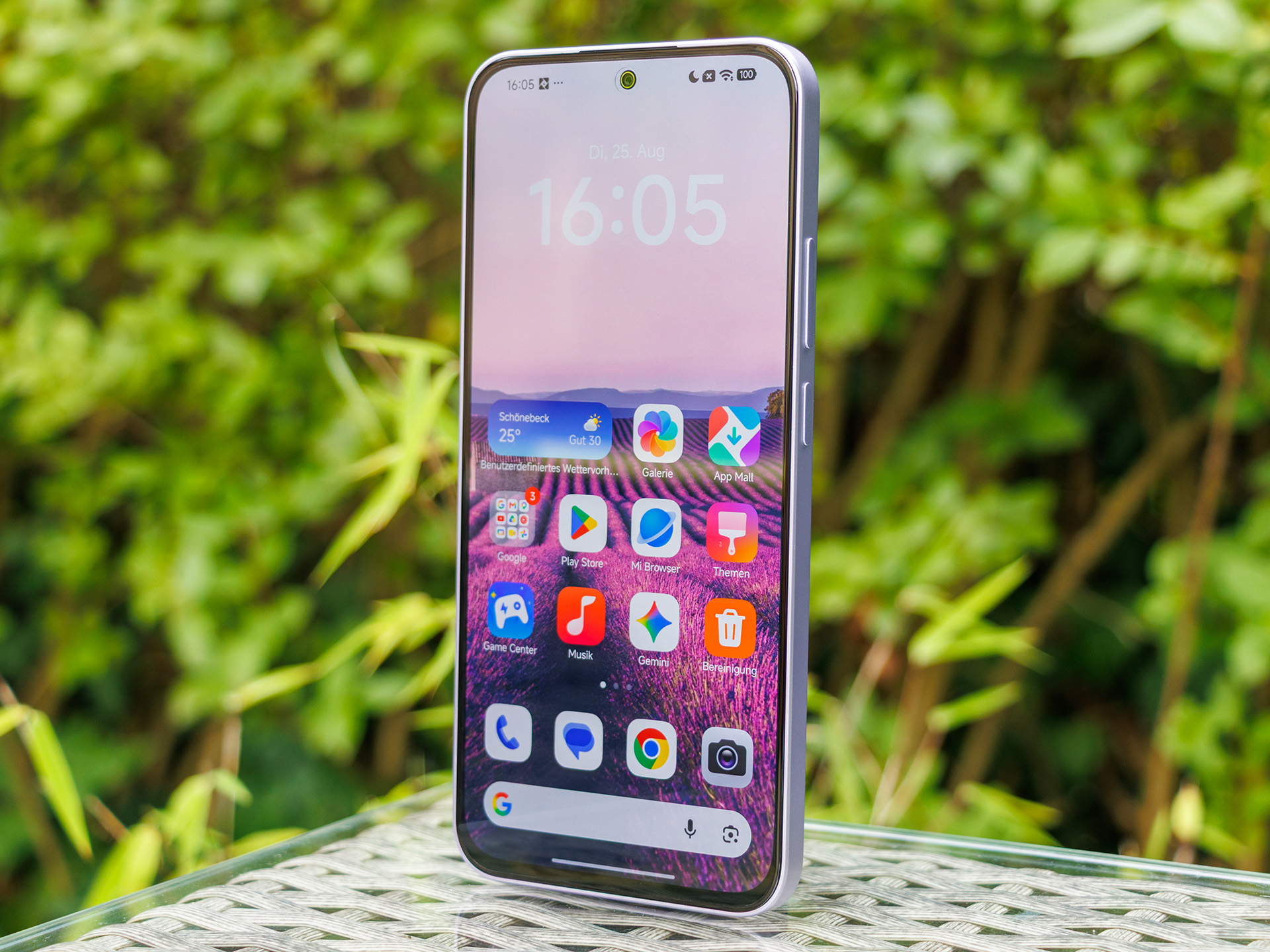
The Xiaomi Redmi Note 17 5G shines with standout battery life, but compared to its predecessor, it disappoints due to numerous cutbacks in performance, camera, display, and features.
Xiaomi Redmi Note 17 5G
- 10/29/2026 v8
Daniel Schmidt
 Total Sustainability Score:
Possible alternatives compared
Image | Model / Review | Price | Weight | Drive | Display |
|---|---|---|---|---|---|
1. 72.9%  | Xiaomi Redmi Note 17 5G Qualcomm Snapdragon 4 Gen 4 ⎘ Qualcomm Adreno 613 ⎘ 6 GB Memory, 256 GB UFS 2.2 | List Price: 380€ | 225 g | 256 GB UFS 2.2 Flash | 6.99" 2396x1080 376 PPI AMOLED |
2. 75.8%  | Xiaomi Poco X8 Qualcomm Snapdragon 6s Gen 4 ⎘ Qualcomm Adreno 710 ⎘ 8 GB Memory, 256 GB UFS 3.1 | List Price: 320€ | 223 g | 256 GB UFS 3.1 Flash | 6.83" 2772x1280 447 PPI AMOLED |
3. 74.6%  | Motorola Moto G87 Mediatek Dimensity 6400 ⎘ ARM Mali-G57 MP2 ⎘ 8 GB Memory, 256 GB UFS 2.2 | List Price: 400€ | 183 g | 256 GB UFS 2.2 Flash | 6.78" 2772x1272 450 PPI AMOLED |
4. 79%  | Samsung Galaxy A37 5G Samsung Exynos 1480 ⎘ Samsung Xclipse 530 ⎘ 8 GB Memory, 256 GB UFS 3.1 | List Price: 519€ | 196 g | 256 GB UFS 3.1 Flash | 6.70" 2340x1080 385 PPI Super AMOLED |
5. 77.3%  | Realme 16 Pro MediaTek Dimensity 7300 ⎘ ARM Mali-G615 MP2 ⎘ 8 GB Memory, 256 GB UFS 3.1 | List Price: 380€ | 192 g | 256 GB UFS 3.1 Flash | 6.78" 2772x1272 450 PPI AMOLED |
Transparency
The selection of devices to be reviewed is made by our editorial team. The test sample was given to the author by the manufacturer free of charge for the purposes of review. There was no third-party influence on this review, nor did the manufacturer receive a copy of this review before publication. There was no obligation to publish this review. As an independent media company, Notebookcheck is not subjected to the authority of manufacturers, retailers or publishers.
This is how Notebookcheck is testing
Every year, Notebookcheck independently reviews hundreds of laptops and smartphones using standardized procedures to ensure that all results are comparable. We have continuously developed our test methods for around 20 years and set industry standards in the process. In our test labs, high-quality measuring equipment is utilized by experienced technicians and editors. These tests involve a multi-stage validation process. Our complex rating system is based on hundreds of well-founded measurements and benchmarks, which maintains objectivity. Further information on our test methods can be found here.
 Add as a preferred source on Google


