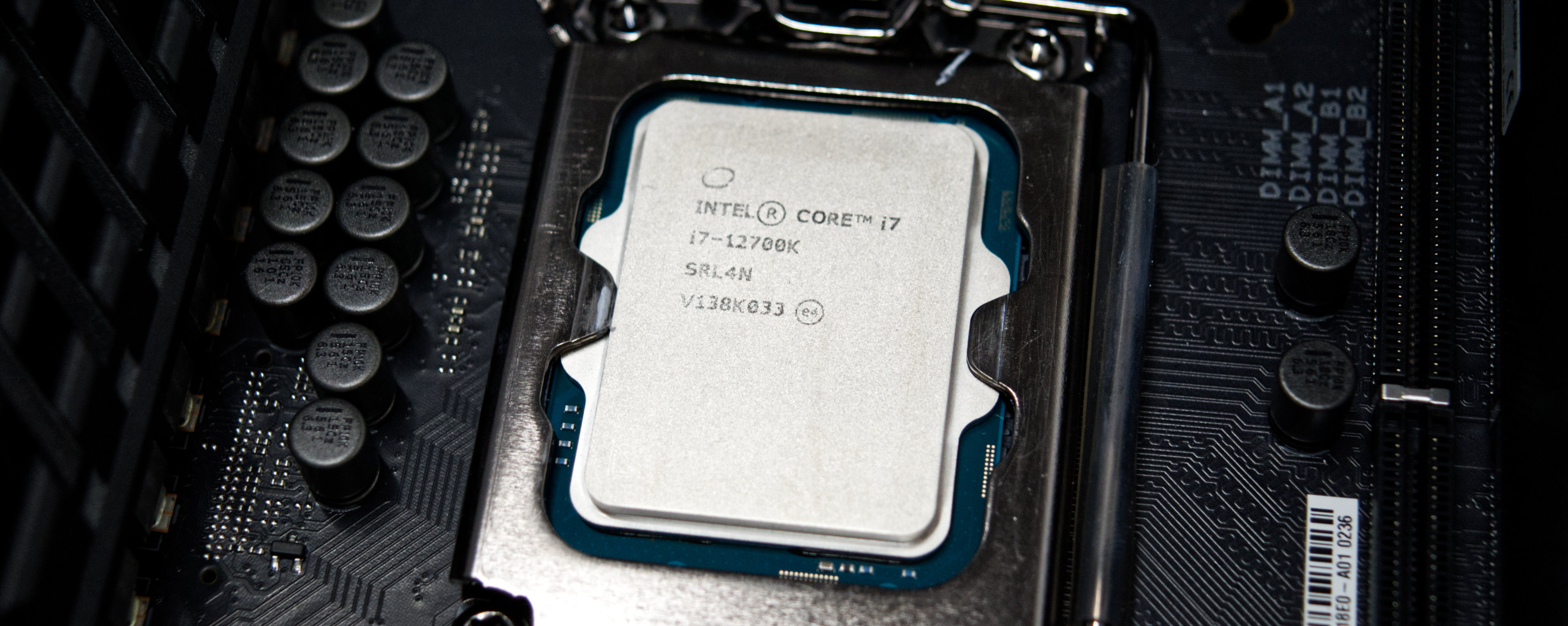
The Intel Core i7-12700K is a high end CPU for desktops based on the Alder Lake architecture. It was first announced in November 2021 and offers 8 performance cores and 4 efficiency cores. The performance cores (P-cores) support HyperThreading, leading to 20 Threads that can be processed at once. The performance cores can clock with up to 5 GHz (Turbo Boost Max 3.0), the efficiency cores can clock with up to 3.9 GHz. All cores can use 25 MB Smart Cache. The integrated memory controller supports up to 128 GB DDR5 with 4800 MT/s (dual channel).
Thread Director (in hardware) can support the operating system to decide which thread to use on the performance or efficiency cores for the best performance.
The integrated graphics adapter is based on the Xe-architecture and called Intel UHD Graphics 770. It clocks between 300 and 1.5 GHz.
For AI tasks, the CPU also integrates GNA 3.0 and DL Boost. Quick Sync in version 8 is the same as in the Rocket Lake CPUs and supports MPEG-2, AVC, VC-1 decode, JPEG, VP8 decode, VP9, HEVC and AV1 decode in hardware.
Performance
The average 12700K in our database is way ahead of the Ryzen 7 5800X and the Ryzen 9 3900X, as far as multi-thread benchmark scores are concerned. Which is a very, very impressive result, as of late 2022.
Power consumption
This Core i7 series chip has a Base power consumption of 125 W, with its highest Intel-recommended Turbo power consumption sitting at 190 W. It might be a good idea to get an AIO cooling solution for a chip this power hungry.
The i7-12700K is manufactured on Intel's fourth-generation 10 nm process marketed as Intel 7 for lower-than-average, as of early 2023, energy efficiency.
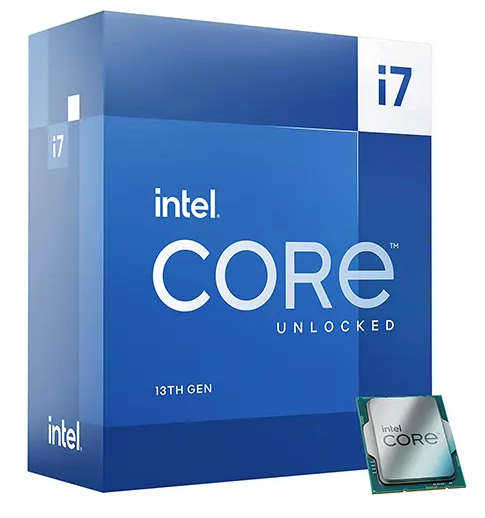
The Intel Core i7-13700 is a fast and relatively economical desktop processor from the current Raptor Lake series. The processor was introduced in early 2023 and offers a base clock of 2.1 GHz. It reaches up to 5.2 GHz in Turbo mode. As with Alder Lake-S, Raptor Lake-S is also based on a hybrid design that combines P and E cores. Compared to the Intel Core i7-12700, the number of E-cores has been doubled to 8, meaning that the Intel Core i7-13700 offers up to 24 threads together with its 8 P-cores. The processor continues to be manufactured using the 10 nm production process called "Intel 7". There is no freely selectable multiplier for the Intel Core i7-13700 (compared to the faster i7-13700K) and the LGA 1700 socket introduced with the Alder Lake series continues to serve as the basis.
Performance
Compared to the Intel Core i7-12700, the IPC of the new Core i7-13700 has been increased slightly. At the same time, the 4 additional E-cores now provide slightly more performance for multi-threaded tasks. This puts the Intel Core i7-13700 at the level of an Intel Core i9-12900K, which also offers a total of 24 threads.
iGPU
The Intel Core i7-13700 is a processor with an integrated graphics unit. The Intel UHD Graphics 770 however is only suitable for office use and very old or low demanding games.
Power consumption
The TDP of the Intel Core i7-13700 is 65 watts in PL1. Intel defines the PL2 limit at 219 watts. If the restrictions regarding power consumption are deactivated in the BIOS, the PL2 value can be reached permanently and even exceeded with good cooling. However, a high-quality and powerful cooling unit should be used for this.
Average Benchmarks Intel Core i7-12700K → 100%n=48
Average Benchmarks Intel Core i7-13700 → 113%n=48
- Range of benchmark values for this graphics card - Average benchmark values for this graphics card * Smaller numbers mean a higher performance 1 This benchmark is not used for the average calculation
v1.35
log 17. 06:38:35
#0 ran 0s before starting gpusingle class +0s ... 0s
#1 checking url part for id 14033 +0s ... 0s
#2 checking url part for id 14997 +0s ... 0s
#3 redirected to Ajax server, took 1765949915s time from redirect:0 +0s ... 0s
#4 did not recreate cache, as it is less than 5 days old! Created at Tue, 16 Dec 2025 05:18:30 +0100 +0s ... 0s
#5 composed specs +0.004s ... 0.004s
#6 did output specs +0s ... 0.004s
#7 getting avg benchmarks for device 14033 +0.003s ... 0.008s
#8 got single benchmarks 14033 +0.004s ... 0.012s
#9 getting avg benchmarks for device 14997 +0.003s ... 0.016s
#10 got single benchmarks 14997 +0.004s ... 0.02s
#11 got avg benchmarks for devices +0s ... 0.02s
#12 min, max, avg, median took s +0.043s ... 0.063s







 - Average benchmark values for this graphics card


 Add as a preferred