




Unprecedented clock speed: Full AMD Zen 6 Medusa desktop and laptop CPU leak clarifies 6.5+ GHz boost frequency
Serial leaker Moore’s Law Is Dead has been consistently leaking details about the AMD Zen 6 “Medusa” CPU architecture. Thanks to the leaker, we know what AMD is planning with Zen 6, including core counts, IPC improvements, lineup segmentation, mobile lineup, and more. MLID has now published a “full” Zen 6 leak, where the leaker goes over everything there is to know about Zen 6. However, for us, the most interesting aspect of this Zen 6 story is the absurdly high clock speed and AMD’s plan for laptop Zen 6 APUs.
If you are not up to speed on Zen 6, we highly recommend checking MLID’s latest video out, which is linked at the end.
Jumping straight into the potential Zen 6 clock speeds, MLID initially leaked that the big “classic” Zen 6 cores could boast a crazy 7 GHz boost frequency. This is possible because AMD’s alleged use of TSMC’s cutting-edge N2X 2 nm node for the 12-core CCDs.
MLID now claims that Zen 6 will “100%” clock above 6.5 GHz. Per the leaker, people at AMD are confident that the Zen 6 desktop CPUs will achieve a 6.6 GHz or higher boost clock. This will beat the current 6.2 GHz boost clock of the Core i9-14900KS, which is currently the best consumer CPU in terms of out-of-the-box boost frequency.
Naturally, such a high clock speed will also noticeably boost Zen 6's performance in predominantly single-threaded tasks like gaming.
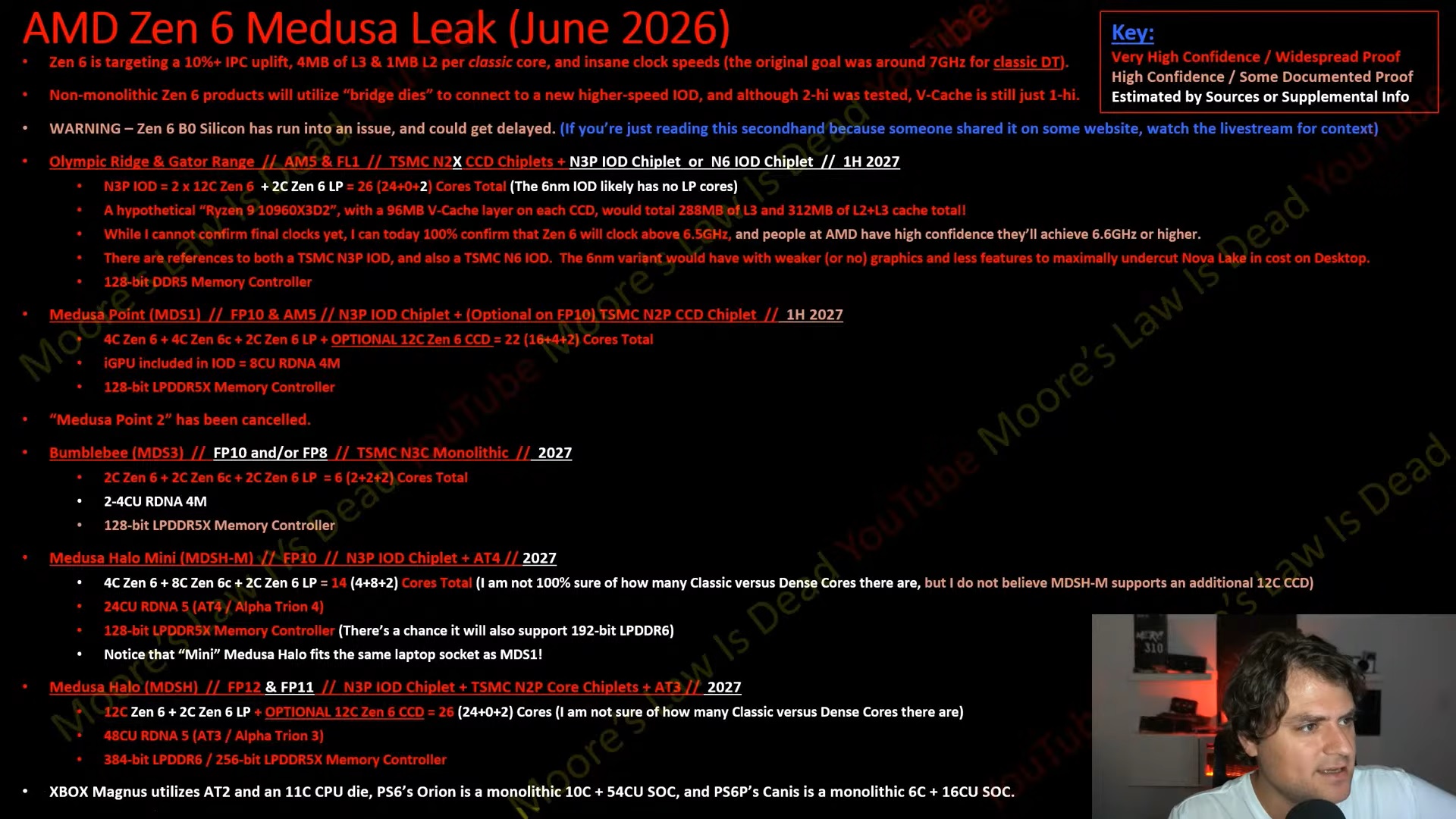
Talking about gaming, MLID reiterates his claim of 288 MB of 3D V-Cache for a supposed flagship Ryzen 9 109060X3D2 with one 3D V-Cache die per 12-core CCD. We just hope AMD doesn’t name the CPU like this. It’s terrible.
AMD Zen 6 Medusa Point and Medusa Halo
Rather than following the existing strategy of releasing a small APU with a capable iGPU (Strix Point) and a large APU with a powerful CPU and iGPU (Strix Halo), AMD is reportedly set to offer a third option to laptop OEMs. Per MLID, the Zen 6 Medusa laptop CPUs will include:
- A 10-core Zen 6 Medusa Point APU with an RDNA 4M iGPU with 8 CUs
- A 14-core Medusa Halo Mini with an “AT4” RDNA 5 iGPU with 24 CUs
- A 26-core Medusa Halo with an “AT3” RDNA 5 iGPU with 48 CUs
As mentioned in previous leaks, AMD is using the Alpha Trion (AT) designations for its next-gen graphics dies that will be shared between the desktop GPUs, laptop iGPUs, and the Xbox Magnus APU.
The interesting thing about the Medusa Halo Mini APU is that it shares the platform/socket with Medusa Point. So, according to MLID, Windows laptop OEMs will have the option of choosing the cheaper Medusa Point or the more expensive Medusa Halo Mini. With the latter, laptop OEMs can skip a dedicated GPU as the Medusa Halo Mini’s iGPU is expected to be at the same level as a mobile RTX 4060.
Finally, AMD is also preparing a low-end Zen 6 Bumblebee APU with up to six Zen 6 cores and an 8 CU RDNA 4 iGPU.
MLID reports that the Zen 6 desktop CPUs and Medusa Point mobile APUs could be here in H1 2027. So, we can expect AMD to officially launch the next-gen Ryzen processors at CES 2027.
Source(s)
Moore's Law Is Dead on YouTube, Teaser image source: AMD, BoliviaInteligente on Unsplash, edited
 Add as a preferred source on Google


