




Nvidia goes after Tesla and SpaceX with Uber and BYD robotaxi fleets as it plans orbital data center AI chip
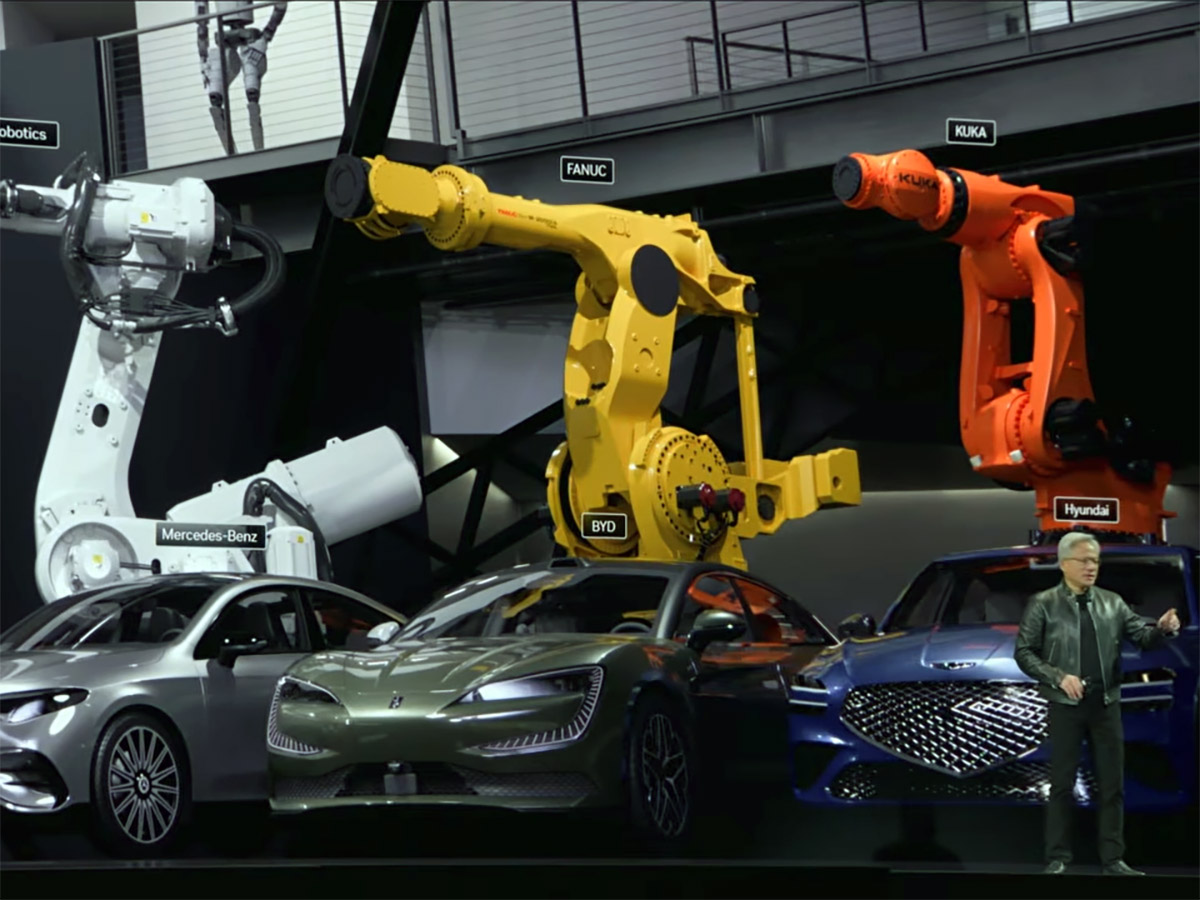
While Elon Musk has said that he is not losing any sleep over Nvidia's plug-and-play autonomous driving system Alpamayo, the world's largest company has now signed up the biggest EV and ride-share names as customers.
At GTC 2026, Nvidia CEO Jensen Huang unveiled an expanded roster of partners for its Drive Hyperion platform, signaling a direct challenge to Tesla’s dominance in the robotaxi sector.
Nvidia self-driving system customers
Leading the charge is Uber, which will be deploying 100,000 Level 4 autonomous vehicles across 28 global markets on four continents, starting with San Francisco and Los Angeles in early 2027.
While Tesla relies on its vertically integrated FSD stack, Nvidia is countering with Alpamayo 1.5, an open-source "Physical AI" ecosystem. Instead of mapping sensors directly to commands, Alpamayo is a Vision-Language-Action (VLA) model that Nvidia says comes with 10 billion parameters and can "think out loud."
At the event, Nvidia introduced Alpamayo 1.5, expanding the system's capabilities "with an interactive, steerable reasoning model," and said that it has bagged multiple customers for the Hyperion autonomous driving platform, including the world's largest EV maker BYD, as well as Hyundai and Kia.
As a lot of Tesla's sky-high market cap hinges on it becoming and staying a leader in the autonomous driving and robotaxi races, Nvidia's push to commoditize those realms, especially with customers like Uber and BYD, may affect Tesla's valuation.
Vera Rubin Space-1 orbital data center chip
Nvidia announced that it will also be making chips for orbital data centers, stepping on SpaceX's toes. Elon Musk's company teased not long ago that it will be aiming to send AI data center infrastructure into space so that it can take advantage of solar energy without straining terrestrial grids.
Nvidia’s "Vera Rubin Space-1" chips aim to process data directly in orbit, eliminating the latency of beaming raw data back to Earth. While Elon Musk bets on vertical integration between Starlink and xAI, Nvidia is positioning itself as the "brains" for every other orbital startup, from Planet Labs to NASA.
"Of course, in space there's no conduction, no convection; there's just radiation, so we have to figure out how to cool these systems in space, but we've got lots of great engineers working on it," quipped Huang. These challenges are the same ones that SpaceX will be facing, so it will either have to challenge Nvidia in AI chip development or become a customer for its Vera Rubin Space-1 production.
Source(s)
 Add as a preferred source on Google


