




Webb's 255-hour-long observation reveals invisible dark matter in a map area containing nearly 800,000 galaxies

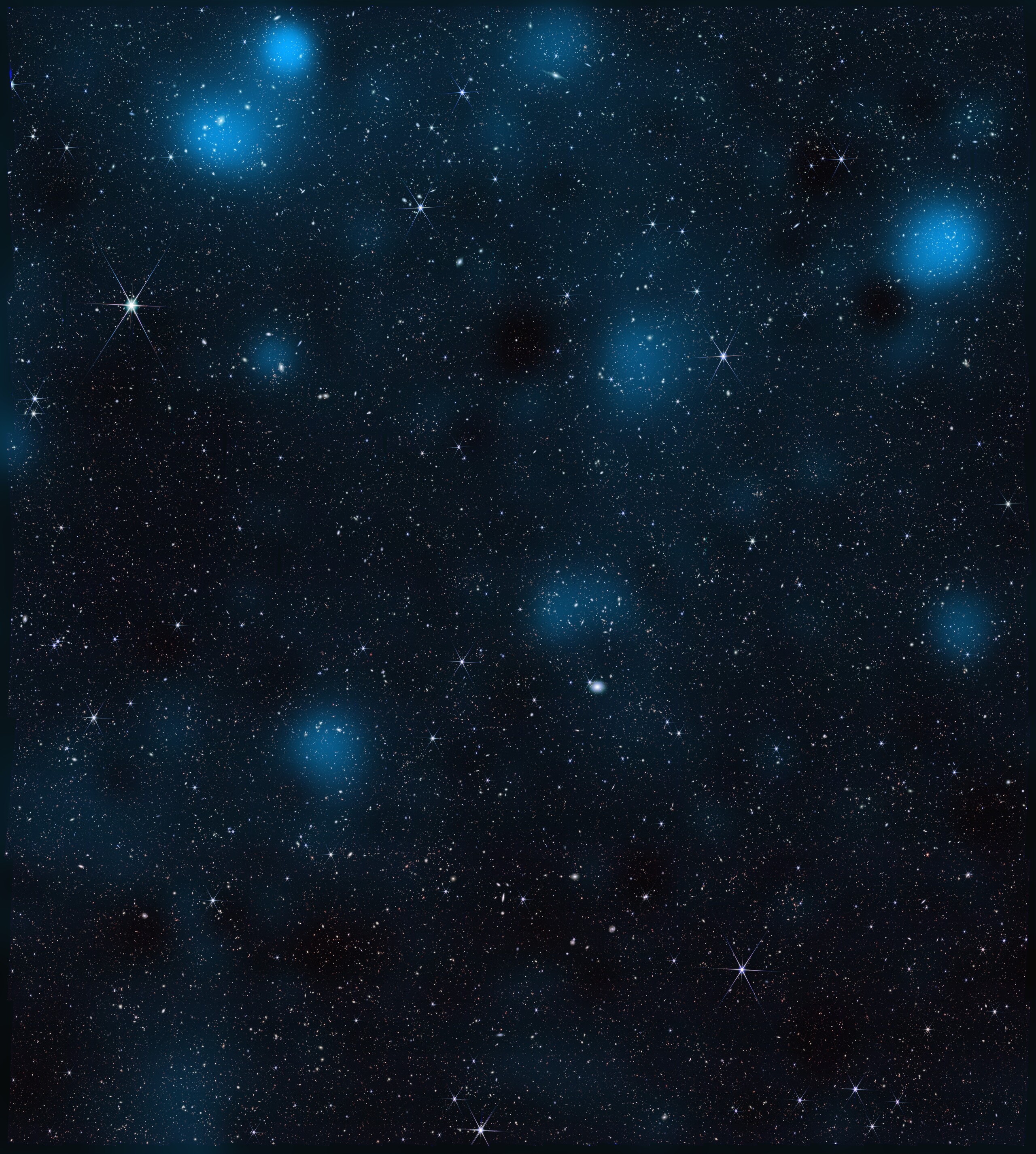
As part of the Cosmic Evolution Survey (COSMOS) project, Webb captured an area of the sky located in the constellation Sextans. The region measures 0.54 square degrees — that is, about two and a half times the size of a Full Moon. This expanse of sky shown in the image contains nearly 800,000 galaxies. The area is also overlaid with a map of dark matter.
Dark matter is not visible to the naked eye or to traditional telescopes. This is because it neither emits, reflects, absorbs, nor blocks light. However, dark matter can be detected because it interacts with the universe through gravity. Large clusters of dark matter can cause a curvature in space-time. As light travels from nearby galaxies to Earth through this curvature, it bends. That bending of light is called gravitational lensing.
Gravitational lensing is of two types: strong and weak. In strong gravitational lensing, the bending of light is significant enough to be visually obvious in images. For weak gravitational lensing, there is a much more subtle distortion of the light. Astronomers analyze thousands of galaxies to identify patterns. This Webb dark matter map is based on weak gravitational lensing.
In this image, the dark matter is represented in blue. Brighter blue areas indicate a higher density of dark matter. While Hubble previously mapped the dark matter in this area of the sky in 2007, Webb’s map reveals new clumps of dark matter, as it contains about twice as many galaxies as Hubble’s map. Webb’s map also offers a higher resolution view.
Several other telescopes have been part of the COSMOS project. Scientists are using the different views to understand how galaxies grow and how dark matter influences their evolution.
 Add as a preferred source on Google


