Tech forecast 2026: AI hype, Apple foldable, 1000-watt chips and robot invasion

Anyone who thinks the AI hype is dying down is mistaken. In its latest report, TrendForce paints a picture that looks like revolution. As readers may have already guessed, AI is the primary driving force. Ten major trends are set to shape 2026. Analysts firmly expect the first foldable iPhone to be released at the end of 2026. Although the company is entering new territory here, Apple may still be able to avoid typical teething problems such as display creases thanks to its highly specialized supply chain. Liquid metal hinges are expected to do the trick here. However, the price is likely to be steep, easily breaking the $2,000 mark. Laptops are also being upgraded: MacBook Pros are expected to switch to OLED from 2026.
But things are really heating up in data centers. Since AI models are becoming increasingly powerful, current cooling solutions are proving increasingly insufficient and so the chip industry needs to radically rethink its approach. Nvidia's upcoming B200 and B300 chips are expected to consume over 1,000 watts of thermal power. Air cooling won't get you very far here. TrendForce estimates that by 2026, almost half of all AI servers will require liquid cooling.
Data transport is also being reinvented in order to prevent enormous amounts of data from clogging up networks. HBM4 and silicon photonics are the solutions being utilized here. In the case of the latter, data is transmitted using light instead of electricity, enabling high-speed data transfer, increased efficiency and low energy consumption. Furthermore, storage manufacturers are heavily investing in QLC NAND, an inexpensive form of long-term data storage.
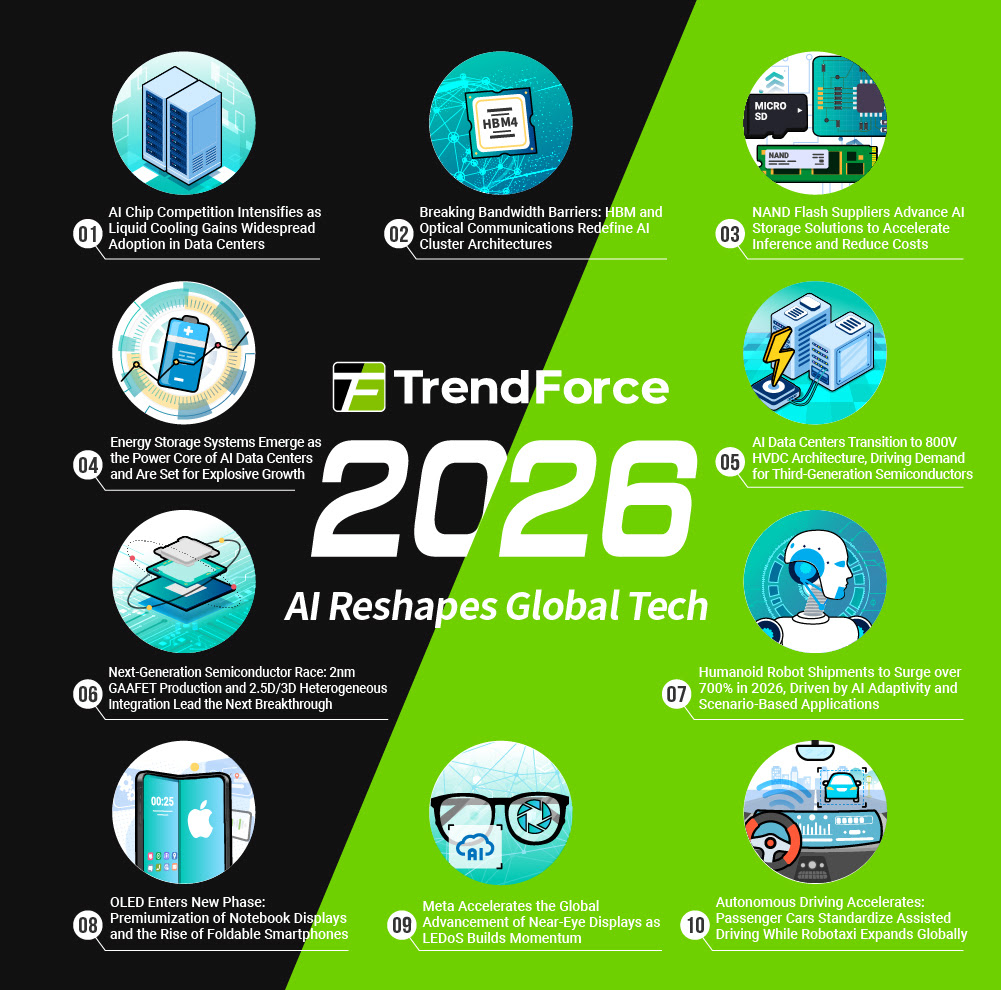
2026 is set to be the year of humanoid robots, as AI gains ever more momentum. Experts expect sales figures of AI-powered robots to skyrocket by 700%. Thanks to smart AI brains, these metal companions take over mundane tasks. Computers are also taking over on the roads. Level 2 driving assistants are becoming standard. Even our glasses are getting smart. Meta is working on AR glasses with LEDoS technology, which will be bright, efficient and bring AI directly to the retina.
Source(s)
 Add as a preferred source on Google