




Steam averages almost 70 new games a day in 2026
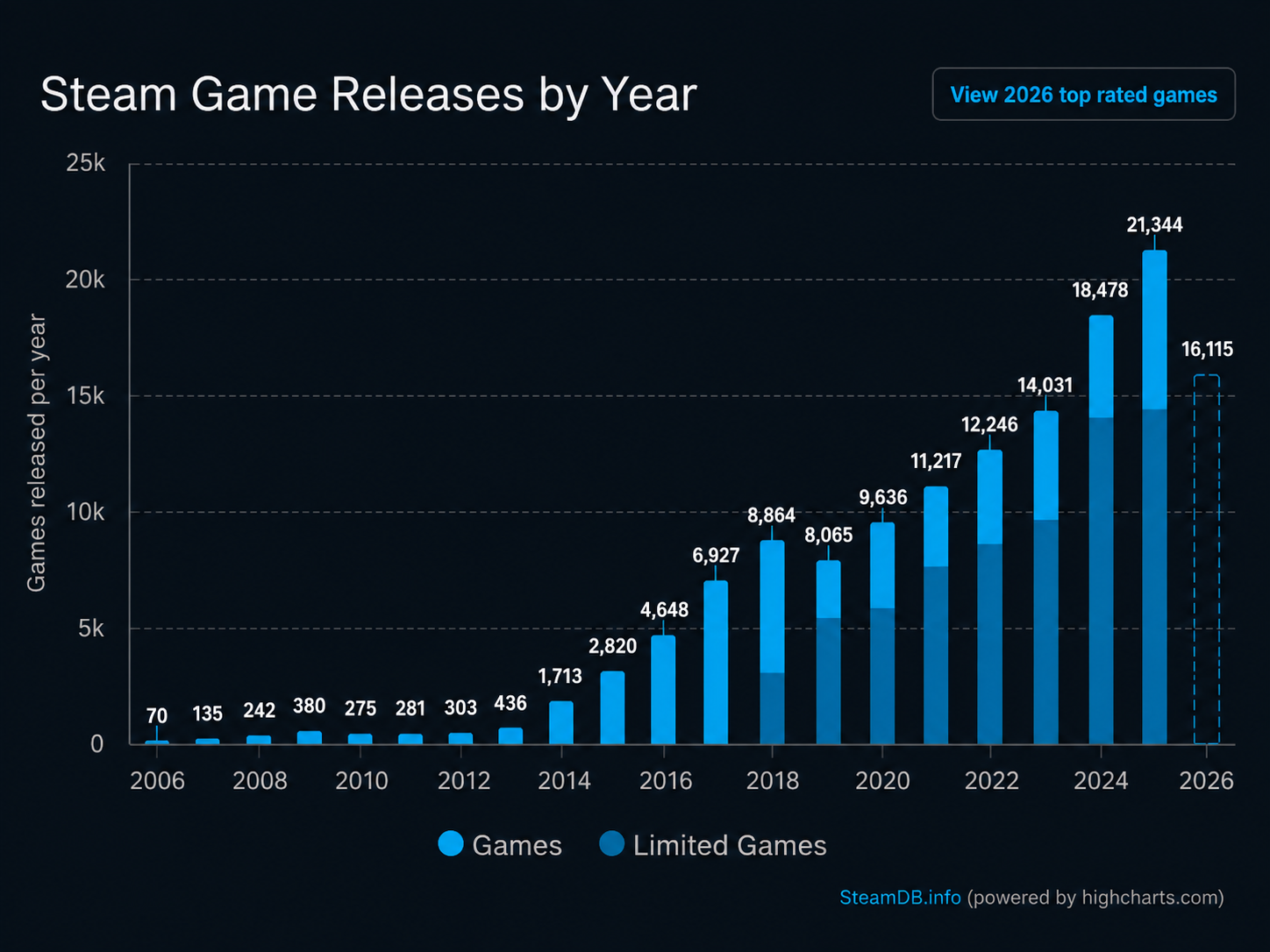
Steam's catalogue continues to grow rapidly.
According to SteamDB, 16,115 games had been released on Steam in 2026 as of August 20. The database records 21,344 releases in 2025 and 18,478 in 2024, compared with 4,648 in 2016.
Across the first 232 days of 2026, that works out at approximately 69.5 releases per day.
Valve already has multiple systems designed to help players navigate new releases.
According to its current Steamworks visibility documentation, a game entering full release begins appearing on the New Releases page and is also added to the All New Releases list. Valve describes this as providing a baseline of views against which customer interest can be measured.
When a logged-in Steam user visits the New Releases Queue, Steam generates a selection from a pool of recently released titles and prioritises those with the fewest views since release. Games can still be filtered according to the user's preferences, associated tags and product type.
Valve says games can gain additional visibility through personalised recommendations, New and Trending sections, Top Sellers lists, Steam Curators and the Discovery Queue. Buying and playing a game are described as strong signals of player interest, while supported languages and tags can also affect where a title is shown.
Alongside Steam's own discovery systems, independent games publications are applying their own editorial criteria when selecting titles for coverage.
Independent publications use their own selection criteria
LudoChamber describes itself as an independent digital games journal that considers video games through their design, storytelling and cultural context.
Its editorial committee says games are selected not simply for their visibility, but according to factors including design approach, narrative strength, formal originality, cultural context and potential for critical discussion. It also states that major releases and smaller independent works receive the same degree of editorial attention.
LudoChamber says its purpose is not to provide a final purchasing verdict, but to help readers understand how a game works, what it attempts to say and why it may matter. Every 20 reviews form a new issue.
Overlooked.gg takes a different approach. The site focuses on indie games and publishes one review a week, on Tuesdays.
It states that every game it reviews is bought at full price by someone on its team and that it accepts no developer keys or sponsored coverage.
Overlooked.gg also says that thousands of indie games launch every year and many go largely unnoticed. Its weekly reviews provide another editorial method for selecting individual titles from that wider field.
A similar grassroots approach can be seen on Reddit, where one r/gaming user says they spend six to seven hours a week browsing SteamDB, store descriptions, reviews and trailers to compile weekly roundups of lesser-known releases.
LudoChamber and Overlooked.gg use different models, but both rely on editorial selection when deciding which games to cover.
Human selection offers another route through a large catalogue
Steam's own systems already provide several routes through its catalogue.
Valve says full releases receive baseline visibility through the New Releases Queue, while player behaviour, preferences, supported languages and tags can influence where games appear elsewhere on the store.
Independent publications provide another kind of filter, using their own stated editorial criteria to select games for coverage.
The two approaches are not mutually exclusive. Steam can personalise discovery using player and product signals, while an editor or publication can choose to examine a particular game according to its own editorial remit.
The scale of Steam's catalogue makes the distinction noteworthy. With 16,115 releases already recorded by August 20, 2026, players are navigating a volume of new games substantially larger than that recorded a decade ago.
At an average of almost 70 new releases per day so far this year, there is no shortage of material to sort through.
 Add as a preferred source on Google


