




Maximum clarity: Innovative e-paper reaches human-eye resolution without backlight
A research team from Chalmers University of Technology and Uppsala University in Sweden has developed a groundbreaking display that reaches the visual limit of the human eye – without any backlight. Published in Nature, the so-called Retina E-Paper uses reflective nanostructures to overcome the physical constraints of conventional displays, offering exceptional image clarity and energy efficiency.
From OLED to electrochromic: a new approach to display technology
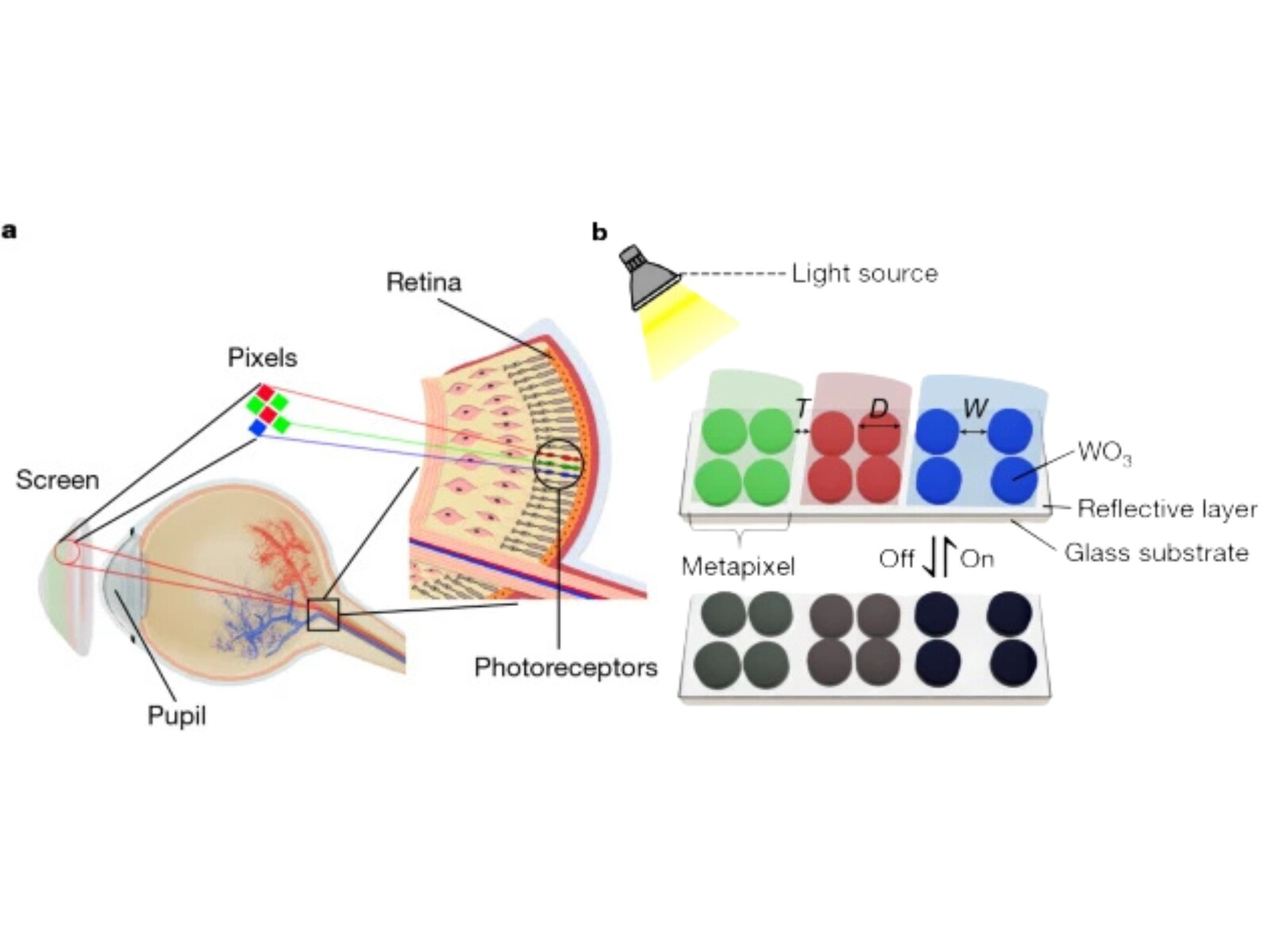
While OLED and micro-LED displays face physical limitations when pushed to extreme miniaturization – including reduced brightness, color instability and higher energy consumption – Retina E-Paper takes a different approach. Instead of emitting light, it harnesses ambient illumination. Its electrochromic nanopixels, made from tungsten trioxide (WO₃) layered on a platinum–aluminum substrate, reflect incoming light. By selectively inserting ions, the material switches between insulating and metallic states, allowing precise electrical control over color.
Up to 25,000 PPI
Each pixel of the Retina E-Paper measures just 560 nanometers – smaller than many viruses – resulting in a pixel density of more than 25,000 PPI. This exceeds the visual acuity of the human eye, making images appear as sharp as physically possible. For comparison, standard OLED monitors such as the ASUS ROG Strix OLED XG27AQDMG (currently priced at around $690 on Amazon) offer a pixel density of just 110 PPI at a 2560 × 1440 resolution on a 27-inch screen.
Color control in the Retina E-Paper is achieved through Mie scattering and grid modes, enabling both additive (RGB) and subtractive (CMY) color mixing. The display achieves a contrast ratio of around 50% and reflects up to 80% of ambient light. In testing, it reached a switching time of 40 milliseconds, allowing video playback at more than 25 frames per second. Power consumption is exceptionally low – about 1.7 mW/cm² during video playback and only 0.5 mW/cm² for static images.
At present, no images of a demonstration unit or functional prototype featuring the Retina E-Paper as a complete display have been released. The visuals published in Nature so far are limited to microscopic views of the nanopixel structure and sample images from laboratory test setups.
Source(s)
Image source: Bruno Henrique/ Pixabay
 Add as a preferred source on Google


