




Google Pixel 11 Pro XL Geekbench 7 result offers early look at Tensor G6 performance
Google's upcoming Pixel 11 Pro XL has appeared on Geekbench 7 with what appears to be the Tensor G6 running at its full clock speed. While the new chip posts a respectable single-core improvement over internal Tensor G5 reference data supplied to Notebookcheck, its unusual seven-core configuration appears to take a toll on multi-core performance.
The Pixel 11 Pro XL scores 2,112 points in Geekbench 7 single-core and 5,196 points in multi-core. More interestingly, the test identifies the Tensor G6 as a seven-core processor with an unusual three-cluster configuration. There are two cores running at up to 2.65 GHz, four at up to 3.38 GHz, and a single prime core clocked at a rather lofty 4.11 GHz. Exactly which Arm Cortex/Lumex IP each core uses is unknown. Now, a seven-core CPU in an SoC is not exactly uncommon, with both Qualcomm and MediaTek adopting the stragegy. However, lower-binned parts usually surface after their full-bodied counterparts.
The listing also shows 16 GB of memory, along with Android 17 and the Kodiak motherboard identifier, something we spotted earlier this year. While public Geekbench 7 data is still relatively sparse, Notebookcheck received reference results directly from Primate Labs around the launch of Geekbench 7. In that dataset, a Tensor G5-powered Pixel 10 averaged 1,973 points in single-core and 5,872 points in multi-core, based on two samples.
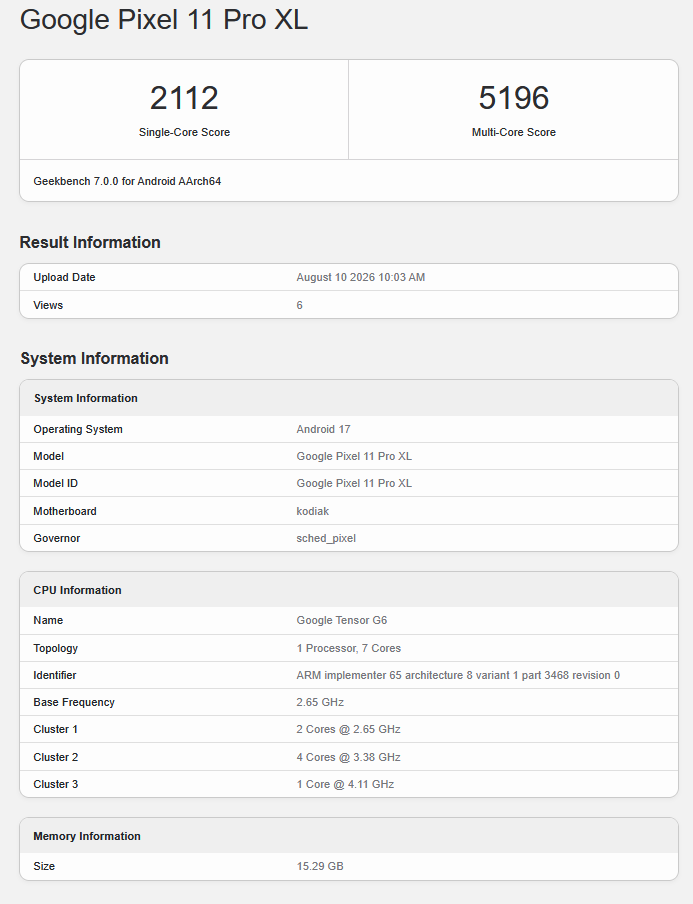
As Geekbench 7 results are not comparable with Geekbench 6 scores, we have to rely on data that might not represent real-world performance of the concerned chips. Compared with those reference figures, the Tensor G6 is approximately 7% faster in single-core performance. Multi-core performance, however, goes in the opposite direction, with the Pixel 11 Pro XL result coming in roughly 12% lower than the Tensor G5 reference. The apparent regression may partly be explained by Google's unusual CPU configuration. The Tensor G5 has eight CPU cores, while Geekbench detects only seven on the Tensor G6. Therefore, Google appears to be trading some multi-core performance for higher peak clock speeds.
The raw Geekbench metadata also appears to confirm a new Imagination Technologies GPU for the Tensor G6. The benchmark identifies the GPU as 'PowerVR C-Series CXTP-48-1536 MC1', replacing the PowerVR D-Series DXT-48-1536 found in the Tensor G5. As always, pre-release benchmark results should be treated cautiously. This is currently just one Pixel 11 Pro XL submission, while the Tensor G5 comparison is based on reference results supplied by Primate Labs and not real-world data.
Source(s)
 Add as a preferred source on Google


