




Gaming PC build uses no parts from Intel, AMD or Nvidia: Benchmarked
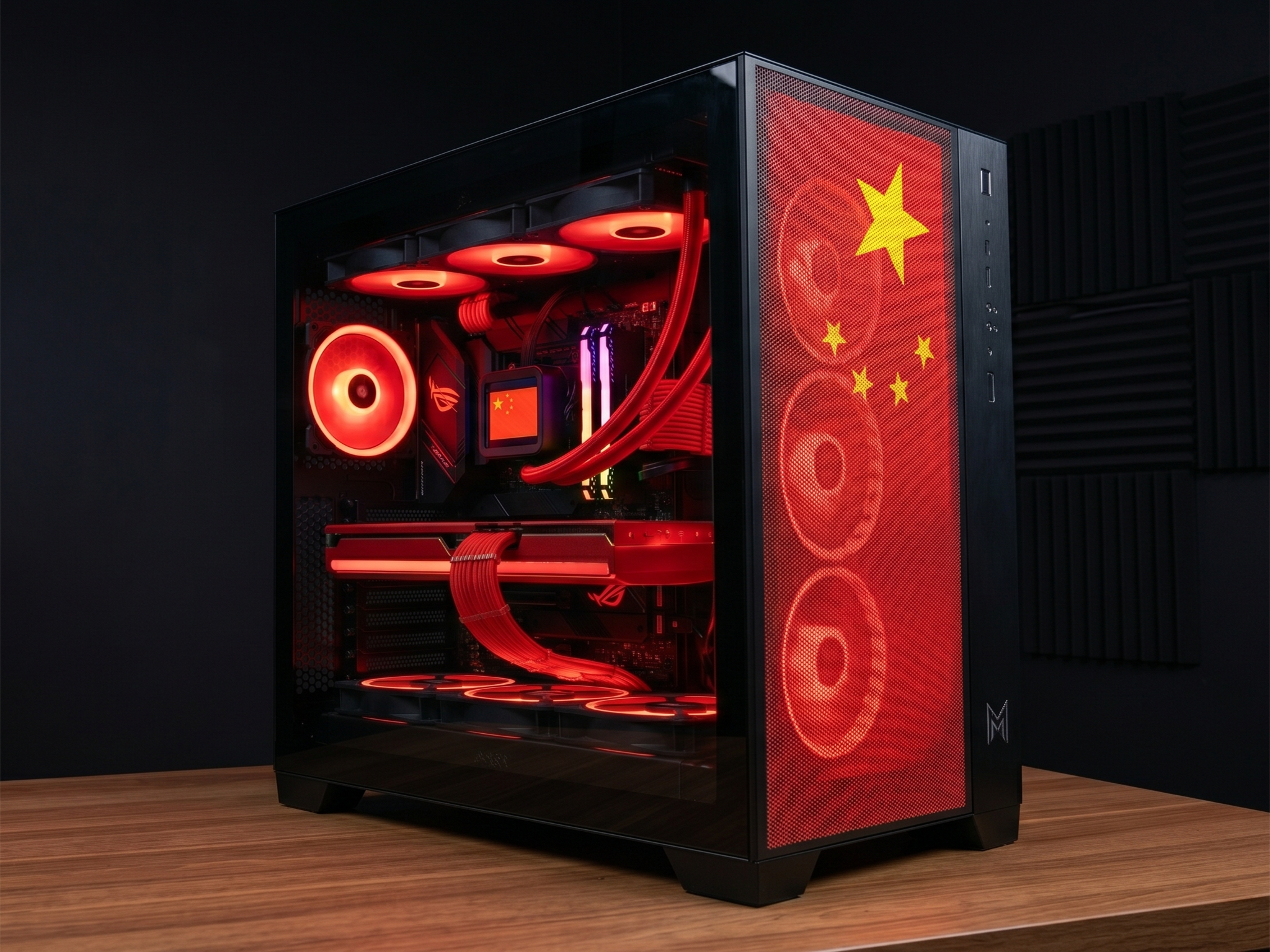
While China has made significant progress in developing its own CPUs and GPUs, buying and using them, especially in a gaming PC presents something of a challenge.
Not to shy away from a challenge, this is exactly what GPUSpecs (via YouTube) managed to do: Building a PC without using any parts from AMD, Intel or Nvidia.
The CPU in use is a Zhaoxin KaiXian KX 7000, sporting 8 cores and 8 threads with a boost clock of 3.6 GHz. On paper, these specs might seem fairly respectable.
Perhaps the most interesting fact about this particular CPU is that it was developed under an x86 license from a now-defunct Intel competitor called Cyrix. Cyrix reverse-engineered Intel's x86 CPUs, and in 1982, released its own variation. Despite various lawsuits, the company actually retained the rights to develop x86 CPUs and that license, through a series of acquisitions over the years, ended up in the hands of Zhaoxin. For those who remember, Cyrix was best known for its budget, but totally underwhelming CPUs that competed with everything from the 386 to the Pentium.
The CPU slots into a socket that looks extremely similar to a standard LGA 1700 socket, although GPUSpecs notes that cross-compatibility isn't likely, despite the motherboard looking fairly standard and being built (perhaps even more bizarrely) by Asus.
The GPU takes the form of a Moore Threads MTT S80 equipped with 4096 MUSA (Moore Threads equivalent to CUDA) cores, 16GB GDDR6, and a clock speed of 1.8 GHz. Moore Threads place performance in line with an RTX 3060 Ti.
Despite a few RAM compatibility and driver issues, the PC boots up and seems largely indistinguishable from a regular Windows PC. However, that's where the similarities end.
With a Geekbench CPU score of 789, the KaiXian KX 7000 performs just over half as well as an i5-7500 from 2017. Games didn't fare much better, with Forza Horizon 5 playing at a fairly terrible 24.2 average FPS on 1080p low, with significantly worse 1% lows.
Red Dead Redemption 2 and Spiderman Remastered failed to start, and when Cyberpunk did work, the machine churned out an average 22.3 FPS, also on 1080p low settings.
Performance of the 8-year-old Shadow of the Tomb Raider was equally poor, with an average of 21.3 FPS on 1080p low, and 1% lows in the slideshow range.
It was a similar story with the even older Grand Theft Auto V, and the (supposedly) optimised for MTT Black Myth Wukong, which cranked out around 13 FPS.
Resident Evil 3 Remake was the only marginally playable game, with an average of 44 FPS, but the 1% lows again turned the game into a stuttery mess.
At approximately $500 for just the CPU and motherboard, and $300 for the MTT S80 on AliExpress, (without factoring in the RAM, Case, PSU, and SSD), this build is neither cheap nor performant. However, the pace at which China is developing its domestic CPU and GPU technology means it might not be long before the "all-China" gaming PC might be competing for your desk space.
Until then, the budget RTX 5050 paired with a Ryzen 5 5500 (discounted by 47% on Amazon) will undoubtedly give you far better performance.
Source(s)
 Add as a preferred source on Google


