


Full frame vs. pocket power: Can DJI and Insta360 replace a mirrorless camera?
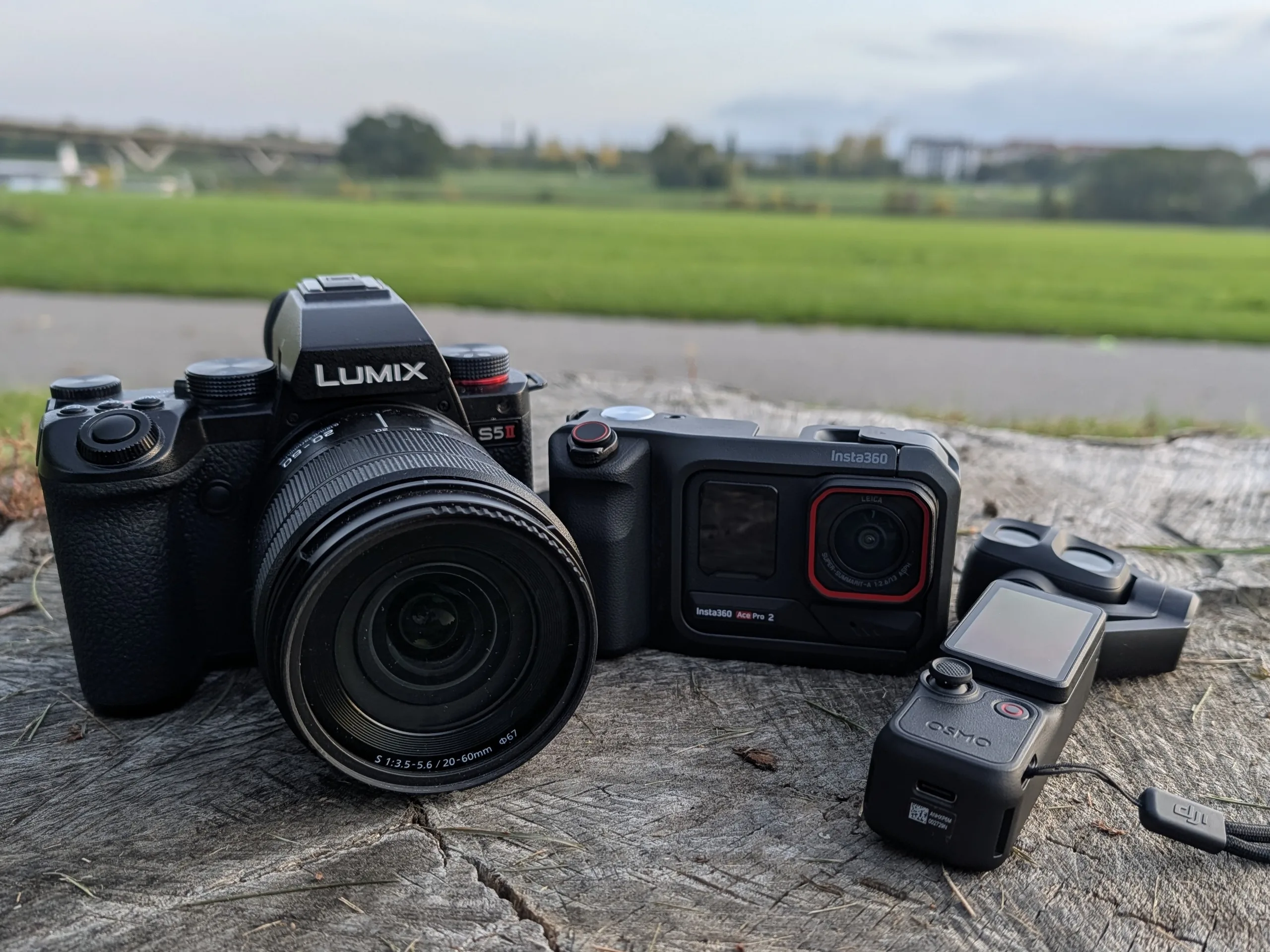
The camera market has not merely evolved in recent years—it has fundamentally shifted. High-quality video and photography are no longer the exclusive domain of bulky, expensive interchangeable-lens cameras with large sensors and complex physical controls. Increasingly, compelling visuals come from gimbal and action cameras—categories that historically required accepting mediocre image quality and substantial compromises.
This short series explores a core question: How much camera—and which type—do you actually need when stepping beyond a smartphone? What are the practical differences between these systems in daily use? While this is in many ways an unequal comparison, it remains directly relevant for everyday decision-making—particularly when choosing a travel and family camera rather than gear for dedicated client work or high-end production. There is a clear reason for this evaluation: manufacturers like DJI and Insta360 have expanded far beyond traditional niches, offering complete ecosystems of grips, lens mods, wireless microphones, and accessories built for maximum field versatility.
Given the impressive performance of modern smartphone cameras, it is reasonable to question whether a dedicated camera is still necessary. Yet, there are solid reasons to carry one: you might want to disconnect from your phone during vacation, preserve its battery life, or avoid handing an expensive device loaded with personal data to strangers or children at the beach—all while capturing high-quality photos that go beyond basic selfies.
This first installment evaluates image quality and overall shooting capabilities, while the second part will cover workflow, product ecosystems, accessories, and our final verdict. It is worth noting that while this evaluation uses three specific cameras, they primarily serve as representatives of their broader product categories. Consequently, our findings regarding handling, optics, and functional limitations should generally apply—at least to a approximation—to comparable hardware across these segments, such as the Insta360 Luna Ultra or DJI Osmo Action 6.
An uneven comparison
Representing traditional modern interchangeable-lens cameras is the Panasonic Lumix S5-II, paired with the Lumix S 20–60mm f/3.5–5.6 kit lens. Currently retailing for around $1,800, this full-frame setup weighs just under 1,050 grams—making it a absolute heavyweight compared to the other two contestants. Representing the gimbal category is the DJI Osmo Pocket 4 Pro (Creator Combo on Amazon for $989), which tips the scales at a mere 230 grams; readers interested in a deeper dive can check out our detailed standalone review. Finally, the Insta360 Ace Pro 2 action camera is the lightest and most affordable option here, weighing just 182 grams unequipped and starting at approximately $370.
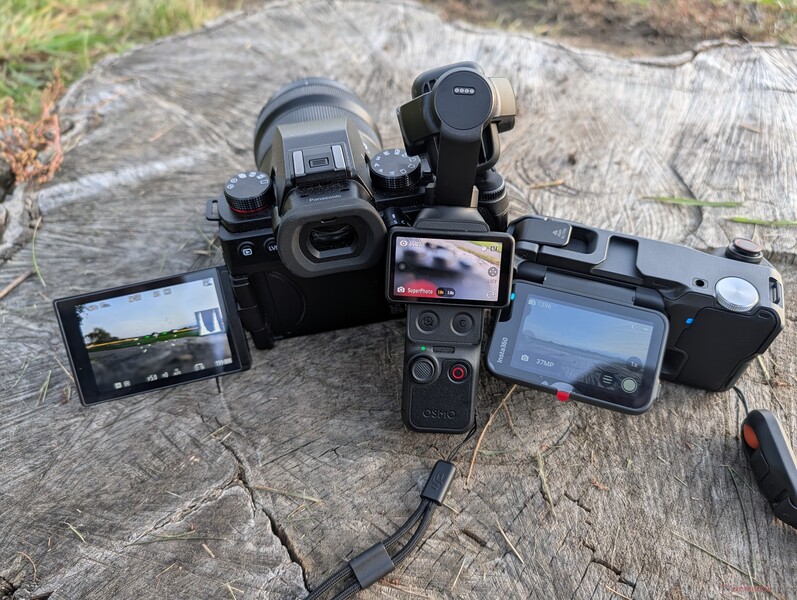
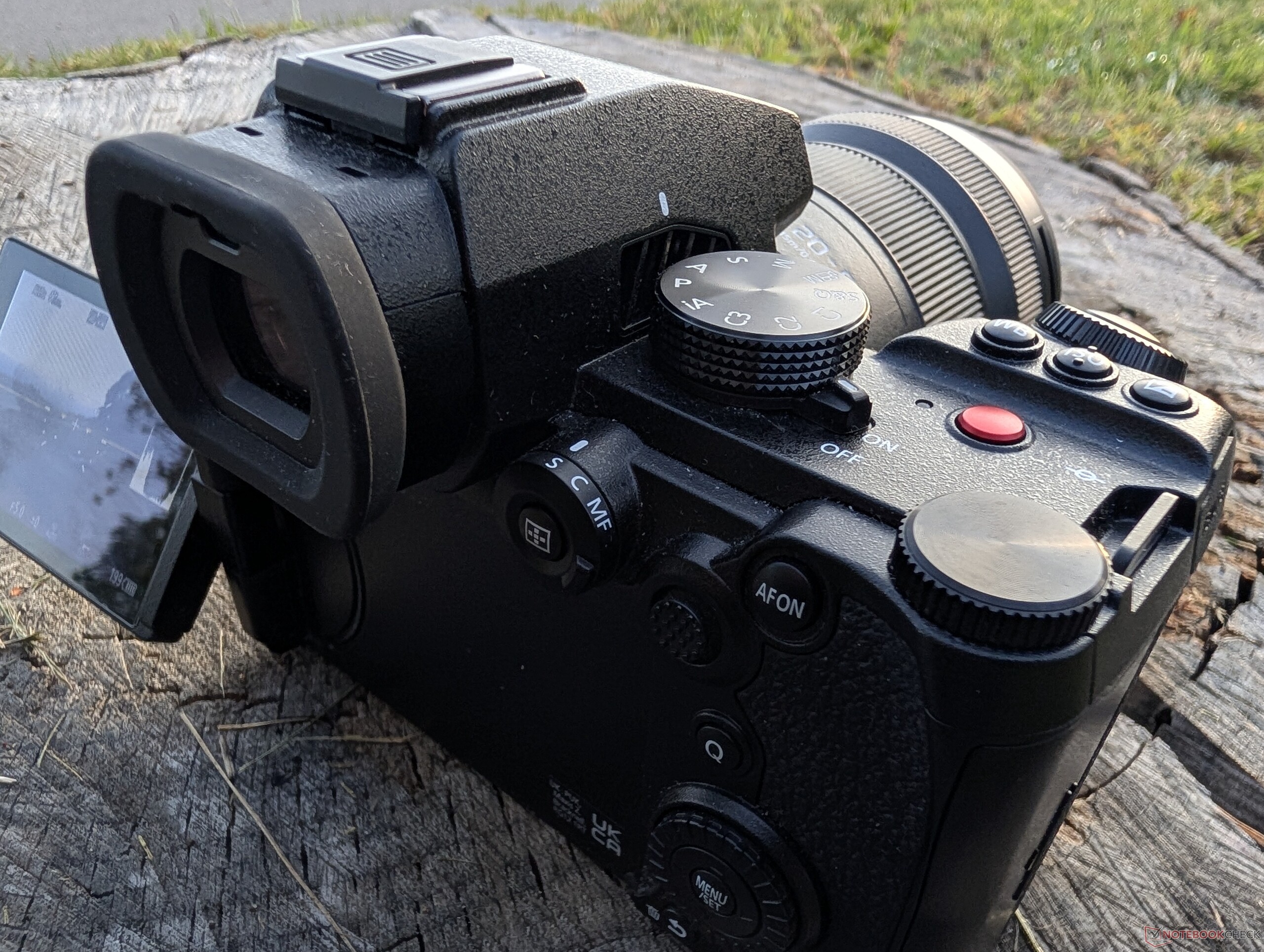
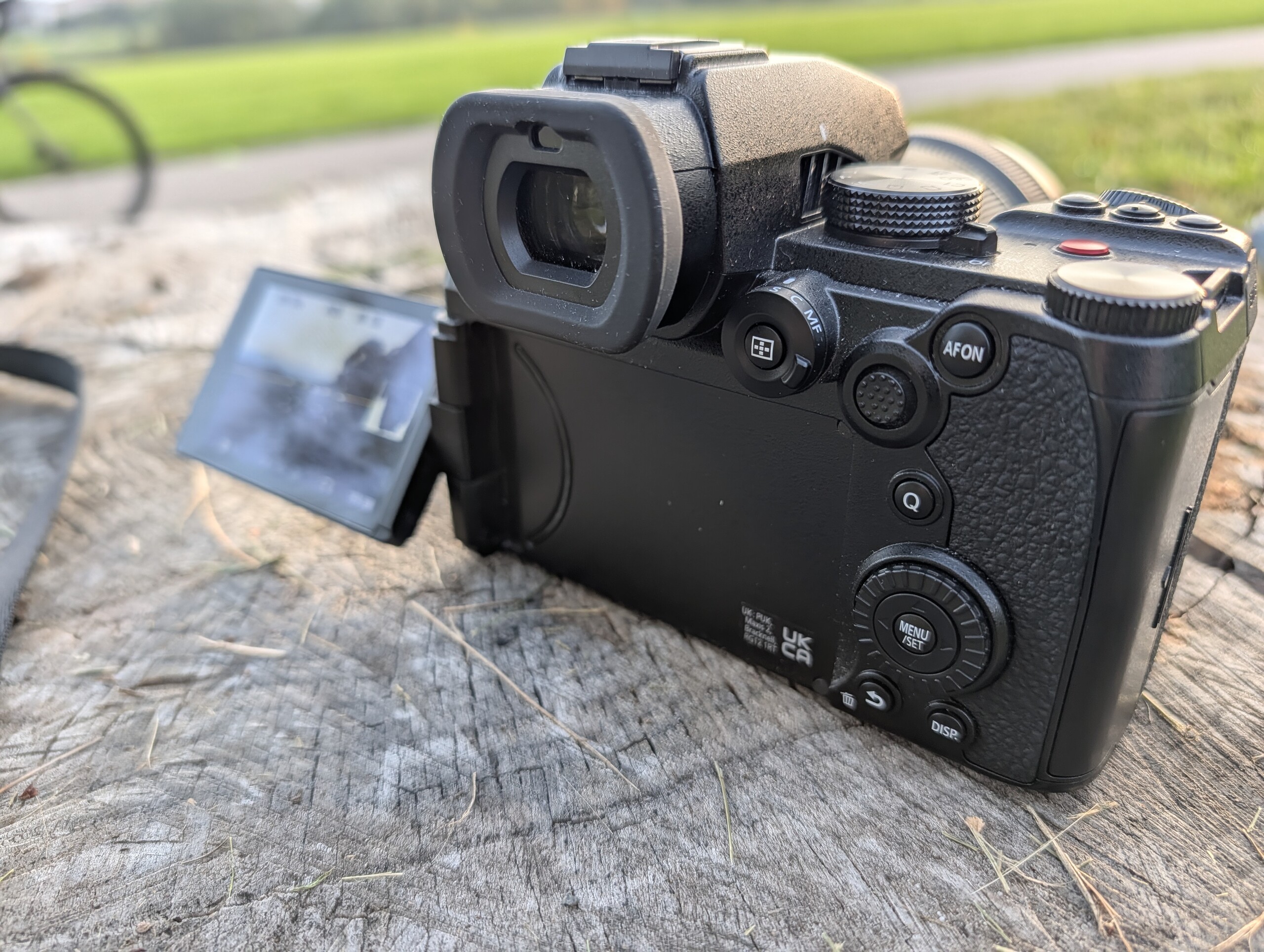
Depending on how you count them, the Panasonic Lumix S5-II offers five control dials, numerous buttons—several of which are custom-assignable—a directional pad, and a touchscreen. While I rarely use the fully articulating touch display to navigate menus, it serves well for live view, particularly since the clickable joystick allows for extremely fast focus point adjustment. The primary advantage of these physical controls is tactile efficiency: parameters like aperture and shutter speed can be adjusted simultaneously without looking. Even more crucial in daily operation, key settings remain immediately accessible without menu diving.
On the DJI Osmo Pocket 4P, by contrast, operation relies heavily on the primary touchscreen. Rotating the display into landscape orientation does more than just signal fellow DJI users at tourist spots via its distinctive click—it powers on the camera instantly. Positioned below the screen, alongside the zoom rocker, is a customizable function button that accepts single, double, triple, and long presses. This is paired with a dedicated record button and a clickable joystick for gimbal control or zooming. However, physical dials for parameters like shutter speed are entirely absent. Adjusting shutter speed and ISO manually requires swiping left into manual mode, which relies exclusively on touch input. Frustratingly, the menu closes automatically after each shot, making quick exposure tweaks unnecessarily tedious. The compact design also forces autofocus point selection onto the small touch display. On a positive note, the Osmo Pocket 4P is the only model in this test with integrated storage—offering a generous and practical 107 GB out of the box.

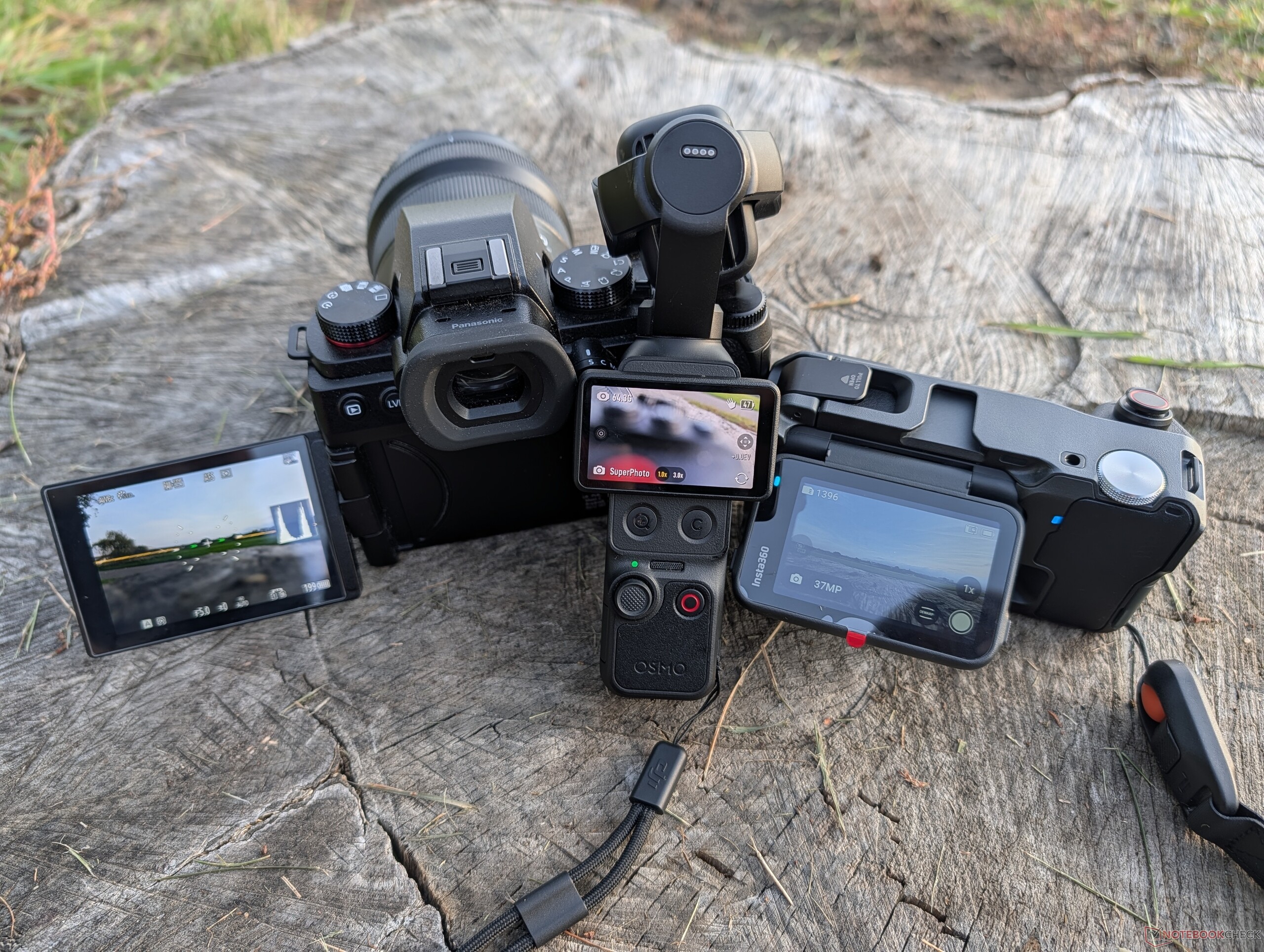
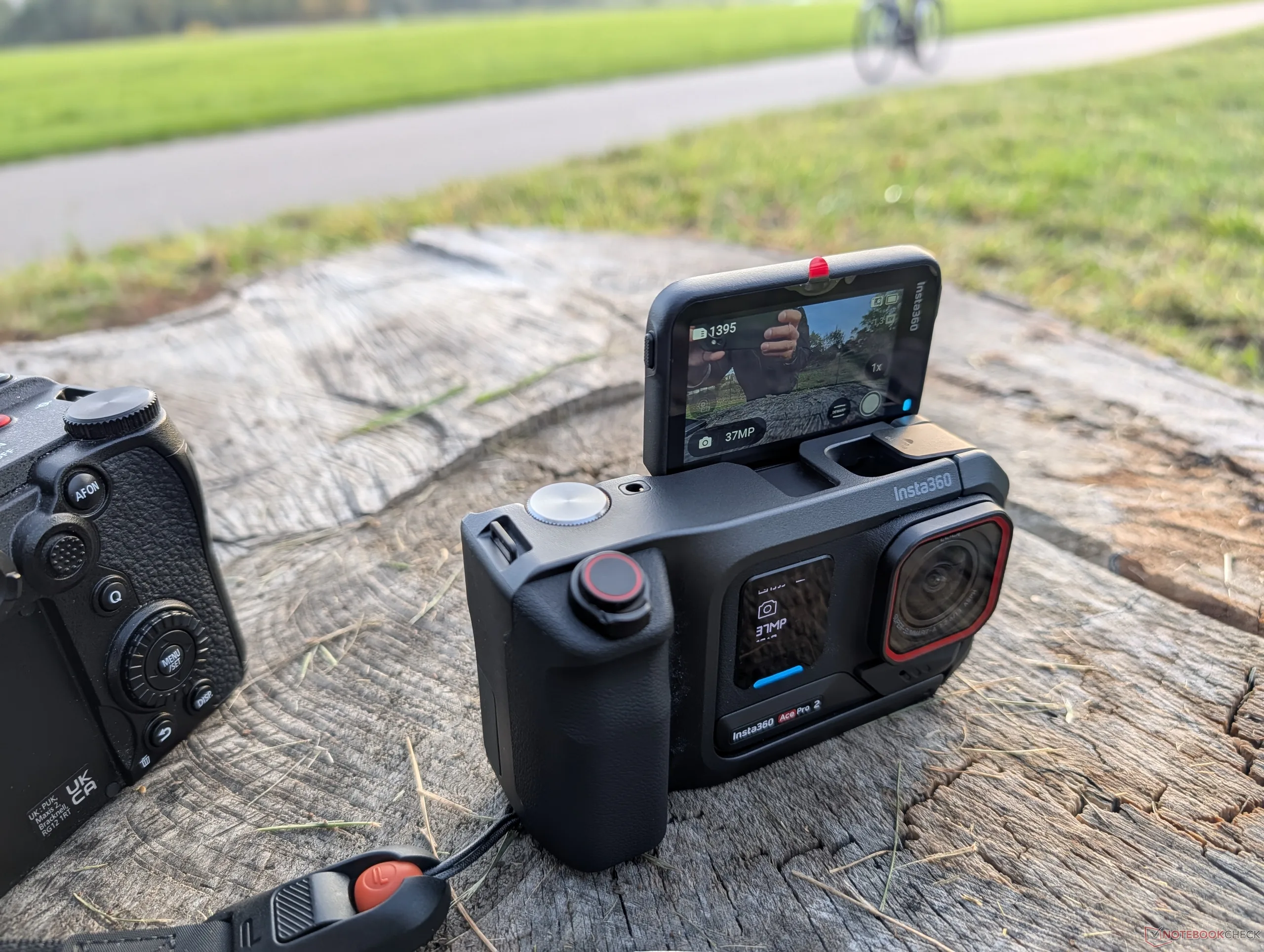
Unsurprisingly for an action camera, the Insta360 Ace Pro 2 offers a minimal physical interface: a record button and a power button that also doubles as a quick mode switcher. Conceptually, the Osmo Pocket 4P and Ace Pro 2 share a similar touch-first philosophy, using live view as the primary UI hub where four-way directional swipes call up settings or media playback. However, adding the optional Pro Grip Kit alters the handling dynamic significantly. The kit equips the Ace Pro 2 with a control dial, a toggle for the purely digital zoom, and a dedicated shutter button—considerably enhancing ergonomics, even if the implementation ultimately feels somewhat "more show than substance." While the dial can control shutter speed, shooting modes, ISO, exposure compensation, or filter effects, manual focus control is entirely absent (more on that later). Furthermore, selecting the active parameter still requires navigating the touch menu, as simultaneous touchscreen and dial inputs are not supported.
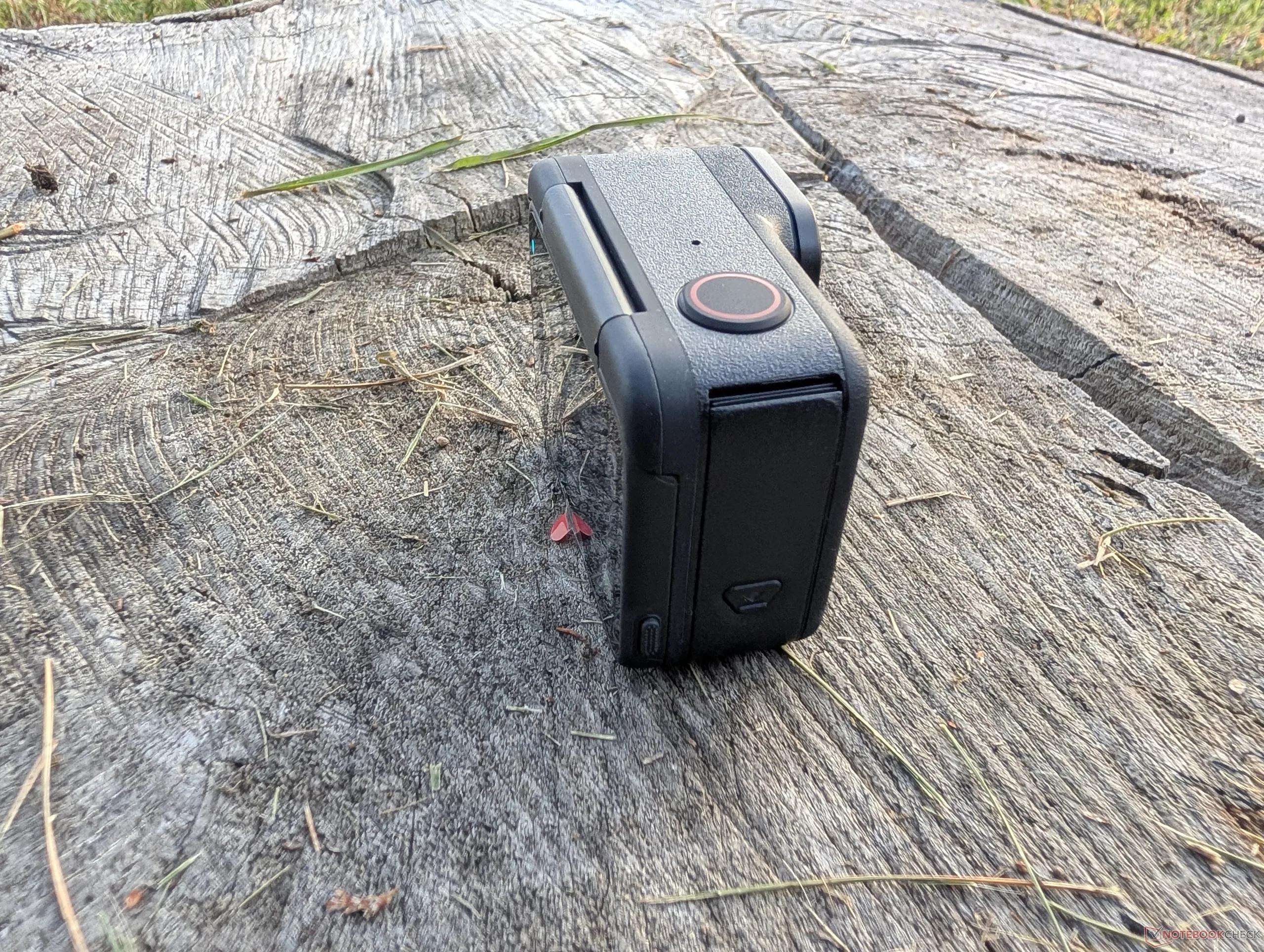
The Ace Pro 2 features a flip-up screen, though its design involves clear trade-offs: it tilts exclusively upward without swiveling or swinging out to the side, which complicates overhead framing. Unlike the Lumix S5-II, the display cannot be folded inward face-down to protect the glass during transport—a feature that would make particular sense here given the secondary front display, even if such a multi-axis hinge would be mechanically more delicate. That said, the Ace Pro 2 holds a distinct advantage over the Osmo Pocket 4P with its noticeably larger main screen, which makes touch interaction and composition vastly easier. Additionally, unlike the Osmo Pocket 4P, the Ace Pro 2 utilizes a removable battery.
Pocket or backpack?
In everyday use and while traveling, a clear distinction quickly emerges: bringing along the DJI Osmo Pocket 4P or Ace Pro 2 requires almost no second thought, whereas carrying a full-frame mirrorless camera demands a deliberate decision. In direct comparison, the Lumix S5-II undoubtedly grants the greatest creative freedom and framing flexibility, yet its sheer bulk makes it cumbersome to haul around. This becomes particularly noticeable on long hikes or extended city walks, where you often just want to capture a quick photo or video clip on the fly. While you can sling a large mirrorless body around your neck or mount it to a backpack strap, it remains inherently unwieldy. By contrast, the Osmo Pocket 4P slips effortlessly into a trouser pocket and deploys in a single movement.
However, the Osmo Pocket 4P exhibits two design quirks that, while causing no damage during testing, left me with a lingering sense of unease. For one, a rigid protective hard case is not included as standard, leaving the exposed camera vulnerable to mechanical pressure inside a pocket while walking. Additionally, the gimbal does not automatically stow itself into a protective position when powered off, and the integrated lens element cannot be easily replaced if damaged. These durability concerns are non-existent with the Ace Pro 2: it features robust protective glass, dispenses with delicate mechanical gimbals altogether, and boasts native waterproofing out of the box—making even heavy downpours a non-issue.


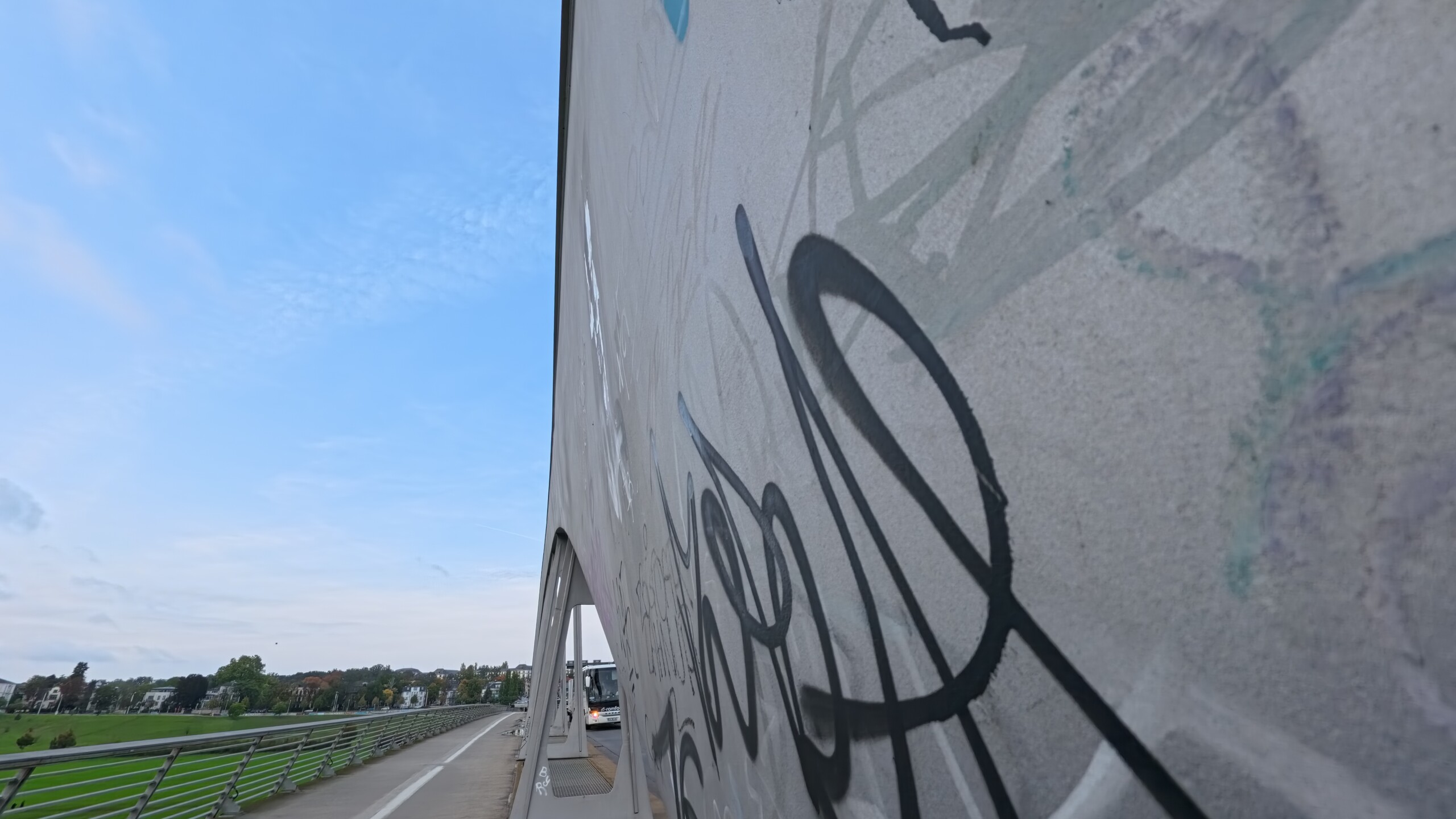


In practice, however, the Osmo Pocket 4P's mechanical gimbal and genuine optical telephoto lens expand its creative potential far more than I had anticipated. Capturing shots from unusual angles becomes effortless. The gimbal does more than just track moving subjects—it can also lock onto a stationary object, keeping it perfectly framed as you move around it. While that might sound abstract, it is a remarkably practical feature when experimenting with perspective or keeping unwanted crowds out of frame at busy tourist spots. Dedicated gimbals are available for smartphones and mirrorless setups, of course, but for interchangeable-lens systems, they are heavy, bulky rigs you rarely carry along "just in case." Moreover, using them with zoom lenses—especially those with external zooming mechanisms that shift weight—often demands rebalancing after every significant focal length adjustment.
The discretion factor should not be understated, either. Smaller hardware is far less conspicuous in public. While secretly photographing or filming people is obviously out of the question, handling a large mirrorless body and lens in front of market stalls or crowded street scenes can feel intrusive. With the Osmo Pocket 4P or Ace Pro 2, you simply blend in as an unobtrusive tourist.



Focus and burst shooting remain stumbling blocks
Real-world scenarios quickly highlight why these two compact cameras cannot fully replace a dedicated interchangeable-lens system for still photography. The Osmo Pocket 4P lacks burst shooting entirely, while the Ace Pro 2 offers only a rudimentary implementation. In practice, only the Lumix S5-II reliably captures fast-moving subjects or unexpected action, thanks to rapid continuous shooting paired with accurate subject tracking for humans, animals, and vehicles. Its full-frame sensor also provides crucial high-ISO headroom, enabling fast shutter speeds to freeze motion without suffering from severe image noise.
Furthermore, both compact models lack manual exposure bracketing—preventing users from capturing exposure series for manual HDR merging or focus stacking. Instead, they rely heavily on automated computational HDR, though both do at least support RAW capture.
By design, the Ace Pro 2 utilizes a fixed-focus lens that keeps everything sharp from roughly 40 centimeters to infinity. While this simplifies operation in fast-paced situations, underwater, or when handed to children—and effectively eliminates misfocused shots—it significantly restricts creative framing. Images tend to look flat and documentary-like, offering almost no scope for optical background separation. Nevertheless, the Ace Pro 2 delivers solid photos, with its processing pipeline effectively correcting typical action-camera lens distortion.
Focal length differences are equally significant. The Lumix S5-II covers 20 to 60 mm with its kit lens, expandable via interchangeable lenses. The Ace Pro 2 features an ultra-wide 13 mm equivalent lens, whereas the Osmo Pocket 4P provides a 20 mm wide-angle alongside a genuine 60 mm optical telephoto module. Having an optical telephoto lens gives the Osmo Pocket 4P a major advantage on the road, particularly when isolating subjects. DJI also offers magnetic add-on optics, while the Ace Pro 2 relies on clip-on attachments—a topic we will examine in detail in part two.
Transparency
The selection of devices to be reviewed is made by our editorial team. The test sample was provided to the author as a loan by the manufacturer or retailer for the purpose of this review. The lender had no influence on this review, nor did the manufacturer receive a copy of this review before publication. There was no obligation to publish this review. As an independent media company, Notebookcheck is not subjected to the authority of manufacturers, retailers or publishers.
 Add as a preferred source on Google


