




February Picture of the Month: ESA shares beautiful image of a spiral galaxy
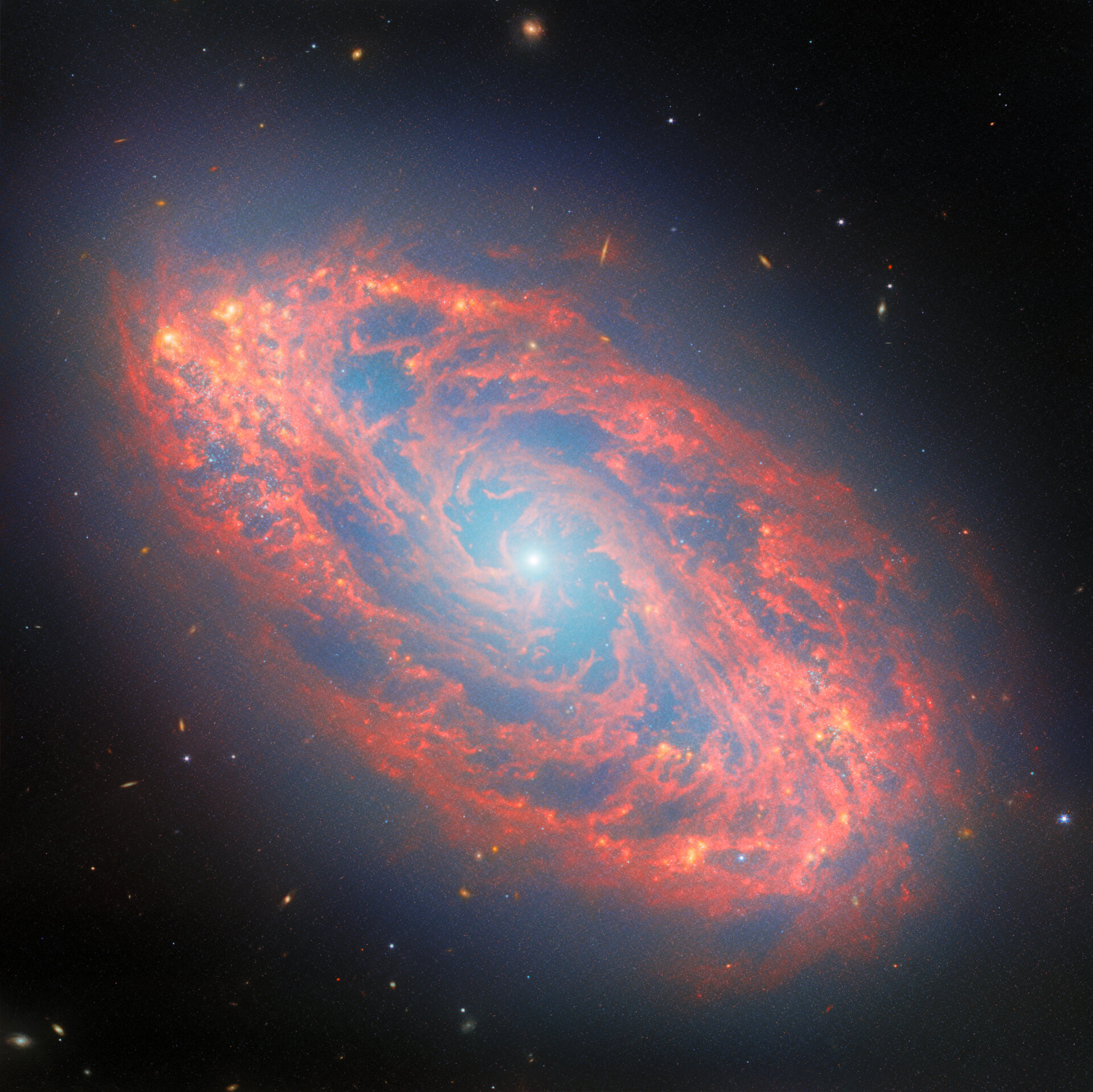
NGC 5134 is a spiral galaxy located 65 million light-years away in the constellation Virgo. At 65 million light-years away, the galaxy is quite close enough for Webb to observe in detail. For this observation, Webb joined the forces of its Near-InfraRed Camera (NIRCam) and Mid-Infrared Instrument (MIRI).
NIRCam captures light from the stars and star clusters that dot the galaxy’s spiral arms. The stars appear blue-white. MIRI, on the other hand, captures light emitted by the warm dust present around the stars in the galaxy. The dust appears bright red and orange in this image. The glowing dust reveals complex organic molecules like polycyclic aromatic hydrocarbons. This provides an opportunity for astronomers to study the chemistry happening in interstellar clouds
The image reveals the galaxy’s glowing blue-white core. Clumps of dust and gas are scattered around the galaxy’s spiral arms. The dust and gas together form interstellar clouds. These clouds are the site of star formation. In some areas of the image, the interstellar cloud is dense, while in other areas, they appear patchy. This could be due to the clearing action of the powerful radiation from young stars. Stars use up gas from the clouds when forming. When the stars die, they release some of the gas back into the surrounding area. For massive stars about eight times the mass of our Sun, this release is through cataclysmic supernova explosions that spread across hundreds of light-years. For stars like our Sun, the explosions are more gentle.
In the background of this image, there are more distant galaxies. But the understanding of the stellar lifecycle obtained from galaxies like NGC 5134 can be applied to studying those distant galaxies.
Source(s)
 Add as a preferred source on Google


