 Deutsch
 Español
 Français
 Italiano
 Nederlands
 Polski
 Português
 Русский
 Türkçe
 Svenska
 Chinese
 Magyar
Razer Blade Series
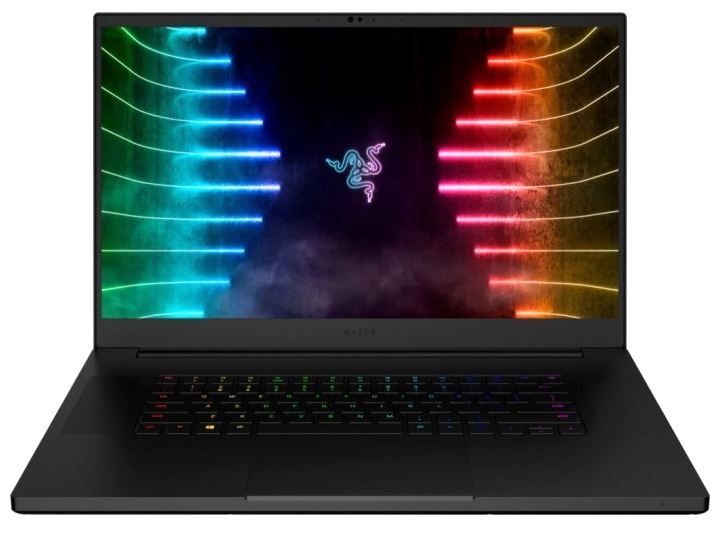 Processor: Intel Core i7 2640M, Intel Core i7 3632QM, Intel Core i7 4702HQ, Intel Core i7 4720HQ, Intel Core i7 6700HQ, Intel Kaby Lake i7-7700HQ, Intel Tiger Lake i7-11800H
Graphics Adapter: NVIDIA GeForce GT 555M, NVIDIA GeForce GTX 1060 Mobile, NVIDIA GeForce GTX 660M, NVIDIA GeForce GTX 765M, NVIDIA GeForce GTX 870M, NVIDIA GeForce GTX 970M, NVIDIA GeForce RTX 3070 Laptop GPU
Display: 14.00 inch, 17.30 inch
Weight: 1.84kg, 1.88kg, 1.9kg, 1.904kg, 1.946kg, 1.95kg, 1.96kg, 2kg, 2.75kg, 3kg, 3.2kg
Price: 1700, 1800, 2000, 2100, 2149, 2600, 2699, 2700, 2800 euro
Average of 109 scores (from 160 reviews)
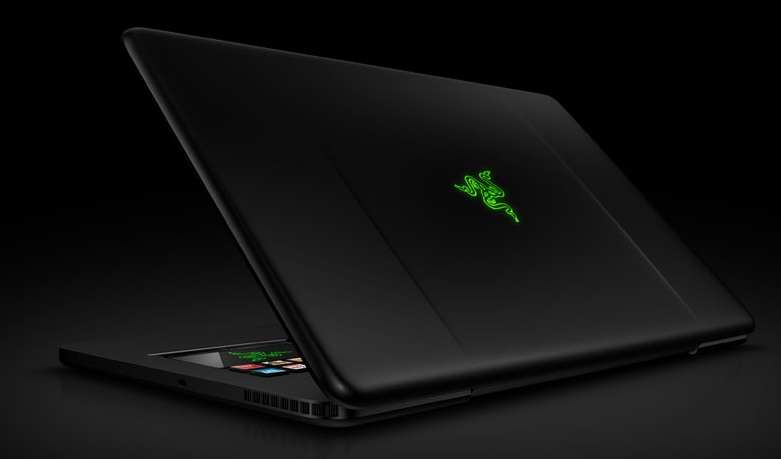
Razer Blade
Specifications
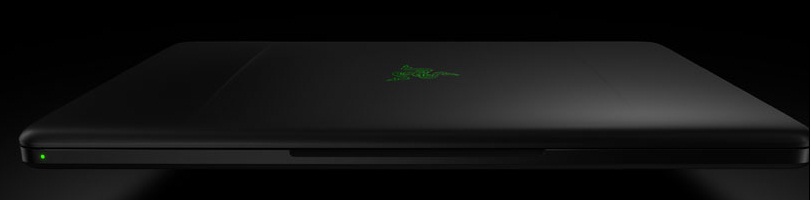 Notebook: Razer Blade
Processor: Intel Core i7 2640M
Graphics Adapter: NVIDIA GeForce GT 555M
Display: 17.30 inch, 16:9, 1920 x 1080 pixels
Weight: 3.2kg
Price: 2800 euro
Links: Razer homepage Blade (Model)
Pricecompare
Average Score:
Reviews
Source: Techradar
 Archive.org version
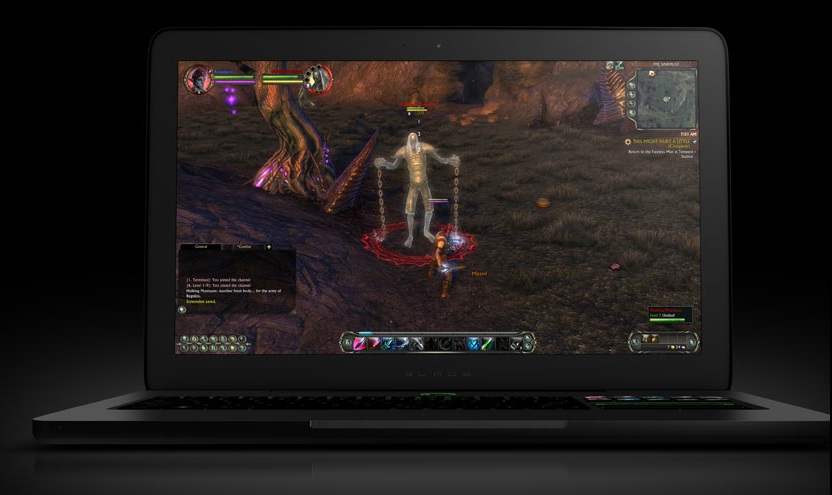
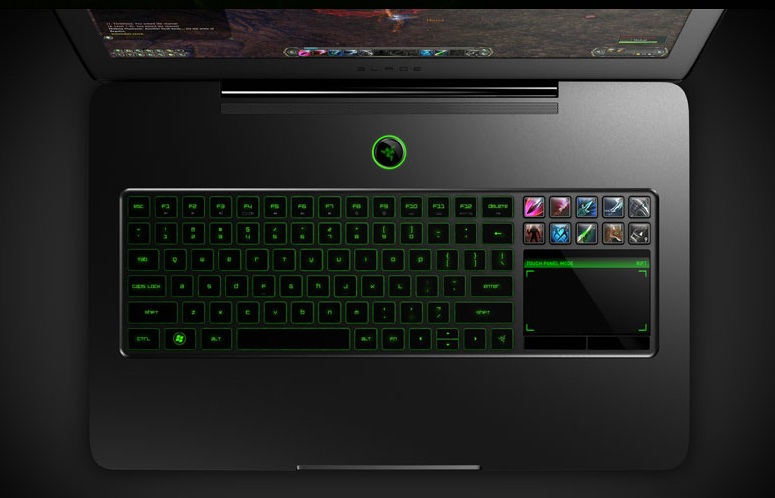
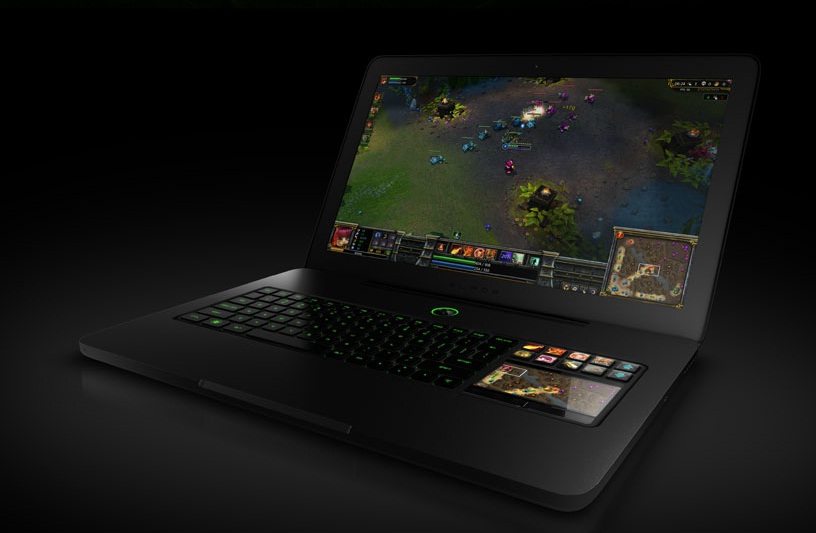
Our time with the Razer Blade at PAX Prime 2012 was all too brief, but we were intrigued by the combination of raw power, tight form factor and the stunning Switchblade UI. The Blade impressed us when it was first announced in August 2011 as part of Razer's "PC Gaming's Not Dead campaign", and the San Diego-based computer maker has certainly made its point. This new redesign is very exciting, especially at the not-unaffordable price point of $2499. We look forward to putting the Razer Blade through its paces for a full review!
Single Review, online available, Very Short, Date: 09/01/2012
Source: Comp Reviews
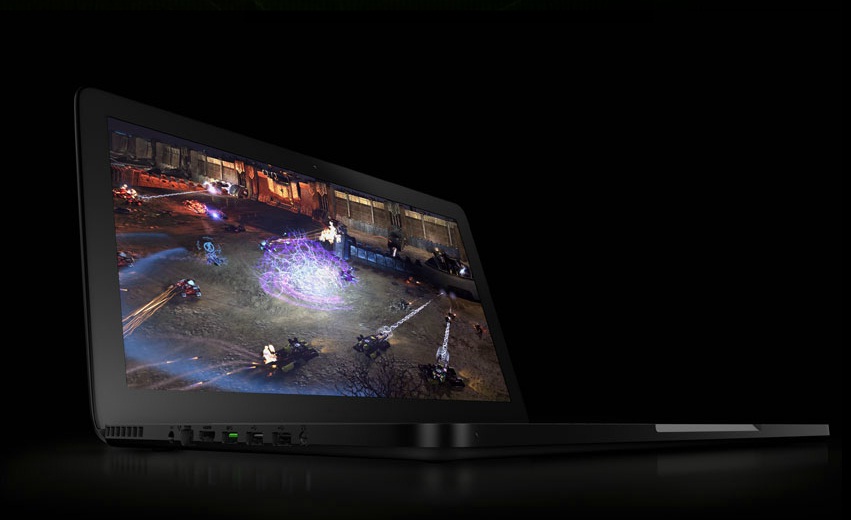
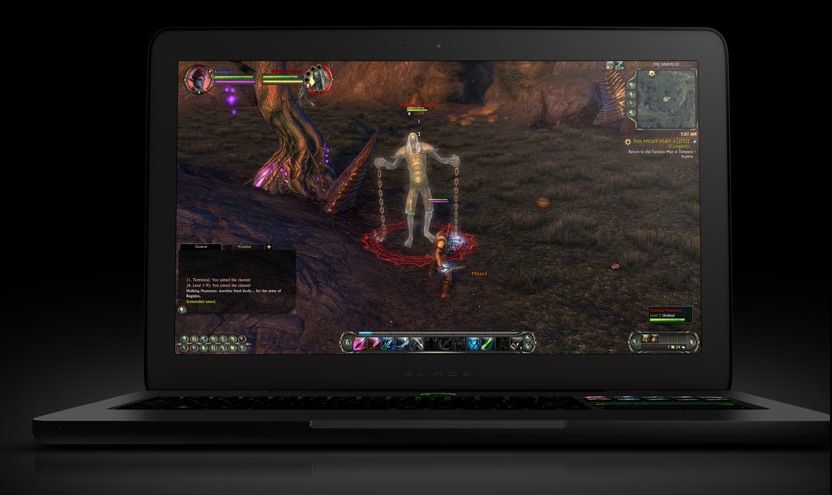
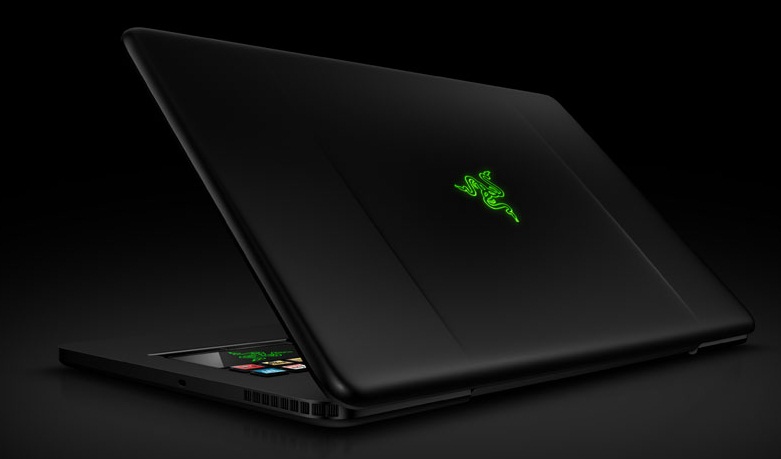
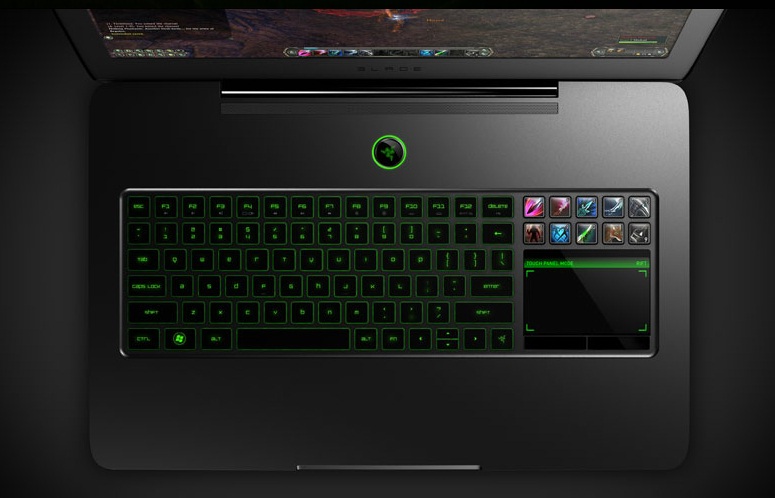
Archive.org versionRazer made a huge splash with the Blade at CES 2012 thanks to its extremely thin profile, fancy LCD backlit keys and trackpad and promise of high gaming performance. For the most part, this system does deliever as being the thinnest 17-inch on the market with its unique trackpad and programmable buttons.
Single Review, online available, Short, Date: 07/18/2012
Rating: Total score: 60%
Source: CNet
Archive.org versionYou can't accuse Razer of playing it safe. Razer's first laptop, the Razer Blade, is a thin gaming computer with some futuristic design touches, but a high price means you're paying for design -- and for the second-screen signature Switchblade UI interface that doesn't do as much as we hoped it would...yet.
Single Review, online available, Long, Date: 04/10/2012
Rating: Total score: 60% performance: 60% mobility: 70%
Source: AnandTech
Archive.org versionBefore starting on the Blade itself, let’s talk about what it represents to Razer as a company. This is Razer’s first foray into the PC space, and it’s a very, very solid first effort. There are definitely some details that show they’re new to this game, but they’re the kinds of things that Razer will figure out as they move forward.
Single Review, online available, Long, Date: 03/15/2012
Source: Tweaktown
Archive.org versionUnfortunately it's going to be out of reach of many and I really hope Razer come back soon with a cheaper model, maybe a 15-inch version with some cut down specs, to open up the Blade laptop to the mass gaming market. To Min and the rest of the Razer team, just don't ditch the SSD though and keep all your cool bits you added to the Blade, as it is a really good product in my opinion and deserves the hype surrounding it. Now, I think I was about to install Battlefield 3 on the Blade, allow me to get back to it, will you?
Single Review, online available, Short, Date: 02/08/2012
Source: T3
Archive.org versionThe Razer Blade is definitely a niche product, and an odd one at that. You’ll get some fast hardware in a well-designed package, but because of the placement of the touch screen, the laptop feels really wide. Even though this thing comes equipped with a large 17.3-inch screen, there’s no optical drive, and hardcore gamers might also find that they’ll run out of space pretty quickly with only 256GB on the SSD. With a $2,700 sticker price, you probably have some incredibly specific gaming needs if you’re the target for this machine.
Single Review, online available, Very Short, Date: 01/12/2012
Source: PC World
Archive.org versionIt takes quite a bit of bravado to claim that this machine is going to "save PC gaming," but I can see where Razer's going with this. Consoles have stolen the limelight, largely leaving us PC gaming fans stuck with shoddy ports. A product like the Blade is supposed to get people talking again, about the unique features and opportunities you can only get on a PC. I'm still partial to desktops, and that $2800 price tag gives me pause -- it's closer to the higher end of the desktop replacement category. But well heeled gamers take note: this is one to watch.
Single Review, online available, Very Short, Date: 08/26/2011
Razer Blade RZ09-00830100-R3U1
Specifications
 Notebook: Razer Blade RZ09-00830100-R3U1
Processor: Intel Core i7 3632QM
Graphics Adapter: NVIDIA GeForce GTX 660M
Display: 17.30 inch, 16:9, 1920 x 1080 pixels
Weight: 3kg
Price: 2000 euro
Links: Razer homepage
Pricecompare
Average Score:
Reviews
Source: Hardwareheaven
Archive.org versionStarting with the build quality and design of the new Razer Blade we have a system which has taken the Ultrabook concept and built a gaming system around it. This of course means a significant change in size to accommodate the large 17" display but also allows a much more flexible choice of components. The overall build quality of the Blade is very good with the metal chassis finished nicely.
Single Review, online available, Very Long, Date: 02/08/2013
Rating: Total score: 90% price: 90% performance: 90% workmanship: 100%
Source: Comp Reviews
Archive.org versionRazer's New Blade system corrects many of the performance issues that plagued the original model of thin gaming laptop. In particular, the graphics and processor and now much closer to a full gaming system than the past model. The drawback still is the extreme price tag that is nearly a thousand dollars more than many similarly performance equipped systems.
Single Review, online available, Short, Date: 02/04/2013
Rating: Total score: 80%
Source: PC World
Archive.org versionSo if you're a LAN party aficionado looking for something lighter than the usual massive gaming laptops, Razer's Blade is a sleek system that will turn heads. But if you're looking to acquire a thin, light 17-inch laptop as a tool for photography or other general use, you'll want something else.
Single Review, online available, Short, Date: 11/19/2012
Source: CNet
Archive.org versionThe new Blade makes good on its promise of improving its internal specs to a level we expected in the first place. It's still impressively thin, runs games better than before, and has a striking design. However, the Switchblade UI, while innovative in concept, doesn't yet have the sort of gaming support it needs. Who knows when it will. The Blade is the most portable of the big-screen gaming laptops, and the new version improves on the first.
Single Review, online available, Long, Date: 10/17/2012
Source: PC Mag
Archive.org versionIf you want truly portable gaming, there's no passing up the Razer Blade (2012). With its lightweight, slim design, and relatively long battery life, the Blade is one of the few gaming laptops that will actually game on the go. It's also one of only two laptops on the market to feature the Switchblade interface (the other is the previous Razer Blade laptop). You'll get better raw performance if you pick up the Editors' Choice Alienware M17X R4, but unlike the Alienware, you actually can pick up the Razer Blade (2012) since it's half the weight. And while the $2,500 price of the Blade may seem a bit steep, it's not hard to justify for on-the-go gaming.
Single Review, online available, Medium, Date: 10/11/2012
Rating: Total score: 80%
Source: T Break
Archive.org versionAt the end of the day the new Razer Blade provides a very unique experience for PC gamers. Of course, you can get a far better specced gaming laptop for far more than the single option available on the new Razer Blade, like Alienware; or slightly better specs with a slightly lesser price point, like MSI and ASUS. However, none of those companies have the build of the new Razer Blade, vis-à-vis real portability.
Single Review, online available, Medium, Date: 10/07/2012
Rating: Total score: 90%
Source: AnandTech
Archive.org versionThough they are unwilling to release sales figures, Razer claims that the original Blade was an unqualified sales hit, with demand far outstripping supply in the first number of weeks after it went on sale. Undoubtedly, they weren’t manufacturing units in any huge volumes, but it’s safe to say that Razer themselves weren’t expecting the Blade to sell as fast as it did. But even though the original Blade was a success, it wasn’t really a hard product to follow up.
Single Review, online available, Long, Date: 10/03/2012
Source: Wired Magazine
Archive.org versionWhile the Blade remains a quirky and wholly unique computing — and gaming — computer, I’m hard-pressed to name a more enjoyable gaming laptop. Using the touchpad instead of a mouse for WASD games isn’t easy, but it’s doable in a pinch — and external mice are still cheap. And hey, Razer would probably love to sell you one of those, too.
Single Review, online available, Very Short, Date: 10/01/2012
Rating: Total score: 70%
Source: Engadget
Archive.org versionIt's hard to hit the market with a self-given description as the "world's first true gaming laptop" only to get knocked down by critics. Subpar audio, a finicky hinge and crippled performance were all common complaints about the original Razer Blade. The reaction among gamers sent a shockwave through Razer, and the company vowed to do better.
Single Review, online available, Long, Date: 09/30/2012
Source: Laptop Mag
Archive.org versionWe didn't think it could be done. But Razer has managed to create a highly portable 17.3-inch gaming notebook that delivers remarkable performance for its size. Getting the new quad-core Core i7 CPU and Nvidia GTX graphics in a sleek 0.88-inch shell is pretty sweet. And, there's no denying that its Switchblade UI is one of the most innovative things we've seen in a gaming notebook in a while.
Single Review, online available, Long, Date: 09/30/2012
Rating: Total score: 70%
Source: Techradar
Archive.org versionWe're very much impressed. From top to bottom, the Razer Blade is a very well-thought out design, and is a joy to use on a day-to-day basis. The hardest-core gamers will marvel at the quick key effects the customizable Switchblade UI permits. Everyone else will marvel at how cool it is.
Single Review, online available, Very Long, Date: 09/30/2012
Rating: Total score: 90%
Foreign Reviews
Source: Notebookinfo
 DE→EN Archive.org version
Single Review, online available, Medium, Date: 11/07/2012
Rating: Total score: 92% performance: 90% display: 90% mobility: 90% ergonomy: 100% emissions: 88%
Source: Chip.de
DE→EN Archive.org versionPositive: unique device; thin chassis Negative: mediocre performance; high price
Single Review, online available, Medium, Date: 12/03/2012
Razer Blade 14 inch
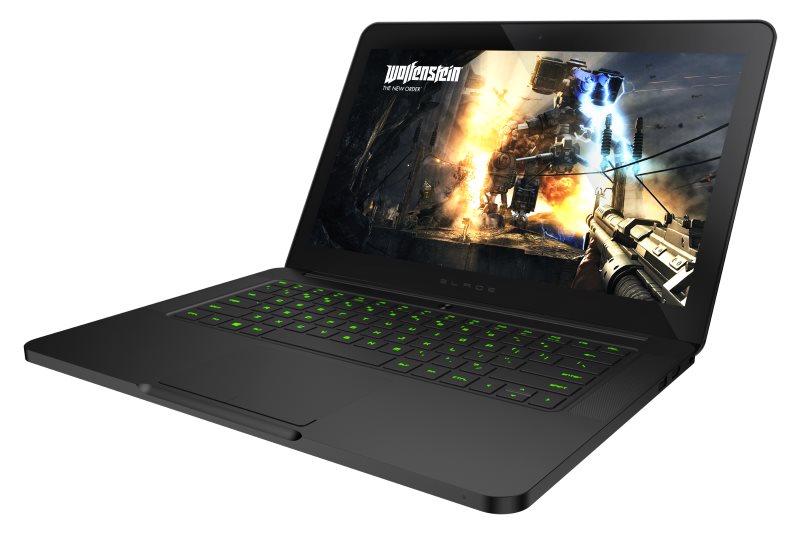
The latest 14 inch Razer Blade is super thin. In fact, it is marketed as the world’s thinnest gaming laptop. It is super light at 1.8 kg and is filled to the brim with power. The design is the Razer Blade’s signature look is all premium stealth plane black with minimalist green accents. It is sturdy without doubt and the keyboard is as perfect as usual for Alienware keyboards. For those familiar with the previous Razer Blades, this latest offering is missing the unique Switchblade interface. This could be a good step into the mainstream market – most people prefer not to learn how to use new interfaces. However, the Switchblade interface was a spark of innovation that was impressive and exciting and some fans will miss it.
The 1600 x 900 TN display provides a purportedly slightly faster response time by milliseconds and allows a thinner profile, but it is not what one expects from a high end device. Under the slim hood is a 2.2 GHz (up to 3.2 GHz with Turbo Boost) Intel Core i7 4702HQ Haswell processor, 8GB of RAM and NVIDIA's GTX 765M GPU. With the power saving Haswell core users can expect over 6 hours of battery life for moderate use – previously unheard of from a powerful gaming machine. Most games can run at the highest settings, while the most demanding ones will run well on medium settings. It is not future proof, since it cannot quite handle the most demanding games on the highest settings now, future games will be sure to flummox it. Considering the high price of the Razer Blade, this is unacceptable – but the brand is known to have its fans.
Specifications
 Notebook: Razer Blade 14 inch
Processor: Intel Core i7 4702HQ
Graphics Adapter: NVIDIA GeForce GTX 765M 2048 MB
Display: 14.00 inch, 16:9, 1600 x 900 pixels
Weight: 1.904kg
Price: 1700 euro
Sold in: Anglo-America
Links: Razer homepage Blade 14 inch (Model)
Pricecompare
Average Score:
Reviews
A wolf in sheep's clothing. Gaming notebooks do not necessarily have to be big, bulky and heavy. Razer shows that you can also put a lot of performance into a thin case.
Source: CNet
Archive.org version"If the Blade had a display like its 17-inch cousin, this would be an Editors' Choice laptop." That's what I said last year about the Razer Blade 14. This Blade definitely offers up the fantastic display I dreamed of, but it doesn't have the same great battery life -- and it's more expensive.
Single Review, online available, Long, Date: 05/09/2014
Rating: Total score: 84% performance: 90% mobility: 60%
Source: CNet
Archive.org version"If the Blade had a display like its 17-inch cousin, this would be an Editors' Choice laptop." That's what I said last year about the Razer Blade 14. This Blade definitely offers up the fantastic display I dreamed of, but it doesn't have the same great battery life -- and it's more expensive.
Single Review, online available, Long, Date: 05/09/2014
Rating: Total score: 84% performance: 90% mobility: 60%
Source: Engadget
Archive.org versionRazer CEO Min-Liang Tan describes the 2014 Razer Blade as a "no-compromise" gaming laptop, and that's almost accurate. Between the machine's screaming graphics performance, its thin chassis and that new QHD+ touchscreen, I was hard-pressed to find a legitimate complaint. Even so, the shadow of compromise is indeed here.
Single Review, online available, Long, Date: 05/06/2014
Rating: Total score: 86%
Source: Engadget
Archive.org versionRazer CEO Min-Liang Tan describes the 2014 Razer Blade as a "no-compromise" gaming laptop, and that's almost accurate. Between the machine's screaming graphics performance, its thin chassis and that new QHD+ touchscreen, I was hard-pressed to find a legitimate complaint. Even so, the shadow of compromise is indeed here.
Single Review, online available, Long, Date: 05/06/2014
Rating: Total score: 86%
Source: Digital Versus
Archive.org versionThe 14" Razer Blade is a poorly executed great idea. It's thinner and lighter than the competing gaming laptops and has just as good processing and gaming capabilities as the best of them. Unfortunately, it overheats like crazy and has ridiculously low screen contrast, bringing down the overall experience.
Single Review, online available, Long, Date: 10/04/2013
Rating: Total score: 60%
Source: Digital Versus
Archive.org versionThe 14" Razer Blade is a poorly executed great idea. It's thinner and lighter than the competing gaming laptops and has just as good processing and gaming capabilities as the best of them. Unfortunately, it overheats like crazy and has ridiculously low screen contrast, bringing down the overall experience.
Single Review, online available, Long, Date: 10/04/2013
Rating: Total score: 60%
Source: Techspot
Archive.org versionWith the new 14-inch Razer Blade, the company has created a gaming machine the likes of which we may not have seen for at least another couple of years otherwise. This sort of fearless innovation is exactly what the PC gaming hardware industry needs to take them beyond the big scary boxes and into the hearts and homes of gamers everywhere.
Single Review, online available, Short, Date: 07/05/2013
Source: Techspot
Archive.org versionWith the new 14-inch Razer Blade, the company has created a gaming machine the likes of which we may not have seen for at least another couple of years otherwise. This sort of fearless innovation is exactly what the PC gaming hardware industry needs to take them beyond the big scary boxes and into the hearts and homes of gamers everywhere.
Single Review, online available, Short, Date: 07/05/2013
Source: CNet
Archive.org versionIn what direction should PC gaming evolve? Tablet, laptop, or hybrid? Experimental or traditional? Ditching gimmicks and delivering on function, Razer’s slim 14-inch gaming laptop marries true power and good battery life into an excellent PC. All it lacks a stellar display.
Single Review, online available, Medium, Date: 07/02/2013
Rating: Total score: 79% performance: 90% mobility: 80%
Source: Digital Trends
Archive.org versionThe original Blade was interesting, but it fell short in performance and portability, making it more of a curiosity than a strong choice for consumers. Now, thanks to new hardware and a new design, Razer fulfilled its original vision. This gaming laptop can handle most games at high detail, yet it provides battery life that’s just a tad above an average Ultrabook.
Single Review, online available, Long, Date: 07/02/2013
Rating: Total score: 80%
Source: Engadget
Archive.org versionRazer's 14-inch Blade is almost everything we wanted out of the company's first gaming laptop: a smaller, less-expensive machine with longer battery life, more power and a shockingly attractive chassis. These elements lift the machine's stature, defining it not only as a solid gaming machine, but also as a great Windows laptop in general.
Single Review, online available, Long, Date: 07/02/2013
Source: Laptop Mag
Archive.org versionRazer has churned out a sexy and powerful gaming laptop with an amazingly slim profile. The Blade 14's high-end specs allow it to trade shots with heavyweights without breaking a sweat. We also love the customizable, backlit keyboard and more than 8 hours of battery life (when you're not gaming).
Single Review, online available, Long, Date: 07/02/2013
Rating: Total score: 80%
Source: Maximum PC
Archive.org versionThe Razer Blade isn’t without its flaws, but the fact that it’s half the size of many gaming laptops while offering much more power, all in a super sexy form factor, is crazy. It may not be cheap at $2,000, but Razer’s new philosophy of squeezing the most power per cubic-inch is noble and should be applauded.
Single Review, online available, Medium, Date: 07/02/2013
Rating: Total score: 90%
Source: PC Mag
Archive.org versionFrom its lightweight, portable design to its significantly improved performance, better graphics, and much longer battery life, it's clear that the Razer Blade (2013) is the laptop to buy if you want PC gaming on the go. Compared to the bulk and weight of other gaming PCs—even portable systems like the Maingear Pulse 11 and the Alienware m14x R2—the 14-inch Razer Blade (2013) is something different. It's not so drastic a change as Razer's other portable gaming PC, the Razer Edge Pro$1,214.15 at Amazon, but with such a clear improvement in performance, battery-life, and overall portability, it's our new Editors' Choice for ultraportable gaming PCs.
Single Review, online available, Short, Date: 07/02/2013
Rating: Total score: 80%
Source: Techradar
Archive.org versionUltimately and despite these few concerns, the Razer Blade sets a new high mark for what a mid-size Windows laptop can and should be. It looks fantastic, exhibits top-notch performance in both day-to-day use and gaming. And it's comfortable to work on. One final note: It's worth mentioning that PC gaming laptops are experiencing an impressive renaissance right now. Ever since Windows 8 released at the end of 2012, we've seen a series of pretty amazing systems come across our desks.
Single Review, online available, Long, Date: 07/02/2013
Rating: Total score: 90% price: 80% performance: 100% features: 100% workmanship: 90%
Source: Wired Magazine
Archive.org versionWIRED Record-setting performance on all fronts — including battery life. Impressive portability, particularly for a gaming rig. Looks good, especially if you like snake symbology. TIRED A bit slow to boot. Pricey. No touchscreen. Still no SD card reader.
Single Review, online available, Very Short, Date: 07/02/2013
Rating: Total score: 90%
Source: AnandTech
Archive.org versionI went into reviewing the Razer Blade 14-inch skeptical, and I came out of it largely a believer. Razer has done a million things right with this notebook design, and I actually have a very hard time understanding why a user would spend up for the 17-inch Razer Blade Pro. This 14-inch unit has almost everything you want and very little you don't, and it is the definitive gaming ultrabook.
Single Review, online available, Long, Date: 07/02/2013
Source: CNet
Archive.org versionIn what direction should PC gaming evolve? Tablet, laptop, or hybrid? Experimental or traditional? Ditching gimmicks and delivering on function, Razer’s slim 14-inch gaming laptop marries true power and good battery life into an excellent PC. All it lacks a stellar display.
Single Review, online available, Medium, Date: 07/02/2013
Rating: Total score: 79% performance: 90% mobility: 80%
Source: Digital Trends
Archive.org versionThe original Blade was interesting, but it fell short in performance and portability, making it more of a curiosity than a strong choice for consumers. Now, thanks to new hardware and a new design, Razer fulfilled its original vision. This gaming laptop can handle most games at high detail, yet it provides battery life that’s just a tad above an average Ultrabook.
Single Review, online available, Long, Date: 07/02/2013
Rating: Total score: 80%
Source: Engadget
Archive.org versionRazer's 14-inch Blade is almost everything we wanted out of the company's first gaming laptop: a smaller, less-expensive machine with longer battery life, more power and a shockingly attractive chassis. These elements lift the machine's stature, defining it not only as a solid gaming machine, but also as a great Windows laptop in general.
Single Review, online available, Long, Date: 07/02/2013
Source: Laptop Mag
Archive.org versionRazer has churned out a sexy and powerful gaming laptop with an amazingly slim profile. The Blade 14's high-end specs allow it to trade shots with heavyweights without breaking a sweat. We also love the customizable, backlit keyboard and more than 8 hours of battery life (when you're not gaming).
Single Review, online available, Long, Date: 07/02/2013
Rating: Total score: 80%
Source: Maximum PC
Archive.org versionThe Razer Blade isn’t without its flaws, but the fact that it’s half the size of many gaming laptops while offering much more power, all in a super sexy form factor, is crazy. It may not be cheap at $2,000, but Razer’s new philosophy of squeezing the most power per cubic-inch is noble and should be applauded.
Single Review, online available, Medium, Date: 07/02/2013
Rating: Total score: 90%
Source: PC Mag
Archive.org versionFrom its lightweight, portable design to its significantly improved performance, better graphics, and much longer battery life, it's clear that the Razer Blade (2013) is the laptop to buy if you want PC gaming on the go. Compared to the bulk and weight of other gaming PCs—even portable systems like the Maingear Pulse 11 and the Alienware m14x R2—the 14-inch Razer Blade (2013) is something different. It's not so drastic a change as Razer's other portable gaming PC, the Razer Edge Pro$1,214.15 at Amazon, but with such a clear improvement in performance, battery-life, and overall portability, it's our new Editors' Choice for ultraportable gaming PCs.
Single Review, online available, Short, Date: 07/02/2013
Rating: Total score: 80%
Source: Techradar
Archive.org versionUltimately and despite these few concerns, the Razer Blade sets a new high mark for what a mid-size Windows laptop can and should be. It looks fantastic, exhibits top-notch performance in both day-to-day use and gaming. And it's comfortable to work on. One final note: It's worth mentioning that PC gaming laptops are experiencing an impressive renaissance right now. Ever since Windows 8 released at the end of 2012, we've seen a series of pretty amazing systems come across our desks.
Single Review, online available, Long, Date: 07/02/2013
Rating: Total score: 90% price: 80% performance: 100% features: 100% workmanship: 90%
Source: Wired Magazine
Archive.org versionWIRED Record-setting performance on all fronts — including battery life. Impressive portability, particularly for a gaming rig. Looks good, especially if you like snake symbology. TIRED A bit slow to boot. Pricey. No touchscreen. Still no SD card reader.
Single Review, online available, Very Short, Date: 07/02/2013
Rating: Total score: 90%
Source: AnandTech
Archive.org versionI went into reviewing the Razer Blade 14-inch skeptical, and I came out of it largely a believer. Razer has done a million things right with this notebook design, and I actually have a very hard time understanding why a user would spend up for the 17-inch Razer Blade Pro. This 14-inch unit has almost everything you want and very little you don't, and it is the definitive gaming ultrabook.
Single Review, online available, Long, Date: 07/02/2013
Source: Pocket Lint
Archive.org versionThe Razer Blade 14 unhinges the typical gaming laptop concept: this slender 14-inch slab is far smaller and thinner than a typical gaming laptop but doesn't hold back on the power or specification. Pocket-lint was on hand at the E3 gaming expo in Los Angeles, California, where we spent some time with the Razer Blade 14.
Single Review, online available, Very Short, Date: 06/17/2013
Source: Pocket Lint
Archive.org versionThe Razer Blade 14 unhinges the typical gaming laptop concept: this slender 14-inch slab is far smaller and thinner than a typical gaming laptop but doesn't hold back on the power or specification. Pocket-lint was on hand at the E3 gaming expo in Los Angeles, California, where we spent some time with the Razer Blade 14.
Single Review, online available, Very Short, Date: 06/17/2013
Foreign Reviews
Source: PC Games Hardware - Heft 12/2013
Single Review, , Length Unknown, Date: 11/01/2013
Rating: Total score: 89%
Source: PC Games Hardware - Heft 12/2013
Single Review, , Length Unknown, Date: 11/01/2013
Rating: Total score: 89%
Source: 01Net
 FR→EN Archive.org version
Positive: High quality screen; newest components; very thin aluminum case.
Single Review, online available, Very Short, Date: 03/13/2014
Source: 01Net
FR→EN Archive.org versionPositive: High quality screen; newest components; very thin aluminum case.
Single Review, online available, Very Short, Date: 03/13/2014
Razer Blade 14 (2014)
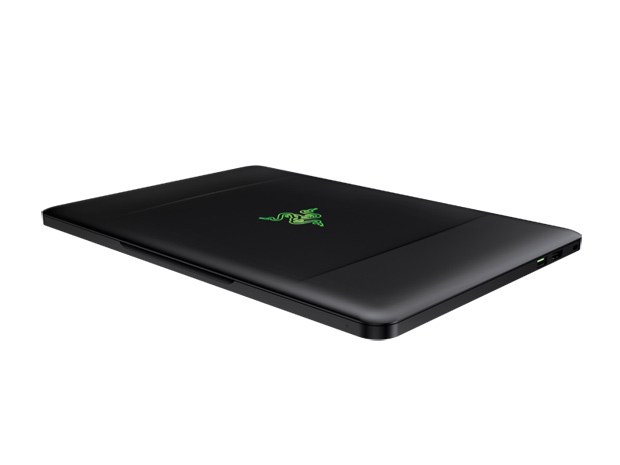
When it comes to gaming gear, Razer is no stranger. With the introduction of their latest Razer Blade 14 inch laptop designed for gaming, they show why they are one of the top dogs in this industry. The Razer Blade 14 inch runs on an Intel Core i7 4702HQ processor, which comes to no surprise as gaming laptops require the best of the best. The graphical capabilities of the Razer Blade is truly enhanced with its Nvidia GeForce GTX 870M graphic card, which is one of the highest performance graphic cards out there in the market.
All the graphical prowess will be of no use if there isn't a screen that is capable of supporting it. Thankfully, this time around, Razer did not disappoint in this aspect. The Razer Blade 14 inch comes with a 14 inch screen with an amazing pixel resolution of 3200 by 1800 pixels, the best of its class and probably among most laptops. Furthermore, the screen comes with a touchscreen, which is a rare for a gaming laptop but still a nice feature to have, especially when coupled with Windows 8.
Despite this powerhouse's extremely high specifications, the laptop itself is thin and light. It is only 0.7 inch thick and weighs 4.47 pounds (2.03 kg), making it very mobile and easy to pack. Unfortunately, the Razer Blade sacrifices its battery power to give all these benefits. But in its defense, a gaming laptop should not be expected to have a great battery life, anyway.
Specifications
 Notebook: Razer Blade 14 (2014)
Processor: Intel Core i7 4702HQ
Graphics Adapter: NVIDIA GeForce GTX 870M
Display: 14.00 inch, 16:9, 3200 x 1800 pixels
Weight: 2kg
Links: Razer homepage
Pricecompare
Average Score:
Reviews
Source: Computer Shopper
Archive.org versionThough it's nice to see that Razer was listening to criticism of last year's Razer Blade for not having full HD resolution, the 3,200x1,800 display of this year's update feels like overcompensating, since it's hard to get playable frame rates at such sky-high resolution.
Single Review, online available, Medium, Date: 12/29/2014
Rating: Total score: 70%
Source: Comp Reviews
Archive.org versionThe 2013 version of the Razer Blade was an amazingly small yet powerful gaming laptop that had an extremely flawed display. Razer has addressed that problem with the 2014 version by including a great ultra high resolution display that also features a touchscreen. This finally makes the system worth its premium price but it does introduce a new problem of reduced battery life which is disappointing.
Single Review, online available, Short, Date: 08/29/2014
Rating: Total score: 80%
Source: Gadgetguy
Archive.org versionIt’s expensive though, that much we have to acknowledge, especially at $3499, but you are paying for something that is offering some of the best performance this side of the portable PC gaming world, and that’s something. If you’ve checked out the competition for gaming computers and aren’t impressed, it’s time to see what Razer has to offer, because while it’s not cheap, the Razer Blade 14 is very, very impressive.
Single Review, online available, Short, Date: 08/20/2014
Rating: Total score: 90% price: 80% performance: 90% features: 100% workmanship: 100%
Source: Laptop Mag
Archive.org versionAfter three iterations, Razer continues to lead the charge on what a true portable gaming notebook should be. The $2,399 Blade 14 is a near-perfect merging of power and portability, delivering the sleek, sexy chassis I've come to know and love, with enough oomph to knock competitors on their arses. And the 3200 x 1800 display is a sight to behold.
Single Review, online available, Long, Date: 08/10/2014
Rating: Total score: 80%
Source: PC Mag
Archive.org versionThe Razer Blade (2014) is disappointing, mostly because we had such high hopes. Razer still manages to outfit the laptop with some amazing capabilities, but it feels like the company reached too far, too soon, stepping up the resolution at the expense of gameplay, and opting for powerful hardware that chews through battery life and runs alarmingly hot. Past models of the Blade left us eagerly anticipating the point when Razer could finally bring everything together into an ultraportable gaming system that required no compromises, but between the heat, the short battery life, the display issues, and the higher price, we're still left waiting. The previous model, the Editors' Choice Razer Blade (2013), is still available through Razer and other retailers, so it remains our top pick for ultraportable gaming, thanks to better battery life and a more affordable price.
Single Review, online available, Very Short, Date: 07/28/2014
Rating: Total score: 70%
Foreign Reviews
Source: CNet France
FR→EN Archive.org versionSingle Review, online available, Short, Date: 06/10/2014
Rating: Total score: 80%
Source: Ixbt
 RU→EN Archive.org version
Positive: Compact size; perfect design; good hardware; excellent screen; excellent keyboard. Negative: Weak speakers; noisy under load.
Single Review, online available, Very Long, Date: 07/16/2015
Source: Notebook-Center.ru
RU→EN Archive.org versionPositive: Compact size and high performance; ultra-high resolution display; perfect assembly. Negative: Expensive.
Single Review, online available, Short, Date: 11/04/2014
Source: 3DNews.ru
RU→EN Archive.org versionPositive: Elegant look; lightweight; excellent performance; good cooling system.
Single Review, online available, Long, Date: 08/18/2014
Source: Ferra.ru
RU→EN Archive.org versionPositive: Powerful hardware; compact size and light weight; comfortable keyboard; very high resolution display; good battery life. Negative: Hot under load; relatively slow and small capacity SSD.
Single Review, online available, Long, Date: 07/29/2014
Source: Ferra.ru
RU→EN Archive.org versionPositive: Attractive design; metal case; comfortable keyboard; very high resolution display; long battery life. Negative: Hot under load; low capacity storage.
Single Review, online available, Long, Date: 07/29/2014
Source: Hi-Tech Mail
RU→EN Archive.org versionPositive: Compact size and very powerful performance; high-quality screen; comfortable keyboard; efficient and quiet cooling system.
Single Review, online available, Long, Date: 07/28/2014
Source: Zoom
RU→EN Archive.org versionPositive: Excellent gaming performance; lightweight and compact size; stunning display; good design; stylish look. Negative: Relatively short battery life.
Single Review, online available, Long, Date: 07/22/2014
Razer Blade 14 2015
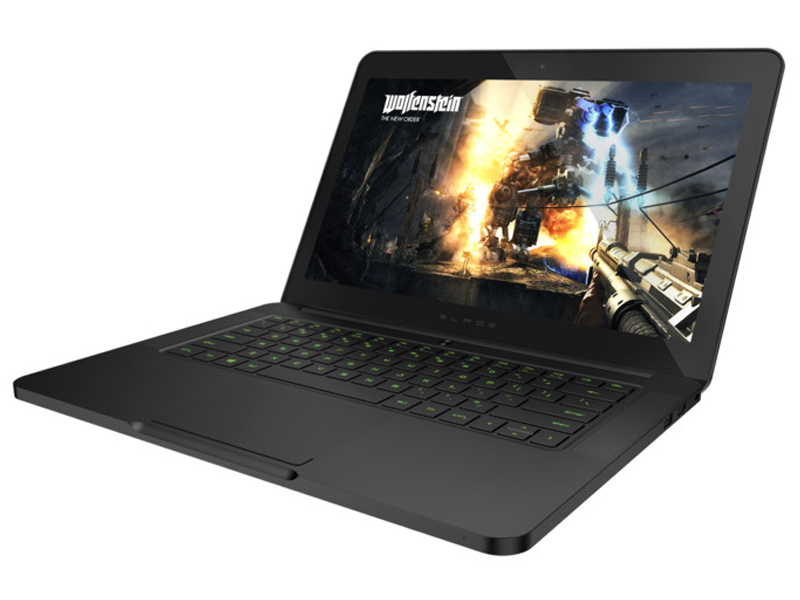
Razer's Blade series of gaming laptops combine a high level of power and relative lightweight features for portability. Rather than having a huge screen, the Razer Blade 14 has a 14 inch screen with a resolution of 3200 x 1800 pixels and a pixel density of 262 ppi. Thus, images are sharp, clear and vibrant, which makes any gaming experience more realistic and immersive. A unique feature of the Razer Blade 14 is the incorporation of the IGZO (Indium Gallium Zinc Oxide) display technology which gives the graphics extra quality, because IGZO screens work at a significantly higher speed than usual a-Si TFT screens. The graphic vibrancy is consistent over wide viewing angles as well. The Razer Blade 14 has unparalleled portability as it measures only 0.7 inches (1.78 cm) and weighs slightly over 2 kg. The processor in this system is an Intel Core i7 4720HQ with base clock of 2.6 GHz and a Turbo clock of up to 3.6 GHz. Additionally, there are an NVIDIA GEForce GTX 970M graphic card and an integrated Intel graphics card. The NVIDIA Optimus technology is used for graphics switching. There is also a 16 GB RAM and users choose between a 128, 256 or 512 GB SSD.Specifications
 Notebook: Razer Blade 14 2015
Processor: Intel Core i7 4720HQ
Graphics Adapter: NVIDIA GeForce GTX 970M 3072 MB
Display: 14.00 inch, 16:9, 3200 x 1800 pixels
Weight: 2kg
Price: 2100 euro
Links: Razer homepage
Pricecompare
Average Score:
Reviews
Sharp performer. The Blade is back with a honed edge to take the crown in the razor-thin gaming category. Does this refreshed model make the cut? Or is it just a dull point?
Source: Digital Trends
Archive.org versionIf you want a gaming laptop, and you want one that’s actually portable, you don’t have many choices outside of the Razer Blade. Thankfully, it’s a well-equipped option with an attractive exterior, solid performance, and decent battery life. Unfortunately, you pay a premium for the Blade’s bright spots.
Single Review, online available, Long, Date: 09/18/2015
Rating: Total score: 80%
Source: Digital Trends
Archive.org versionIf you want a gaming laptop, and you want one that’s actually portable, you don’t have many choices outside of the Razer Blade. Thankfully, it’s a well-equipped option with an attractive exterior, solid performance, and decent battery life. Unfortunately, you pay a premium for the Blade’s bright spots.
Single Review, online available, Long, Date: 09/18/2015
Rating: Total score: 80%
Source: Laptop Mag
Archive.org versionRazer continues to dance gracefully along the edge of power and portability. The updated Blade ($2,399) retains some of my favorite things (design, keyboard, display and battery life) and updates the rest with a powerful Core i7 processor and Nvidia GeForce GTX 970M GPU. The result is a laptop that not only delivers solid frame rates, but can also easily double as a powerful multimedia or business notebook.
Single Review, online available, Long, Date: 05/14/2015
Rating: Total score: 80%
Source: Laptop Mag
Archive.org versionRazer continues to dance gracefully along the edge of power and portability. The updated Blade ($2,399) retains some of my favorite things (design, keyboard, display and battery life) and updates the rest with a powerful Core i7 processor and Nvidia GeForce GTX 970M GPU. The result is a laptop that not only delivers solid frame rates, but can also easily double as a powerful multimedia or business notebook.
Single Review, online available, Long, Date: 05/14/2015
Rating: Total score: 80%
Source: Computer Shopper
Archive.org versionAll told, the Razer Blade remains, as it has since 2013, one of the sleekest and most stylish, not to mention most portable, of gaming laptops. And whereas, in our review of the 2014 model, we suggested the Blade was better off at the 1,600x900 resolution of its predecessor, we can now say with confidence that the 2015 Razer Blade performs well enough to work and play at 1,920x1,080 and higher resolutions.
Single Review, online available, Long, Date: 05/08/2015
Rating: Total score: 80%
Source: Computer Shopper
Archive.org versionAll told, the Razer Blade remains, as it has since 2013, one of the sleekest and most stylish, not to mention most portable, of gaming laptops. And whereas, in our review of the 2014 model, we suggested the Blade was better off at the 1,600x900 resolution of its predecessor, we can now say with confidence that the 2015 Razer Blade performs well enough to work and play at 1,920x1,080 and higher resolutions.
Single Review, online available, Long, Date: 05/08/2015
Rating: Total score: 80%
Source: CNet
Archive.org versionWhether it's for gaming, multimedia enjoyment, work or all of the above, the Razer Blade is a fantastic choice if you need high performance, but don't want to sacrifice mobility to get it. Battery life and price are the only real downsides here. If neither are an issue for you, put it at the top of your list.
Single Review, online available, Long, Date: 04/29/2015
Rating: Total score: 85% performance: 90% mobility: 70%
Source: CNet
Archive.org versionWhether it's for gaming, multimedia enjoyment, work or all of the above, the Razer Blade is a fantastic choice if you need high performance, but don't want to sacrifice mobility to get it. Battery life and price are the only real downsides here. If neither are an issue for you, put it at the top of your list.
Single Review, online available, Long, Date: 04/29/2015
Rating: Total score: 85% performance: 90% mobility: 70%
Source: Kitguru
Archive.org versionThe fact that the Razer Blade 14 is not officially sold or supported in the United Kingdom hasn’t stopped enthusiast users importing it. As we discussed earlier in the review, Amazon are now working with a select group of partners, offering various configurations for sale under the AMAZON PRIME delivery service. These dealers are also offering 1 year technical support and warranty terms, via local UK repair stations. Of course without official support there is an extra risk involved, but hardcore UK Razer gamers wanting the most portable, powerful gaming solution may find this too good to resist.
Single Review, online available, Very Long, Date: 04/02/2015
Rating: Total score: 80%
Source: Kitguru
Archive.org versionThe fact that the Razer Blade 14 is not officially sold or supported in the United Kingdom hasn’t stopped enthusiast users importing it. As we discussed earlier in the review, Amazon are now working with a select group of partners, offering various configurations for sale under the AMAZON PRIME delivery service. These dealers are also offering 1 year technical support and warranty terms, via local UK repair stations. Of course without official support there is an extra risk involved, but hardcore UK Razer gamers wanting the most portable, powerful gaming solution may find this too good to resist.
Single Review, online available, Very Long, Date: 04/02/2015
Rating: Total score: 80%
Source: PC Mag
Archive.org versionWith a new processor and graphics card, the Razer Blade (2015) delivers better graphics performance and longer battery life than its predecessor, fixing two of the bigger problems I had with the 2014 Blade. Heat is still a big concern, but that's a problem endemic to the category. As it stands, the Razer Blade 2015 not only outshines the 2014 model, it also offers a better overall value than the previous Editors' Choice, the Razer Blade (2013). If you still aren't sold on the new Razer Blade, the MSI GS60 Ghost Pro 3K is a great alternative (and our top pick for midpriced gaming laptops), but the Razer Blade (2015) is our Editors' Choice for ultraportable gaming.
Single Review, online available, Very Short, Date: 02/11/2015
Rating: Total score: 80%
Source: PC Mag
Archive.org versionWith a new processor and graphics card, the Razer Blade (2015) delivers better graphics performance and longer battery life than its predecessor, fixing two of the bigger problems I had with the 2014 Blade. Heat is still a big concern, but that's a problem endemic to the category. As it stands, the Razer Blade 2015 not only outshines the 2014 model, it also offers a better overall value than the previous Editors' Choice, the Razer Blade (2013). If you still aren't sold on the new Razer Blade, the MSI GS60 Ghost Pro 3K is a great alternative (and our top pick for midpriced gaming laptops), but the Razer Blade (2015) is our Editors' Choice for ultraportable gaming.
Single Review, online available, Very Short, Date: 02/11/2015
Rating: Total score: 80%
Foreign Reviews
Source: Gamestar
DE→EN Archive.org versionSingle Review, online available, Long, Date: 02/04/2016
Source: Gamestar
DE→EN Archive.org versionSingle Review, online available, Long, Date: 02/04/2016
Source: HardwareLuxx
DE→EN Archive.org versionSingle Review, online available, Long, Date: 12/20/2015
Source: HardwareLuxx
DE→EN Archive.org versionSingle Review, online available, Long, Date: 12/20/2015
Source: Allround-PC.com
DE→EN Archive.org versionSingle Review, online available, Long, Date: 12/12/2015
Source: Allround-PC.com
DE→EN Archive.org versionSingle Review, online available, Long, Date: 12/12/2015
Source: CNet France
FR→EN Archive.org versionSingle Review, online available, Short, Date: 05/26/2015
Rating: Total score: 80%
Source: CNet France
FR→EN Archive.org versionSingle Review, online available, Short, Date: 05/26/2015
Rating: Total score: 80%
Source: HwT
 DA→EN Archive.org version
Single Review, online available, Long, Date: 01/14/2016
Rating: Total score: 77% price: 40% performance: 80% workmanship: 100%
Source: HwT
DA→EN Archive.org versionSingle Review, online available, Long, Date: 01/14/2016
Rating: Total score: 77% price: 40% performance: 80% workmanship: 100%
Razer Blade 14 inch 2016
The unrealistically thin yet powerful Razer Blade 14 inch 2016 almost defies physics. Rounded edges, clean lines and a minimalistic matte black chassis provide the design core, while the multi-colored keyboard backlight breaks through this monotone color scheme. The top cover sports the ionic triple snake Razer logo in green. Display on the Razer Blade 14 inch 2016 is a stunning 14 inch QHD panel at a whooping 3200 x 1800 resolution with touch capability. Colors are rich and deep while the detail produced is simple exceptional. This is mostly due to the Indium Gallium Zinc Oxide panel technology that allows for faster propagation times. The built-in stereo speakers provide a surprisingly rich sound experience. The Windows 10 system comes with an Intel Core i7-6700HQ quad-core processor clocked at 2.6 GHz base speed, 16 GB dual-channel DDR4 RAM which is non-upgradable, a powerful Nvidia GeForce GTX970M GPU with 6 GB GDDR5 VRAM and up to 512 GB SSD as internal storage. Other features found on the laptop are Bluetooth 4.1, a 2 MP webcam, a USB 3.1 Type C connector, three USB 3.0 ports and an HDMI out. The Razer Blade 14 inch 2016 comes with a built-in Lithium-Ion Polymer battery pack rated at 70 Wh.Specifications
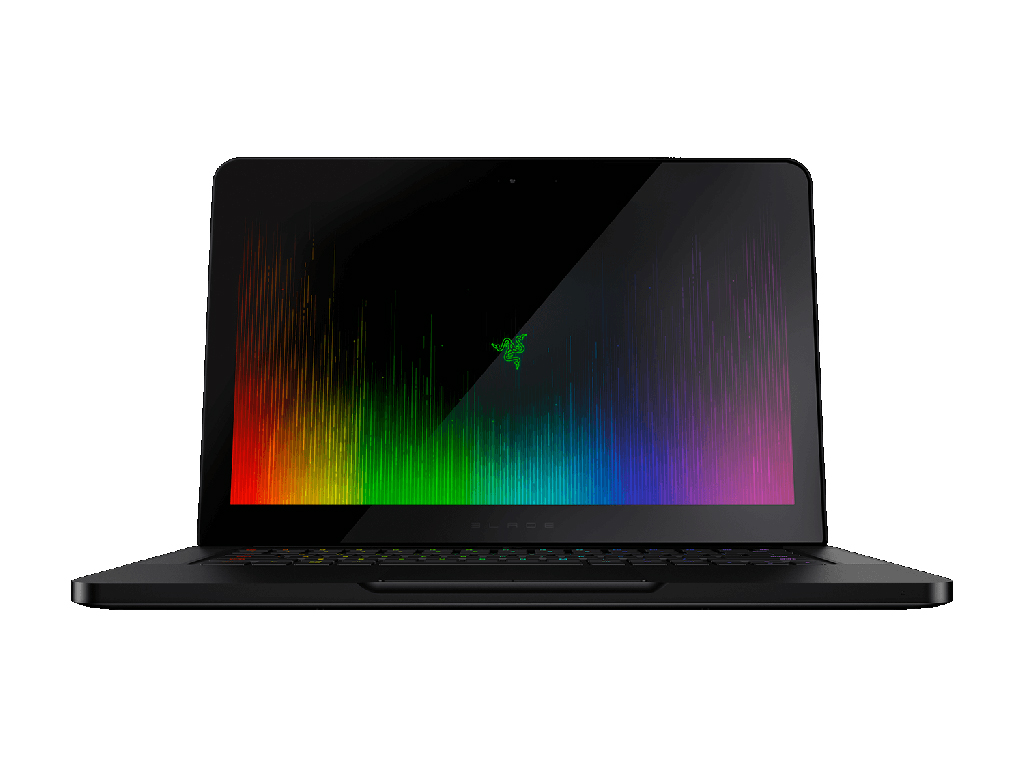 Notebook: Razer Blade 14 inch 2016
Processor: Intel Core i7 6700HQ
Graphics Adapter: NVIDIA GeForce GTX 970M
Display: 14.00 inch, 16:9, 3200 x 1800 pixels
Weight: 1.9kg
Price: 1800 euro
Links: Razer homepage Blade 14 inch 2016 (Model)
Pricecompare
Average Score:
Reviews
Source: Trusted Reviews
Archive.org versionOf the three new Razer laptops, the Razer Blade is probably my favourite. It’s the best option for someone who needs a good laptop for work, a good laptop for gaming, and doesn’t want to compromise in either direction. It’s expensive, sure – but all thin, light and powerful laptops are. And with a slick design, it’s hard to fault the new Blade.
Single Review, online available, Medium, Date: 10/20/2016
Source: Techradar
Archive.org versionWe've always appreciated Razer's Blade gaming laptops for their attention to build quality and design. It's something that, at the time of their debut, was a bit lacking in the world of Windows notebooks. From the start, Razer has always been after a very specific type of gamer. And, it's only in this revision that we think we're starting to see who that is. With the addition of Thunderbolt 3, doubling the video RAM and cranking up battery life: Razer has made its Blade a rather appealing option to people that both work (or study) in visual fields and happen to be PC gamers.
Single Review, online available, Medium, Date: 08/09/2016
Rating: Total score: 90%
Source: Good Gear Guide
Archive.org versionSure, you can find a similarly spec'd laptop for a few hundred less, but not one that crams this performance into such an ultraportable form factor. Add in USB-C, the promise of the Razer Core, and that PCIe SSD? Pretty snazzy. So if you need a laptop today, and can’t wait for the 1070 to go mobile and start making its way into products, the 2016 Blade is a solid choice.
Single Review, online available, Long, Date: 07/22/2016
Rating: Total score: 80%
Source: PC World
Archive.org versionSure, you can find a similarly spec'd laptop for a few hundred less, but not one that crams this performance into such an ultraportable form factor. Add in USB-C, the promise of the Razer Core, and that PCIe SSD? Pretty snazzy. So if you need a laptop today, and can’t wait for the 1070 to go mobile and start making its way into products, the 2016 Blade is a solid choice. Just be aware it’s not a very future-proofed option at this point.
Single Review, online available, Very Short, Date: 07/22/2016
Rating: Total score: 80%
Source: IGN
Archive.org versionSure, you can find a similarly spec'd laptop for a few hundred less, but not one that crams this performance into such an ultraportable form factor. Add in USB-C, the promise of the Razer Core, and that PCIe SSD? Pretty snazzy. So if you need a laptop today, and can’t wait for the 1070 to go mobile and start making its way into products, the 2016 Blade is a solid choice. Just be aware it’s not a very future-proofed option at this point.
Single Review, online available, Very Short, Date: 07/22/2016
Rating: Total score: 80%
Source: Techspot
Archive.org versionOf course, by that way of thinking you’ll be waiting around for the next big thing indefinitely and never get to enjoy what’s available in the present. As it stands today, the 2016 Blade is an excellent contender for anyone looking for a sleek and lightweight gaming notebook with room to grow. You can likely get a bit more bang for your buck elsewhere although be prepared to take on a bit more bulk in the process.
Single Review, online available, Very Long, Date: 07/18/2016
Rating: Total score: 85%
Source: Ultrabook Review
Archive.org versionI’m very impressed with this year’s version of the Razer Blade. It is a very powerful laptop, considering the small size, it gets solid specs, and let’s not forget it still offers decent battery life. On top of that, the 2016 is more affordable than the previous Blades. However, you do have to consider the fact that this laptop still only comes with an Nvidia GTX 970M graphics chip, while soon to be released GTX 1070M laptops should offer a significant performance bump.
Single Review, online available, Long, Date: 06/24/2016
Rating: Total score: 80%
Source: Comp Reviews
Archive.org versionRazer's Blade laptop has come a long way from when it was first introduced. The latest version continues to improve on many of the flaws that kept it from being a great laptop for those that want to game on the go. The system offers some great power in a portable package but the price is still quite high. With a little more tweaking, Razer could end up with a truly spectacular laptop.
Single Review, online available, Medium, Date: 06/19/2016
Rating: Total score: 80%
Source: Computer Shopper
Archive.org versionStiffer competition over the past year has caused Razer to both improve its 14-inch Blade and lower its price. The 2016 Blade offers the fastest components available in a chassis this size on the processor, graphics, and RAM fronts (not to mention the storage subsystem, with its PCI Express SSDs).
Single Review, online available, Long, Date: 06/10/2016
Rating: Total score: 80%
Source: Mobile Tech Review
Archive.org versionIt's hard not to fall in love with the 2016 Razer Blade, and that's what we like for a machine this expensive. It has an immaculate design that's cool looking yet calm enough to take to work. Performance is very impressive, particularly for something this thin and light. The IGZO QHD+ touch screen is pretty and on my short list for photo and video editors who need good color accuracy and brightness.
Single Review, online available, Long, Date: 06/07/2016
Rating: Total score: 85%
Source: Digital Trends
Archive.org versionThe Razer Blade is impressive, packing high-end hardware into such a slick chassis, but it comes at a cost. The 2016 Blade starts at $2,000 for the version with a 256GB PCIe SSD. The highest-end Asus UX501 costs just $1,700, and you get a 512GB SSD, 4K touchscreen, and 960M.
Single Review, online available, Long, Date: 05/25/2016
Rating: Total score: 80%
Source: CNet
Archive.org versionRazer, in particular, has the been leading the charge toward more modern-feeling gaming laptops for some time, fitting high-end parts into very slim cases with tastefully understated designs. The Razer Blade is a slim gaming laptop that hits a good balance between power and portability, with the intriguing promise of adding a desktop graphics card later on.
Single Review, online available, Long, Date: 05/16/2016
Rating: Total score: 84% performance: 80% mobility: 60%
Source: Laptop Mag
Archive.org versionPound-for-barely-there-pound, the Razer Blade is the best portable gaming laptop out there. For $1,999, gamers get a laptop that performs as if it were a 17-inch laptop. Thanks to its Core i7 processor and Nvidia graphics with 6GB of RAM, the Blade is a beast, whether it's shredding through enemies or spreadsheets.
Single Review, online available, Long, Date: 05/06/2016
Rating: Total score: 90%
Source: CNet
Archive.org versionTo be honest, I'm still not sure I'll buy a Blade. As much as I love its solid construction and perfectly weighted hinge, I need to see how long the battery lasts. I also generally prefer laptops with 1080p screens. (Games generally run more smoothly on lower-resolution displays.) But I also don't see a lot of gaming desktops in my future -- not now that external graphics are a thing.
Single Review, online available, Medium, Date: 03/15/2016
Foreign Reviews
Source: CNet France
FR→EN Archive.org versionPositive: Comfortable keyboard; multi-color backlight. Negative: Relatively high price.
Single Review, online available, Medium, Date: 10/10/2016
Rating: Total score: 80%
Razer Blade (2016)
Released in 2016, the Blade 14 inch from the manufacturer Razer is thought to be the convenient version for those who want a powerful laptop with comfortable design. With 1.9 kg weight only and the 14-inch screen, this notebook is compact for user to bring with when travelling. However, its performance is still similar to the previous version's, actually there are not too many changes or improvements. Razer still keeps the same graphics card (NVIDIA GeForce GTX 970) as the last year’s model. This is also true for chassis, screen, touchpad, etc. Yet the Razer Blade 14 inch 2016 is powered by the i7-6700HQ processor from Intel’s 6th generation of the Core i-series. In addition, this manufacturer still develops it with some new ameliorated features for a comparative price.Design and Display
Regarding page UltrabookReview, the general design of the Blade 2016 is rather extraordinary. Although it hasn’t changed much during a year, it’s still one of the best constructed and best looking laptops. “It’s not the fastest gaming notebook on the planet but at just 4.5 pounds (2.04 kg) with a profile that’s thinner than a dime standing on its side, you’ll have no trouble tossing it in your backpack as you walk out the door”, said page TechSpot. The chassis, as remarked from page UltrabookReview, is very well constructed. Razer opted for the same anodized aluminum unibody design, which is a good move in the reviewer’s opinion. According to UltrabookReview, the Sharp IGZO IPS 14-inch QHD touchscreen with a maximum resolution of 3,200 x 1,800 pixels is still a real pleasure to look at after already two years. Yet, “Perhaps the only thing not to like about the screen is that it’s glossy and has a high reflection factor” (TechSpot’s quote).Keyboard and Trackpad
For the trackpad, it’s exactly the same as in the previous models. “It works very well in my opinion, correctly registering all my touch gestures without fail. Tracking was accurate and it felt very smooth to the touch and comfortable to use”, UltrabookReview gave an opinion. Moreover, TechSpot supposed that at 10.48 cm (4.125 inch) wide, the touchpad of the Blade 14 inch 2016 is plenty large for a system of this size. Rather than integrate the mouse click buttons directly into the touchpad, Razer went with physical click buttons, a practice that isn’t nearly as common as it used to be. Besides, the keyboard itself is more than adequate for a gaming notebook and the layout leaves nothing to be desired. The reviewer of page TechSpot said that if he had had to single out one shortcoming, it would have been that the key travel is a tiny bit shallow. According to page UltrabookReview, “Like the Razer Blade Stealth, the Razer Blade uses a very unique keyboard. It’s Razer’s Chroma variant, so each key is programmable to 16 million color choices. So if you ever wanted a keyboard with the ability to make each key a different color, this is the one for you”. Nevertheless, also from this page, the reviewer complained that one of the other big issues he had with the keyboard was there was no backlighting for the secondary key functions. On top of that, the media keys are not backlit either, so finding the key to turn off the keyboard lighting ironically requires a flashlight until you memorize its location.Performance and Emissions
Equipped with a sixth generation Skylake Core i7-6700HQ processor, the Razer Blade should be very capable of essential web tasks, along with some more intensive productivity workloads such as heavy spreadsheet editing, photo editing and more (a remark from page TechSpot). “Unfortunately, the RAM is soldered onto the motherboard, so there is no way to upgrade it in the future”, complained UltrabookReview. The Blade 2016 version falls in line with other laptops using the Nvidia GTX 970 chip. As an evaluation from UltrabookReview, in Witcher 3, this laptop itself just reached 38 - 42 fps at High Setting at 1080p resolution, the CPU was at 83 Celsius degrees, and GPU temperature was 85 Celsius degrees, while the frame rate fell to around 25 - 30 fps with Ultra settings. When it comes to graphics performance, the 970M was able to run most modern games at the native 3,200 x 1,800 resolution at normal/medium graphics quality. Bumping up to high/ultra at this resolution resulted in a framerate drop that’s below acceptable standards. For the heat, whereas most notebooks take in fresh air from the bottom of the system and expel it out of the side or back, the Blade disposes of hot air via vents below the display that channel air up from the bottom of the screen. Using an infrared temperature gauge, the reviewer of page TechSpot found that the wrist rest never climbed above 40.56 C (105 Fahrenheit) during heaving gaming, which is barely warm. But for UltrabookReview, under gaming loads, the laptop gets extremely hot. Hence, it will definitely be difficult to do long sessions directly on your lap. Also from that page, they thought: “Under full gaming load, the laptop’s fan start to get extremely loud. The pitch was pretty high, which made the noise more noticeable to others in the room”.Battery Life and Audio
About the battery, as commented on UltrabookReview, “The Razer Blade lasted a stellar 7 hours and 45 minutes before shutting down using stock “Power Saver” power profile, 40% brightness, Wi-Fi off, bluetooth off and running 720p movie in a continuous loop. I am pretty impressed with the battery readings I was able to measure with the Razer Blade”. Sadly, the Blade doesn’t follow this trend. Its 70 Wh battery regularly struggles to last longer to three-to-four hours, even when doing basic tasks, such as word processing and web browsing. As for the speakers, they are good but not great. Evaluated from TechSpot, it feels as though the speakers are right on the edge of being overpowered. “Unfortunately, the speakers aren’t the highest quality in terms of putting out sound. Still, as far as gaming laptops go, they are pretty good” (quoted from UltrabookReview).Verdict
In conclusion, the Razer Blade 14 inch 2016 did not have considerable upgrades as user expected. Yet, the beautiful and high resolution display of this laptop as well as its thin and slim design could conquer most customers, even though they are extremely awkward. Furthermore, the performance of this notebook is not really an disadvantage, however, do not consider it an advantage as well. Yet, the laptop is still powerful enough for every demands even some heavy gaming. “I’m very impressed with this year’s (2016) version of the Razer Blade. Although there are a couple areas that need a little more work, I think they’ve improved in a couple key areas that have piqued my interest” (from the UltrabookReview’s perspective). On contrary, there are some flaws existing, such as: the Nvidia 9 series mobile GPU is on its way out, or a touch display is useless on a non-convertible system. In general, page UltrabookReview concluded that this is a powerful laptop, considering the small size. They really did a nice job taking up as much space in such a small footprint and keeping the weight low and let’s not forget it is still having decent battery life. Press Review by Capuchino SaberSpecifications
 Notebook: Razer Blade (2016)
Processor: Intel Core i7 6700HQ
Graphics Adapter: NVIDIA GeForce GTX 1060 Mobile 6144 MB
Display: 14.00 inch, 16:9, 3200 x 1800 pixels
Weight: 1.96kg
Price: 2600 euro
Links: Razer homepage
Pricecompare
Average Score:
Reviews
Solid as a Rock. The new Razer Blade packs a GTX 1060 in a great aluminum case. The laptop offers reliable input devices, Thunderbolt 3 and an amazing IGZO panel. With all this on the table, what could go wrong? Besides some smaller issues, the greatest weakness was its lackluster gaming performance. However, the latter has now been fixed with an EC update.
Source: Reviewed.com
Archive.org versionThere are plenty of reasons why this laptop deserved to win our Best of Year award, but it's really the combination of all those strong assets that make this latest Blade a strong choice. With Apple sacrificing so many critical assets on its pro machines, it's great to see that Razer is unafraid to continue offering users what they want and need in a package that truly focuses in on the highest performance possible. If you opt for the Blade over a similarly-equipped MacBook Pro, you won't be giving up much, and what you get in return is a top-notch typing experience, blisteringly fast graphics, and a lower price. Headed into 2016, it's the professional PC laptop to beat. Even dyed-in-the-wool Mac people should consider the Blade they're looking to switch from the Mac to a comparable Windows PC with the best performance available.
Single Review, online available, Very Long, Date: 12/06/2016
Source: Reviewed.com
Archive.org versionThere are plenty of reasons why this laptop deserved to win our Best of Year award, but it's really the combination of all those strong assets that make this latest Blade a strong choice. With Apple sacrificing so many critical assets on its pro machines, it's great to see that Razer is unafraid to continue offering users what they want and need in a package that truly focuses in on the highest performance possible. If you opt for the Blade over a similarly-equipped MacBook Pro, you won't be giving up much, and what you get in return is a top-notch typing experience, blisteringly fast graphics, and a lower price. Headed into 2016, it's the professional PC laptop to beat. Even dyed-in-the-wool Mac people should consider the Blade they're looking to switch from the Mac to a comparable Windows PC with the best performance available.
Single Review, online available, Very Long, Date: 12/06/2016
Source: Forbes
Archive.org versionThe Blade is a robust laptop, it has an understated style that hides some mouth-watering specifications within the thin chassis, and it delivers an almost flawless experience.
Single Review, online available, Very Long, Date: 12/03/2016
Source: Forbes
Archive.org versionThe Blade is a robust laptop, it has an understated style that hides some mouth-watering specifications within the thin chassis, and it delivers an almost flawless experience.
Single Review, online available, Very Long, Date: 12/03/2016
Source: Mobile Tech Review
Archive.org versionIt's hard not to fall in love with the 2016 Razer Blade, and that's what we like for a machine this expensive. It has an immaculate design that's cool looking yet calm enough to take to work. Performance is very impressive, particularly for something this thin and light. Both the 1920 x 1080 matte IPS display and the IGZO QHD+ touch screen are pretty and on my short list for photo and video editors who need good color accuracy and brightness (I lean toward the 1080p matte display for lack of glare and better contrast and viewing angles).
Single Review, online available, Very Long, Date: 11/24/2016
Rating: Total score: 90%
Source: Mobile Tech Review
Archive.org versionIt's hard not to fall in love with the 2016 Razer Blade, and that's what we like for a machine this expensive. It has an immaculate design that's cool looking yet calm enough to take to work. Performance is very impressive, particularly for something this thin and light. Both the 1920 x 1080 matte IPS display and the IGZO QHD+ touch screen are pretty and on my short list for photo and video editors who need good color accuracy and brightness (I lean toward the 1080p matte display for lack of glare and better contrast and viewing angles).
Single Review, online available, Very Long, Date: 11/24/2016
Rating: Total score: 90%
Source: Gear Open
Archive.org versionOf the three new Razer laptops, the Razer Blade is probably my favourite. It’s the best option for someone who needs a good laptop for work, a good laptop for gaming, and doesn’t want to compromise in either direction. It’s expensive, sure – but all thin, light and powerful laptops are. And with a slick design, it’s hard to fault the new Blade.
Single Review, online available, Short, Date: 10/21/2016
Source: Gear Open
Archive.org versionOf the three new Razer laptops, the Razer Blade is probably my favourite. It’s the best option for someone who needs a good laptop for work, a good laptop for gaming, and doesn’t want to compromise in either direction. It’s expensive, sure – but all thin, light and powerful laptops are. And with a slick design, it’s hard to fault the new Blade.
Single Review, online available, Short, Date: 10/21/2016
Foreign Reviews
Source: PC Games
DE→EN Archive.org versionSingle Review, online available, Long, Date: 12/02/2016
Source: PC Games
DE→EN Archive.org versionSingle Review, online available, Long, Date: 12/02/2016
Source: PC Games
DE→EN Archive.org versionSingle Review, online available, Long, Date: 11/22/2016
Source: PC Games
DE→EN Archive.org versionSingle Review, online available, Long, Date: 11/22/2016
Source: Lyd og Billede
DA→EN Archive.org versionSingle Review, online available, Medium, Date: 05/09/2017
Rating: Total score: 67%
Source: Lyd og Billede
DA→EN Archive.org versionSingle Review, online available, Medium, Date: 05/09/2017
Rating: Total score: 67%
Source: Ljud och Bild
 SV→EN Archive.org version
Single Review, online available, Very Short, Date: 06/02/2017
Rating: Total score: 67%
Source: Ljud och Bild
SV→EN Archive.org versionSingle Review, online available, Very Short, Date: 06/02/2017
Rating: Total score: 67%
Razer Blade (2016) FHD
Specifications
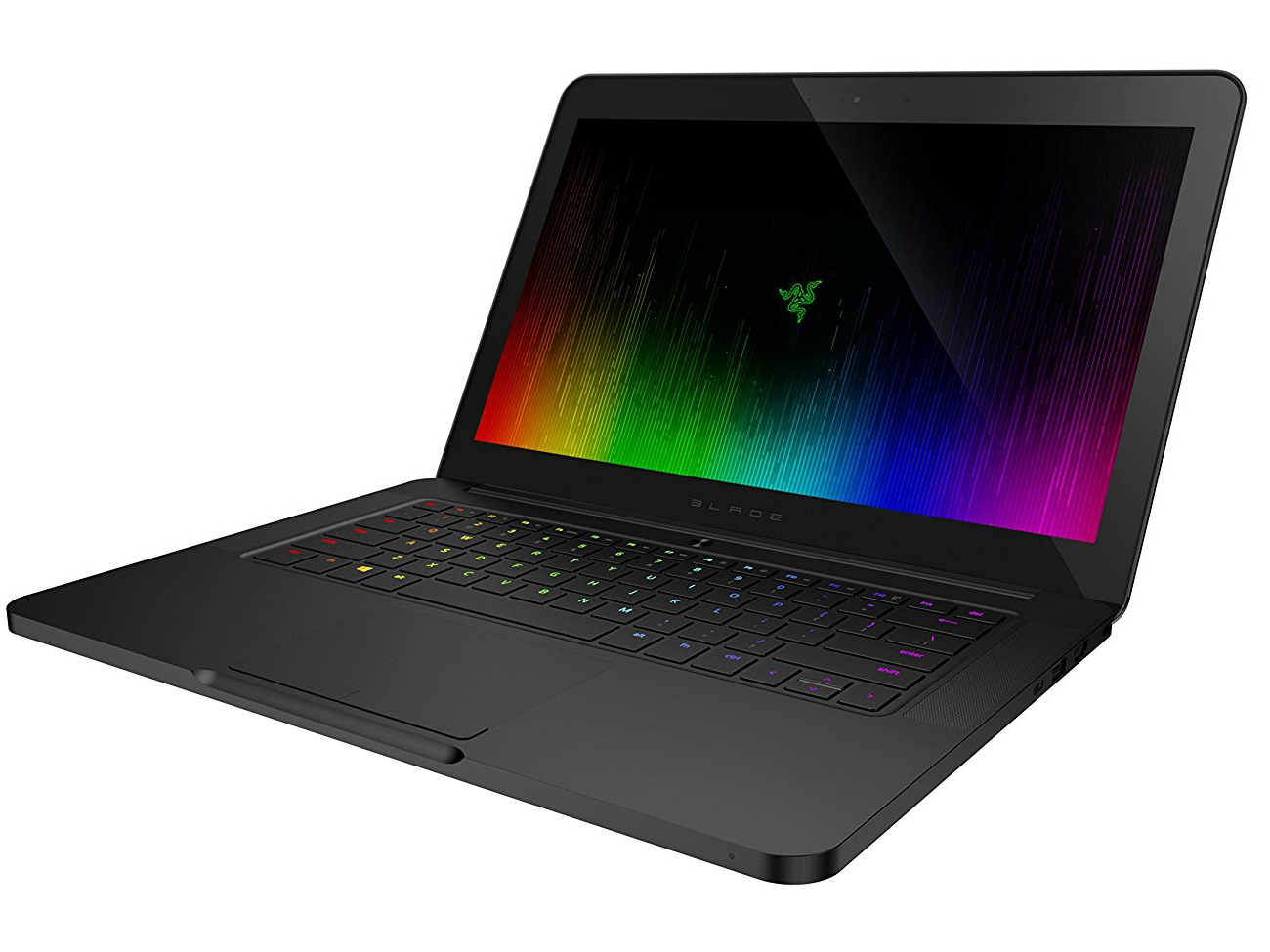 Notebook: Razer Blade (2016) FHD
Processor: Intel Core i7 6700HQ
Graphics Adapter: NVIDIA GeForce GTX 1060 Mobile 6144 MB
Display: 14.00 inch, 16:9, 1920 x 1080 pixels
Weight: 1.88kg
Price: 2700 euro
Links: Razer homepage
Pricecompare
Average Score:
Reviews
Successful. Razer's thin 14-inch is packed with powerful hardware that can handle all modern games on the matte Full HD display. You also get good input devices and Thunderbolt 3. The stamina of the small system is not bad, either.
Source: Techradar
Archive.org versionWe’ve always appreciated Razer’s Blade gaming laptops for their attention to build quality and design. It’s something that, at the time of their debut, was a bit lacking in the world of Windows notebooks. From the start, Razer has always been after a very specific type of gamer.
Single Review, online available, Very Long, Date: 12/12/2016
Rating: Total score: 90%
Source: Techradar
Archive.org versionWe’ve always appreciated Razer’s Blade gaming laptops for their attention to build quality and design. It’s something that, at the time of their debut, was a bit lacking in the world of Windows notebooks. From the start, Razer has always been after a very specific type of gamer.
Single Review, online available, Very Long, Date: 12/12/2016
Rating: Total score: 90%
Source: PC Mag
Archive.org versionThe new Razer Blade brings an unmatched combination of performance and portability, with new components that put it beyond the power of its 970M-wielding forebear. It doesn't lose anything in the process, and in fact gains longer battery life. It's probably not worth upgrading if you already have the previous model, but if you held out for a Pascal card, you're in luck. The Alienware 13 comes close, but the Blade offers a bigger screen (especially important as some might already consider 14 inches too small), a longer-lasting battery, and a nicer design. If you expect to take your laptop with you frequently, or move it around often, the Blade is unbeatable due to its power and build quality, earning our Editors' Choice for ultraportable gaming laptops. If your system will remain more stationary, you don't mind carrying a bigger laptop, or you are set on a larger, higher-resolution display, our recommendation in this price range is the HP Omen 17.
Single Review, online available, Medium, Date: 12/01/2016
Rating: Total score: 80%
Source: PC Mag
Archive.org versionThe new Razer Blade brings an unmatched combination of performance and portability, with new components that put it beyond the power of its 970M-wielding forebear. It doesn't lose anything in the process, and in fact gains longer battery life. It's probably not worth upgrading if you already have the previous model, but if you held out for a Pascal card, you're in luck. The Alienware 13 comes close, but the Blade offers a bigger screen (especially important as some might already consider 14 inches too small), a longer-lasting battery, and a nicer design. If you expect to take your laptop with you frequently, or move it around often, the Blade is unbeatable due to its power and build quality, earning our Editors' Choice for ultraportable gaming laptops. If your system will remain more stationary, you don't mind carrying a bigger laptop, or you are set on a larger, higher-resolution display, our recommendation in this price range is the HP Omen 17.
Single Review, online available, Medium, Date: 12/01/2016
Rating: Total score: 80%
Source: Laptop Mag
Archive.org versionThe Razer Blade boasts VR-ready graphics a captivating Chroma keyboard and solid battery life in a devastatingly slim profile.
Single Review, online available, Very Long, Date: 11/07/2016
Rating: Total score: 80%
Source: Laptop Mag
Archive.org versionThe Razer Blade boasts VR-ready graphics a captivating Chroma keyboard and solid battery life in a devastatingly slim profile.
Single Review, online available, Very Long, Date: 11/07/2016
Rating: Total score: 80%
Foreign Reviews
Source: Notebookinfo
DE→EN Archive.org versionSingle Review, online available, Medium, Date: 01/18/2017
Rating: Total score: 90% performance: 90% display: 85% mobility: 95% ergonomy: 95% emissions: 78%
Source: Notebookinfo
DE→EN Archive.org versionSingle Review, online available, Medium, Date: 01/18/2017
Rating: Total score: 90% performance: 90% display: 85% mobility: 95% ergonomy: 95% emissions: 78%
Razer Blade FHD Matte, Kaby Lake
Specifications
 Notebook: Razer Blade FHD Matte, Kaby Lake
Processor: Intel Kaby Lake i7-7700HQ
Graphics Adapter: NVIDIA GeForce GTX 1060 Mobile 6144 MB
Display: 14.00 inch, 16:9, 1920 x 1080 pixels
Weight: 1.9kg
Price: 2000 euro
Links: Razer homepage
Pricecompare
Average Score:
Reviews
Source: Techradar
Archive.org versionThe 2017 Razer Blade is stronger and longer lasting than last year’s, making that steep price tag all that much easier to justify. But, as the Blade begins to out-pro the MacBook Pro much less comparable gaming laptops, we'd like to see more original features come to this model.
Single Review, online available, Long, Date: 05/08/2018
Rating: Total score: 90%
Source: Techno Buffalo
Archive.org versionThere are other alternative computers that offer the same specs as the Blade, but none offer the same premium and portable design. And that’s why you should consider Razer’s beefy laptop: To receive a level of refinement few others can match.
Single Review, online available, Medium, Date: 09/03/2017
Rating: Total score: 80%
Source: Reviewed.com
Archive.org versionIf you like to game on-the-go, you can't get much better than the Blade. Between the slim profile and top-tier components, it not only packs serious computing power, it's also one of the most portable gaming laptops I've ever seen. Whether you're tweaking that presentation at the airport or watching Stranger Things on your morning commute, it's the type of laptop that works well as a productivity machine too.
Single Review, online available, Short, Date: 09/02/2017
Rating: Total score: 90%
Source: Techspot
Archive.org versionThe main factor that will prevent people from buying the Razer Blade is its price. The Blade starts at $1,900 for the model with 256GB of storage, but really you’ll want to spend at least $2,100 to net yourself a 512GB SSD. This makes the Blade several hundred dollars more expensive than any equivalent GTX 1060 gaming laptop, even slim competitors from MSI and Gigabyte. If you want the best, you’ll need to pay for the best.
Single Review, online available, Very Long, Date: 05/22/2017
Rating: Total score: 85%
Source: Hardware Zone
Archive.org versionThe only other point of contention is how much of a gaming experience can you appreciate from a 14-inch screen as opposed to the more common 15.6-inch gaming notebook models, for which there are plenty of choices. This clearly boils down to personal needs like high portability, yet wanting to have great gaming hardware equivalent to the larger notebooks. If so, the Razer Blade is your clear choice. However, if you clearly prioritize the need for a larger screen for better visual impact, which is quite important for gaming casually or professionally, you should consider the 15.6-inch gaming notebook tier instead.
Single Review, online available, Very Long, Date: 05/15/2017
Rating: Total score: 85% price: 80% performance: 80% mobility: 90% workmanship: 90%
Source: Techradar
Archive.org versionThe 2017 Razer Blade is stronger and longer lasting than last year’s, making that steep price tag all that much easier to justify. But, as the Blade begins to out-pro the MacBook Pro much less comparable gaming laptops, we'd like to see more original features come to this model.
Single Review, online available, Very Long, Date: 04/04/2017
Rating: Total score: 90%
Source: The Verge
Archive.org versionBut at the end of the day, the Razer Blade is largely effortless machine. While it lacks the customization of a full-sized gaming desktop, Razer’s made great choices when it comes to the Blade’s hardware, leaving you with a powerful, actually portable gaming laptop that looks great and most importantly, plays games great. The Razer Blade may be based in compromises, but Razer seems to have found a niche that makes it just right.
Single Review, online available, Very Long, Date: 03/31/2017
Rating: Total score: 80%
Source: Hexus
Archive.org versionThe 2017 Blade is without a doubt Razer's best revision to date. Now armed with an Intel Core i7-7700HQ processor and Nvidia GeForce GTX 1060 graphics, this unmistakable 14in machine has the rare ability to double as an everyday workhorse and a potent full-HD gaming platform.
Single Review, online available, Very Long, Date: 03/20/2017
Source: Laptop Mag
Archive.org versionHowever, if you want all the colors of the rainbow and then some, you might want to consider the Alienware 13 and its incredible OLED display. Starting at $1,799, the Alienware 13 has similar specs and power, although it's somewhat heavier and has shorter battery life. But if you're looking for a VR-ready notebook that's powerful, portable and downright pretty, you can't go wrong with the Razer Blade.
Single Review, online available, Very Long, Date: 03/15/2017
Rating: Total score: 80%
Source: Trusted Reviews
Archive.org versionPeople on the market for an Ultrabook, or Windows-flavoured MacBook Pro rival, have plenty of options. For example, the Dell XPS 15 doesn’t match the Blade for graphical grunt, but it’s cheaper, lighter and, if you go for the GTX 1050 option, is more than good enough for video editing and lightweight gaming.
Single Review, online available, Very Long, Date: 02/14/2017
Rating: Total score: 80% price: 70% performance: 90% display: 80% mobility: 60% workmanship: 80%
Source: CNet
Archive.org versionRazer made its slim 14-inch Blade into one of the smallest VR-ready PCs last September by dropping in Nvidia's GeForce GTX 1060 GPU. That's now being joined by the latest "Kaby Lake" silicon from Intel.
Single Review, online available, Short, Date: 02/13/2017
Foreign Reviews
Source: PC Online.com.cn
 zh-CN→EN Archive.org version
Positive: Powerful hardware; high gaming performance; good cooling system; slim size.
Single Review, online available, Very Long, Date: 04/17/2017
Razer Blade (2017)
Specifications
 Notebook: Razer Blade (2017)
Processor: Intel Kaby Lake i7-7700HQ
Graphics Adapter: NVIDIA GeForce GTX 1060 Mobile 6144 MB
Display: 14.00 inch, 16:9, 1920 x 1080 pixels
Weight: 1.84kg
Price: 2149 euro
Links: Razer homepage
Pricecompare
Average Score:
Reviews
I Am What I Am. The Razer Blade combines great performance with good mobility and a healthy dose of design. The result is an appealing notebook which weighs in at less than 2 kg and measures less than 20 mm thick. The price is not for the faint of the heart, however.
Source: Techradar
Archive.org versionThe 2017 Razer Blade is stronger and longer lasting than last year’s, making that steep price tag all that much easier to justify. But, as the Blade begins to out-pro the MacBook Pro much less comparable gaming laptops, we'd like to see more original features come to this model.
Single Review, online available, Long, Date: 06/06/2018
Rating: Total score: 90%
Source: Techradar
Archive.org versionThe 2017 Razer Blade is stronger and longer lasting than last year’s, making that steep price tag all that much easier to justify. But, as the Blade begins to out-pro the MacBook Pro much less comparable gaming laptops, we'd like to see more original features come to this model.
Single Review, online available, Long, Date: 06/06/2018
Rating: Total score: 90%
Source: Hardware Zone
Archive.org versionThe only other point of contention is how much of a gaming experience can you appreciate from a 14-inch screen as opposed to the more common 15.6-inch gaming notebook models, for which there are plenty of choices. This clearly boils down to personal needs like high portability, yet wanting to have great gaming hardware equivalent to the larger notebooks. If so, the Razer Blade is your clear choice. However, if you clearly prioritize the need for a larger screen for better visual impact, which is quite important for gaming casually or professionally, you should consider the 15.6-inch gaming notebook tier instead.
Single Review, online available, Very Long, Date: 08/06/2017
Rating: Total score: 85% price: 80% performance: 80% mobility: 90% workmanship: 90%
Source: Hardware Zone
Archive.org versionThe only other point of contention is how much of a gaming experience can you appreciate from a 14-inch screen as opposed to the more common 15.6-inch gaming notebook models, for which there are plenty of choices. This clearly boils down to personal needs like high portability, yet wanting to have great gaming hardware equivalent to the larger notebooks. If so, the Razer Blade is your clear choice. However, if you clearly prioritize the need for a larger screen for better visual impact, which is quite important for gaming casually or professionally, you should consider the 15.6-inch gaming notebook tier instead.
Single Review, online available, Very Long, Date: 08/06/2017
Rating: Total score: 85% price: 80% performance: 80% mobility: 90% workmanship: 90%
Source: Hardware Zone
Archive.org versionThe only other point of contention is how much of a gaming experience can you appreciate from a 14-inch screen as opposed to the more common 15.6-inch gaming notebook models, for which there are plenty of choices. This clearly boils down to personal needs like high portability, yet wanting to have great gaming hardware equivalent to the larger notebooks. If so, the Razer Blade is your clear choice. However, if you clearly prioritize the need for a larger screen for better visual impact, which is quite important for gaming casually or professionally, you should consider the 15.6-inch gaming notebook tier instead.
Single Review, online available, Very Long, Date: 07/01/2017
Rating: Total score: 85% price: 80% performance: 80% mobility: 90% workmanship: 90%
Source: Hardware Zone
Archive.org versionThe only other point of contention is how much of a gaming experience can you appreciate from a 14-inch screen as opposed to the more common 15.6-inch gaming notebook models, for which there are plenty of choices. This clearly boils down to personal needs like high portability, yet wanting to have great gaming hardware equivalent to the larger notebooks. If so, the Razer Blade is your clear choice. However, if you clearly prioritize the need for a larger screen for better visual impact, which is quite important for gaming casually or professionally, you should consider the 15.6-inch gaming notebook tier instead.
Single Review, online available, Very Long, Date: 07/01/2017
Rating: Total score: 85% price: 80% performance: 80% mobility: 90% workmanship: 90%
Source: Hot Hardware
Archive.org versionStill, the $1899 Razer Blade does so much right that we are more than comfortable recommending it. This machine has been a lot of fun to play with over the last couple of weeks. Yes, there's better price/performance value for the money on the market currently, but we'd be hard-pressed to find another notebook that performs on the level of the Razer Blade in such a sharp, lightweight package.
Single Review, online available, Very Long, Date: 06/22/2017
Source: Hot Hardware
Archive.org versionStill, the $1899 Razer Blade does so much right that we are more than comfortable recommending it. This machine has been a lot of fun to play with over the last couple of weeks. Yes, there's better price/performance value for the money on the market currently, but we'd be hard-pressed to find another notebook that performs on the level of the Razer Blade in such a sharp, lightweight package.
Single Review, online available, Very Long, Date: 06/22/2017
Source: CNet
Archive.org versionThe Razer Blade is an elegantly subdued mainstream gaming laptop with great performance.
Single Review, online available, Short, Date: 06/19/2017
Rating: Total score: 83% performance: 80% mobility: 80% workmanship: 90%
Source: CNet
Archive.org versionThe Razer Blade is an elegantly subdued mainstream gaming laptop with great performance.
Single Review, online available, Short, Date: 06/19/2017
Rating: Total score: 83% performance: 80% mobility: 80% workmanship: 90%
Foreign Reviews
Source: Curved
DE→EN Archive.org versionSingle Review, online available, Long, Date: 05/15/2017
Source: Curved
DE→EN Archive.org versionSingle Review, online available, Long, Date: 05/15/2017
Source: Hitek
FR→EN Archive.org versionSingle Review, online available, Medium, Date: 04/19/2017
Rating: Total score: 87% price: 70% performance: 100% display: 90% mobility: 90% workmanship: 100%
Source: Hitek
FR→EN Archive.org versionSingle Review, online available, Medium, Date: 04/19/2017
Rating: Total score: 87% price: 70% performance: 100% display: 90% mobility: 90% workmanship: 100%
Razer Blade 2017 UHD, Kaby Lake
Specifications
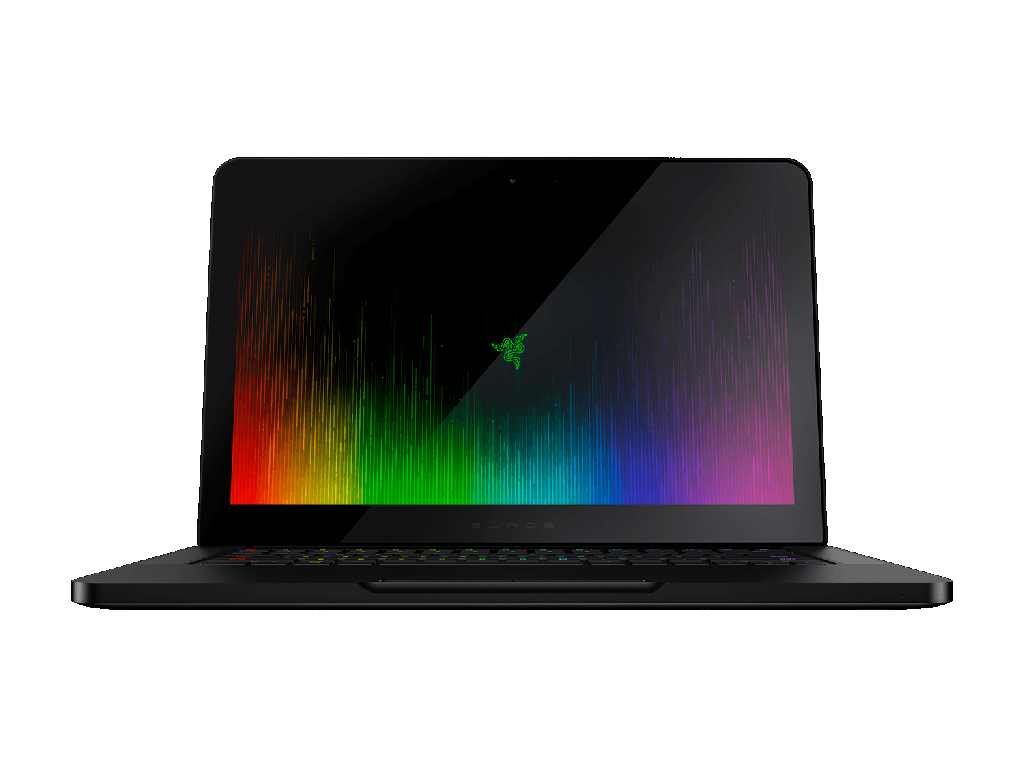 Notebook: Razer Blade 2017 UHD, Kaby Lake
Processor: Intel Kaby Lake i7-7700HQ
Graphics Adapter: NVIDIA GeForce GTX 1060 Mobile 6144 MB
Display: 14.00 inch, 16:9, 3840 x 2160 pixels
Weight: 1.95kg
Links: Razer homepage
Pricecompare
Average Score:
Reviews
Source: Slashgear
Archive.org versionThe Razer Blade is an impressive machine. If a gaming desktop is out of the question and a huge gaming laptop sounds like an unpleasant burden, look no further than Razer’s colorful and slim alternative. The addition of a 4K UHD display, latest Intel processor, and increased memory make for a solid update over past models. The laptop’s ultraportable size is truly impressive, but its loud fans mean many people won’t want to use it in public.
Single Review, online available, Medium, Date: 03/24/2018
Rating: Total score: 90%
Source: iTech Post
Archive.org versionRazer is known for making innovative yet expensive gaming laptops. The company has successfully carved its niche in the gaming industry with its consistently impressive products that cater to every whim of many a serious gamer. The 2017 Razer Blade is no different. Razer packed some serious features and capabilities into one beautifully designed hardware and came up with a gaming laptop that only the MacBook Pro can rival.
Single Review, online available, Medium, Date: 04/13/2017
Foreign Reviews
Source: Golem
DE→EN Archive.org versionSingle Review, online available, Short, Date: 01/25/2018
Source: Log.com.tr
 TR→EN Archive.org version
Single Review, online available, Long, Date: 08/24/2017
Rating: Total score: 90%
Source: PC Online.com.cn
zh-CN→EN Archive.org versionPositive: Good hardware; decent ergonomy; good connectivity; long battery life. Negative: Poor display; noisy under loads; relatively high price.
Single Review, online available, Medium, Date: 04/25/2017
Razer Blade (2017) UHD
Specifications
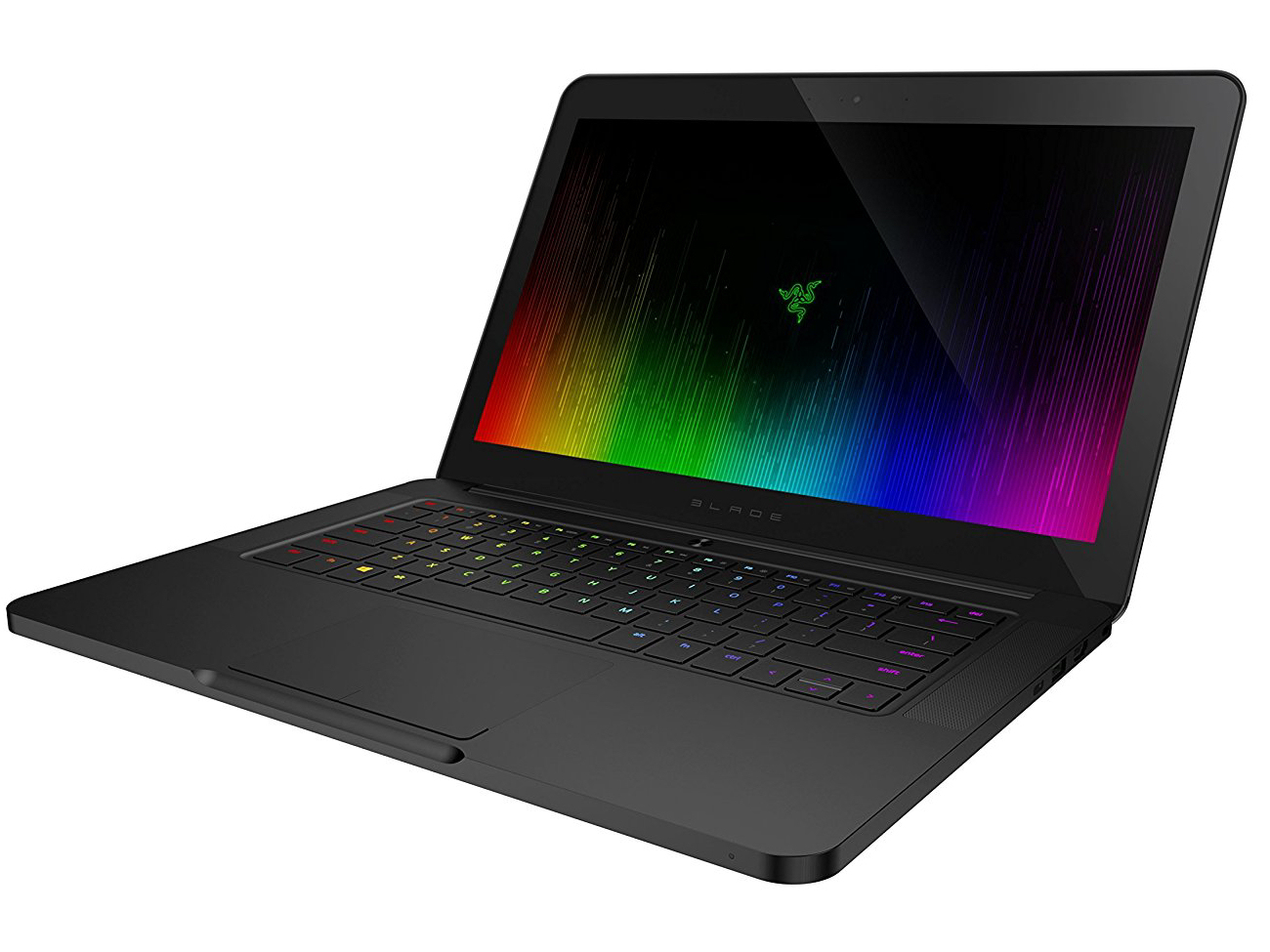 Notebook: Razer Blade (2017) UHD
Processor: Intel Kaby Lake i7-7700HQ
Graphics Adapter: NVIDIA GeForce GTX 1060 Mobile 6144 MB
Display: 14.00 inch, 16:9, 3840 x 2160 pixels
Weight: 1.946kg
Price: 2699 euro
Links: Razer homepage
Pricecompare
Reviews
Christmas tree in UHD. A fully configurable RGB keyboard backlight is one of Razer's most distinctive features. In time for the holiday season, Razer has released a UHD variant of the Kaby Lake and GTX 1060-powered Razer Blade notebook, best to be showcased with opened lid underneath the Christmas tree.
Foreign Reviews
Source: Antyweb
 PL→EN Archive.org version
Positive: Solid workmanship; metal case; slim size and light weight; long battery life; backlit keys; good connectivity. Negative: Noisy under loads; overheats while using; low performance; easy getting fingerprints.
Single Review, online available, Very Long, Date: 03/22/2018
Source: Antyweb
PL→EN Archive.org versionPositive: Solid workmanship; metal case; slim size and light weight; long battery life; backlit keys; good connectivity. Negative: Noisy under loads; overheats while using; low performance; easy getting fingerprints.
Single Review, online available, Very Long, Date: 03/22/2018
Razer Blade 17 RTX 3070
Specifications
Notebook: Razer Blade 17 RTX 3070Processor: Intel Tiger Lake i7-11800H
Graphics Adapter: NVIDIA GeForce RTX 3070 Laptop GPU 8192 MB
Display: 17.30 inch, 16:9, 1920 x 1080 pixels
Weight: 2.75kg
Price: 2800 euro
Links: Razer homepage
Pricecompare
Reviews
Razer's latest 17.3-inch gaming laptop gets a swift name change alongside several internal updates. If you're still holding onto a GTX gaming laptop, then it's now looking like a good time to upgrade.
Comment
Razer: Razer USA Ltd. is a US hardware manufacturer founded in 1998. The focus is on gaming devices as well as accessories, traditionally computer mice and mouse pads. The products are often named after mythical creatures or animals. However, Razer laptops are also offered under the series name "Blade". Razer has also released a VOIP software called Razer Comms.
Modern games should be playable with these graphics cards at low settings and resolutions. Casual gamers may be happy with these cards.
NVIDIA GeForce GT 555M:
As the successor to the GeForce GT 445M, the GT 555M is available in many different versions based on different chips (GF106, GF116, GF108) with different graphics memory (128 Bit, 192 Bit, DDR3, GDDR5) and varying core speeds.
NVIDIA GeForce GTX 660M:
High-end graphics solution as part of the 600M series and the slowest enthusiast GTX model.
NVIDIA GeForce GTX 765M:
High-End Graphics cards as part of the Geforce 700M series based on the Kepler architecture.
NVIDIA GeForce GTX 870M: High-end graphics card from the GeForce GTX 800M series.
NVIDIA GeForce GTX 970M:
Second fastest high-end graphics card based on the Maxwell GM204 chip from the GeForce GTX 900M series.
With these GPUs you are able to play modern and demanding games fluently at medium detail settings and HD resolution.
NVIDIA GeForce GTX 1060 Mobile: The mobile GTX 1060 is based on the GP106 chip and offer 1280 shaders. Compared to the identically named desktop version it features a slightly lower clock rate. Games in Full HD and maximum details should run fluently on the card.
These graphics cards are able to play the latest and most demanding games in high resolutions and full detail settings with enabled Anti-Aliasing.
NVIDIA GeForce RTX 3070 Laptop GPU: High-End laptop graphics card based on the Ampere GA104 chip. Available in different versions with a TDP from 80 to 125 Watt.
» Further information can be found in our Comparison of Mobile Graphics Cards and the corresponding Benchmark List.
Intel Core i7: The Intel Core i7 for laptops is based on the LG1156 Core i5/i7 CPU for desktops. The base clock speed of the CPUs is relatively low, but because of a huge Turbo mode, the cores can dynamically overclock to up to 3.2 GHz (920XM). Therefore, the CPU can be as fast as high clocked dual-core CPUs (using single threaded applications) but still offer the advantage of 4 cores. Because of the large TDP of 45 W / 55 W, the CPU is only intended for large laptops.
2640M: Very fast dual-core processor based on the Sandy Bridge architecture with an integrated graphics card and dual-channel DDR3 memory controller.
3632QM: An Ivy Bridge-based quad-core processor clocked at 2.2 GHz with Turbo Boost support up to 3.2 GHz. Offers an integrated HD Graphics 4000 GPU and a dual channel DDR3 memory controller. The speciality of the i7-3632QM is the low TDP of 35 Watt compared to 45 Watt of the other Ivy Bridge quad core CPUs (e.g. 3610QM).
4702HQ: Haswell-based quad-core processor clocked at 2.2 GHz with Turbo Boost support up to 3.2 GHz. Offers an integrated HD Graphics 4600 GPU and a dual channel DDR3 memory controller.
4720HQ: Haswell-based quad-core processor clocked at 2.6 GHz with Turbo Boost support up to 3.6 GHz. Offers an integrated HD Graphics 4600 GPU and a dual channel DDR3 memory controller.
6700HQ: Skylake-based quad-core processor for notebooks. Offers an integrated HD Graphics 530 GPU and is manufactured in 14 nm.
Intel Kaby Lake:
i7-7700HQ: Quad-core notebook processor based on the Kaby Lake architecture. Besides four CPU cores (including Hyper Threading), the chips also integrates the HD Graphics 630 GPU and is manufactured in an improved 14 nm process.
Intel Tiger Lake:
i7-11800H: Tiger Lake (H45 series) based high end octa-core SoC for gaming laptops and workstations. The eight CPU cores run at 2.3 GHz to 4.6 GHz. The integrated UHD Graphics GPU offers 32 EUs at up to 1.45 GHz. The chip is manufactured on the second-gen 10 nm Intel SuperFin process.
» Further information can be found in our Comparison of Mobile Processsors.
14.00:
14 inch display size represents a middle ground between the small subnotebook formats and the screens of the standard 15 inch laptops.
The reason for the popularity of mid-sized displays is that this size is reasonably easy on the eyes, provides good resolutions with usable detail sizes, yet does not consume too much power and the devices can still be reasonably compact.
In the past, 14-inch devices were very rare, but now they are the standard for laptops after the 15-inchers.
» To find out how fine a display is, see our DPI List.
1.84 kg:
3.2 kg:
A laptop with this weight is comparatively heavy and less designed for mobility than for use at the desk. Therefore, the devices tend to shine less with battery life than with a large screen and higher performance.
82.13%: This rating is slightly above average, there are somewhat more devices with worse ratings. However, clear purchase recommendations look different.
» Further information can be found in our Notebook Purchase Guide.