




Whoop users could soon be free from expensive subscriptions thanks to this open-source app

Hardware subscription fatigue is reaching a boiling point, and quite frankly, consumers are increasingly tired of buying a premium piece of technology, only to find that their own biometric data is locked behind a mandatory monthly paywall. We saw this friction recently when Oura Ring users began looking for subscription-free workarounds to access their data, and now the movement has arrived for screenless fitness trackers.
The primary target this time is Whoop. From its inception, the company has built its business model on the idea that the wearable is useless without an active subscription. If you stop paying the monthly fee, the device on your wrist essentially becomes a paperweight.
However, an independent developer named Bennet is challenging that paradigm with an open-source project called Goose, which aims to see just how much utility can be squeezed out of the tracker without giving Whoop another dime. Announced recently on X, the project is a raw, pre-alpha proof of concept. It is far from a polished consumer application, but it successfully achieves the unthinkable: it pulls and displays health data directly from the wearable entirely offline.
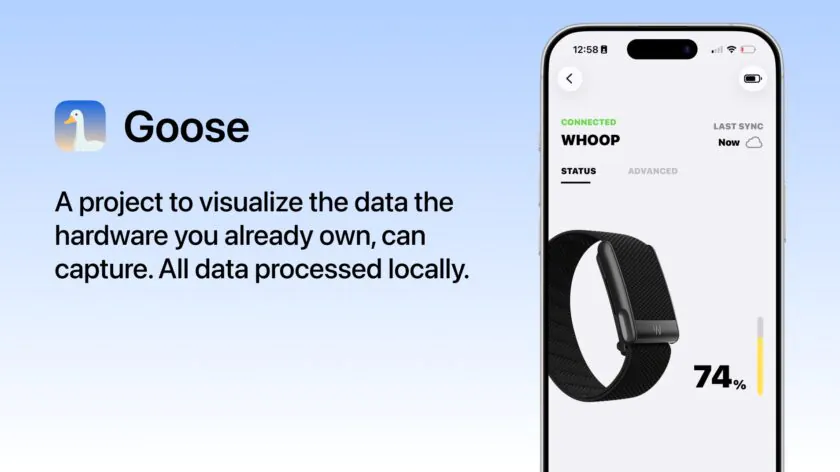
I had a look at the GitHub files, and the app eliminates the need for external servers by operating as a local-first application. When the fitness band transmits data, the app uses standard Bluetooth connection protocols on your phone to intercept the raw data packets right out of the air.
To handle this constant stream of data without melting your phone's battery, the project uses a hybrid architecture. The user interface is built using SwiftUI, giving you a clean dashboard for tracking sleep, strain, and recovery metrics. Meanwhile, the heavy lifting of parsing and decoding those raw Bluetooth packets is handed off to a high-performance backend written in Rust. The two sides communicate locally on the device, ensuring your health data never leaves your phone.
Now, while the achievement is impressive, the project is still a developer's playground rather than a viable alternative for the average user. Because the code is unoptimized, early builds suffer from quite a lot of processing lag. The app is also currently built exclusively for iOS devices, meaning Android users are locked out for the time being. There’s also no support for older hardware, and the app only works with the latest Whoop 5.0 model. If you don't feel like trying out the app, Google recently launched Fitbit Air, a direct competitor to Whoop that doesn't rely heavily on subscriptions. There's also a Google Health premium subscription if you need more information.
 Add as a preferred source on Google


