




Scientists detect northern glow spanning Iceland and Canada
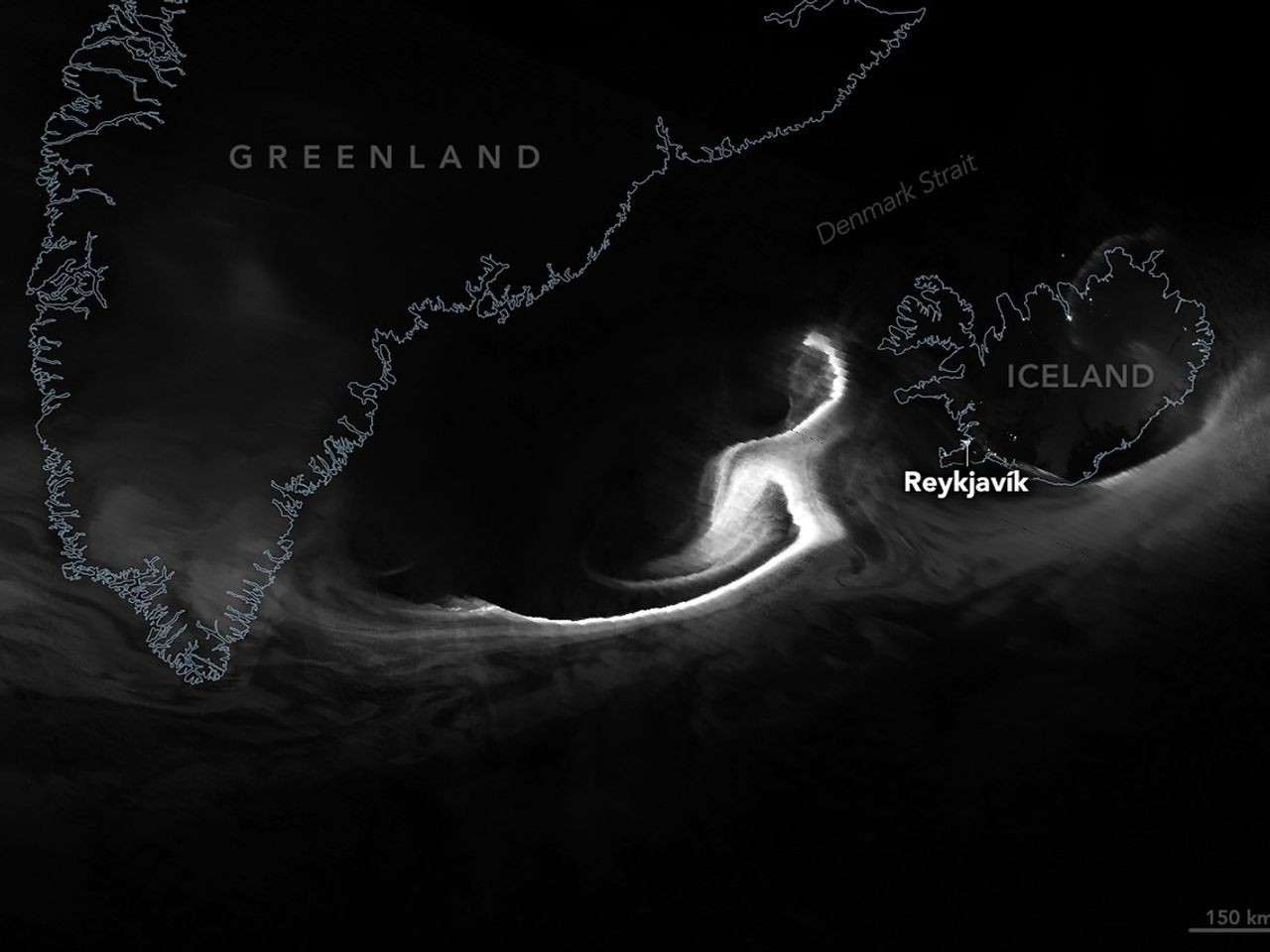
In the early hours of February 16, the VIIRS (Visible Infrared Imaging Radiometer Suite) on the Suomi NPP captured images showing an auroral display (aurora borealis or northern lights). The image at the top shows the lights over the Denmark Strait and Iceland at 4:45 UTC (4:45 a.m. local time in Reykjavík). The second image shows the lights dancing around the Canadian provinces of Québec and Newfoundland and Labrador at about 06:30 UTC (1:30 a.m. local time in Montreal).
The instrument observes light in various wavelengths from green to near-infrared. It then uses filtering techniques to detect signals such as auroras. Although this image appears in grayscale, auroras are actually colorful. They appear in colors ranging from green to purple.
Like all others, this aurora was produced by a geomagnetic storm, specifically a G1 storm. A G1 storm is a minor geomagnetic storm. Though less powerful than higher classifications of geomagnetic storms, G1 storms also cause electrical disturbances that result in auroras. They can also cause slight disruptions in power grids and satellite operations. However, the G1 storm that produced this aurora later progressed into a G2 storm.
With the newly launched GNEISS (Geophysical Non-Equilibrium Ionospheric System Science) mission, NASA is set to gain a bettter understanding of the electrical environment that produces auroras like this one.
Buy the Enokik Northern Light Projector for $29.98 on Amazon.
Source(s)
 Add as a preferred source on Google


