




Hubble captures a dramatic light show around a dying star

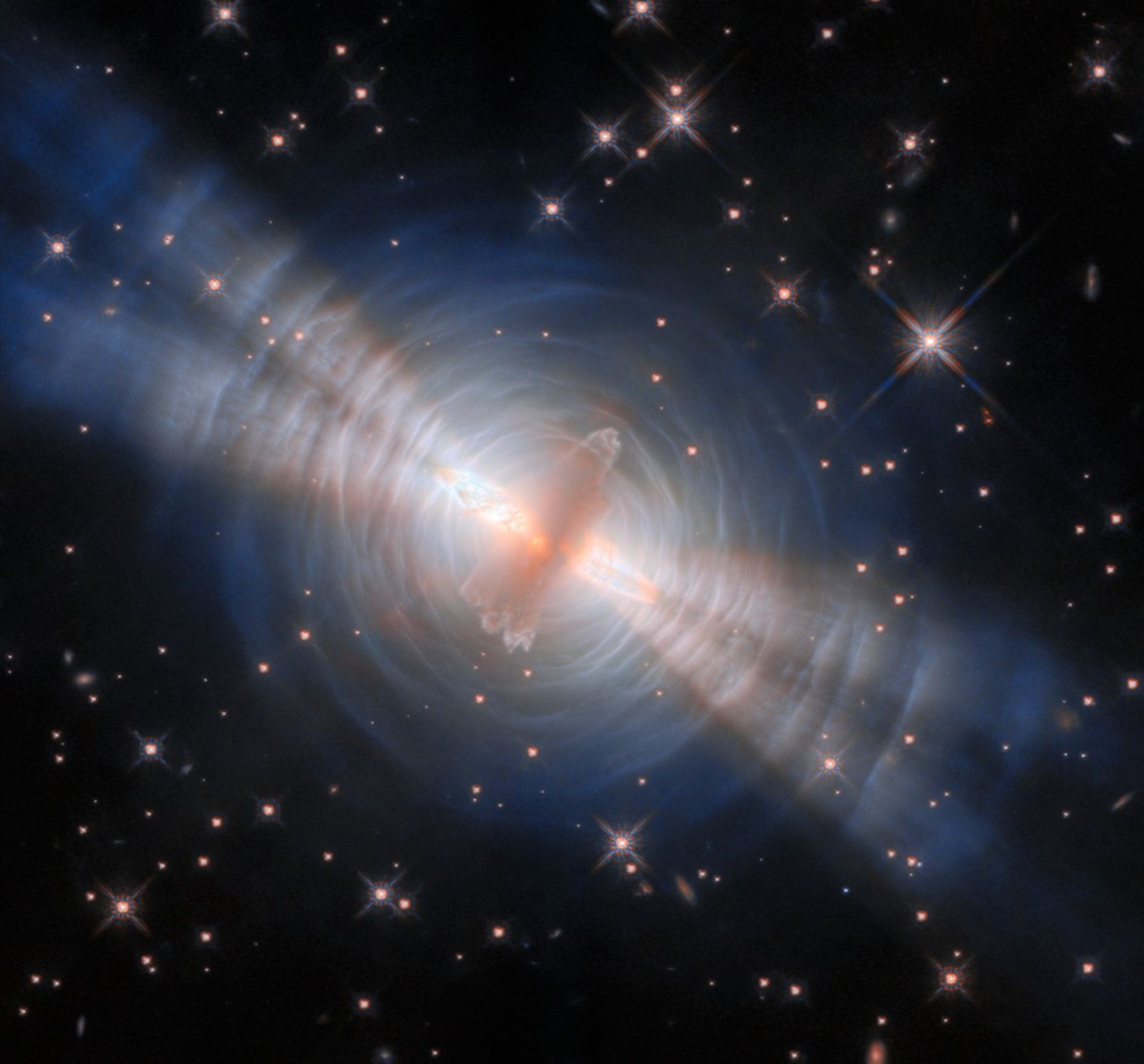
The Egg Nebula is located about 1,000 light-years away in the constellation Cygnus. It is so-named due to its appearance. It has a central star whose light is blocked out by a dense cloud of dust, just like egg white covers the yolk.
In this image, there are two polar beams of light visible on both sides of the central star. This is likely due to light passing through polar openings in the thick central dust.
The light beams also reveal arcs that have a symmetrical ripple-like appearance. This is evidence that the star likely ejected gas and dust in a coordinated manner rather than as a violent explosion. However, scientists have not fully understood how this coordinated ejection happens. The shapes and motions of the beams also suggest gravitational interactions with one or more hidden companion stars buried deep within the thick central dust.
The Egg Nebula is still in a pre-planetary phase — a phase that lasts only a few thousand years. It is yet to become a planetary nebula with an exposed hot core. So, it is not capable of making its surrounding gas glow by ionization. The gas and dust are only reflecting the light from the dying star itself. Tracking this stage is crucial to understanding the late-stage stellar evolution, and Hubble is helping with it.
Source(s)
 Add as a preferred source on Google


