




Update | Nintendo wants Japanese government to limit generative AI use in game development
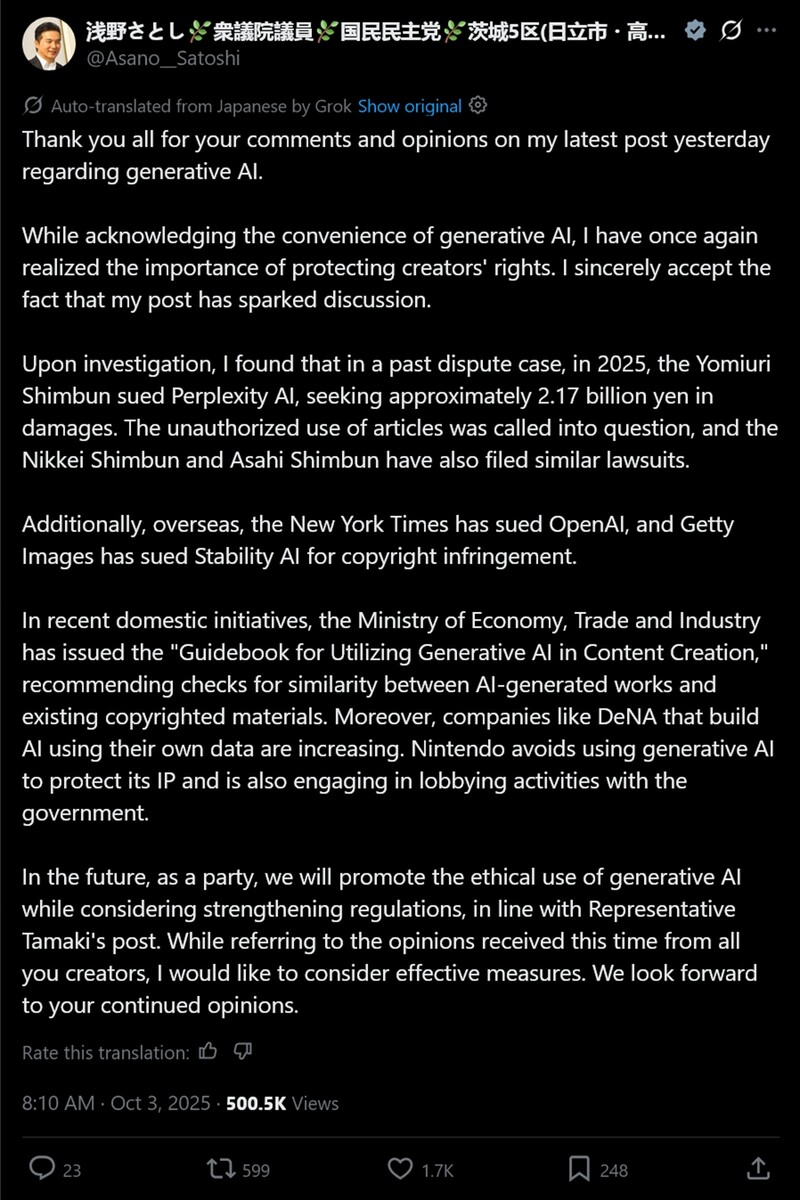
05 October 2025, 02:50 PM GMT update:
Nintendo has since denied the report that it lobbied the Japanese government regarding generative AI. Satoshi Asano has also issued a correction in a new social media post. Nintendo says it will continue to pursue any copyright infringement claims against its IPs.
Original article with some very minor style-related edits continues as follows:
Executives have previously downplayed the role of generative AI in Nintendo games. Nintendo is now more aggressively campaigning against its use by other game developers. Satoshi Asano, a House of Representatives member, recently commented on the gaming giant's lobbying within the Japanese government.
On social media, Asano discusses how the Ministry of Economy, Trade and Industry, compiled a “Guidebook for Utilizing Generative AI in Content Creation”. One of its recommendations is that companies must ensure that AI-produced creations don’t borrow from existing works. He then mentions that Nintendo, which regularly pursues copyright infringement claims, avoids generative AI. It also supports the government’s efforts to regulate the technology.
Nintendo figures like President Shuntaro Furukawa have already warned against the risks of generative AI. Shigeru Miyamoto, the creative force behind many Nintendo games, also explained that the company rarely follows industry trends.
Critics in favor of regulations advocate for defined rules for the role of AI in gaming. Masahiro Sakurai, the mastermind behind the Super Smash Bros. and Kirby titles, acknowledged that AI may be a solution to laborious game development. Still, the tools should only benefit productivity, rather than replace human talent.
Nintendo may face an uphill battle against AI
Many publishers don’t share Nintendo’s views on the controversial subject. A study by the Computer Entertainment Supplier’s Association (CESA) found that over half of Japan’s game companies embrace artificial intelligence. Rivals like Capcom are more confident that it can be used safely without copyright infringement concerns. Some developers already incorporate machine-generated voiceovers and other assets into their titles. These actions prompted Steam to add disclaimers to its store listings.
Nintendo fans are generally supportive of the company’s crusade against generative AI. Nevertheless, most analysts expect opponents to inevitably lose the battle. As game development changes, it will be interesting to see Nintendo’s attitude toward the technology evolve.
Source(s)
 Add as a preferred source on Google


