




Linux gaming: Latest patch brings 7x improvements on 'potato' hardware

Linux Kernel 7.3 will be featuring a scheduler overhaul aimed precisely at gaming performance. If the gains are anything to go by, the update does appear to be quite a success.
The scheduler updates have now been merged into Linux 7.3, aiming specifically at boosting gaming performance on lower-specced machines, including and especially older-generation products.
The patch, thanks to contributor Peter Zijlstra, works by restructuring how cgroup scheduling weight gets distributed.
Technically speaking, it modifies EEVDF to rely on a single runqueue in certain cgroup situations. This, in turn dials down the rescheduling jitter, which has historically had a rather adverse effect on frame pacing on lower-end and last-gen hardware.
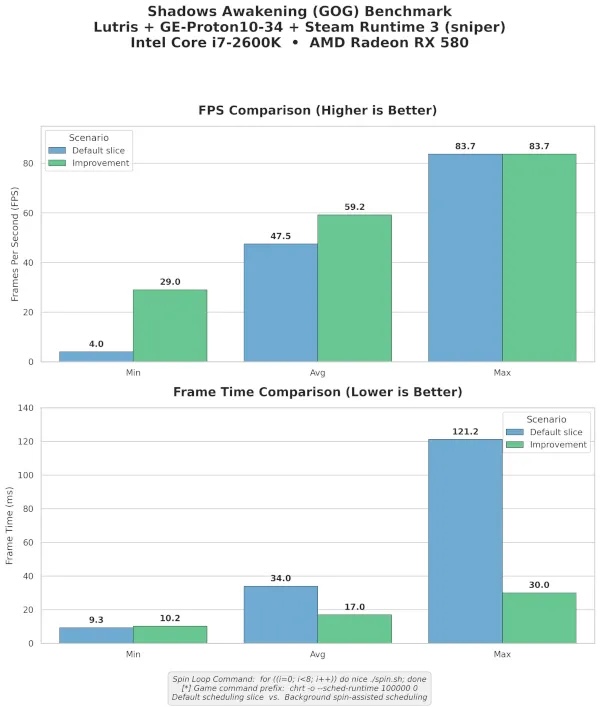
As mentioned earlier, the results are quite impressive. When tested on a system with what now appears to be a prehistoric Intel Sandy Bridge (Core i7 2600K) CPU paired with an AMD Radeon RX 580 Polaris GPU, the aforementioned improved scheduling logic showed promising benchmark improvements under heavy loads.
As pointed out by Phoronix, minimum FPS went up from 4 to a whopping 29, while average FPS went up from 47.5 to a much more playable 59.2. Max frame rates unsurprisingly stayed roughly the same at around 83 or 84 FPS.
Frame times also witnessed a massive jump, as can be inferred from the following image:
True Linux aficionados will know that mainstream kernel adoption is a rather slow process. However, CachyOS, the performance-first Arch-based distro has already announced that the changes will be reflected soon, although an exact time frame was not provided.
Source(s)
 Add as a preferred source on Google


