




Image of two interacting dwarf galaxies emerges as Webb’s Picture of the Month
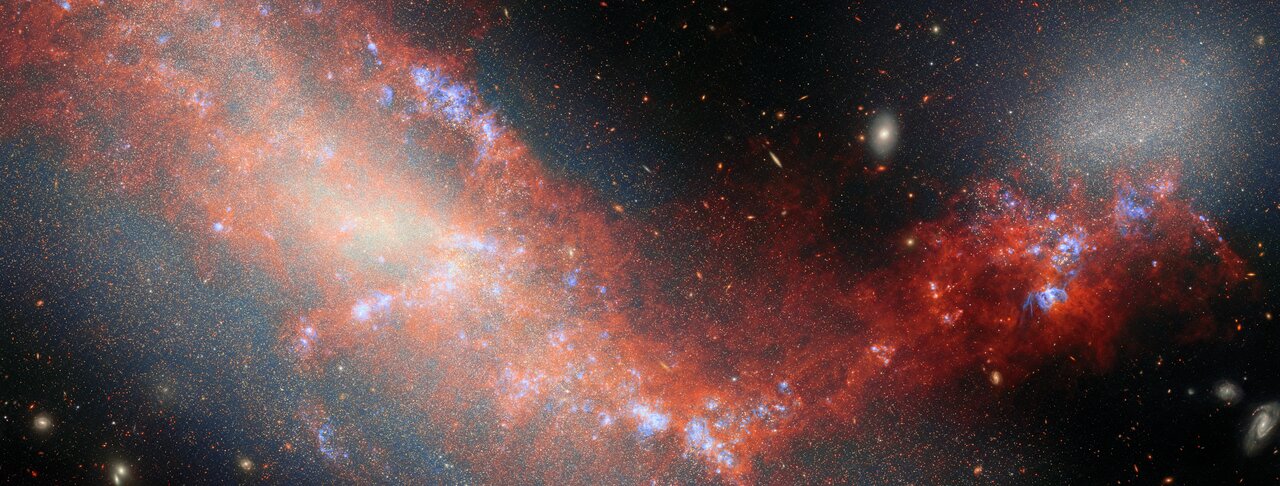
NGC 4490 and NGC 4485 are dwarf companion galaxies located about 24 million light-years away in the constellation Canes Venatici (The Hunting Dogs). These galaxies are connected by a wispy bridge of gas. The connecting gas bridge formed roughly 200 million years ago. During that time, the galaxies wandered close to each other, and NGC 4490 drew and trapped a stream of gas from its dwarf companion.
Star formation then started to take place along the gas bridge. The gas in the bridge became dense enough to host the birth of new stars. More recently, just 30 million years ago, new star clusters formed within the gas bridge. These young star clusters glow bright blue in this image.
Scientists were able to understand the timeline of the galaxies’ interaction thanks to Webb’s observation. Webb utilized its Near-Infrared Camera (NIRCam) and Mid-Infrared Instrument (MIRI) to make the observation. Data from the NIRCam, MIRI, and a single narrow-band filter from Hubble (657N) were used to produce the displayed image.
In the image, the larger galaxy, which is located on the left, is NGC 4490. NGC 4485 is the smaller galaxy located at the top-right of the image. A bright stream of red gas joins the two galaxies.
This Webb observation is part of the Feedback in Emerging extrAgalactic Star clusTers (FEAST) program (#1783). It aims to uncover the once-hidden history between NGC 4490 and NGC 4485.
Source(s)
 Add as a preferred source on Google


