




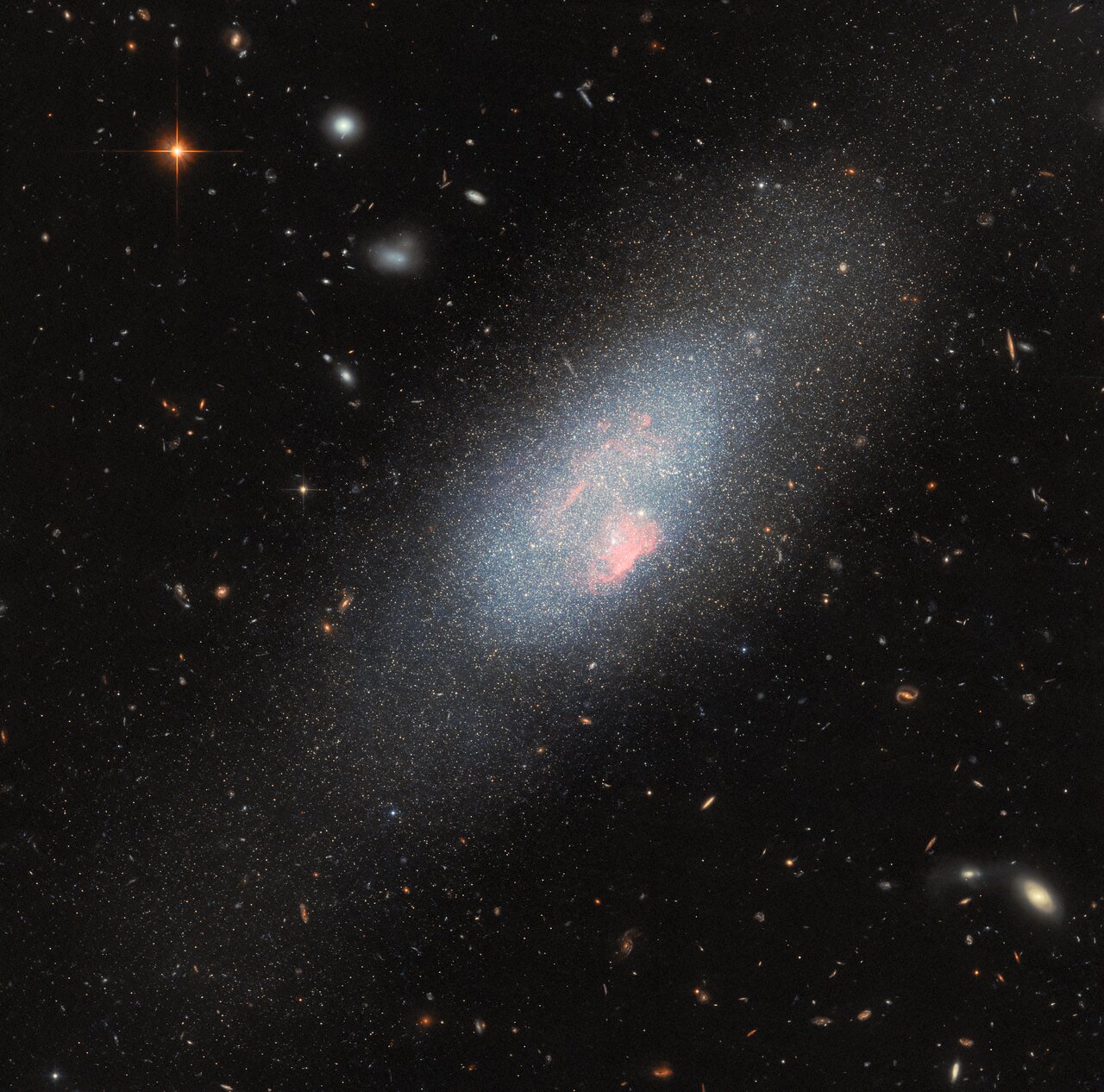
Galaxy with an azure cloud filled with giant stars is the Hubble Picture of the Week pick

Markarian 178 (Mrk 178) is a dwarf galaxy. This means that it is much smaller than our Milky Way. Mrk 178 lies 13 million light-years away in the constellation Ursa Major (The Great Bear). Like other Markarian galaxies, Mrk 178 is remarkably bright when viewed in ultraviolet light.
In this Hubble observation, Mrk 178 appears as a blue compact galaxy in a black background. The blue color indicates that there are countless young hot stars within the galaxy. But the galaxy is not all blue. There’s a red-colored appearance that is more concentrated towards the edge of the galaxy. This reddish appearance is formed due to the presence of a rare class of stars called Wolf-Rayet stars.
Wolf-Rayet stars are extremely massive and extremely hot stars that only last a few million years. These stars are in the final stage of their lives before they explode as supernovae and become a neutron star or black hole. The stars blast away their outer layers into space using strong stellar winds. The strong emissions from the Wolf-Rayet stars ionize the surrounding hydrogen gas, producing the observed red light.
The fact that Wolf-Rayet stars last only a few million years means that something must have triggered the recent burst of star formation. Deeper images from the Large Binocular Telescope revealed faint tidal features around the galaxy. These tidal features suggest that a smaller satellite galaxy in the past might have triggered the recent star formation in Mrk 178.
Future Hubble observations of this galaxy will help astronomers study how star formation exactly happened in Mrk 178.
Source(s)
 Add as a preferred source on Google


