




Dazzling starburst galaxy shines in Hubble’s picture of the week
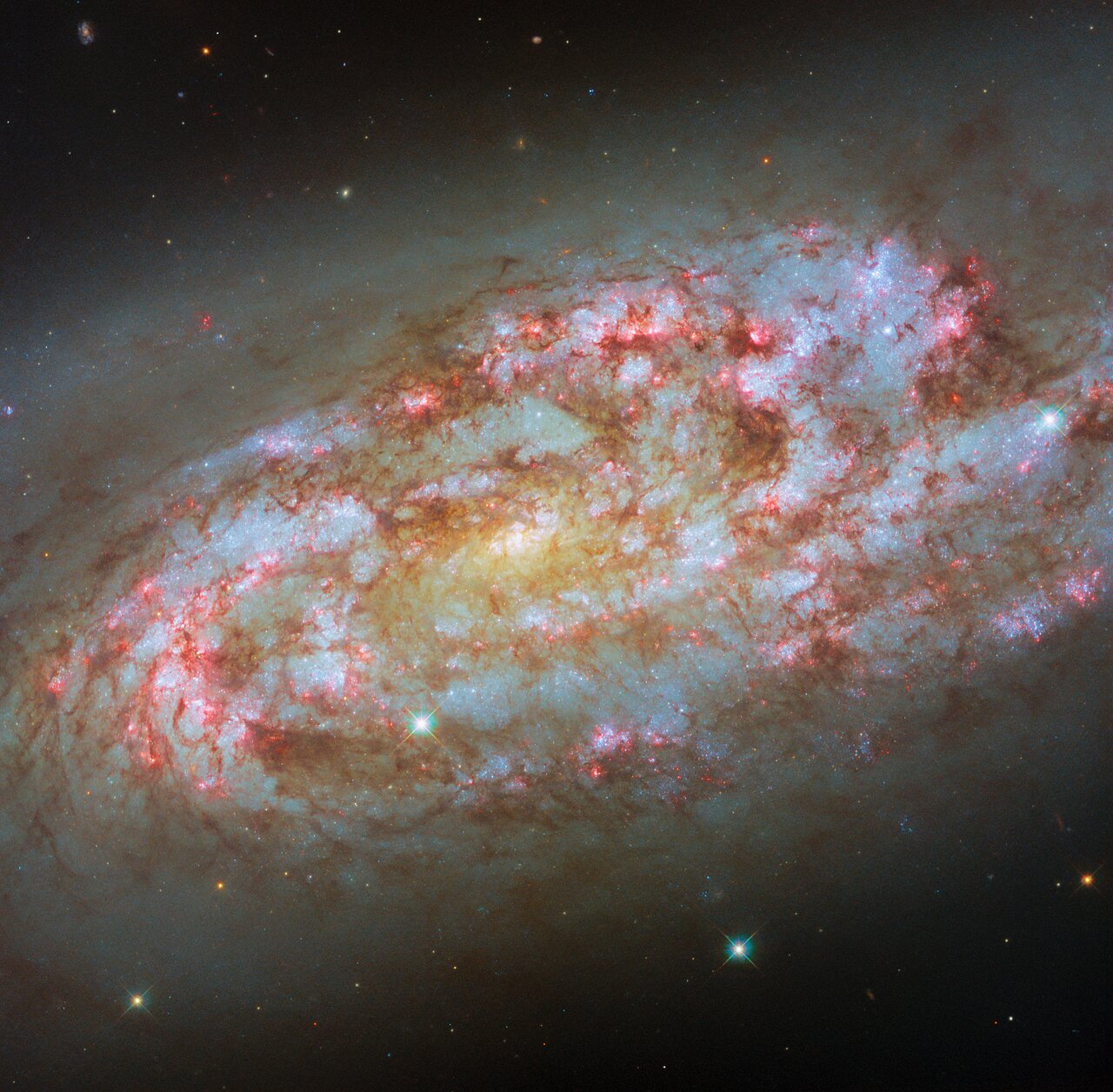
NGC 1792 is a starburst galaxy located over 50 million light-years away in the constellation Columba (The Dove). A starburst galaxy is a galaxy that is undergoing an exceptionally high rate of star formation. In such galaxies, star formation can occur 10 times faster than in the Milky Way.
It's NGC 1792’s high activity and resulting turbulent look that makes it an instant object of interest. Hubble previously observed the galaxy in 2020, showing that the area is filled with young, hot stars. But now, Hubble has revisited the galaxy and has provided even more data.
This new image captures H-alpha light. H-alpha light is a red light produced by ionized hydrogen. The hydrogen molecules are ionized due to the powerful ultraviolet radiation produced by young stars within star-forming clouds. The dense, dark reddish clouds are also remarkable in this image. The clouds and the sparkling spiral arms, in general, cover much of the glowing center.
Scientists are dong research to understand more about regions like this. They have found that the strong gravitational interaction between NGC 1792 and its larger neighbor, NGC 1808, could be the cause of the excessive gas presence in and around NGC 1792. This observation may help astronomers and astrophysicists understand the relation and interaction between gas, star clusters, and supernovae in galaxies.
Buy the beginner-friendly Gskyer Astronomical Refracting telescope for $96.99 on Amazon.
 Add as a preferred source on Google


