From waste to fuel: New method transforms used ground coffee into high-quality fuel in 90 seconds
Global coffee consumption produces at least 18 million tonnes of spent coffee grounds each year. Most of the resulting waste is sent to landfills or incinerated, generating greenhouse gases and environmental pollution. While used ground coffee hold lots of potential as an energy source, its high moisture content has long been an obstacle, since converting it into fuel or carbon products has typically required energy-intensive predrying that makes utilizing this energy source at scale economically unfeasible.
Researchers at the Korea Institute of Geoscience and Mineral Resources have created a process that transforms wet, used ground coffee into high-quality biochar in just 90 seconds without the need for drying or oil extraction beforehand. The process provides a quick, energy-efficient way of converting moisture-heavy organic waste into useful fuel and carbon-based materials. The findings have been published in the Chemical Engineering Journal.
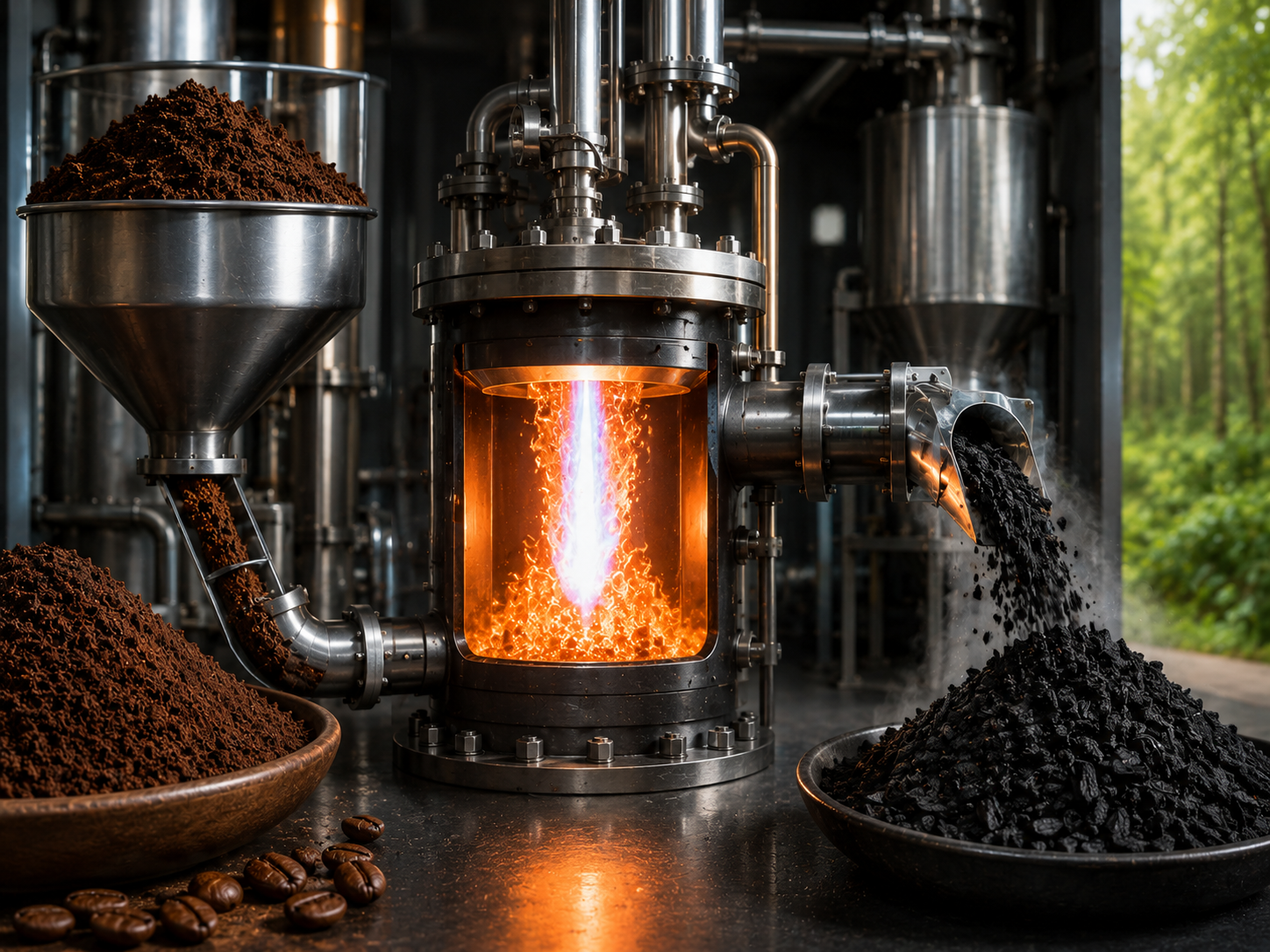
The process itself makes use of Flame Plasma Pyrolysis (FPP), which treats biomass with roughly 55% moisture directly under atmospheric-pressure plasma, using plasma flames at about 800–900°C (1,472–1,652°F) generated from burning LPG and compressed air, eliminating the need for predrying. The intense heat rapidly vaporizes moisture inside the biomass particles, and the resulting pressure buildup causes microscopic "popcorn effect" explosions that boost carbonization and create highly porous structures, turning moisture from an obstacle into a steam-activation agent that speeds reactions and improves product quality. Complete conversion is reached in just 90 seconds under optimized conditions, with a mass reduction of 83.3%.
The resulting biochar is suitable both as a renewable solid fuel and as a high-value carbon material for environmental and industrial uses. Furthermore, the FPP process holds potential for application to a broad range of high-moisture organic wastes, such as food waste, sewage sludge and agricultural residues. Its compact design and ultrafast processing make it especially well-suited for decentralized, onsite waste-to-energy facilities, where resource recovery efforts are often hindered by the costs of transportation and drying.
Source(s)
 Add as a preferred source on Google