




Windows 11 vs Linux RAM usage in web browsing and gaming reveals big difference

Partly due to the ongoing DRAM crisis and partly due to Microsoft’s continuing "enshittification" of Windows, many users are jumping to Linux-based operating systems. This migration has also been driven by the fact that gaming on Linux has come a long way. Gamers are also attracted to Linux due to the platform’s tight resource usage.
Linus Tech Tips has conducted a simple side-by-side comparison of Linux Mint and Windows 11 to see how much of a difference there exists in RAM usage between the two operating systems. Unsurprisingly, Linux uses much less RAM.
Starting with the idle RAM usage, LTT shows that Windows 11 consumes up to 9.3 GB while doing nothing. Linux, on the other hand, uses just 4.7 GB. Opening the lttstore website on FireFox pushed Windows 11 and Linux RAM usage to 10.7 GB and 5.9 GB, respectively. So, Windows 11 consumed an additional 1.4 GB RAM and Linux used 1.2 GB of RAM over idle usage.
The pattern was the same on Chrome while browsing other websites. Windows 11 always reportedly uses considerably more memory during web browsing.
Windows 11 also consumes much more memory in games. In Slay the Spite 2, for instance, LTT’s comparison reveals memory usage of 12.5 GB on Windows 11 and 7.1 GB of Linux. Both systems were apparently running Discord in the background. The difference was also roughly the same in Baldur’s Gate 3 where Windows 11 was using 15 GB in game, while Linux stood at 9 GB.
In short, LTT’s rudimentary test shows that Windows 11 uses much more RAM both during day-to-day use and gaming. However, this doesn’t eniterly mean that Windows 11 sucks at RAM usage, as the system never got close to being RAM-limited.
Windows 11 using more RAM is not inherently bad
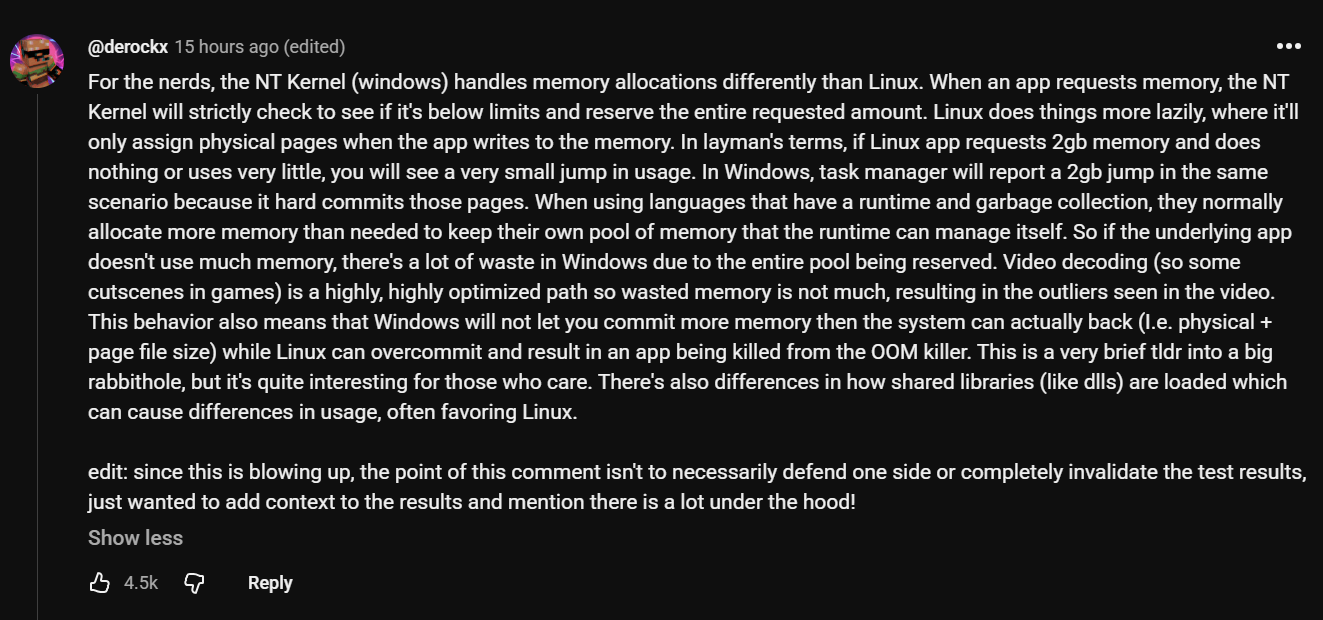
Modern operating systems are intelligent enough to use as much or as little memory they need. As explained by a helpful YouTube comment linked at the end, Windows and Linux handle this RAM management differently, which is why we see such a vast difference between the two.
So, rather than fixating on the amount of RAM an operating system uses, a better approach seems to be to test the responsive and usability of the system. Practically speaking, a system using 16 GB of RAM is not inferior to the one using 8 GB, if the former is snappy and user experience never degrades.
Source(s)
Linus Tech Tips on YouTube, Teaser image source: Navo Hosting on Pixabay, lintober on Pixabay, edited
 Add as a preferred source on Google


