




Why does the watch industry still make billions in the smartwatch era?
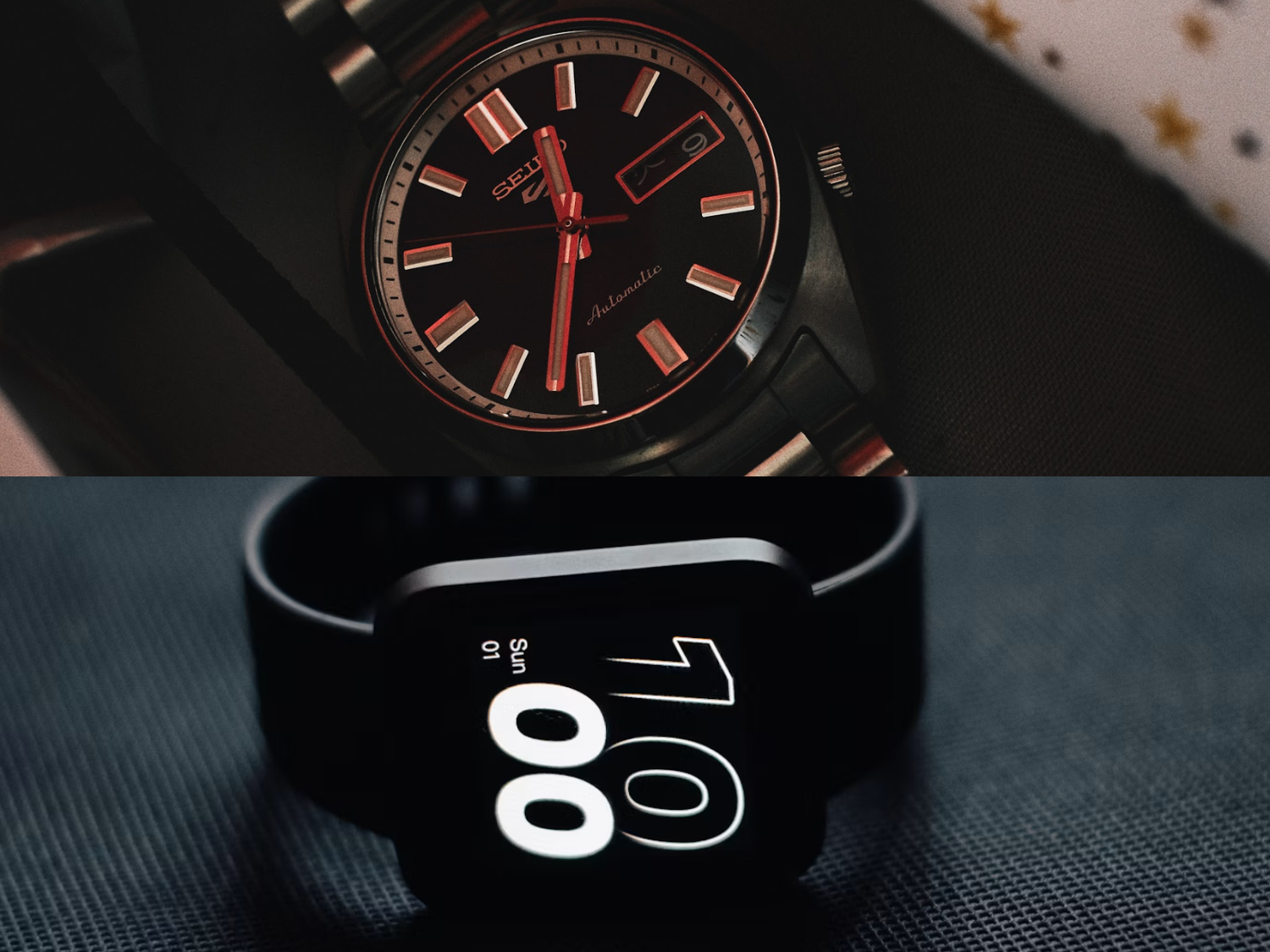
A colleague asked me a pretty standard question last week about dress watch prices: what's the point of buying and wearing a watch? He wears a Huawei. It gives him blood pressure readings, which is more than any Seiko will ever manage. His verdict on the watch I'd been going on and on about was shorter still — it just tells the time.
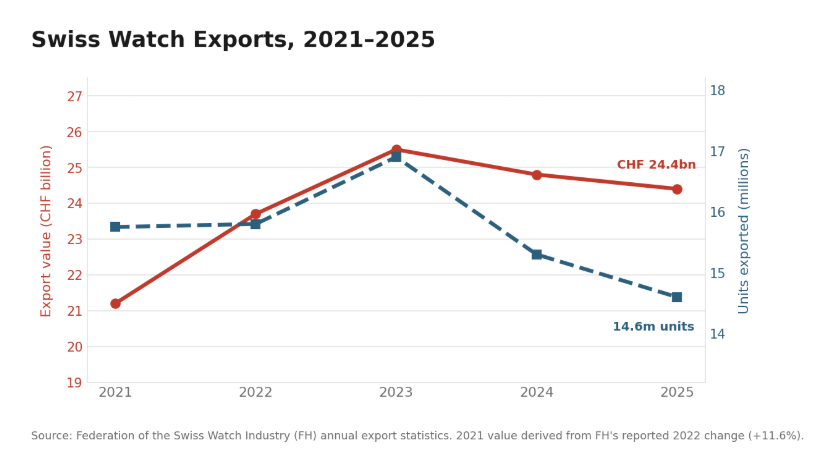
He isn't wrong. He's also, commercially speaking, in a declining minority. In 2025, Swiss watch exports were worth CHF 24.4 billion across roughly 14.6 million units. The entire global smartwatch market — every Apple Watch, every Galaxy, every Huawei — turned over something in the region of $35 billion across ten times as many devices. One of those industries was supposed to have been destroyed by the other about a decade ago.
It wasn't, but the "survival" is stranger than the usual explanations allow. The watch industry didn't beat the smartwatch. It fractured into three separate businesses, each of which found a different way to live alongside it.
The Swiss answer is to sell fewer, charge more
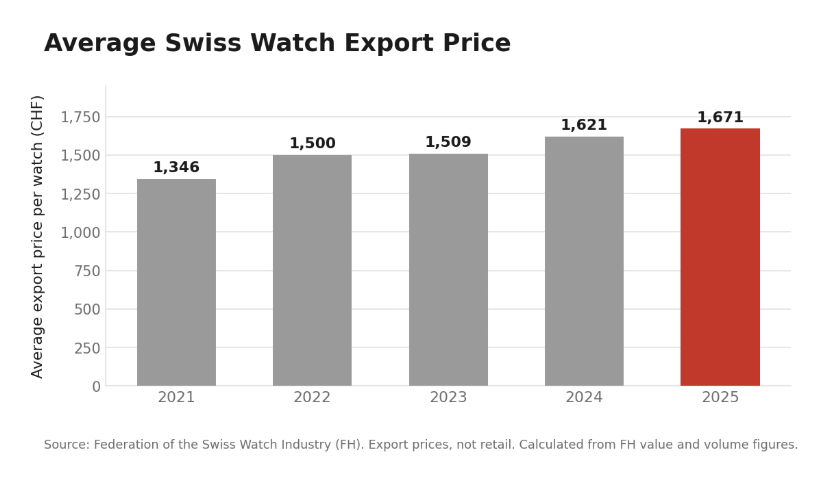
Have a look at the Federation of the Swiss Watch Industry's own figures: export value fell 1.7% in 2025 to CHF 24.4 billion (~$30.3 billion), while unit volumes dropped 4.8% to 14.6 million. That's 740,000 fewer watches than the year before. That followed a worse year: 2024 saw volumes fall 9.4%, or 1.6 million units, to what the FH itself called a "historically low level."
Value held up because the mix changed. Watches above CHF 3,000 (~$3,720) kept showing strong demand while most other categories just declined, and turnover on watches below CHF 3,000 collapsed by 15.6% in 2024 alone. What's more, the industry didn't defend the territory smartwatches took over. It abandoned it and moved upmarket, where a "wrist computer" isn't a competitor because it is not the same category of product.
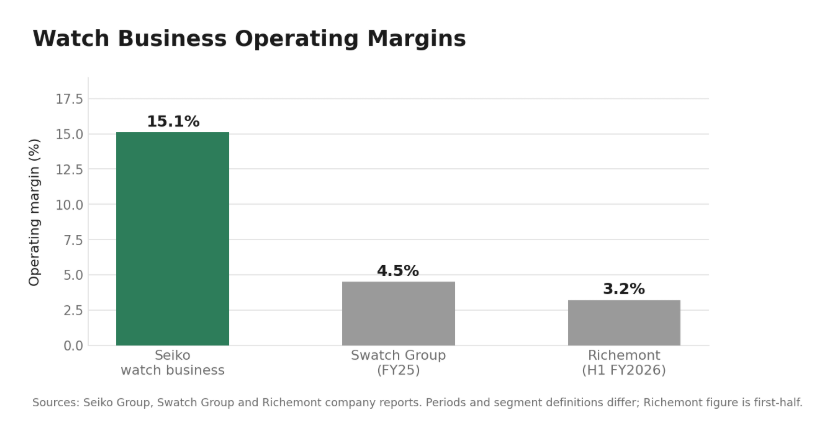
That sort of works, until it doesn't. Profitability paints a far better picture here: Swatch Group's operating margin was at 4.5% in FY25, and Richemont's at 3.2% in H1 2026. Mid-market names have been hit the hardest, with Tudor down 34% and Oris down 23%. An industry that survives by selling fewer, more novel watches is also an industry quietly dismantling the entry point that generates new future customers.
The whole assumption underneath the whole "smartwatches killed watches" narrative is that smartwatches themselves kept winning. Well, they didn't, at least not continuously. Counterpoint recorded a fifth consecutive quarter of decline in Q1 2025; global shipments were down 2% year-on-year. This was driven by weakening Apple volumes and a sharp deceleration in markets like India. The category only returned to growth across 2025 as a whole, up 4% after a down year in 2024, and Apple posted its first annual shipment growth since 2022, thanks to a full portfolio refresh.
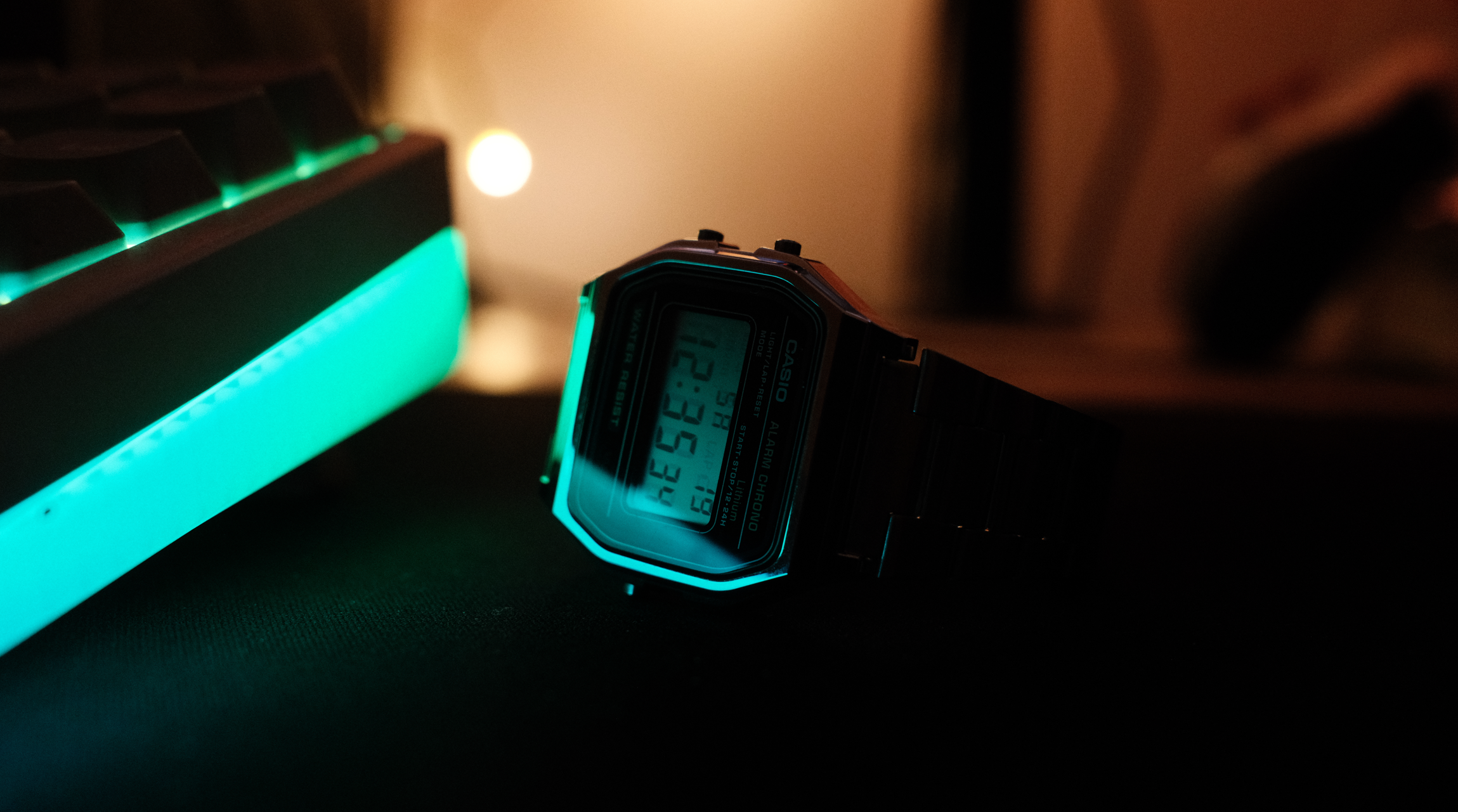
Something else in that data matters even more. In Q1 2025, the sub-$100 smartwatch segment shrank 17% while the $100-200 tier grew 21%. Buyers are consolidating around fewer, better devices, instead of treating them as disposable. If you think about it, that's the kind of behaviour that makes a $50 Casio a rational second purchase and not a redundant one. The smartwatch stopped being the thing you wear everywhere and became the thing you wear for a specific reason.
The Japanese answer is to compete anyway
While the Swiss "retreated upmarket", Japan's big three went the other way and grew faster than either the Swiss or the smartwatch category.
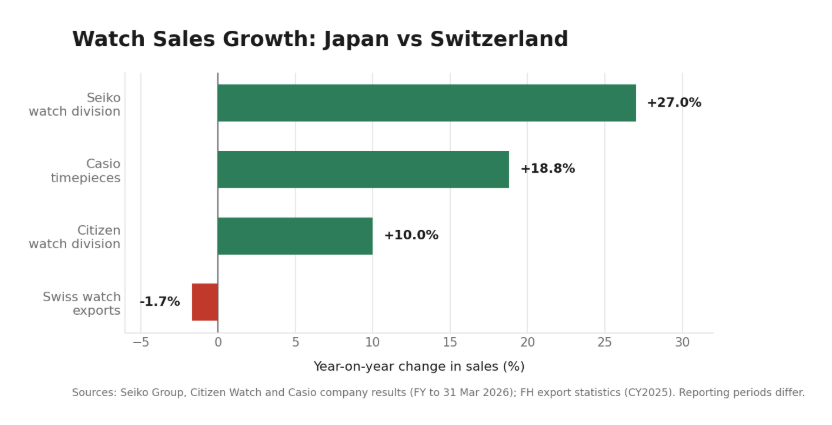
For the fiscal year ending March 2026, Seiko's watch division reported ¥203 billion (~$1.40bn) in sales, up 27% year-on-year (in a period when Swiss exports declined). Citizen's watch business turned over ¥197 billion (~$1.36bm), up 10%, with operating profit up 38%. Casio's own timepiece segment reached ¥185 billion (~$1.28bn), up almost 19% — the fastest growth of the three. Together the three groups generated ¥585 billion, roughly CHF 2.9 billion (~$3.6 billion). You can read more about that here.
If we pay attention to the margins, Seiko's watch business ran a 15.1% operating margin, against 3.2% at Richemont and 4.5% at Swatch Group. Japanese watchmakers are three to five times more profitable than their Swiss counterparts while selling at a fraction of the price, in the exact segment smartwatches were supposed to have annihilated. They managed it by not competing on the smartwatch's terms. A G-Shock's proposition is that it needs nothing from you — no charger (well, most Casios don't), no pairing, no software support window, no replacement in three years. Casio's own Q3 disclosure stated that strong G-Shock demand during the year-end season actually caused inventory shortages. Now that's a product doing something a smartwatch structurally cannot.
What it actually means
The tidy version of this story (mechanical watches as a rebellion against tech) is the least useful angle here, to be honest. The Swiss data very clearly shows an industry shrinking its way to stability. The smartwatch data shows a category that has already hit its own plateau. The Japanese data shows the only players growing at scale, and they're doing it with quartz, at accessible prices, against the competition directly. One could say that the Quartz Revolution 2.0 never really died.
Also, smartwatches didn't kill watches. They killed the cheap, disposable, utility-first watch, the object you bought because you needed to know the time. What survived was everything bought for reasons other than telling the time. The Swiss have built themselves around status and the Japanese around durability, and only the Japanese approach is currently producing growth.
Source(s)
Federation of the Swiss Watch Industry FH, Seiko Group Corporation, Citizen Watch Co. Ltd., Casio Computer Co. Ltd., Counterpoint Research, DemandSage
Featured image (Seiko SRPK87K1 by Anubhav Sharma, Amazfit Bip 3 (Pro) by Indra Projects on Unsplash)
 Add as a preferred source on Google


