




Starlink's rival TeraWave promises 6-terabit satellite internet
Jeff Bezos' Blue Origin has announced TeraWave, a satellite internet network designed to deliver up to 6 terabytes per second of symmetrical bandwidth and aimed squarely at enterprise, data center, and government customers. Unlike Starlink, which serves millions of individual users, TeraWave targets a far smaller customer base.
Blue Origin says the network will support around 100,000 customers globally, focusing on organizations that require sustained throughput and predictable performance for large-scale operations. According to the company, “This network will service tens of thousands of enterprise, data center, and government users who require reliable connectivity for critical operations.”
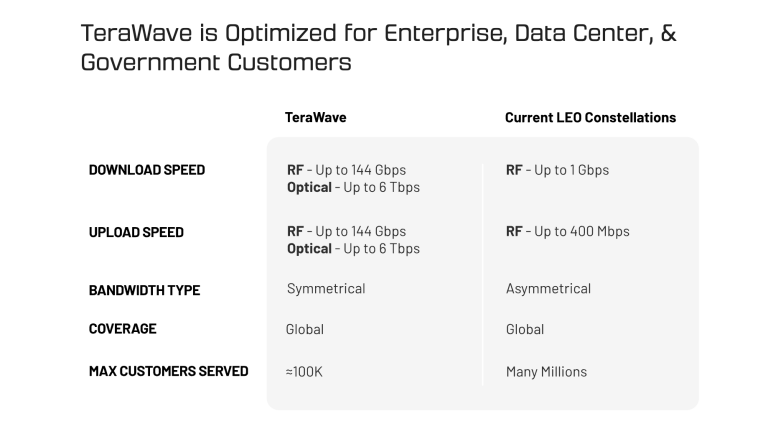
TeraWave relies on a multi-orbit constellation of 5,408 satellites spread across low Earth orbit and medium Earth orbit. Most of the satellites operate in low Earth orbit and connect to ground terminals using radio frequency links that Blue Origin says can reach speeds of up to 144 Gbps. A smaller group of 128 satellites in medium Earth orbit acts as a high-capacity backbone, using optical links to move data at terabit scale between satellites and ground infrastructure.
Those optical links, which rely on laser-based communication rather than traditional radio signals, sit at the core of TeraWave’s capacity claims. Optical inter-satellite links can move large volumes of data with lower latency and less interference, but they also demand precise alignment and stable operating conditions.
Blue Origin plans to begin deploying the TeraWave constellation toward the end of 2027. However, the company has not shared pricing details or early customer commitments, and it remains unclear how quickly enterprise customers will be able to access the highest-capacity links once launches begin.
TeraWave is entering a market with some serious contenders. Elon Musk’s SpaceX continues to expand Starlink, including services tailored for government and military use through Starshield, while Amazon is building out its own low Earth orbit network under the Kuiper program, with enterprise-grade terminals already announced. At the same time, Blue Origin faces the challenge of executing a complex satellite program without the operational head start enjoyed by SpaceX.
Manufacturing thousands of satellites, launching them on schedule, and maintaining reliable optical links across multiple orbits will test the company’s production and launch capabilities.
Source(s)
 Add as a preferred source on Google


