




Amazon Leo is building a massive ground network to rival Starlink

Amazon Leo is preparing to set up over 300 ground-based gateway stations to help deliver robust speeds globally in a bid to directly compete with Starlink. The company made the announcement at last week's AWS re:Invent event, where it explained how it is gearing up to manufacture millions of dishes for consumers and businesses to connect to its satellite internet service.
The company is working on the backend to build out a network of gateway stations to relay data between the Leo satellites and ground-based fiber networks. Networking engineer Nick Matthews said in a session at AWS re:Invent that the company’s ground stations will be made up of five gateway satellite dishes based in remote areas. A slide from his presentation also says the company has over 300 gateways planned, which is a setup that mirrors Starlink and its use of ground stations to route data between orbiting satellites. These ground stations can then send and receive data to another facility called a Point of Presence, which is directly connected to fiber internet networks.
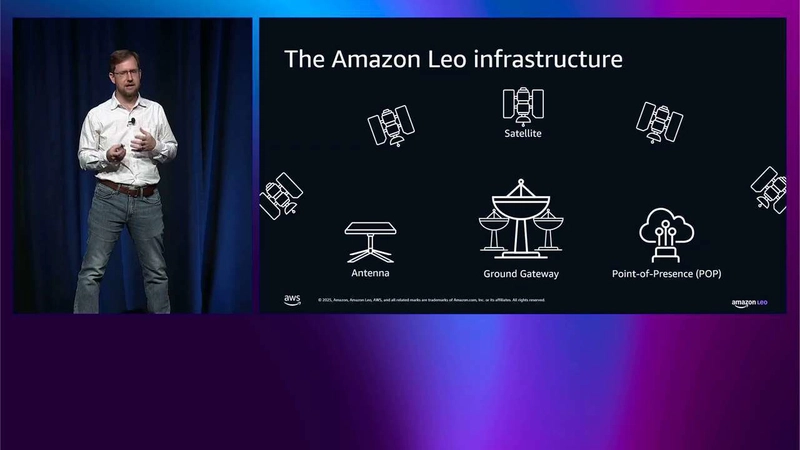
Amazon engineers pointed out that these facilities can connect to the company’s AWS service, which is a major cloud provider that already serves top companies, including Netflix and Twitch. This means you could use the satellite internet service to reach an AWS cloud environment or third-party cloud providers through a private network interconnect if you are an Amazon Leo customer. The result promises to deliver high-quality internet service to both consumers and business users of Amazon Leo, following the recent start of a beta for select enterprise customers.
The company plans on offering speeds of 1Gbps, 400Mbps, and 100Mbps through three different user terminals. However, Matthews said Leo will offer latency at less than 50 milliseconds, which is a bit higher than Starlink, where latency is closer to 30ms. An Amazon executive previously said Leo is aiming to launch in Q1 2026, but the satellite internet service faces an uphill battle with SpaceX. Amazon needs to send up hundreds of additional satellites before it can offer a robust internet service to customers, and another slide in the presentation indicates Leo won't initially offer global coverage.
Currently, Amazon Leo’s constellation spans about 150 satellites, while SpaceX’s Starlink has more than 9,000 and serves over 8 million global customers. SpaceX also revealed in July that it has more than 100 gateway sites in the United States alone, which comprise a total of over 1,500 antennas to serve 2 million users in the US.
Source(s)
 Add as a preferred source on Google


