




Scientists witness the most intense solar superstorm ever recorded on Mars
A solar storm occurs when the Sun suddenly releases large amounts of energy and particles into space. These eruptions can include solar flares, coronal mass ejections (CMEs), and high-energy charged particles. In May 2024, the Sun produced the biggest solar storm in over 20 years. On Earth, they caused spectacular auroras. However, on Mars, due to the lack of a strong magnetic field like Earth’s, the atmosphere was energized, with solar particles directly heating the Martian atmosphere.
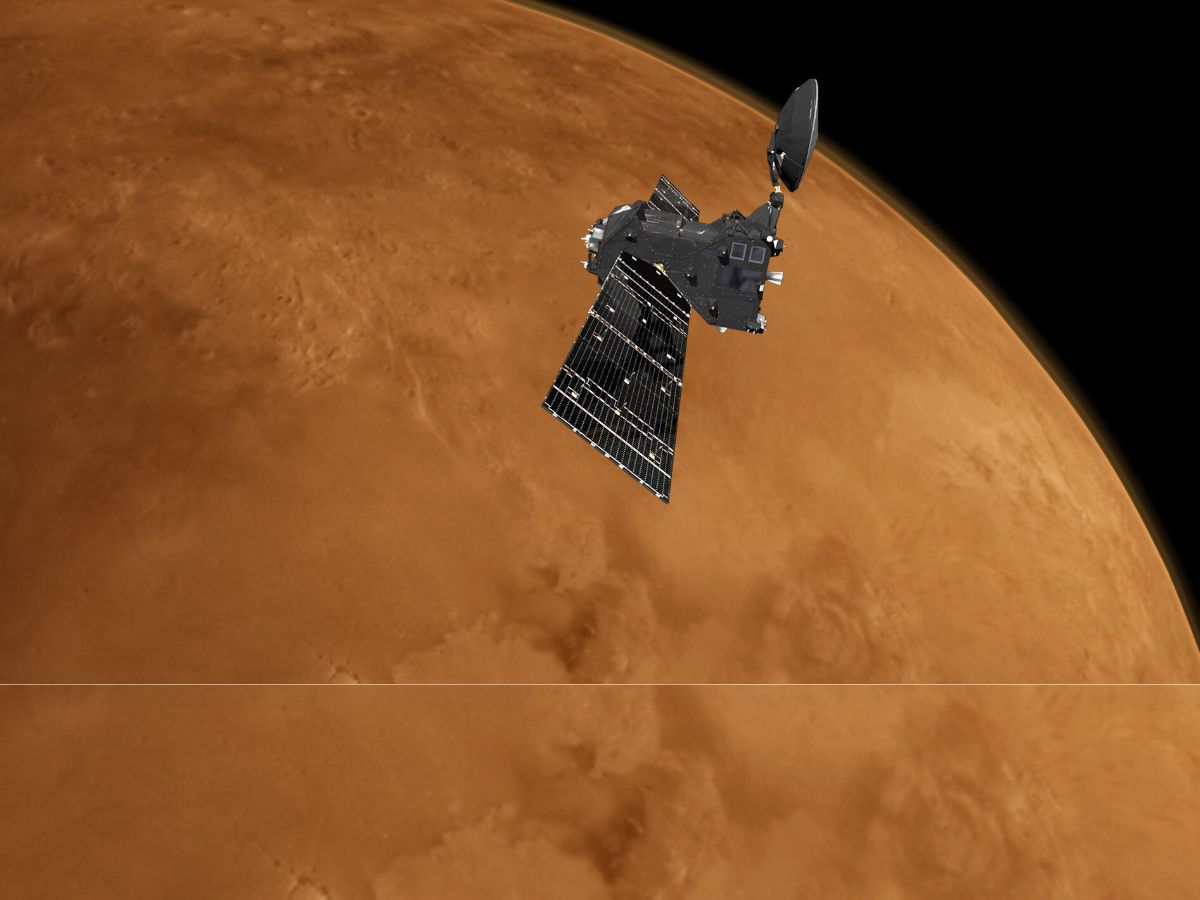
Two spacecraft were orbiting Mars during the storm. They were the Mars Express and the ExoMars Trace Gas Orbiter. The solar storm brought particles that collided with atmospheric atoms and stripped them of electrons, creating ions in a process called ionization in Mars’ ionosphere.
A method called “radio occultation” was used where radio signals were sent from the Mars Express and received by the ExoMars Trace Gas Orbiter. This technique was used ten minutes after the solar flare reached Mars. Observations from NASA’s MAVEN mission were used in confirming the results. Understanding these processes is important for future Mars missions and space weather prediction.
Source(s)
 Add as a preferred source on Google


