




Samsung breaks the 16 Gbps barrier with HBM4E reveal at GTC 2026
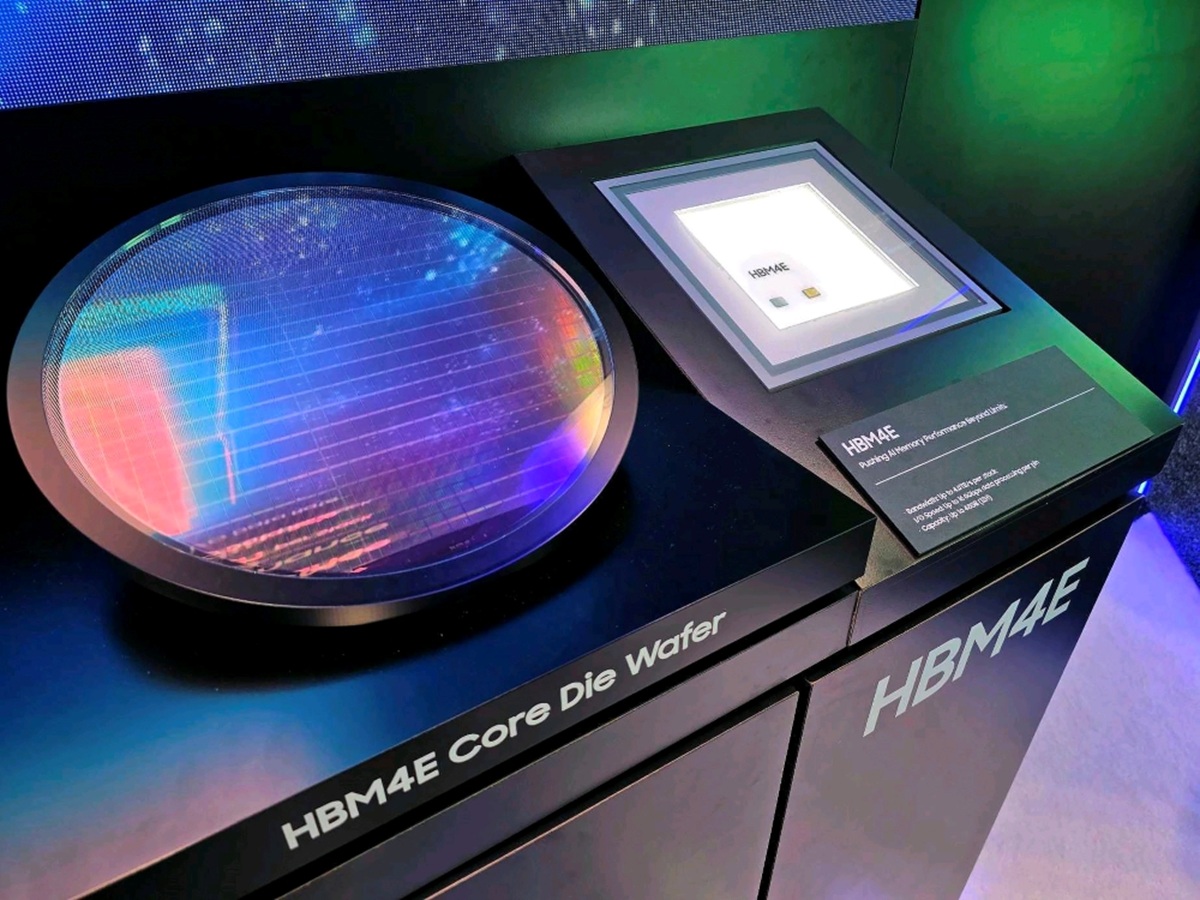
Samsung used Nvidia GTC 2026 to preview its next-step AI memory roadmap, with HBM4E making its first appearance at the show alongside the company’s newly commercialized HBM4. The company said HBM4 is now in mass production for the Nvidia Vera Rubin platform, while HBM4E is being shown as its higher-bandwidth successor for next-generation datacenter workloads.
Samsung puts HBM4 and HBM4E at the center of its GTC message
At the center of Samsung’s GTC 2026 booth is HBM4, which the company said is now in mass production and designed for Nvidia’s Vera Rubin platform. Samsung said the memory delivers a standard 11.7 Gbps processing speed, above the 8 Gbps industry baseline it cited, and can be pushed to 13 Gbps.
The newer HBM4E is the bigger forward-looking reveal. Samsung said it is displaying the part for the first time at GTC 2026, with performance targets of 16 Gbps per pin and 4.0 TB/s of bandwidth. The company is also showing hybrid copper bonding technology, which it said will allow future HBM stacks to reach 16 layers or more while cutting heat resistance by more than 20% compared with thermal compression bonding.
The announcement also widens Samsung’s Nvidia infrastructure pitch
Samsung is using the memory announcement to position itself as a broader supplier for Nvidia-centric AI infrastructure rather than only an HBM vendor. In the separate Nvidia-focused section of its booth, Samsung said it is also highlighting SOCAMM2 server memory and PM1763 SSD storage designed for Nvidia AI systems, while PM1753 SSD is being shown as part of Nvidia’s BlueField-4 STX reference architecture for accelerated storage infrastructure on Vera Rubin.
Samsung said SOCAMM2 is already in mass production and described it as a low-power DRAM-based server memory module aimed at next-generation AI infrastructure. For storage, the company said PM1763 uses PCIe 6.0 for faster transfers and higher capacities, while PM1753 is being pitched around energy efficiency and system performance for inference workloads.
Samsung ties the launch to AI factory and local AI ambitions
Beyond datacenter memory, Samsung is also using GTC 2026 to highlight how its semiconductor and manufacturing operations connect to Nvidia’s AI software stack. The company said it plans to use Nvidia accelerated computing and Omniverse libraries to scale its AI Factory efforts and speed up digital-twin-based manufacturing across its memory, logic, foundry, and advanced packaging operations.
Samsung also used the announcement to talk up local AI hardware. At GTC, the company said it is showcasing PM9E3 and PM9E1 NAND for Nvidia DGX Spark, alongside LPDDR5X and LPDDR6 memory for premium mobile and edge-AI devices. Samsung said LPDDR5X can reach up to 25 Gbps per pin with up to 15% lower power consumption, while LPDDR6 is aimed at 30 to 35 Gbps per pin with added power-management features for future edge-AI workloads.
Source(s)
 Add as a preferred source on Google


