




Core Ultra 9 290K Plus seems out of Ryzen 9 9950X's league with 22% faster multi-core and 15% faster single-core Geekbench performance
Intel’s latest desktop CPUs, the Core Ultra 200S Plus Arrow Lake Refresh, are here. The lineup consists of only two processors, the Core Ultra 5 250K Plus and the Core Ultra 9 290K Plus, as Intel has reportedly canceled the flagship Core Ultra 9 290K Plus. A leaked Geekbench listing reveals that the Core Ultra 9 290K Plus would’ve been a meaningful upgrade over the Core Ultra 9 285K.
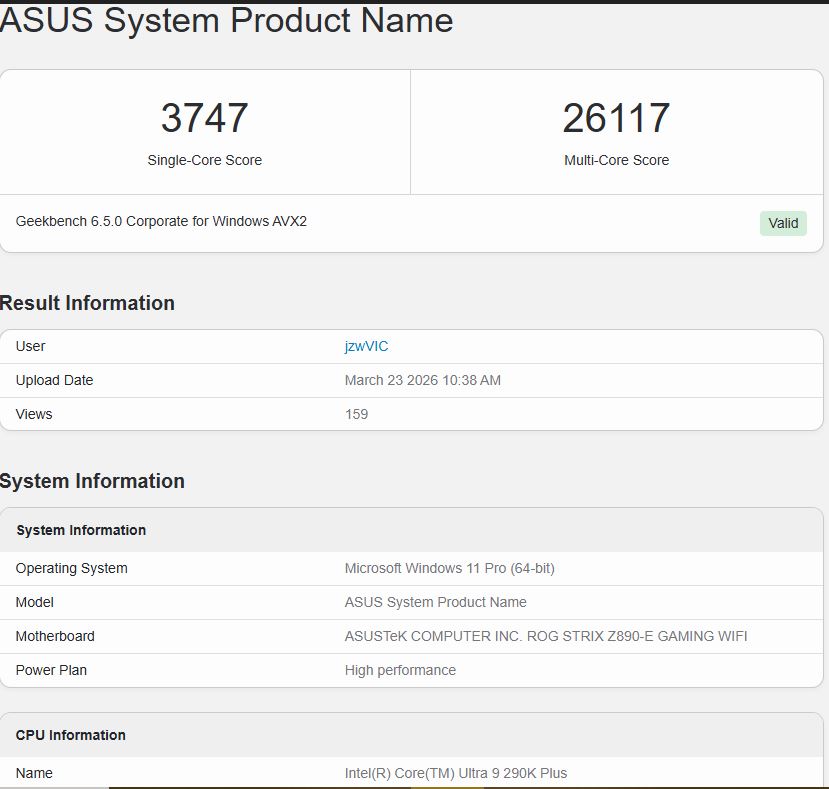
Spotted by HXL on X, the 24-core Core Ultra 9 290K Plus earned single-core and multi-core Geekbench 6.5 scores of 3,747 and 26,117, respectively. As is the case with other Arrow Lake Refresh CPUs, the Core Ultra 9 290K Plus was running at +100 MHz boost clock (5.8 GHz) compared to the Core Ultra 9 285K and was using the new Intel Binary Optimization (IBOT).
The Core Ultra 9 285K clocked in single-core and multi-core Geekbench 6.5 scores of 3,260 and 21,688 in our testing. Compared to these median scores, the leaked Core Ultra 9 290K Plus shows 15% faster single-core and 20% better multi-core performance. This also puts the Core Ultra 9 290K Plus 10% and 22% ahead of the Ryzen 9 9950X in single-core and multi-core Geekbench 6.5 tests, respectively.
In other words, had Intel launched the Core Ultra 9 290K Plus alongside the Core Ultra 5 250K Plus and Core Ultra 7 270K Plus, it would’ve easily beaten the Ryzen 9 9950X in both single-core and multi-core departments.
We don’t know the exact reason why the company scrapped the flagship Arrow Lake Refresh part. It could’ve been a financial decision, as the Core Ultra 7 270K Plus essentially matches the Ryzen 9 9950X for much less money. You can currently buy the Ryzen 9 9950X for around $513 on Amazon, which makes the $299 Core Ultra 7 270K Plus more than $200 cheaper.
All in all, the Intel Arrow Lake Refresh CPUs are great releases. If you are already on the new LGA1851 socket and want a healthy performance upgrade that will hold you over until Nova Lake, the Core Ultra 200S Plus chips make a lot of sense.
Source(s)
Geekbench via HXL on X, Teaser image source: Intel, Mathew Schwartz on Unsplash, edited
 Add as a preferred source on Google


