




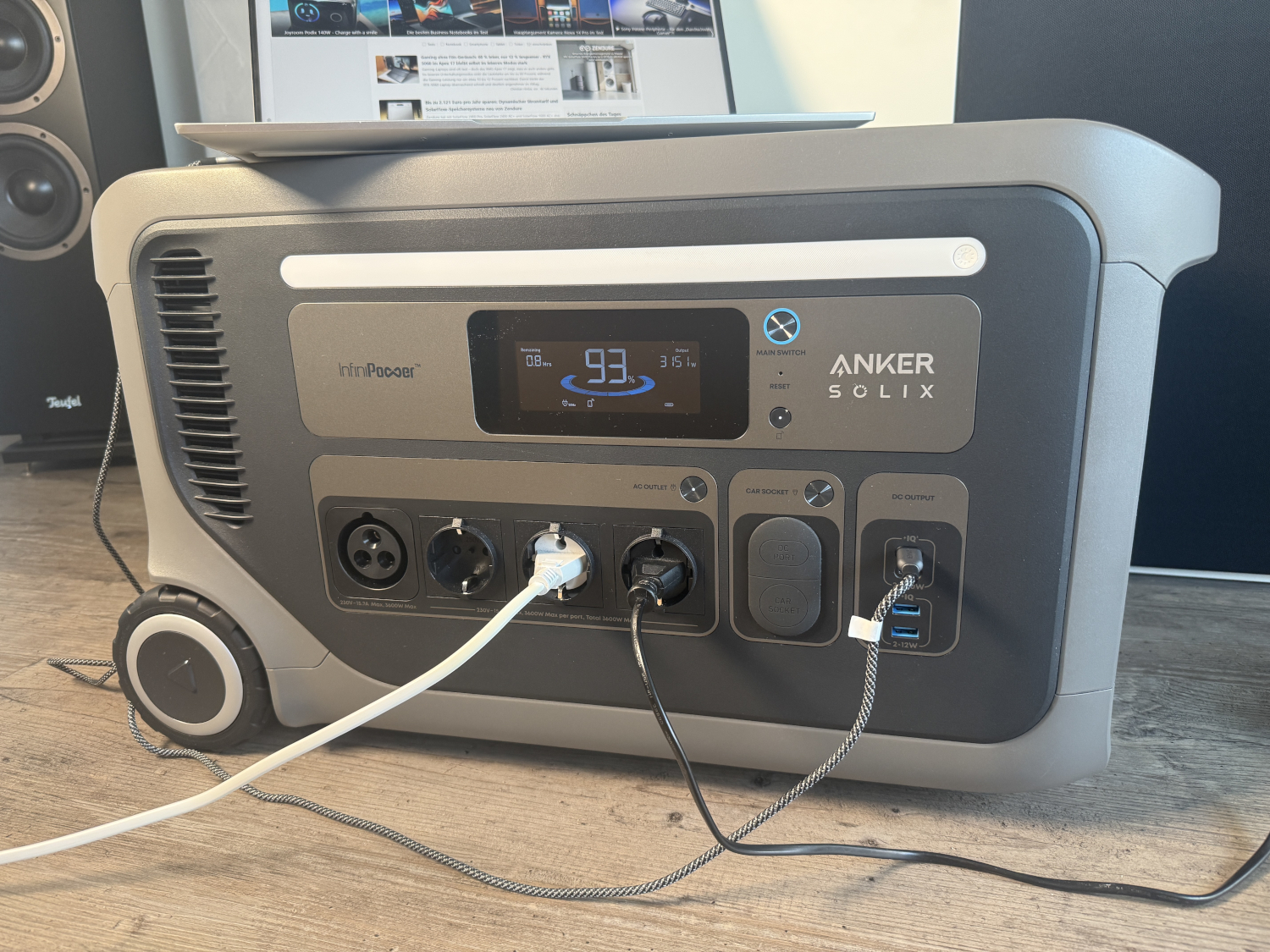
Powerhouse with 3.6 kW and 3 kWh: Anker Solix F3000 review
Heavyweight.
The Anker Solix F3000 is a real powerhouse with its 3,072 Wh capacity (expandable up to 12 kWh) and 3,600 W output. In the test, the power station scored with its strength, but also had to put up with a few minor criticisms.Marcus Schwarten (translated by DeepL / Marcus Schwarten) Published 🇩🇪 🇫🇷 ...
Anker Solix F3000 test conclusion: Strong, big, heavy
The Anker Solix F3000 is a massive power station. In contrast to the C-series, it is primarily suitable for use at home, for example to prepare for a power failure. It can also be used for mobile camping and the like, but with its over 40 kg it is anything but a lightweight and, despite the trolley function, therefore not so easy to transport.

In terms of performance, the F3000 is beyond any doubt and proved its promised performance in the test. It offers many different inputs and outputs and can therefore not only supply many devices, but can also be charged quickly and in many different ways. One of the few criticisms is the efficiency in the low AC range.
For the current market price of less than $1,300, the Anker Solix F3000 is an impressive power source that really comes into its own when stationary.
Pros
Cons
Price and availability
The recommended retail price for the Anker Solix F3000 is $2,599 euros. However, it is already available for significantly less, e.g. directly from the manufacturer and on Amazon.

With the launch of the C1000 Gen 2 and the C2000 Gen 2, Anker Solix is currently focusing on "Gen 2" for its power stations. The Anker Solix F3000 is also quite new, but not a revised second generation. We have tested the Powerstation heavyweight and describe our experiences in our Anker Solix F3000 review.
Important note: In our test we used the European version of the Anker Solix F3000, which differs slightly from the US model.
Data sheet Anker Solix F3000
| Feature/Model | Anker Solix F3000 |
| Capacity | 3.072 Wh |
| expandable | yes (max. 12 kWh) |
| Continuous/peak power | 3,600 W |
| Outputs | 5xAC, 2xUSB-C, 2xUSB-A, 1xCar, 1x Anderson DC |
| Inputs | 1xAC, 3xDC (1xXT60) |
| Charging power AC | 2.9900 W |
| Charging power DC (solar) | 2,400 W |
| Light | yes |
| App | yes |
| Weight | 41.5 kg |
| Dimensions | 65.1 x 30.0 x 37.7 cm |
| MSRP | $2.599 euros |
| available at | Amazon |
Equipment: Powerhouse on two wheels
The new Anker Solix F3000 is positioned between the two models F3800 and F2000 (launched in 2022 as PowerHouse 767, predecessor of the new C2000 Gen 2). It is part of the Flex series, which is positioned above the more compact models of the C series and is primarily intended for emergency power supply. The F3000 has the landscape design of the F2000, rather than the somewhat unwieldy portrait format of the F3800.
In addition to the transportation aids in the form of two rigid handles, a telescopic handle and two wheels, the F3000 also has an LED light that sits across the LCD screen. However, this should only be mentioned in passing, as the performance data is of course even more important. The Anker Solix F3000 successfully demonstrated its 3.600 W output power on paper in the test. This is enough to power almost all devices in a household (although not all at the same time) and to operate tools in the garden, for example.
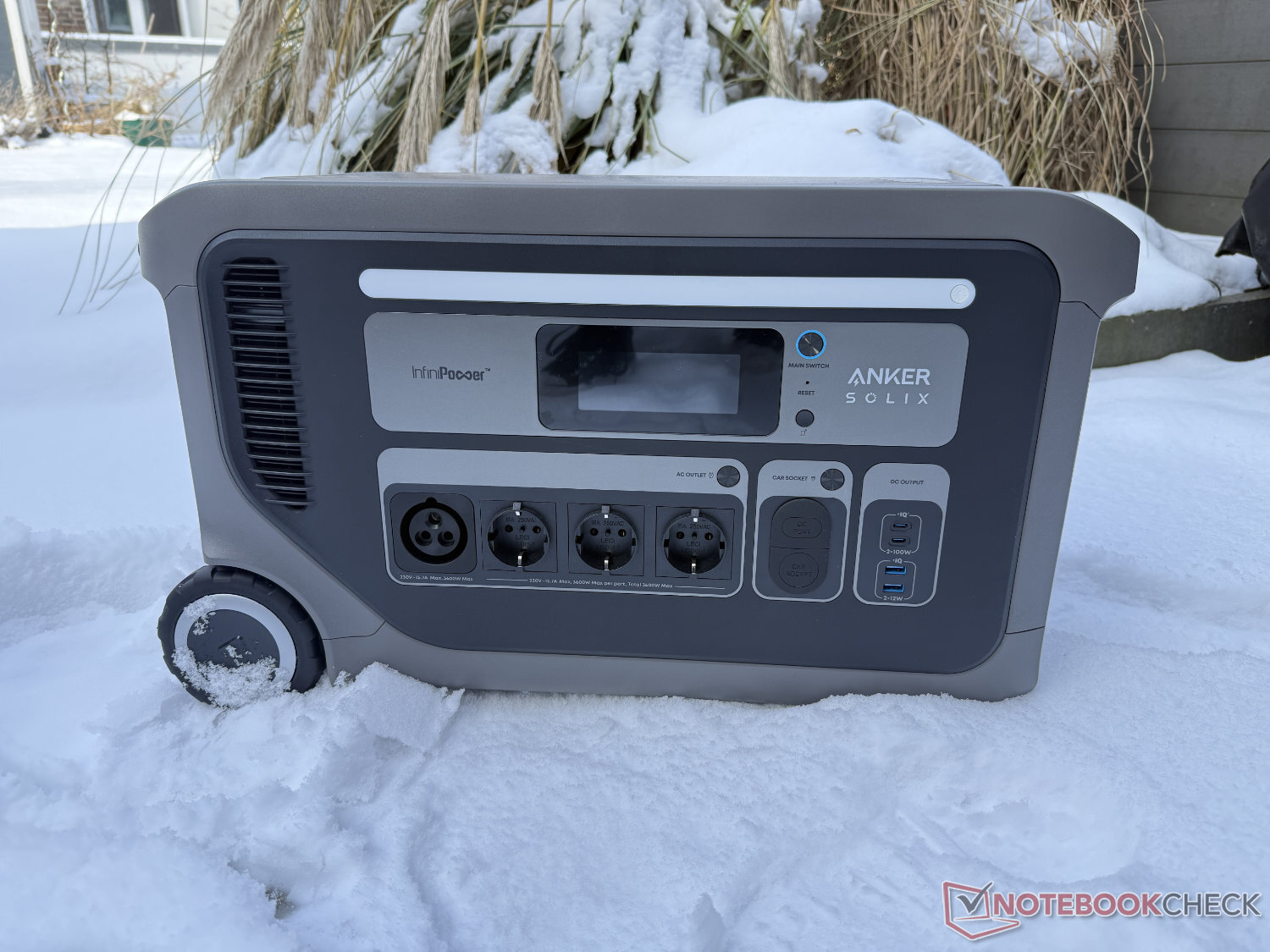
There are not only three AC sockets for the 230 V supply, but also a CEE connection (e.g. for shore power supply for motorhomes). There are also two USB-C (max. 100 W) and two USB-A (max. 12 W) sockets, as well as the usual 12 V vehicle socket.
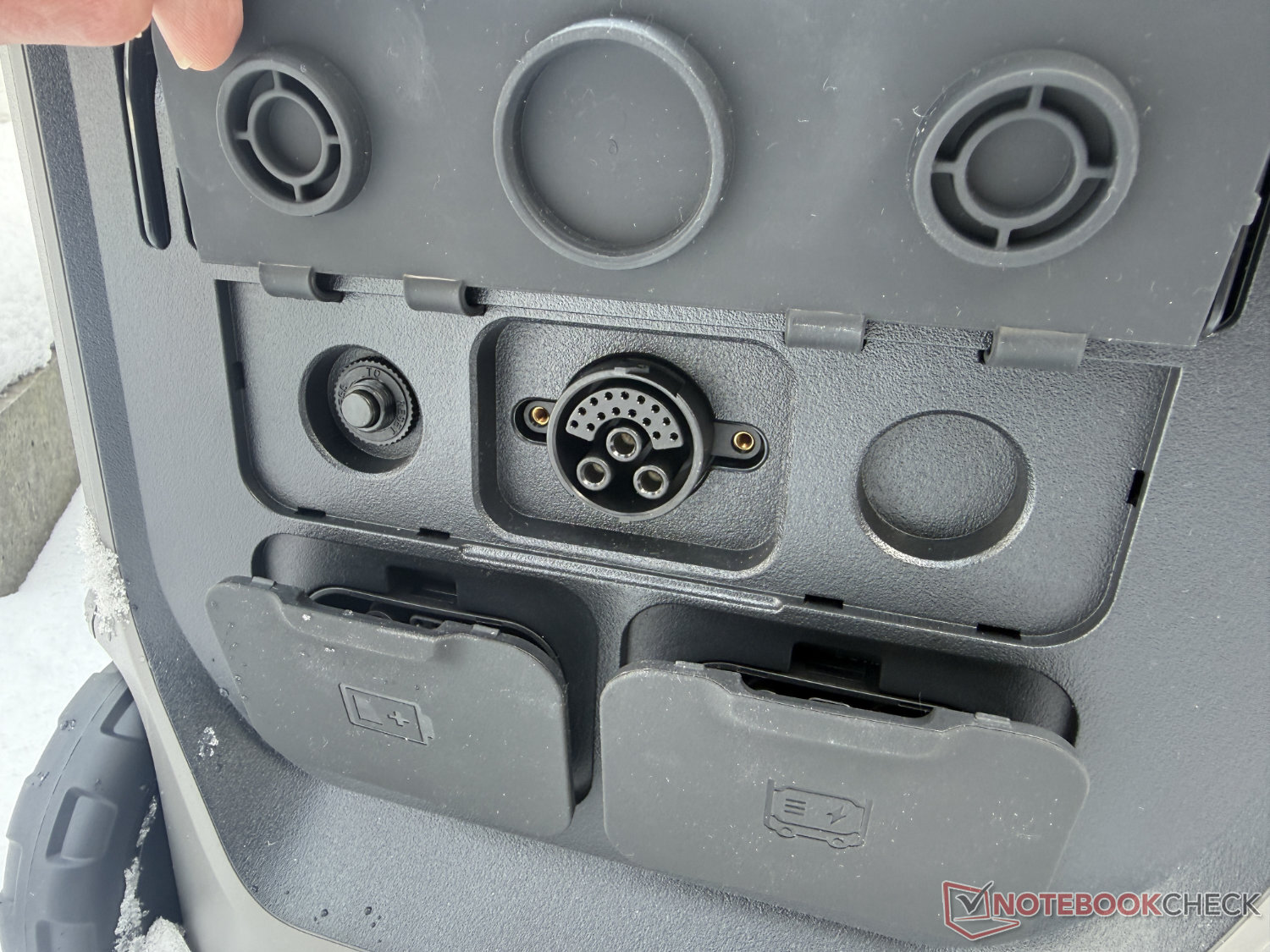
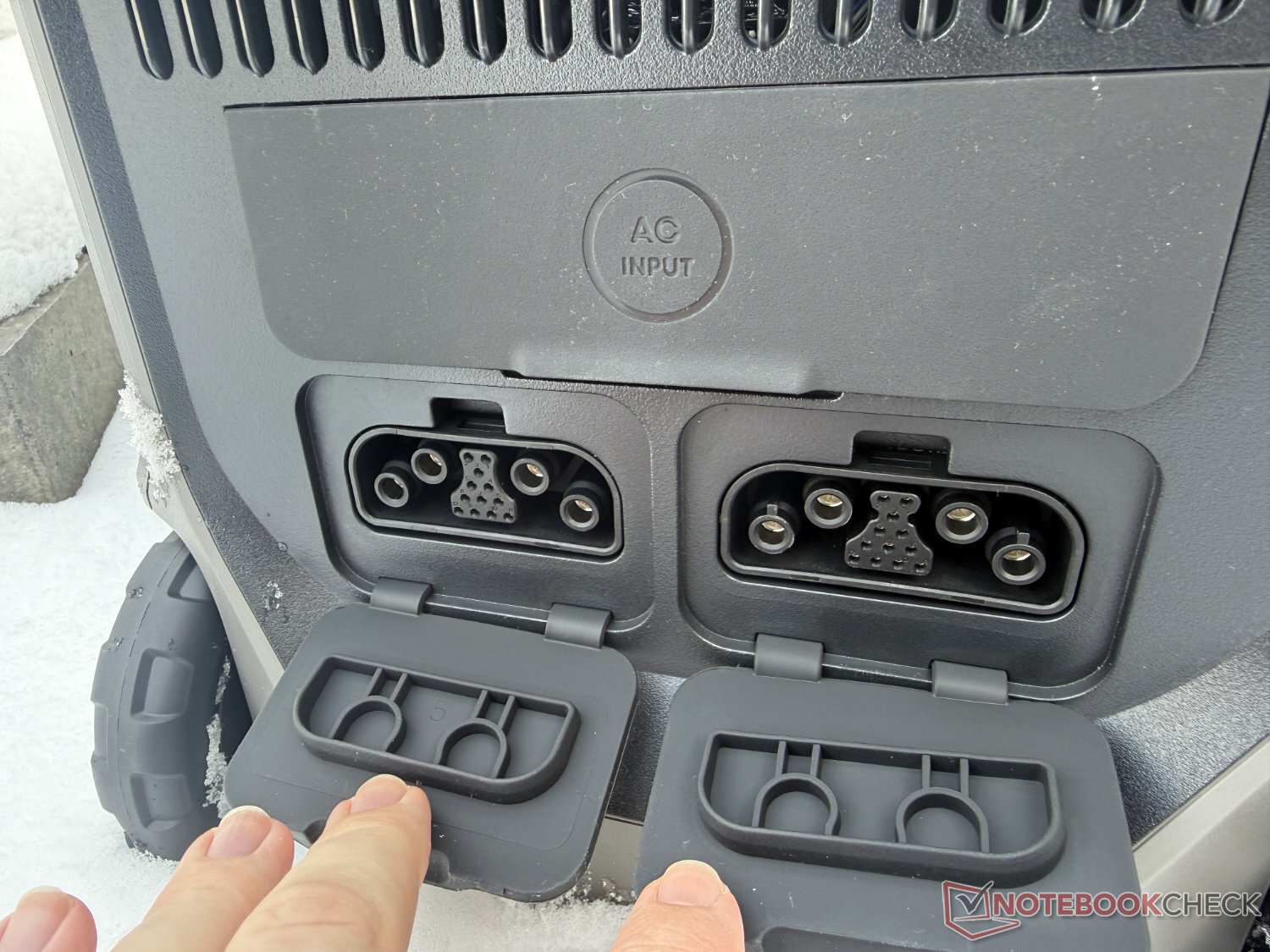
On the input side, the Anker Solix F3000 offers even more options than its smaller C-series siblings. Instead of an IEC plug, it has its own plug connection that can supply up to 2,990 W to a socket and a maximum of 3,600 W via an EV charging station.
The power station can also be supplied with up to 2,400 W of free solar energy via two connections for solar panels. In addition to an XT60 port with 800 W, there is another input with its own plug and 1,600 W available. An adapter cable to MC4 is included. However, you are reliant on official Anker accessories here, just as with the enclosed AC charging cable. The Anker Solix alternator charger ($350 at Amazon) provides up to 800 W to charge the solar generator while driving.
App: via Bluetooth or WLAN
Like all other Anker Solix power stations, the F3000 also offers an app connection. Since we have already talked about the possibilities in in previous tests, we will only briefly discuss it here.
The connection is established via Bluetooth, although a WLAN connection is also possible as an option. You can then use the Anker app for iOS and Android not only for the current values for battery status and power input/output. It is also possible to activate and deactivate the individual connection rows.
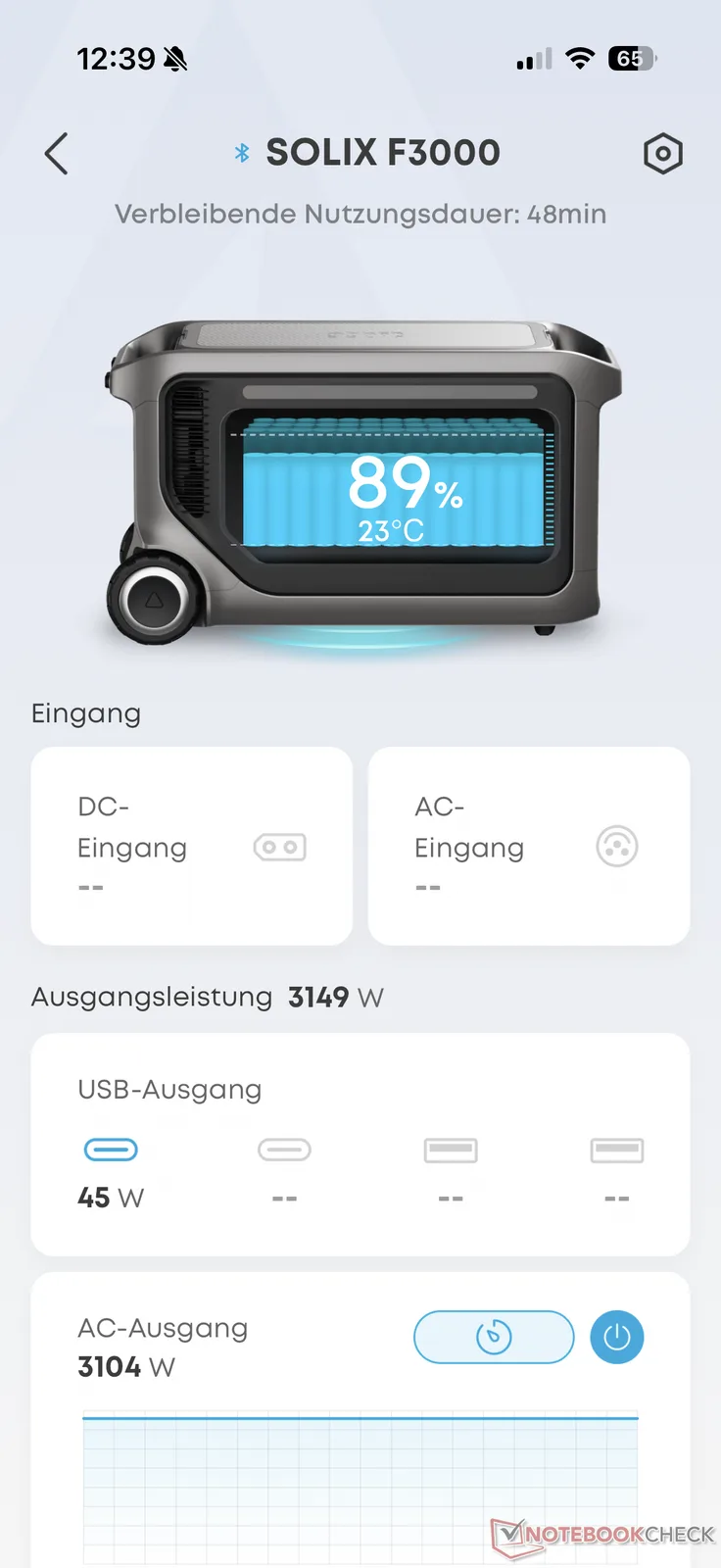
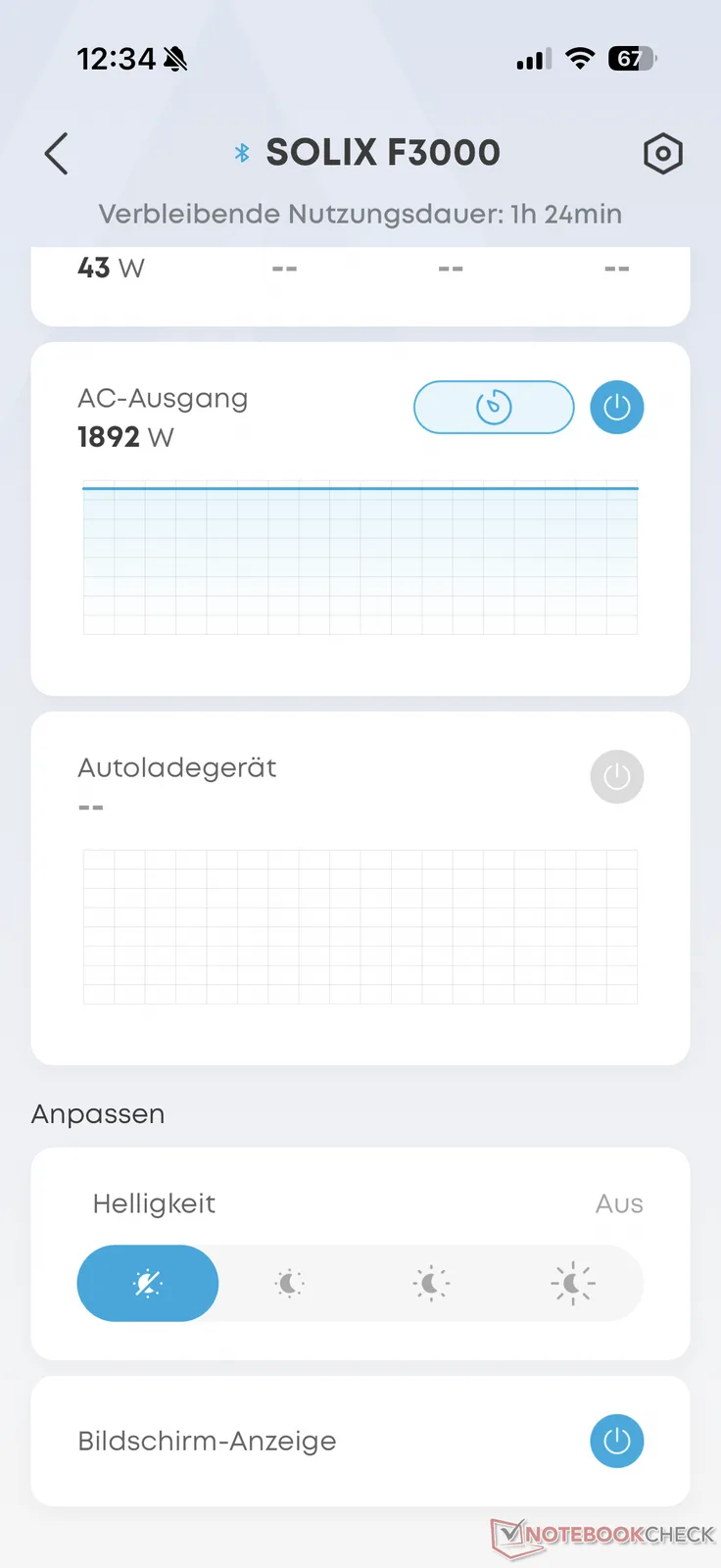
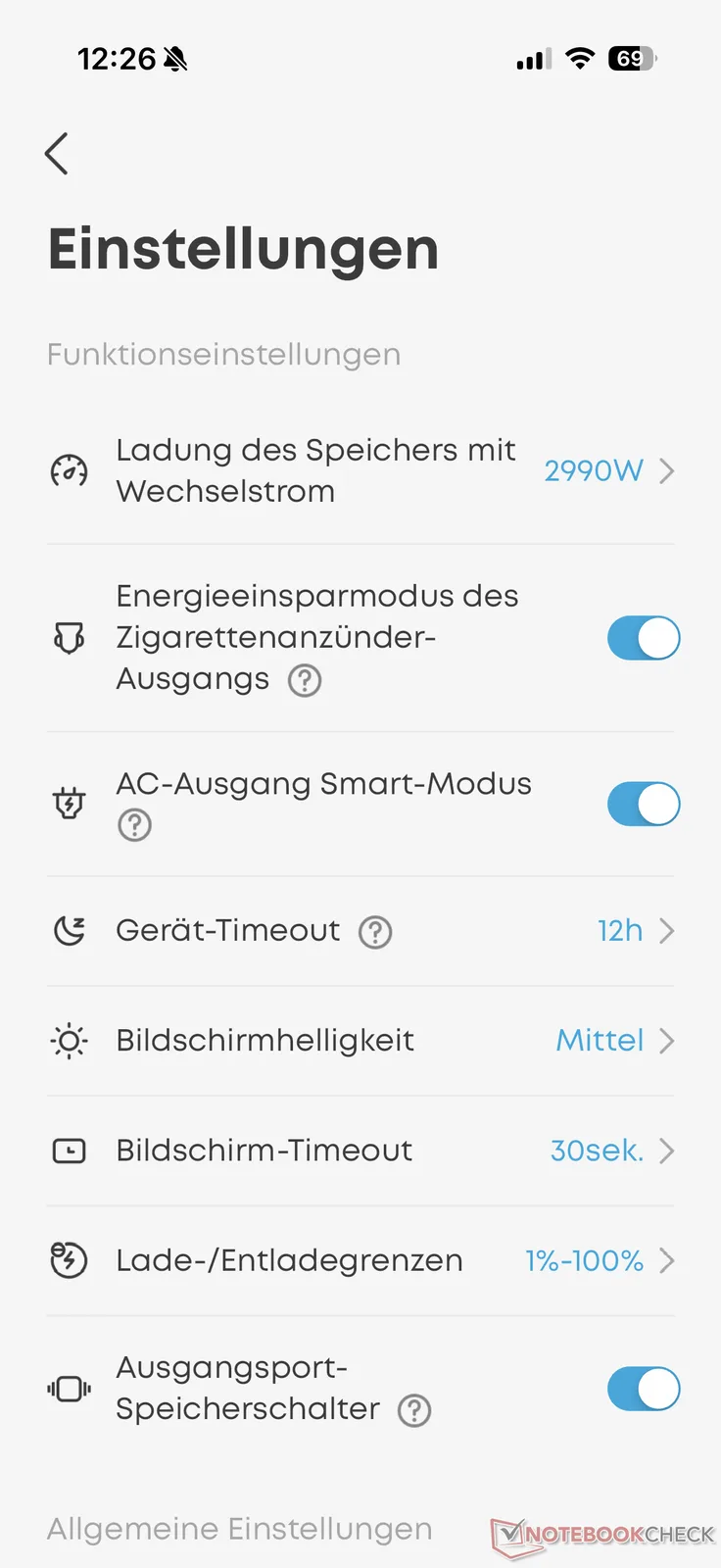
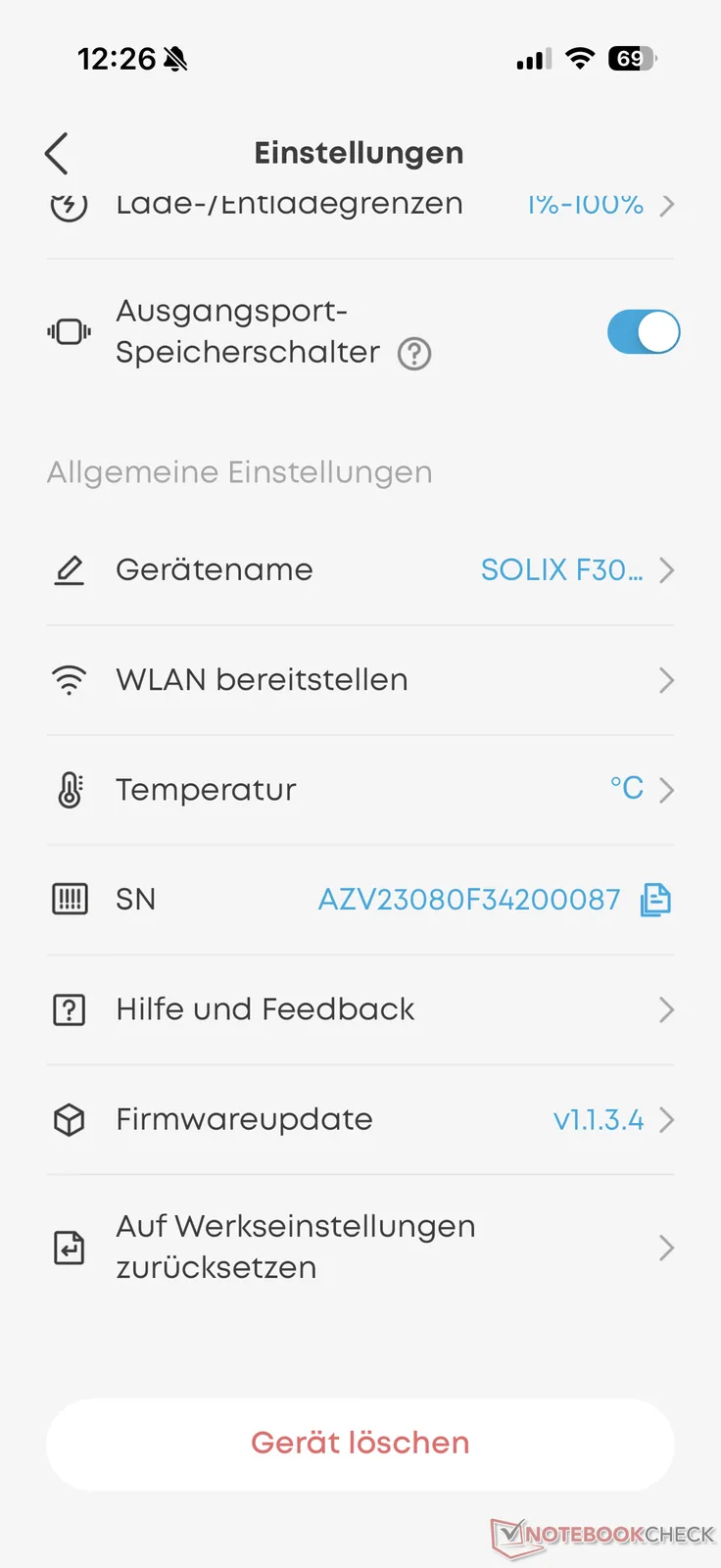
The LED light strip can also be switched on and off via the app and dimmed in three brightness levels. The Anker Solix app also offers various setting options for charging and discharging, the display and firmware updates.
A mode for automatically adjusting the charging times, such as the small Anker Solix C1000 Gen 2 (TOU mode) offers for interaction with dynamic electricity tariffs, we unfortunately did not find on the F3000 - although this would fit much better here. Nevertheless, the maximum charging power can be set in 100 W increments via the app. This means, for example, that the charging process can at least be adjusted somewhat to the surplus of a PV system. In combination with an Anker Solix SolarBank and the like, there is still room for improvement.
Practice: Strong Powerstation heavyweight
The Anker Solix F3000 leaves no doubt about its performance in the test and has successfully proven it. With its 3,600 W continuous output, it defies most demands on a power station. This also applies to its capacity. The integrated 3 kWh can be extended to up to 12 kWh with three expansion batteries if required. However, the device is then no longer intended for mobile use, but as an emergency power supply at home.
At 41.5 kg, the solar generator alone is a heavyweight. This means that the F3000 weighs more than twice as much as the C2000 Gen 2, but offers "only" 1.5 times as much capacity at 3,072 Wh. It is also heavier than many other 3 kWh power stations on the market and weighs as much as some 4 kWh models from other manufacturers, even if these are not necessarily as comprehensive and well equipped.
Loading the F3000 into the car for a camping trip, for example, is a real effort. On the other hand, it is easy to move on level ground thanks to the extendable handle and two robust wheels, even if a little effort is required here too. At the end of the day, you have to weigh up what is more important when deciding what to buy: lower weight or more power/equipment.
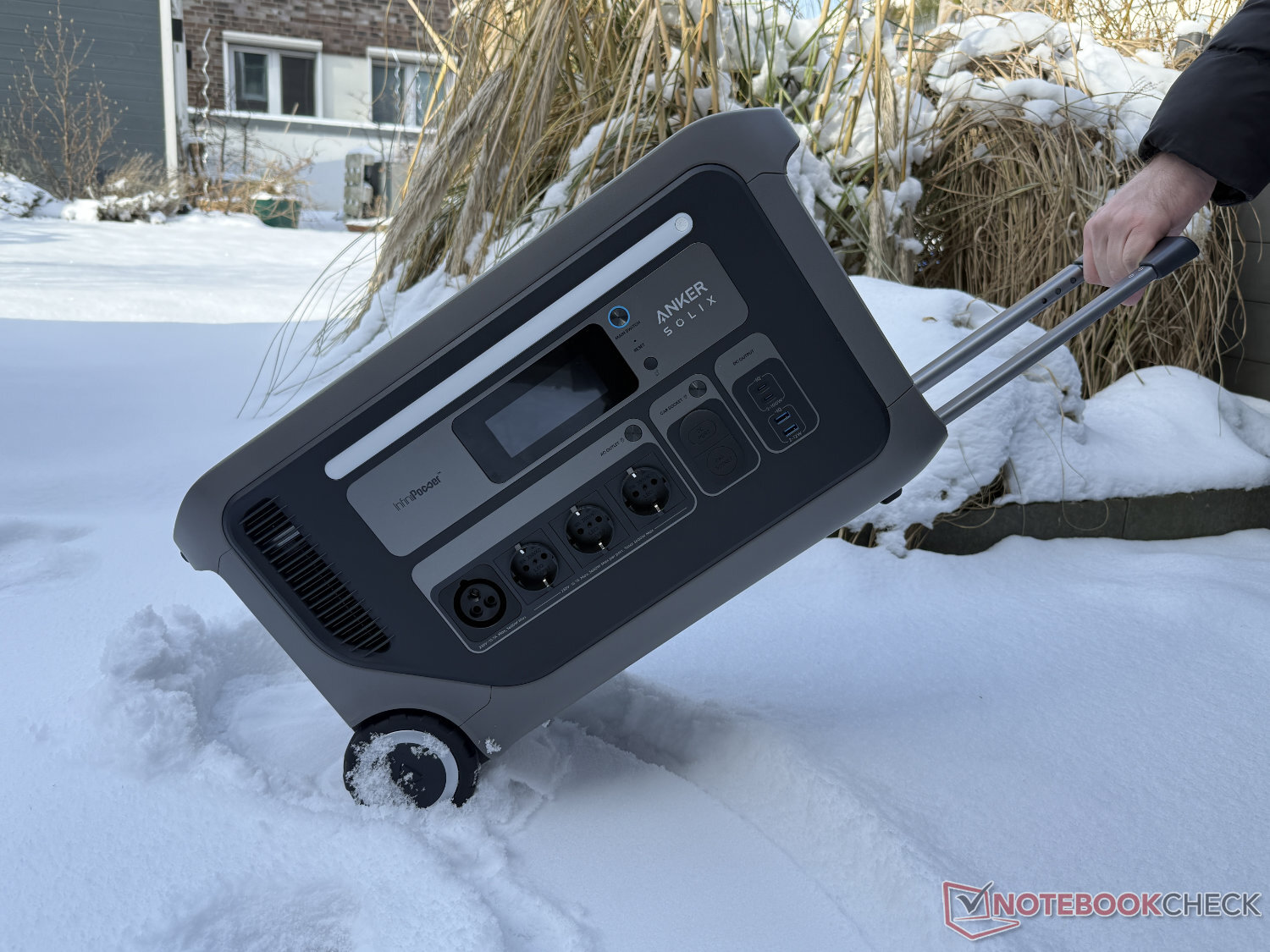
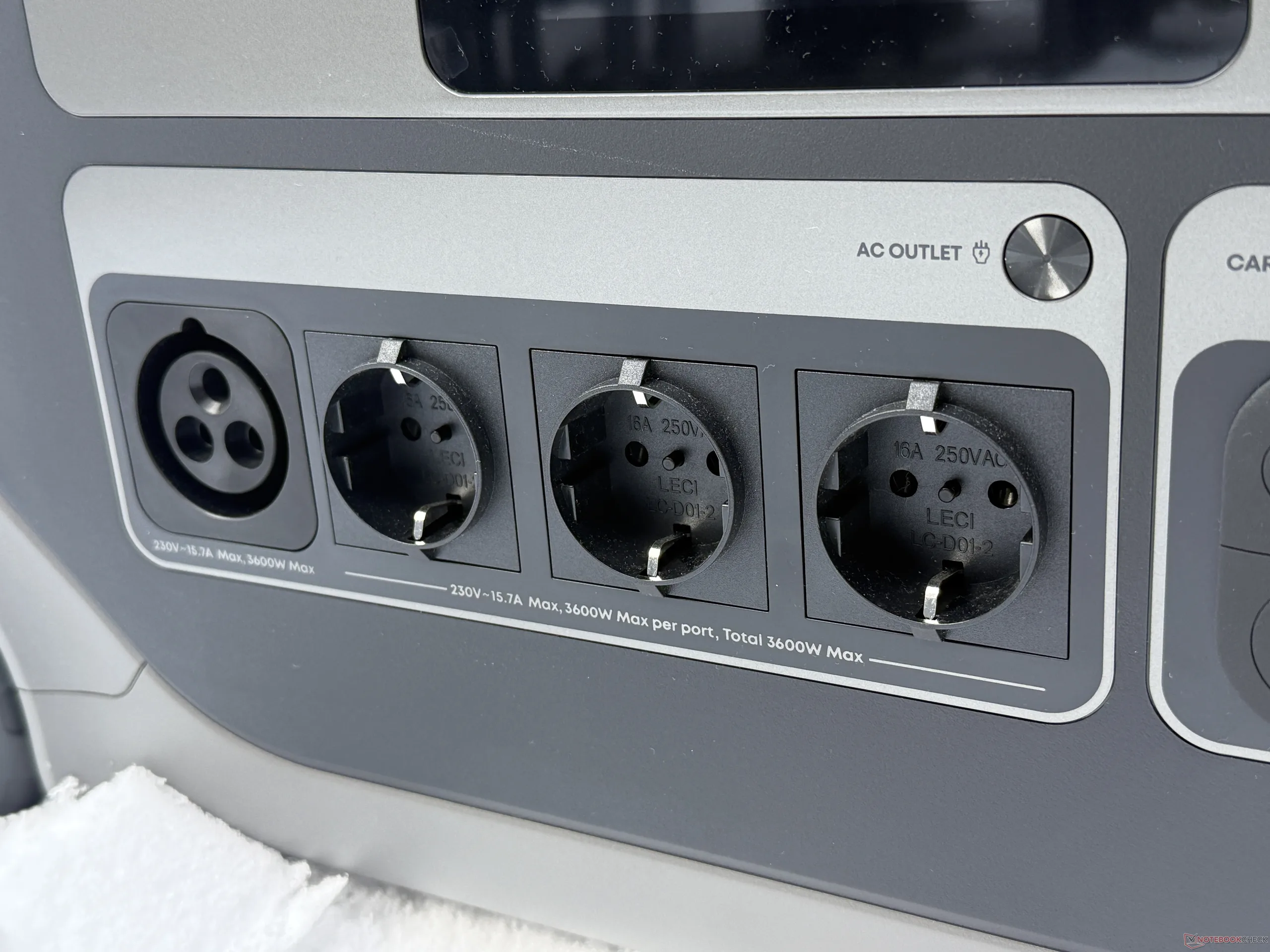
A positive aspect of the Anker Solix F3000 test was its quiet operation. Even with a good 3,000 W AC output, the power station operates very quietly. It only occasionally made a little noise, but remained pleasantly in the background at around 35 dB (measured from a distance of 1 m). In addition, the UPS function for uninterruptible power supply intervened quickly when required.
However, the Anker Solix power pack was not 100 percent convincing in terms of efficiency - at least in the lower load range. With a constant draw of a good 200 W alternating current, around 2,500 Wh of the 3,072 Wh capacity was available in the test (81 percent). This is a solid value for a low load, but not a good one. Other powerstations in the test have shown themselves to be more productive here, for example the (albeit somewhat weaker) Aferiy P280. However, the higher the load, the more efficiently the inverter works in practice. For example, we were able to draw almost 2,800 Wh at a continuous load of 1,800 W, which corresponds to a very good 91 percent.
The value for AC charging was also good, taking just 1:20 hours thanks to a charging speed of up to 2,992 W. According to our measurements, 3,480 Wh were used to fully charge the battery. This means that a good 88 percent of the energy reached the batteries. The rest is conversion loss from alternating current to direct current. Unfortunately, the considerable DC charging option via solar panels couldn't be tested at full power in the winter in Hamburg.
Transparency
The selection of devices to be reviewed is made by our editorial team. The test sample was given to the author by the manufacturer free of charge for the purposes of review. There was no third-party influence on this review, nor did the manufacturer receive a copy of this review before publication. There was no obligation to publish this review. As an independent media company, Notebookcheck is not subjected to the authority of manufacturers, retailers or publishers.
 Add as a preferred source on Google


