




Lighter, stronger and faster, but...: Anker Solix C1000 Gen 2 power station review
Upgrades and downgrades.
The Anker Solix C1000 Gen 2 is a compact yet powerful power station. Compared to its predecessor, it is lighter, provides more power and charges in under an hour. In addition to improvements, there are also a few limitations, as our Anker Solix C1000 Gen 2 review shows.Marcus Schwarten (translated by DeepL / Marcus Schwarten) Published 🇩🇪 🇫🇷 ...
Anker Solix C1000 Gen 2 test summary: Upgrades, but also downgrades
Anker Solix has made a number of improvements to the second generation of its compact 1 kWh C1000 power station. Above all, it charges faster and also provides more output power. Nevertheless, it has become more compact and, above all, lighter.
However, buyers also have to do without some of the functions of the first generation. For example, the Anker Solix C1000 Gen 2 can no longer be extended with an additional battery and no longer has an integrated LED light. Instead, it has a better LCD display.
If you can live with the limitations, the Anker Solix C1000 Gen 2 is a solar generator in the 1 kWh class that can be used flexibly. At just under €1,000 MSRP, it is priced at the same level as comparable models from other well-known manufacturers such as the EcoFlow Delta 3 Plus and is often available for significantly less.
Pros
Cons
Price and availability
The recommended retail price for the Anker SOLIX C1000 Gen 2 is 799 US dollars or 999 euros. However, it is usually available directly from the manufacturer and on Amazon for significantly less.

Important note: This article is a translation of our review of the European version of the Anker Solix C1000 Gen 2. The US version differs in some points.
At IFA 2025, Anker Solix presented the C1000 Gen 2, the second generation of its compact 1 kWh power station. Compared to the first C1000 from the end of 2023 it comes with some improvements, but also a few downgrades. Our Anker Solix C1000 Gen 2 test reveals what these are and what impression the handy power station made on us.
Datasheet Anker Solix C1000 Gen 2 & comparison with C1000
| Feature/Model | Anker Solix C1000 Gen 2 (2025) | Anker Solix C1000 (2023) |
| Capacity | 1,024 Wh | 1,056 Wh |
| expandable | no | yes |
| Continuous/peak power | 2,000 W / 3,000 W | 1,800 W / 3,000 W |
| Outputs | 5xAC, 3xUSB-C, 1xUSB-A, 1xvehicle | 5xAC, 2xUSB-C, 2xUSB-A, 1xvehicle |
| Charging power AC | 1,600 W | 1,300 W |
| Charging power DC (solar) | 600 W | 600 W |
| Inputs | 1xAC, 1xXT60i | 1xAC, 1xXT60i |
| Light | no | yes |
| App | yes | yes |
| Weight | 11.3 kg | 12.9 kg |
| Dimensions | 38.4 × 20.8 × 24.4 cm | 37.6 × 20.5 × 26.7 cm |
| RRP | 799 US dollars / 999 euros | 999 US dollars / 1,199 euros |
| available at | Amazon | Amazon |
Equipment: More power, but less equipment
Anker Solix has made a number of improvements to the second generation of the C1000. Above all, this includes 300 W faster AC charging at 1,600 W, which has even earned the power station a Guinness World Record.
The continuous output power has also increased slightly and is now 2,000 W, which is 200 W higher than the first generation. The short-term peak power available remains at 3,000 W. Solar charging is also identical with a maximum of 600 W (via XT60i).
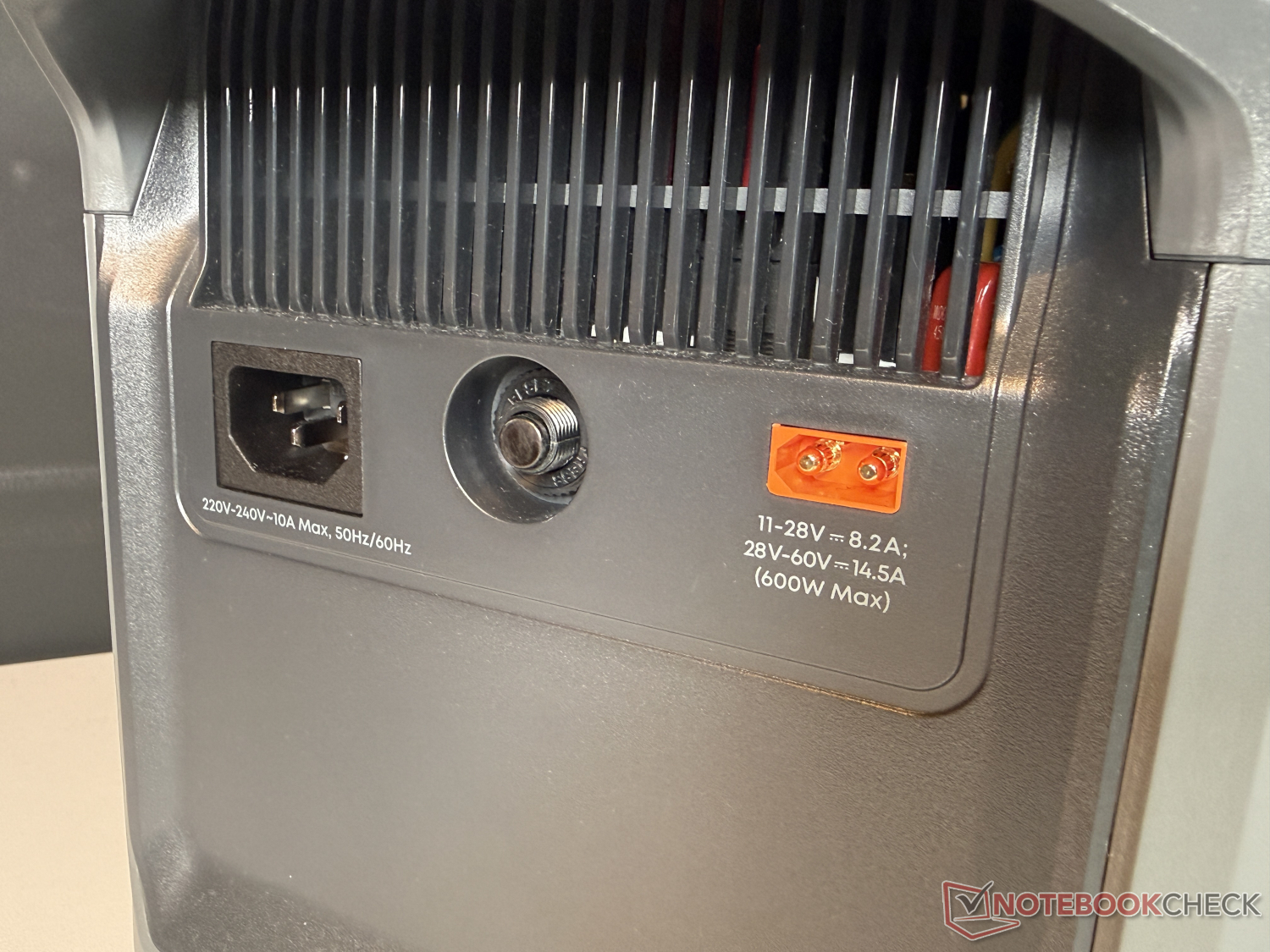

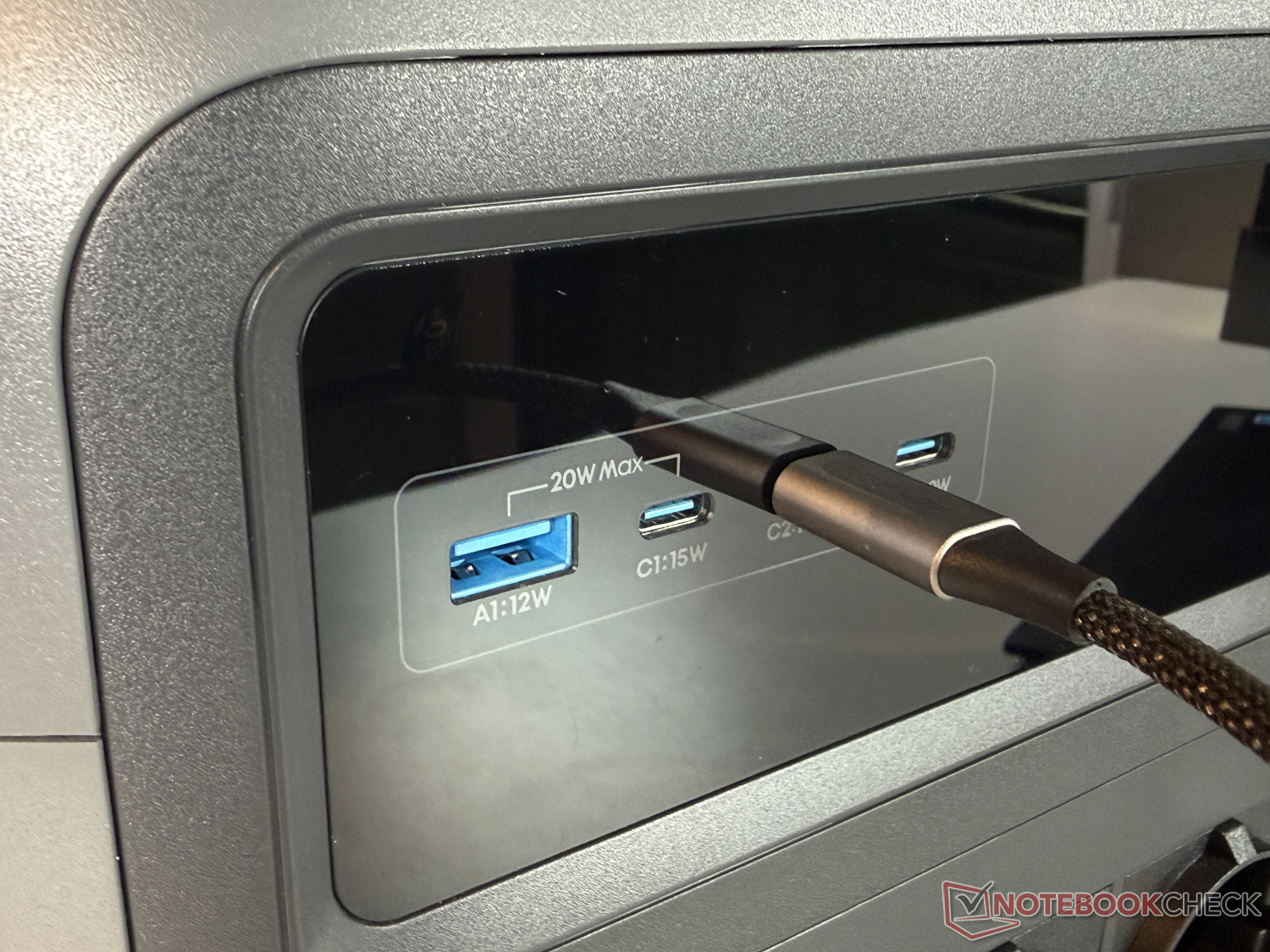
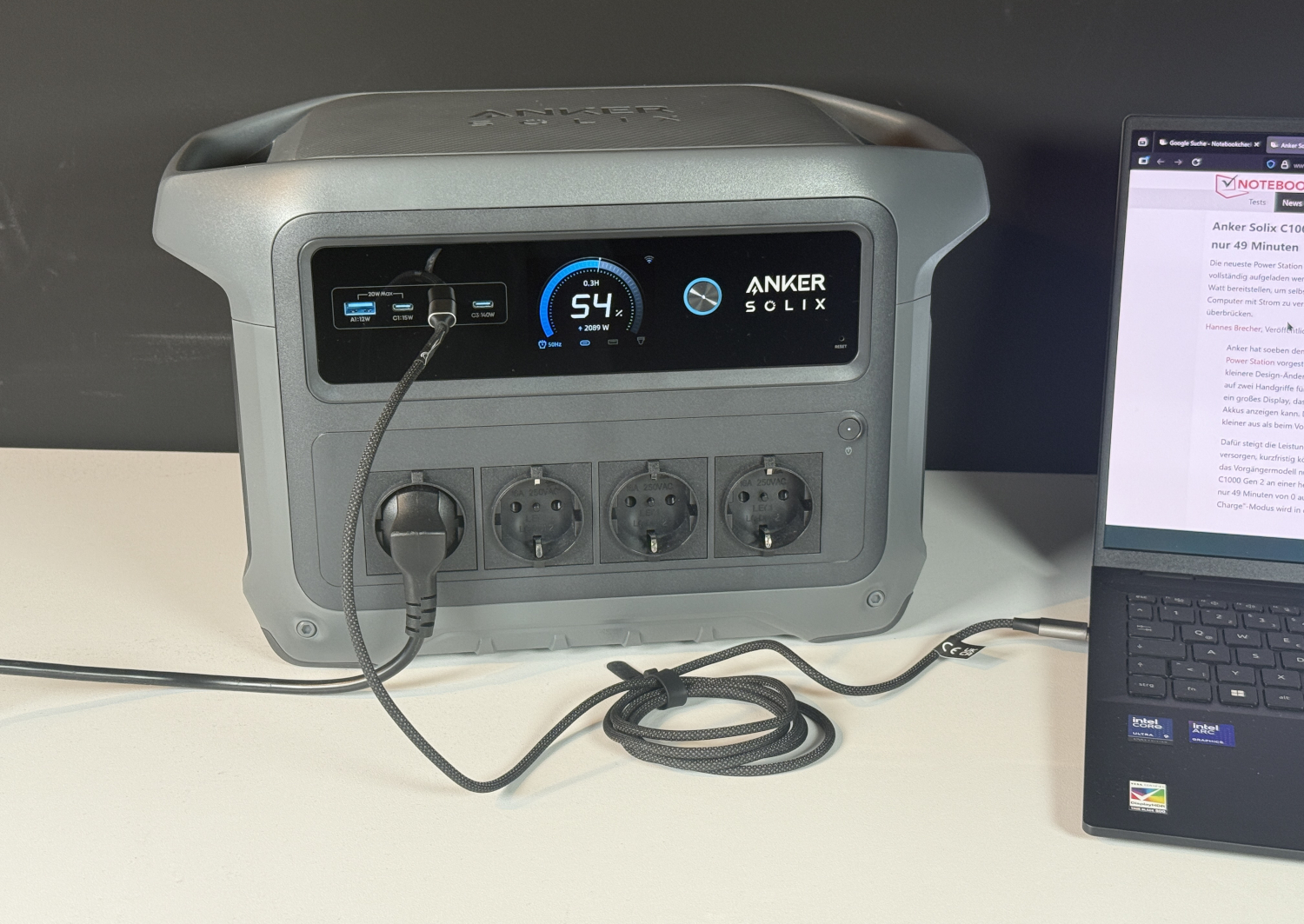
Once again, five AC sockets (which is a lot for a 1 kWh power station), a 12 V car socket and four USB ports are available as connections. Here, Anker Solix now relies on three USB-C and one USB-A (first generation two each) and has also increased the maximum output via USB-C to up to 140 W (instead of 100 W). Apart from the 12 V socket on the side, none of the ports are protected by a cover.

Other improvements include an LC display and a UPS response time halved to 10 ms. All this is packed into a device weighing 11.3 kg. This means that Anker Solix has slimmed down the first C1000 by 1.6 kg. The height has also shrunk by 2 cm, while the width and depth have increased by a few millimeters.
However, we do not want to conceal the fact that the weight reduction is also accompanied by some deterioration. While the reduction in capacity from the previous 1,056 Wh to 1,024 Wh is still manageable, some people may be annoyed by the reduction of the expansion option.
While the Anker Solix C1000 could be doubled in capacity with an additional battery and thus transformed into a 2 kWh power station, this option is no longer available with Generation 2. In addition, there is no integrated LED light in the front any more.
The Anker Solix C1000 Gen 2 is supplied with an AC charging cable, a car charging cable and a quick start guide. This means that the power station can be charged directly after unpacking via the mains and while driving via the on-board socket in a car. Charging via a solar panel with up to 500 Wp is also possible as an option.
App: Control from near and far
Anker Solix has not skimped on the control via app, which is still possible. The connection can be established either via Bluetooth or Wi-Fi (after transmitting the Wi-Fi password). This enables control via smartphone or tablet from a few meters as well as from a greater distance.
Establishing the connection worked without any problems in the test, so that the setup was completed in no time at all. In addition to switching the various connections and the display on and off, the Anker app also allows you to select different modes. In TOU mode, for example, the power station can be charged automatically at more favorable off-peak times. Here, however, it is only possible to store different times and there is no direct connection to dynamic electricity tariffs (such as with the Balcony power stations from Anker Solix).
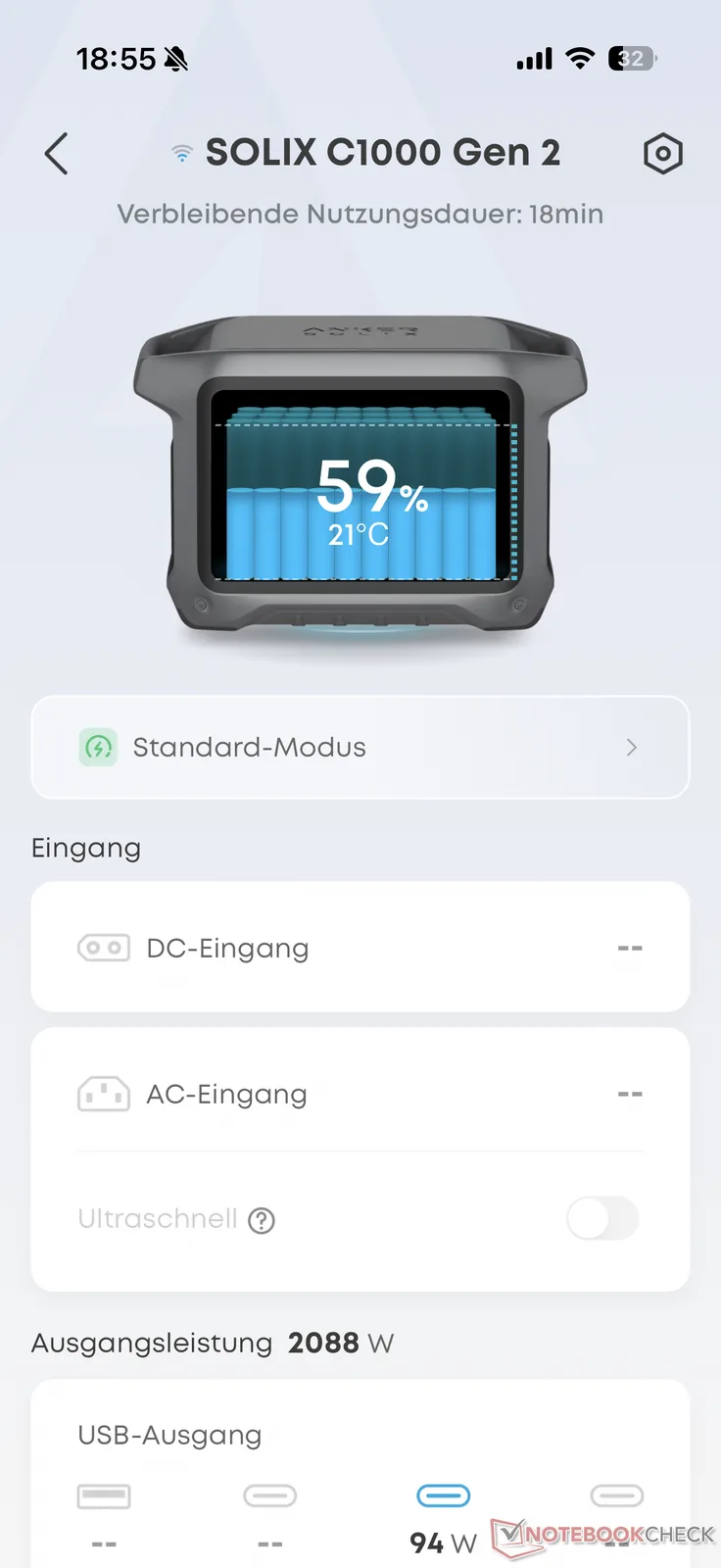
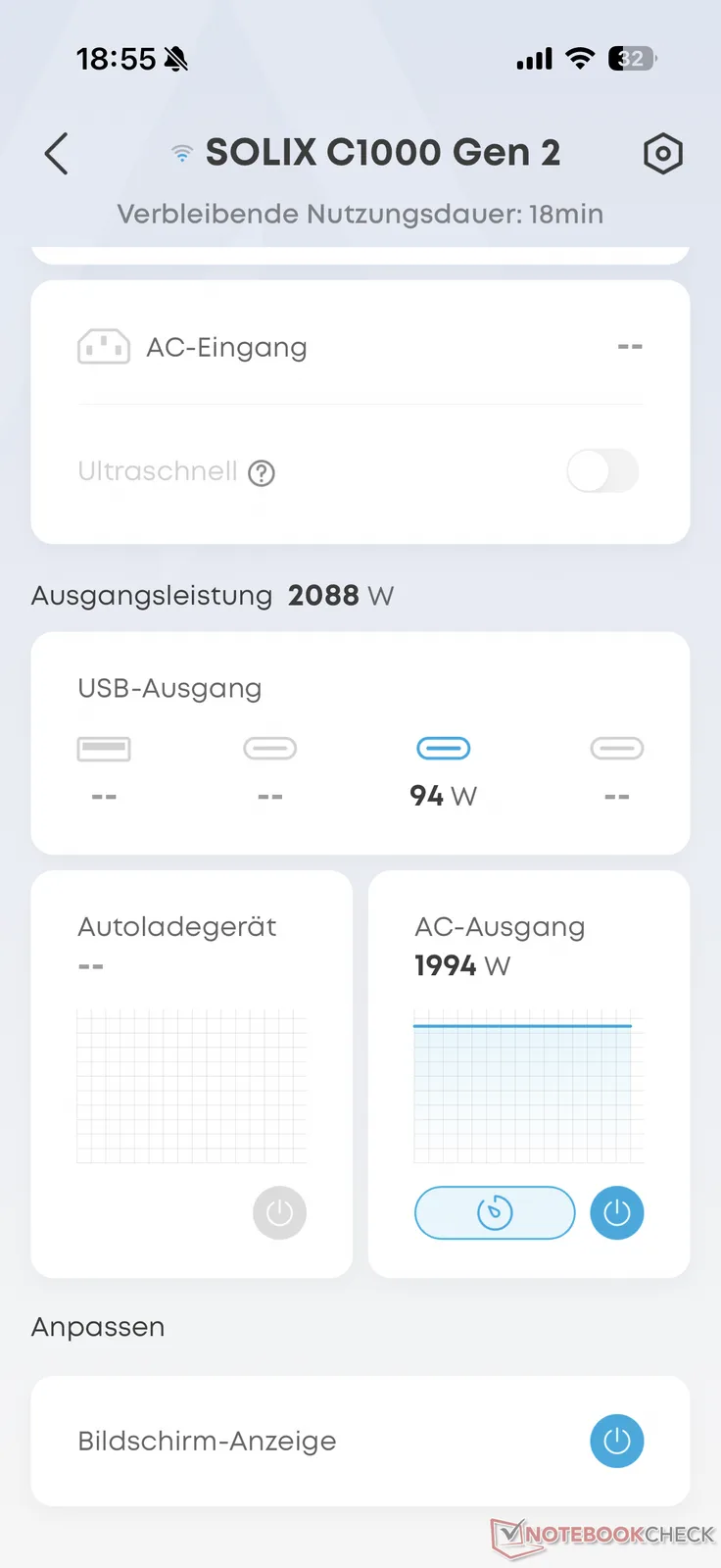
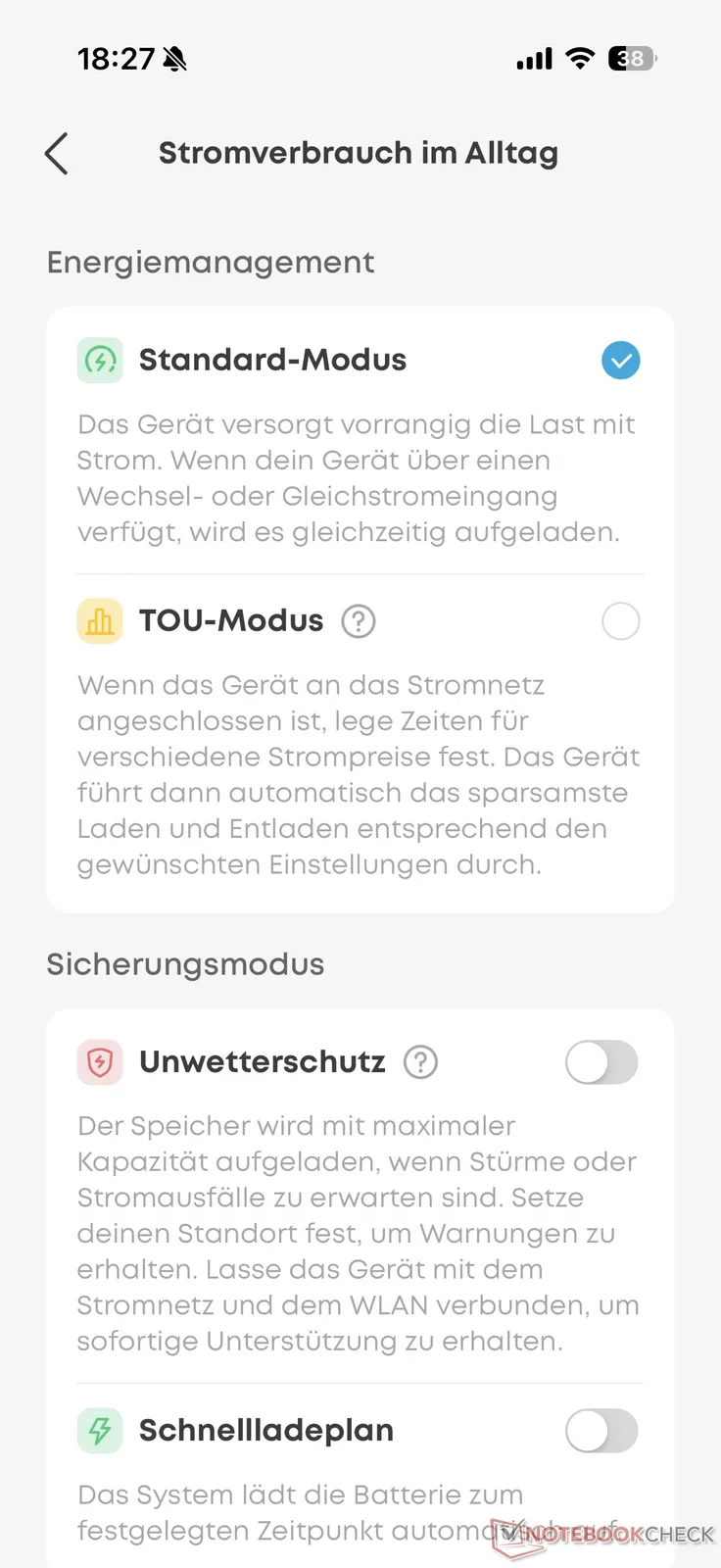
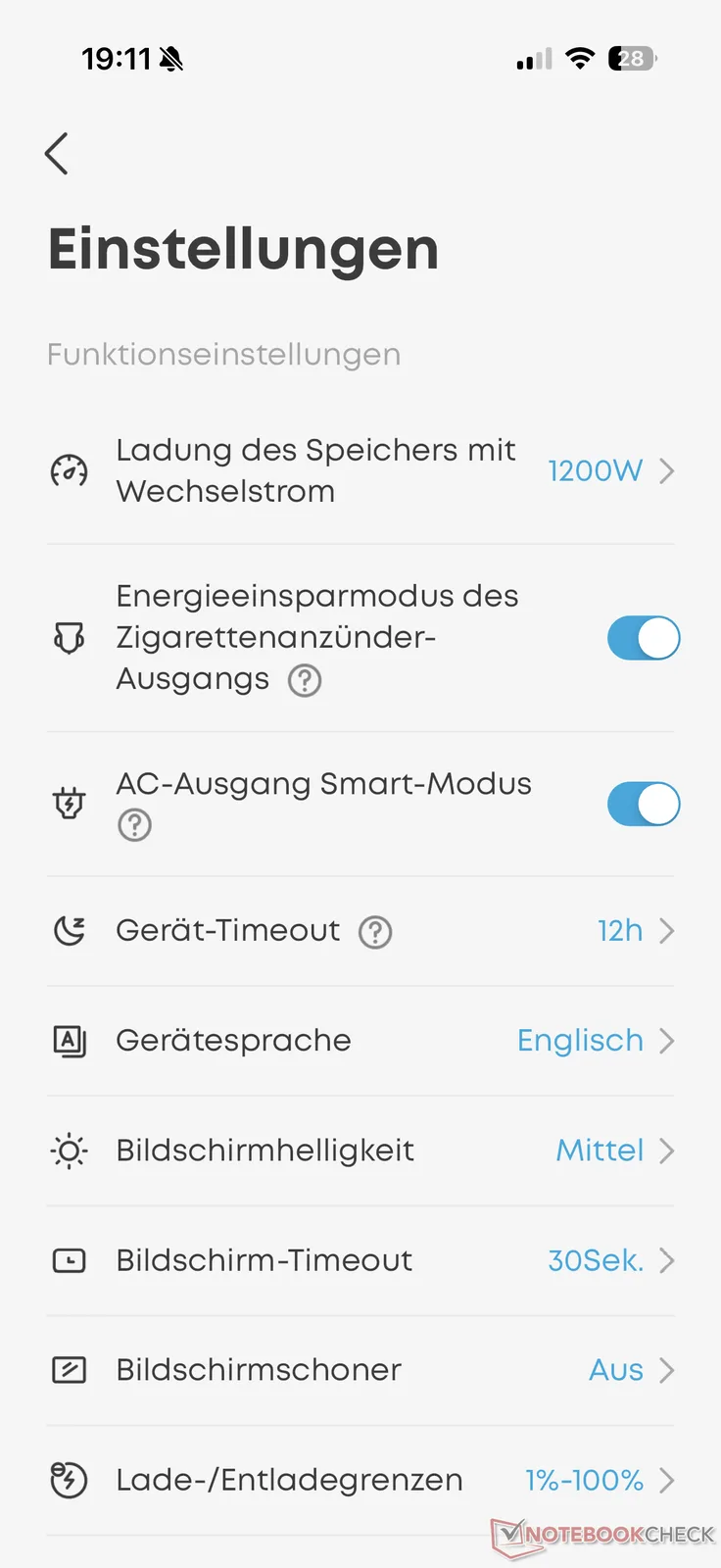
The app also provides information such as the battery charge level and the remaining usage time at the current output power as well as the temperature of the battery cells. Various settings can be made in the menu for maximum charging speed, energy saving, charging and discharging limits and all aspects of the display. Firmware updates are also possible here.
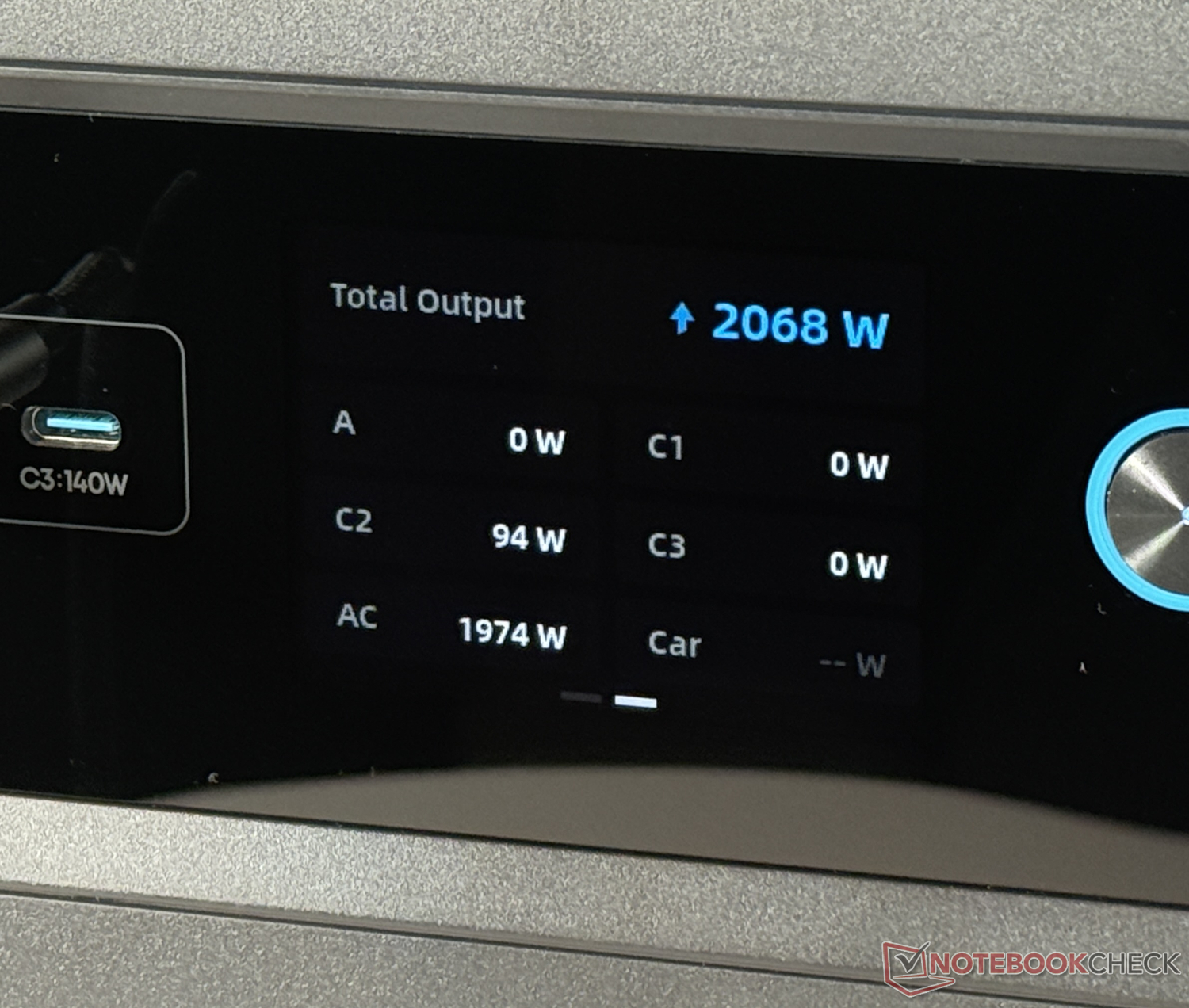
In addition, the improved display now shows more information compared to the first generation. The power button is used to switch between three different screens, which provide detailed information about the input and output power of the various connections.
Practice: Charges in under an hour
We didn't quite reach the 49 minutes charging time specified by the manufacturer for AC charging when testing the Anker Solix C1000 Gen 2 - at least not without the super-fast charging mode, which can be activated via the app. However, at just under 55 minutes, it remained well under the one-hour limit even without Boost and therefore charges particularly quickly. It was noticeable that the charging power was still around 1,200 W even shortly before the end. This is where other power stations usually slow down considerably.
Whether this is good for the battery cells in the long term cannot be definitively determined in our short practical test. Anker Solix promises 4,000 charging cycles or 10 years of performance. However, we can definitely say that 1,110 Wh flowed through the measuring device during an AC charging process according to the measurement (EU version). With a stated capacity of 1,024 Wh, this results in an efficiency of around 92 percent, which is a good value.
The value for AC discharging was not quite as good. With a continuous load of around 250 W at 230 V, we managed to tease 850 Wh (83 percent) out of the power station until it quit with 1 percent charge remaining. The value was even lower with fluctuating AC power consumption. On the other hand, the power station works even more efficiently with DC charging via USB or a car socket, as the inverter is not required here.
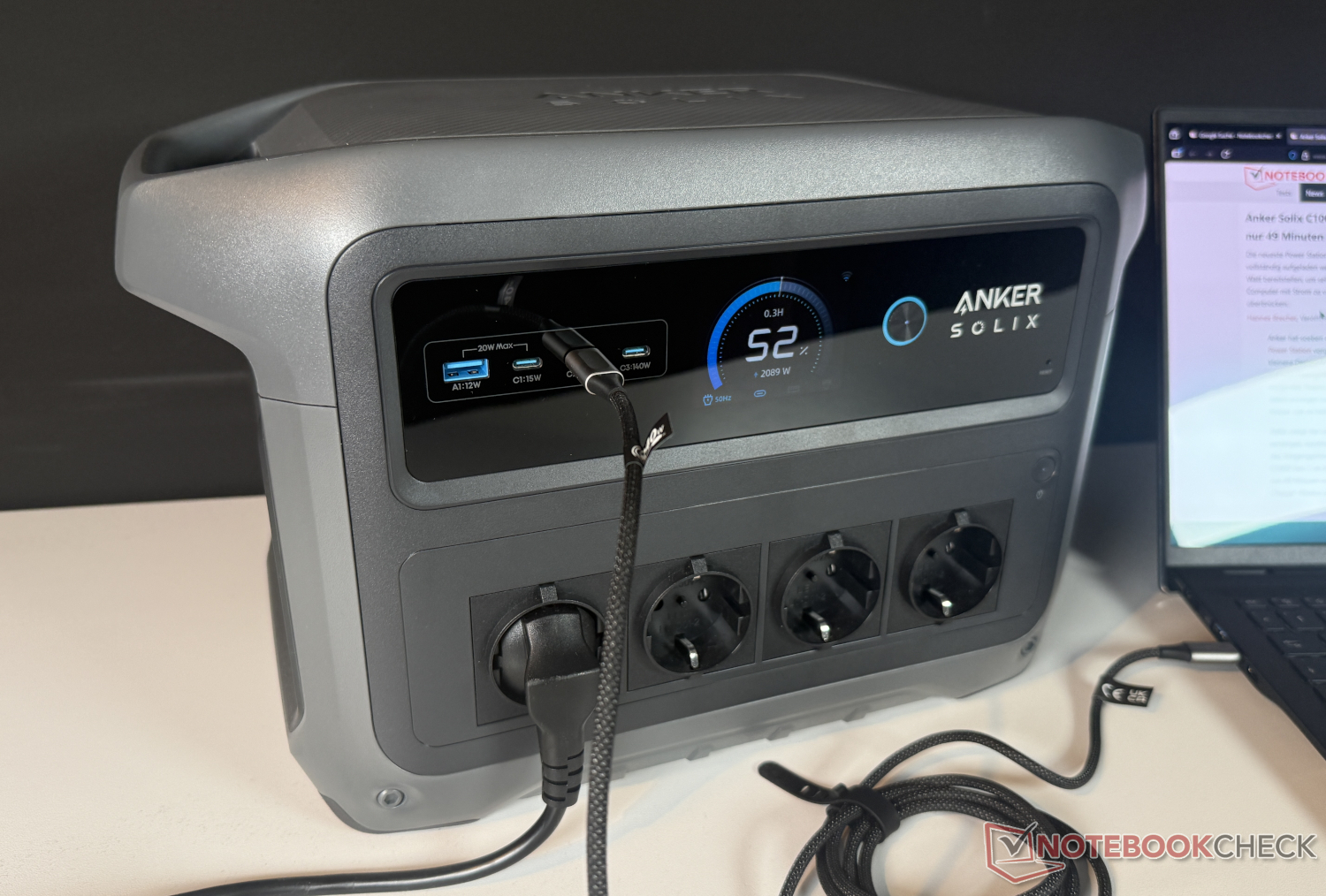
With a continuous AC output of 2,000 W and the same short-term peak output of 3,000 W, the second generation of the Anker Solix C1000 is even more versatile. It now covers even more household appliances. With the larger models such as the Anker Solix F3000 but it cannot keep up.
It should also be noted that the compact power pack is quite audible with a good 45 dB (measured from a distance of 1 m) at higher power output and fast AC charging. At lower loads, it is significantly quieter to silent. The handy size and low weight of the Anker Solix C1000 Gen 2 also made a positive impression during our test. This is particularly useful when carrying around and loading.
However, anyone who wants to use a power station as (emergency) lighting when camping, in the event of a power cut etc. will miss the integrated LED light. The same applies to expandability, which is also no longer available. If you miss this, the first generation of the Anker Solix C1000 is still available as an alternative. At currently around 400 US dollars, it is still available on Amazon.
Transparency
The selection of devices to be reviewed is made by our editorial team. The test sample was given to the author by the manufacturer free of charge for the purposes of review. There was no third-party influence on this review, nor did the manufacturer receive a copy of this review before publication. There was no obligation to publish this review. As an independent media company, Notebookcheck is not subjected to the authority of manufacturers, retailers or publishers.
 Add as a preferred source on Google


