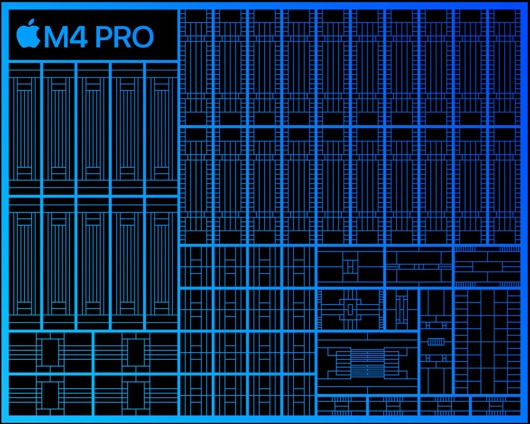
The 14-core Apple M4 Pro is a powerful ARM architecture processor (SoC) for laptops and mini-PCs that debuted in Sep 2024. It features 10 performance CPU cores running at up to 4.5 GHz along with 4 efficient cores running at up to 2.6 GHz. The 20-core M4 GPU and at least 24 GB of fast 273 GB/s LPDDR5x on-package memory depending on the configuration are included as well, as is USB 4 and Thunderbolt 5 support.
The built-in 16 core neural engine (up to 38 TOPS) is found across the whole M4 chip family. Furthermore, all M4 processors are thought to be based on the ARM v9.4-A architecture to a certain degree.
Performance
In our testing, the M4 Pro delivered multi-thread benchmark scores very close to those of the 16-core M3 Max as well as the Intel Core i9-12950HX. Some small generation-to-generation improvement is obviously present but it's the new integrated graphics adapters that are the real stars of the show.
Graphics
The 20-core M4 GPU has hardware support for ray tracing as well as mesh shading and other modern technologies. It supports external displays with resolutions as high as "8K" and it can HW-decode a few popular video codecs such as h.264, h.265 and AV1.
Its gaming performance is at least as good as that of the GTX 1660 Ti Laptop. Please keep in mind that very few games have been compiled specifically for Apple silicon Macs meaning most titles have to be run via emulation layers. Some of them are displayed with visual artefacts as a result, or don't start at all.
The Witcher 3 1080p Ultra = 53 fps (close to the GTX 1660 Ti Laptop)
When under heavy CPU and GPU load, the SoC briefly consumes around 80 W before settling at around 70 W later. With no load at all, it makes do with 2 W to 7 W. A single P-core of the chip eats around 6 W when under heavy load.
The 2nd generation 3 nm TSMC process the M4 Pro is built with delivers good power efficiency, as of late 2024.
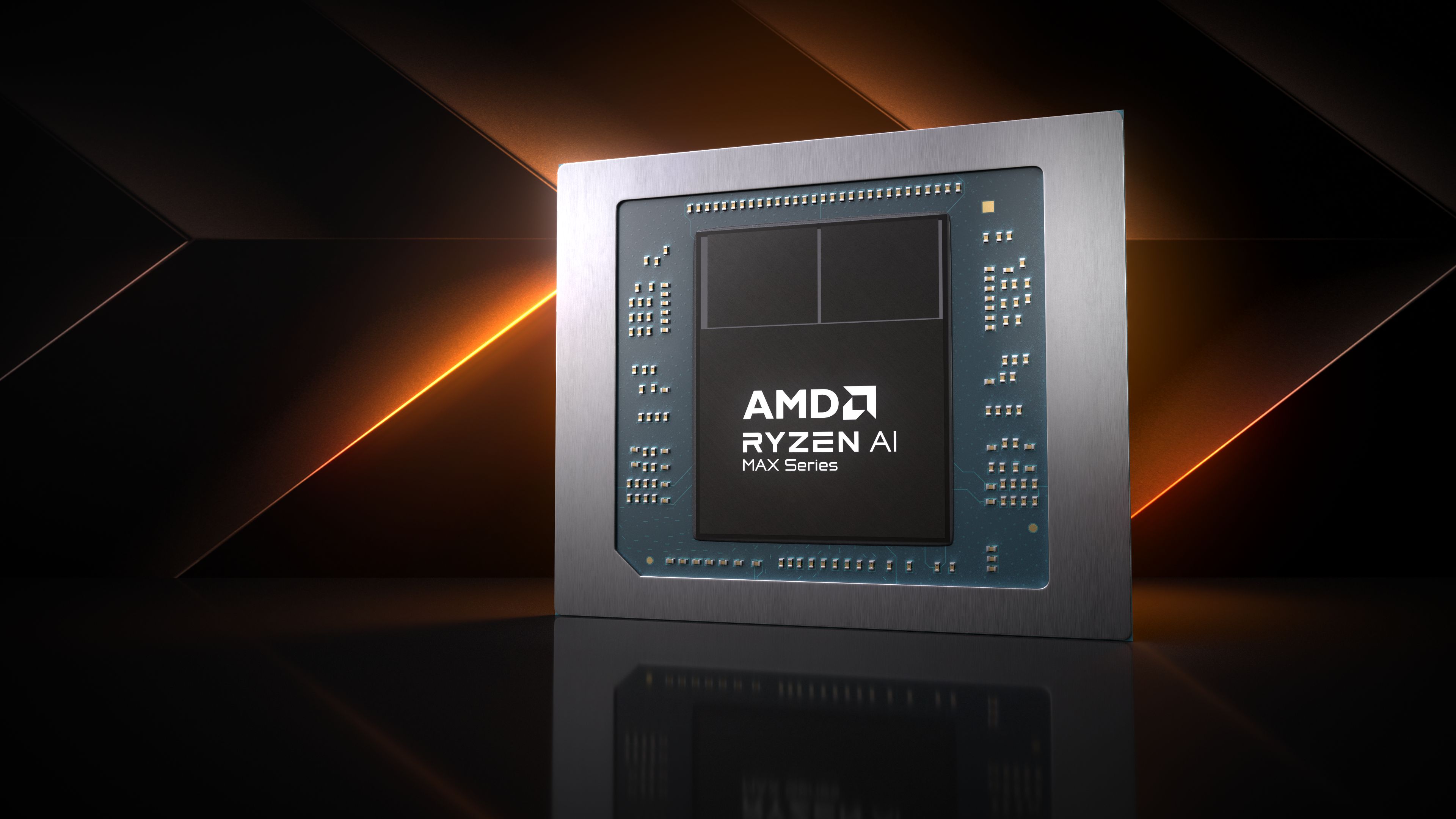
The AMD Ryzen AI Max+ PRO 395 is a powerful Strix Halo family processor that debuted in January 2025. The APU comes with 16 Zen 5 CPU cores running at up to 5.1 GHz, the 40 CU RDNA 3+ Radeon 8060S graphics adapter and the 50 TOPS XDNA 2 neural engine. Unlike its non-PRO sibling, the chip features AMD Secure Processor (an on-package ARM security co-processor), Windows Device Guard and AMD-Vi. Other noteworthy features include PCIe 4, USB 4 and LPDDR5x-8000 RAM support and a whole lot of L3 cache.
Architecture and Features
Unlike Strix Point, Strix Halo parts are powered by Zen 5 cores - no Zen 5c here. It's not clear if this is the desktop Zen 5 implementation with full AVX512 throughput or the mobile one. According to AMD, Zen 5 delivers a 16% IPC improvement over Zen 4 thanks to branch prediction improvements and other refinements.
Elsewhere, the AI Max+ PRO chip supports RAM as fast as LPDDR5x-8000, and is natively compatible with USB 4 (and therefore Thunderbolt). It has PCIe 4.0 support for a throughput of 1.9 GB/s per lane, just like its 8000 series predecessors had. The integrated XDNA 2 NPU delivers up to 50 INT8 TOPS for accelerating various AI workloads.
Performance
From leaks, we know that the Ryzen delivers around 20,700 Geekbench 6.3 Multi points, meaning it trades blow with very powerful desktop CPUs like the Ryzen 9 9900X.
Graphics
The Radeon 8060S is the most powerful iGPU that AMD has on offer, as of Jan 2025. It features 40 RDNA 3+ architecture CUs (2560 unified shaders) that could see it outcompeting lower mid-range desktop graphics cards like the GeForce RTX 4050. This GPU will undoubtedly run any game at 1080p on Ultra, however, the ultimate question is whether or not the cooling solution of the laptop will be powerful enough to let the iGPU shine.
Naturally, the Radeon is capable of driving four SUHD 4320p60 monitors. It can also efficiently encode and decode the most popular video codecs including AVC, HEVC, VP9 and AV1. The latest addition to that list, the VVC codec, is not supported unlike it is with Intel Lunar Lake chips.
Power consumption
The AI Max+ PRO 395 can eat up to 120 W depending on the system and its TDP power targets, with 45 W named as the minimum TDP.
The 4 nm TSMC process that the CPU cores are built with make for decent, as of Jan 2025, energy efficiency.
Average Benchmarks Apple M4 Pro (14 cores) → 100%n=11
Average Benchmarks AMD Ryzen AI Max+ PRO 395 → 91%n=11
- Range of benchmark values for this graphics card - Average benchmark values for this graphics card * Smaller numbers mean a higher performance 1 This benchmark is not used for the average calculation
v1.35
log 05. 07:47:59
#0 ran 0s before starting gpusingle class +0s ... 0s
#1 checking url part for id 18019 +0s ... 0s
#2 checking url part for id 18881 +0s ... 0s
#3 redirected to Ajax server, took 1764917279s time from redirect:0 +0s ... 0s
#4 did not recreate cache, as it is less than 5 days old! Created at Thu, 04 Dec 2025 05:18:50 +0100 +0s ... 0s
#5 composed specs +0.007s ... 0.007s
#6 did output specs +0s ... 0.007s
#7 getting avg benchmarks for device 18019 +0.001s ... 0.008s
#8 got single benchmarks 18019 +0.004s ... 0.012s
#9 getting avg benchmarks for device 18881 +0.004s ... 0.016s
#10 got single benchmarks 18881 +0.006s ... 0.022s
#11 got avg benchmarks for devices +0s ... 0.022s
#12 min, max, avg, median took s +0.034s ... 0.056s






 - Average benchmark values for this graphics card


