




MediaTek Dimensity 8200-Ultra vs Qualcomm Snapdragon 855+ / 855 Plus vs MediaTek MT8188J
MediaTek Dimensity 8200-Ultra
► remove from comparison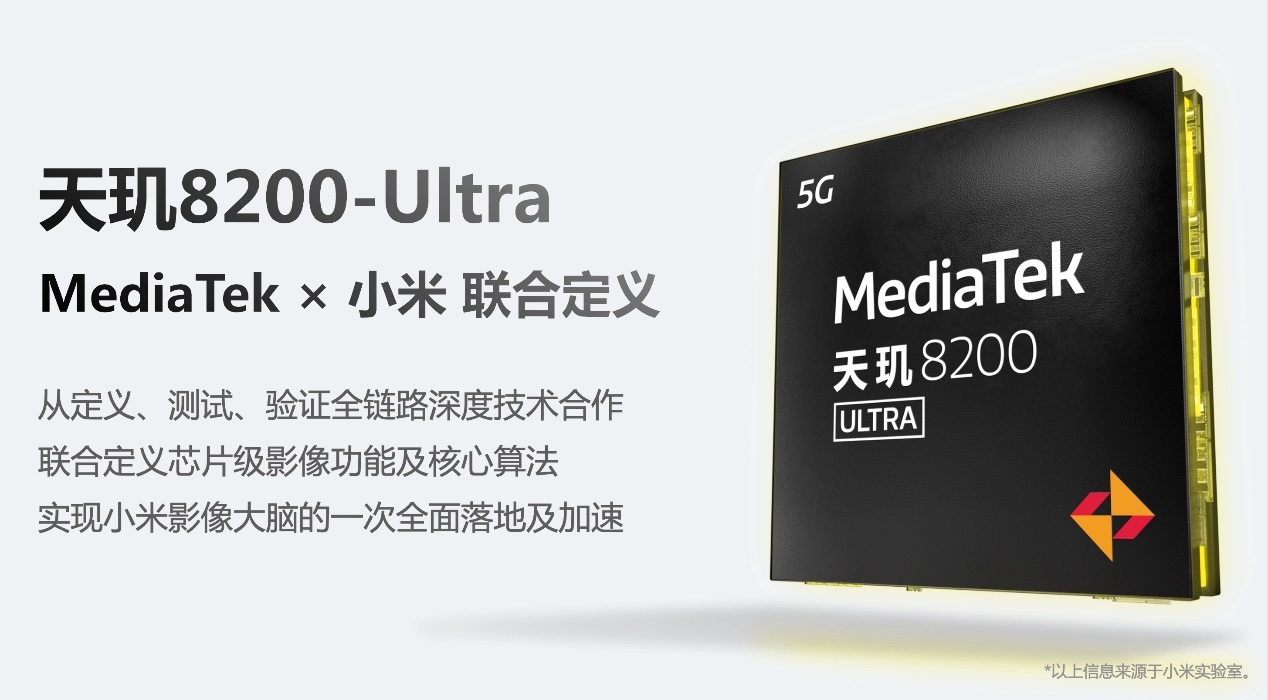
The MediaTek Dimensity 8200-Ultra is a upper mid-range ARM-based SoC (system-on-a-chip) that is manufactured using the modern 4 nm process. It was specially designed for use in Android smartphones and is in the upper class in terms of performance. It supports all current mobile communication standards, including 5G SA.
The CPU works with a total of eight cores, which are divided into two clusters. In the first cluster, an ARM Cortex-A78 power core clocked at 3.1 GHz is joined by three further ARM Cortex-A78 power cores clocked at 3 GHz. In the second cluster, four ARM Cortex-A55 power cores operate at 2.0 GHz. LPDDR5 RAM can be used as RAM and UFS 3.1 is supported as internal memory.
In terms of connectivity, dual 5G with a theoretical peak download speed of up to 4.7 GBit/s is available, as well as WiFi 6E and Bluetooth 5.3.
The Mediatek Dimensity 8200-Ultra is a variant of the otherwise identical Mediatek Dimensity 8200 that has been specially customised for Xiaomi and features improvements to the camera ISP. An Imagiq 785 image processor is responsible for processing the camera data. Video recordings are supported with up to 4K at 60 fps. The CPU part of the older Dimensity 8100 is very similar and offers the same CPU and GPU cores.
The integrated ARM Mali-G610 MC6 graphics unit can power displays with a resolution of up to 2,960 x 1,440 pixels (WQHD+) and a refresh rate of up to 120 Hz. With Full HD+, even up to 180 Hz is possible.
Qualcomm Snapdragon 855+ / 855 Plus
► remove from comparisonThe Qualcomm Snapdragon 855 Plus (855+) Mobile Platform is a high-end smartphone and tablet SoC that Qualcomm announced in 2019. Compared to the normal Snapdragon 855, the 855 Plus offers higher clock speeds of the GPU and CPU. The SoC integrates a fast ‘Prime Core’ that clocks up to 2.96 GHz (up from 2.84 GHz in the 855) and three further fast ARM Cortex-A76 performance cores, which can reach up to 2.42 GHz. These are complemented by four power-saving ARM Cortex-A55 cores that clock up to a maximum of 1.8 GHz.
The SoC also integrates the new X24 LTE modem that Qualcomm promises will deliver up to 2 Gbit/s maximum download speed over LTE Cat.20 and up to 316 Mbit/s upload speeds. The Snapdragon 855 can be configured with the company’s new X50 5G modem too.
Qualcomm has also improved the integrated Wi-Fi modem, which is Wi-Fi 6-ready, has 8x8 Sounding and supports up to 802.11 ay Wi-Fi. The Wi-Fi modem can utilise the 60 GHz mmWave band for up to 10 Gbit/s internet speeds.
The Hexagon 690 DSP has undergone the most revisions of that which Qualcomm has integrated into the Snapdragon 855. The new DSP incorporates a neural processing unit (NPU) with dedicated Tensor-cores that can execute up to 7 trillion operations per second in conjunction with the CPU and GPU. In short, the Snapdragon 855 should be three times faster than the Snapdragon 845 and two times faster than the Kirin 980 SoC.
The Snapdragon 855 also has a Spectra 380 ISP onboard, which is the world’s first chip to incorporate a Computer Vision Engine (CV-ISP) that can perform depth calculations in videos at up to 60 FPS. The Snapdragon 855 should deliver real-time portrait modes or be able to detect objects with relatively low power consumption.
The built-in memory controller supports up to 16 GB LPDDR4x RAM (4 x 16-bit). As the SD855, the 855+ integrates an Adreno 640 graphics card that is now higher clocked and should offer a 15% higher performance.
Qualcomm will manufacturer the Snapdragon 855+ at the Taiwan Semiconductor Manufacturing Company (TSMC) using a 7 nm FinFET process.
MediaTek MT8188J
► remove from comparison
The MediaTek MT8188J is a mid-range ARM SoC (System-on-a-Chip) introduced in the first quarter of 2023, primarily used in Android-based tablets. It is manufactured using a 12-nanometer process and features a total of eight CPU cores (Octa-Core). These consist of two fast Cortex-A78 cores and 6 Cortex-A55 cores that work together in a big.LITTLE configuration.
The A78 cores of the MediaTek MT8188J can clock at speeds of up to 2.2 GHz, while the A55 cores can reach speeds of up to 2 GHz (going down to 500 MHz). For graphics processing, it employs an ARM Mali-G57 MP2 GPU. Additionally, it includes a video decoder with support for H.264 and H.265.
In addition to the CPU and GPU, the chip integrates an LPDDR4 memory controller, capable of supporting up to 8 GB of RAM. The SoC also includes a modem for WiFi 6, Bluetooth 5.3, and LTE up to Cat.7.
| Model | MediaTek Dimensity 8200-Ultra | Qualcomm Snapdragon 855+ / 855 Plus | MediaTek MT8188J | ||||||||||||
| Codename | Cortex-A78 / A55 | Cortex-A76 / A55 (Kryo 485) | Cortex-A78 / A55 | ||||||||||||
| Clock | 2000 - 3100 MHz | <=2960 MHz | 2000 - 2200 MHz | ||||||||||||
| L3 Cache | 4 MB | 5 MB | |||||||||||||
| Cores / Threads | 8 / 8 1 x 3.1 GHz ARM Cortex-A78 3 x 3.0 GHz ARM Cortex-A78 4 x 2.0 GHz ARM Cortex-A55 | 8 / 8 | 8 / 8 | ||||||||||||
| Technology | 4 nm | 7 nm | 12 nm | ||||||||||||
| Features | ARM Mali-G610 MC6 GPU, Dual 5G modem, WiFi 6E, Bluetooth 5.3, H.264/HEVC video decoding | X24 LTE Modem, Adreno 640 GPU | ARM Mali-G57 MP2 GPU, LTE Cat.7 modem, WiFi 6, Bluetooth 5.3, H.264/H.265 video decoding | ||||||||||||
| iGPU | ARM Mali-G610 MP6 | Qualcomm Adreno 640 (250 - 675 MHz) | ARM Mali-G57 MP2 | ||||||||||||
| Architecture | ARM | ARM | ARM | ||||||||||||
| Announced | |||||||||||||||
| Manufacturer | www.google.com | www.qualcomm.com | |||||||||||||
| Series | Qualcomm Snapdragon | ||||||||||||||
| Series: Snapdragon Cortex-A76 / A55 (Kryo 485) |
| ||||||||||||||
| L2 Cache | 1.8 MB | ||||||||||||||
| TDP | 5 Watt |

Benchmarks
Average Benchmarks MediaTek Dimensity 8200-Ultra → 100% n=13
Average Benchmarks Qualcomm Snapdragon 855+ / 855 Plus → 72% n=13
Average Benchmarks MediaTek MT8188J → 67% n=13
 - Average benchmark values for this graphics card
* Smaller numbers mean a higher performance
1 This benchmark is not used for the average calculation


 Add as a preferred