




Competition for the Raspberry Pi CM: Banana Pi BPI-CM7 unveiled
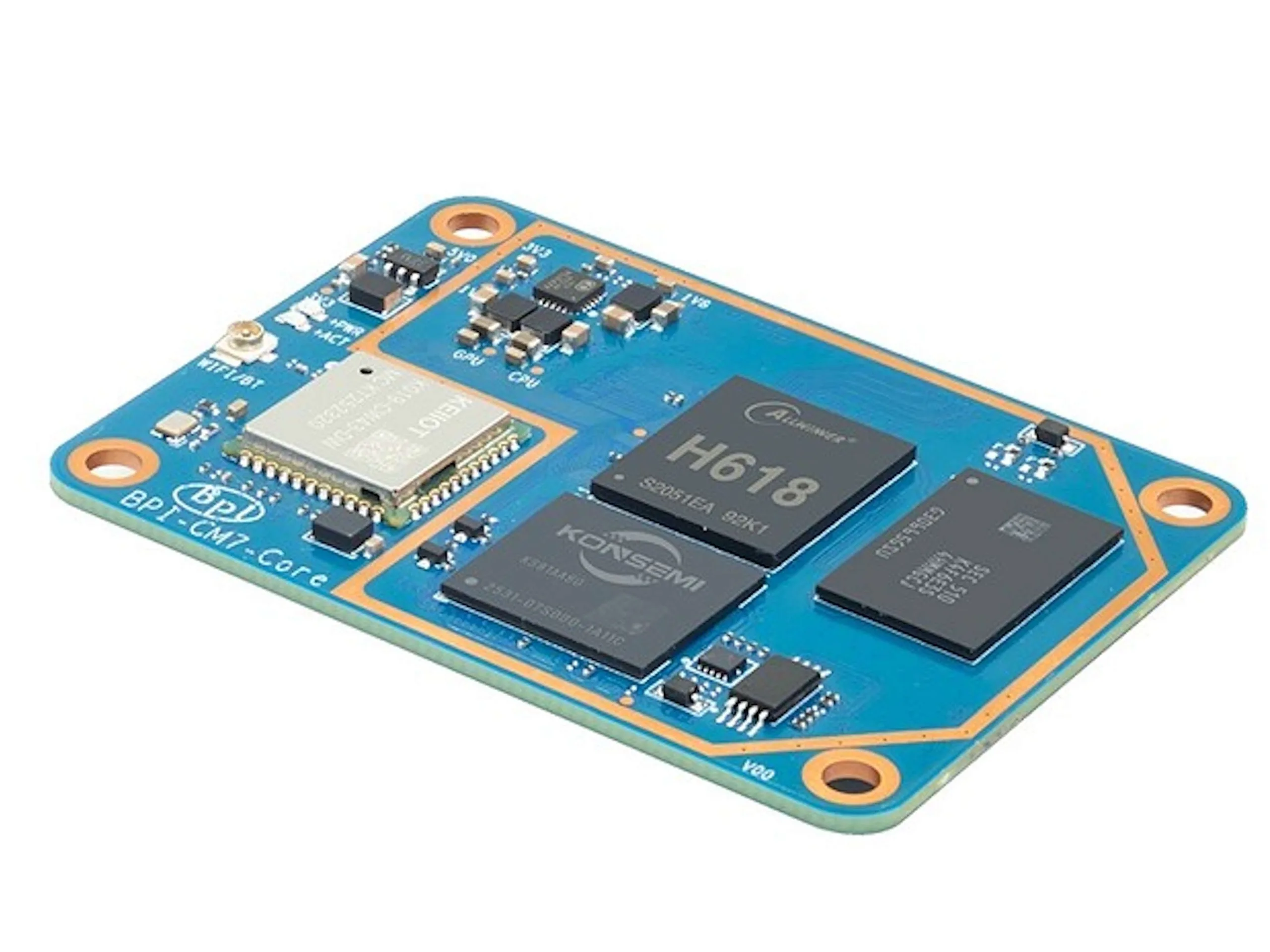
The Banana Pi BPI-CM7 has been officially unveiled. While it is classified as a single-board computer, it does not adopt the traditional layout of a Raspberry Pi (5). Instead, it comes as a compute module. In practice, this means the BPI-CM7 cannot be used standalone, as it lacks standard physical I/O ports. Compute modules like this are typically paired with a carrier board during initial prototyping. The main advantage of this approach is an exceptionally slim profile: developers building custom devices—such as ultra-compact handhelds—can design minimal carrier boards that break out only required interfaces, like USB Type-C and DSI, while omitting unnecessary hardware like Ethernet or HDMI.
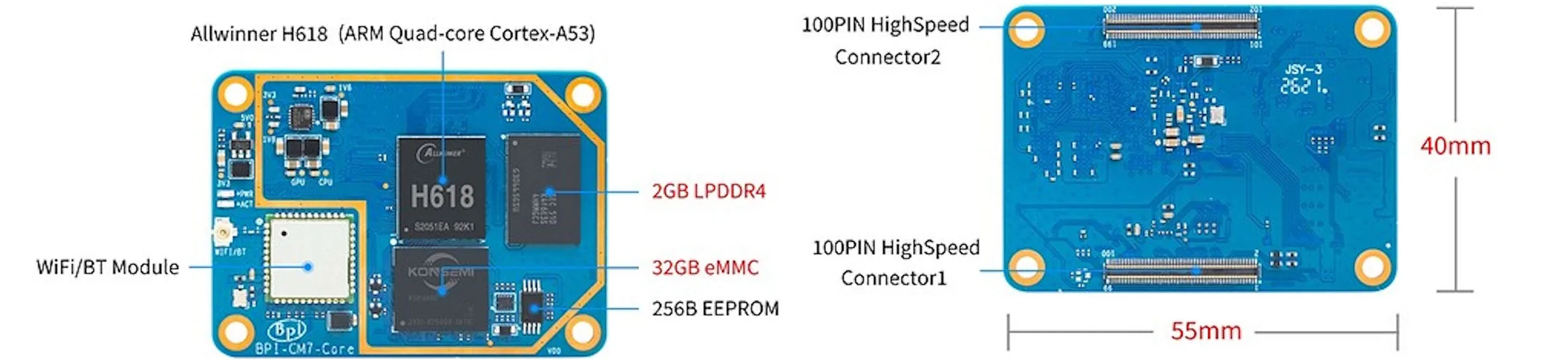
Measuring 55 x 40 mm, the board breaks out signals via two 100-pin high-density connectors and is powered by an Allwinner H618 SoC featuring four Cortex-A53 CPU cores alongside an ARM Mali-G31 GPU. Memory configurations rely on onboard LPDDR4 RAM; a variant featuring 2 GB of RAM and 32 GB of eMMC flash storage has already been confirmed. Wireless connectivity is handled via an integrated module supporting Wi-Fi 5 and Bluetooth 5.0. Networking options include 100 Mbps Fast Ethernet. HDMI video output is supported, provided the host carrier board exposes the appropriate connector, alongside USB 2.0 interface routing. Standard low-level interfaces for sensors and actuators—including GPIO, UART, and SPI—are available, with the module drawing power from a 5 V supply. Banana Pi has not yet released pricing or concrete availability details.
Source(s)
 Add as a preferred source on Google


No comments for this article
