




Astronomers find one of the oldest stars ever, preserving clues from the early universe
After the Big Bang, the universe contained almost only hydrogen and helium. There were no heavy elements, and the early universe had no trace of metals. The first stars were formed a few hundred million years later, and nuclear fusion inside their cores produced the first heavy elements, such as carbon, magnesium, and oxygen. When these stars died, the supernova explosion blasted these elements into space. These elements mixed with the gas clouds and created ingredients for the next generation of stars.
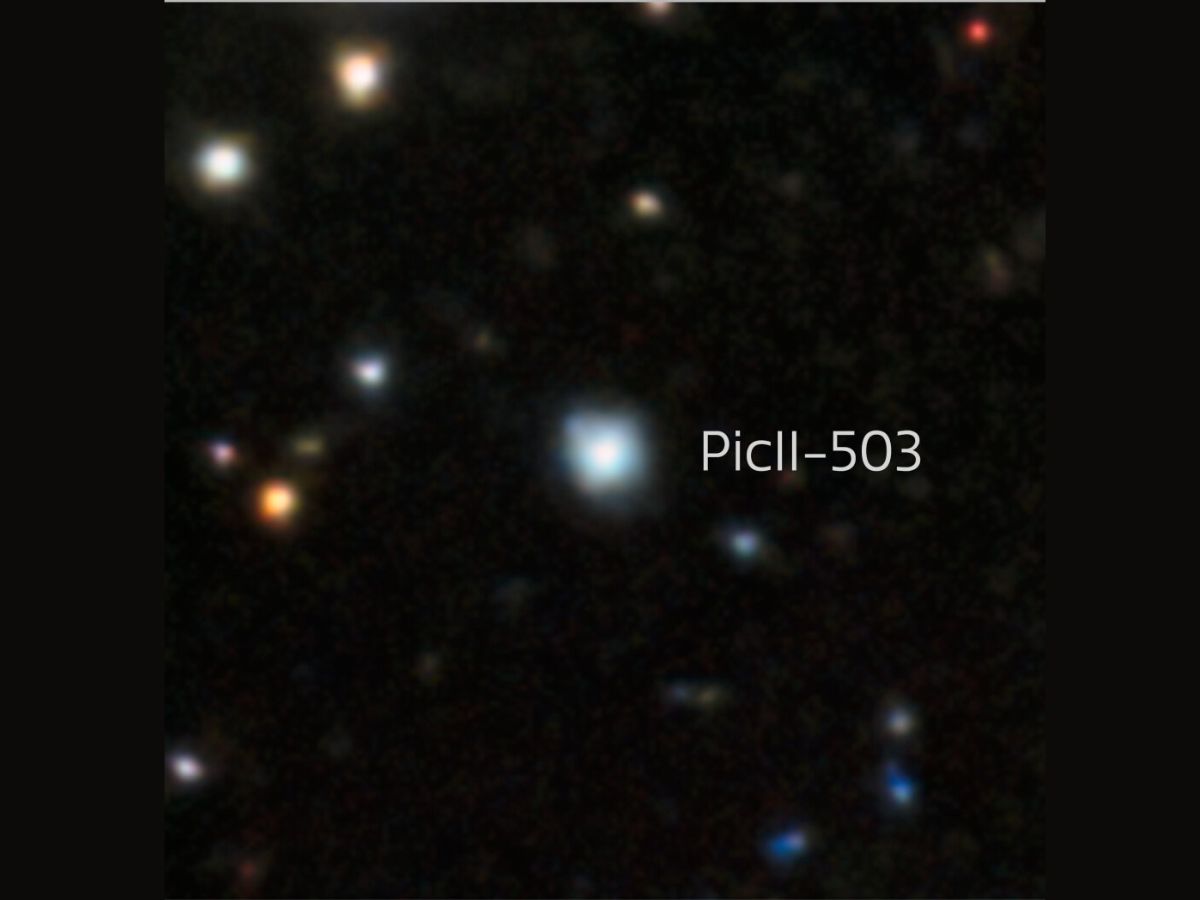
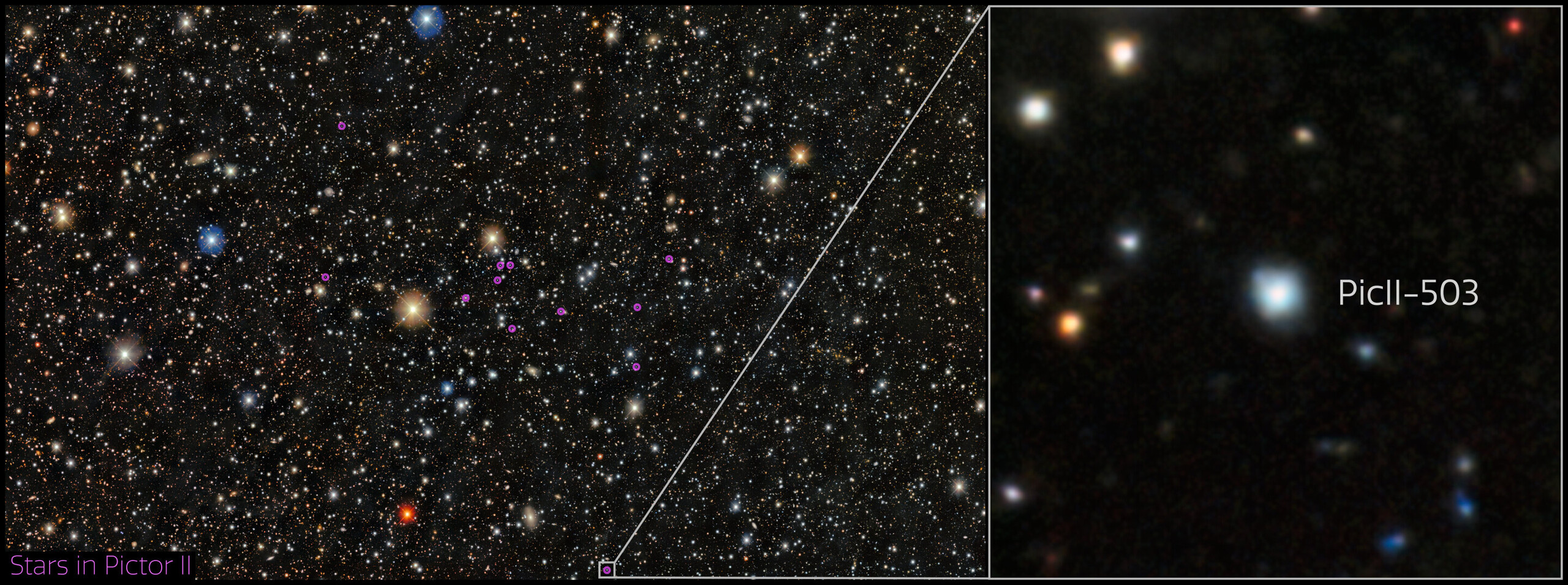
Stars that formed early in cosmic history had very low metallicity and acted as time capsules. PicII-503 is a star found in the dwarf galaxy Pictor II. The surprising thing about this star is that it contains almost no iron and an extremely high carbon abundance. This makes it one of the most chemically primitive stars ever found.
This type of star, called a carbon-enhanced metal-poor (CEMP) star, was identified using the Dark Energy Camera mounted on the Victor M. Blanco Telescope.
Scientists believe the star formed from gas enriched by a low-energy supernova. In that explosion, heavier elements fell back into the collapsed core, allowing only the lighter elements to escape and seed the new star. The gas then formed a second-generation star. PicII-503 gives a direct chemical record of the first stars, increasing our understanding of cosmic chemical evolution.
Source(s)
Image credit: CTIO/NOIRLab/DOE/NSF/AURA Image processing: Image processing: T.A. Rector (University of Alaska Anchorage/NSF NOIRLab), M. Zamani & D. de Martin (NSF NOIRLab) Acknowledgment: PI: Anirudh Chiti, Alex Drlica-Wagner
 Add as a preferred source on Google


