




Astronomers witness the birth of a magnetar inside a supernova for the first time
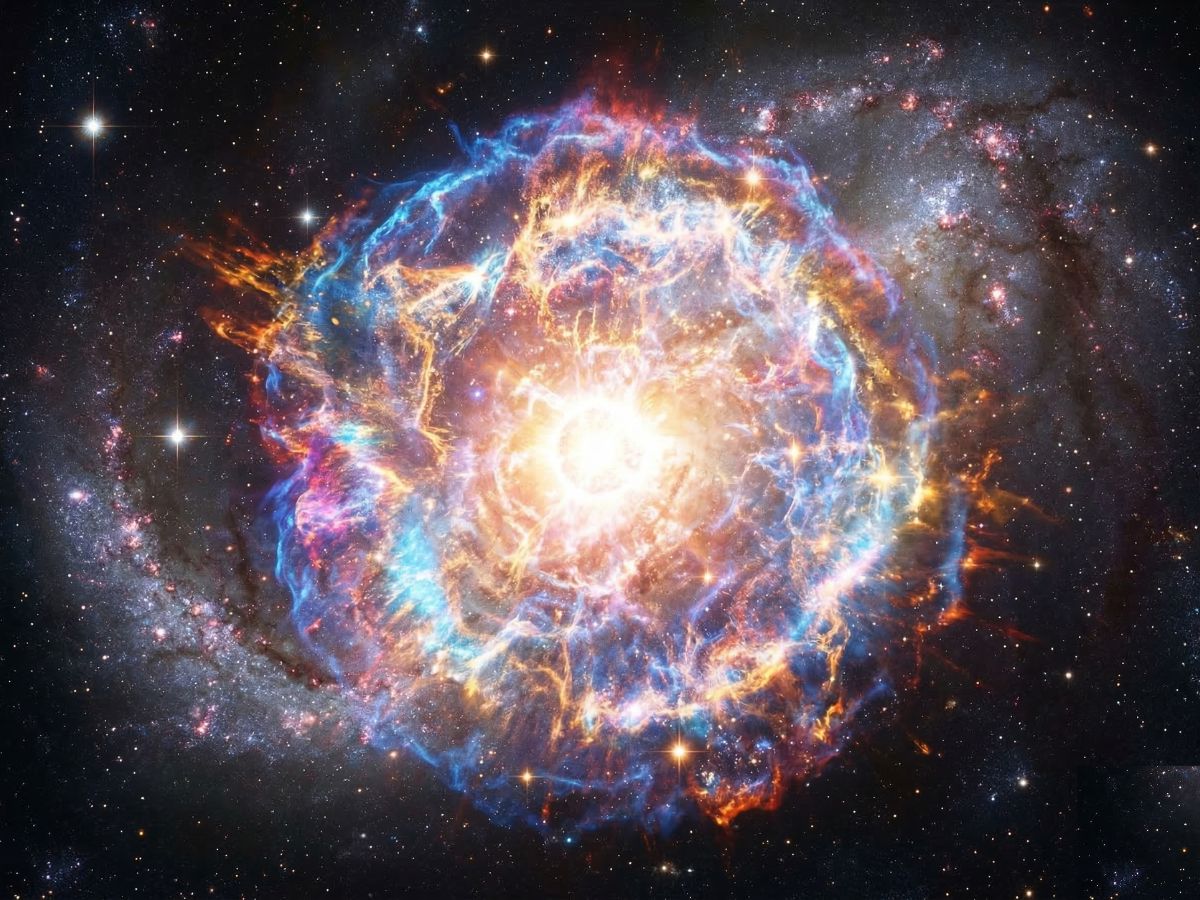
At the end of the life of some stars, there is a violent explosion called a supernova. The outer layers of the star explode outward, and the core collapses, forming a neutron star. This is an extremely dense star filled with neutrons. A magnetar is a special type of neutron star with an extremely powerful magnetic field, rapid rotation, sometimes exceeding 1,000 rotations per second, and huge energy output. This releases an enormous amount of energy into its surroundings.
Superluminous supernovae were discovered in the early 2000s. These explosions are 10 or more times brighter than a normal supernova and last much longer. In 2010, astrophysicist Dan Kasen, along with Lars Bildsten and Stan Woosley, proposed a theory that when a massive star collapses, its core forms a rapidly spinning magnetar. This creates a magnetic field that accelerates particles. These particles crash into the debris of a supernova, reheating it, hence making the explosion much brighter and long-lasting.
More insight has come from studying the brightness of SN 2024afav using telescopes for over 200 days. The brightness showed four bumps that occurred progressively closer together, with increasing oscillation. This is referred to as a chirp.
After a star explodes and forms a magnetar, some debris falls towards the magnetar, forming a spinning ring called an accretion disk. This disk is not completely aligned with the magnetar's spin axis, leading to general relativity frame dragging. The chirp speeds up as the disk moves inward toward the magnetar. Upcoming surveys will be done by the Vera C. Rubin Observatory to find more chirping supernovae. This may lead to the discovery of more newborn magnetars, improving our knowledge of supernovae.
 Add as a preferred source on Google


