




99% dark matter: Hubble Telescope captures a nearly starless galaxy

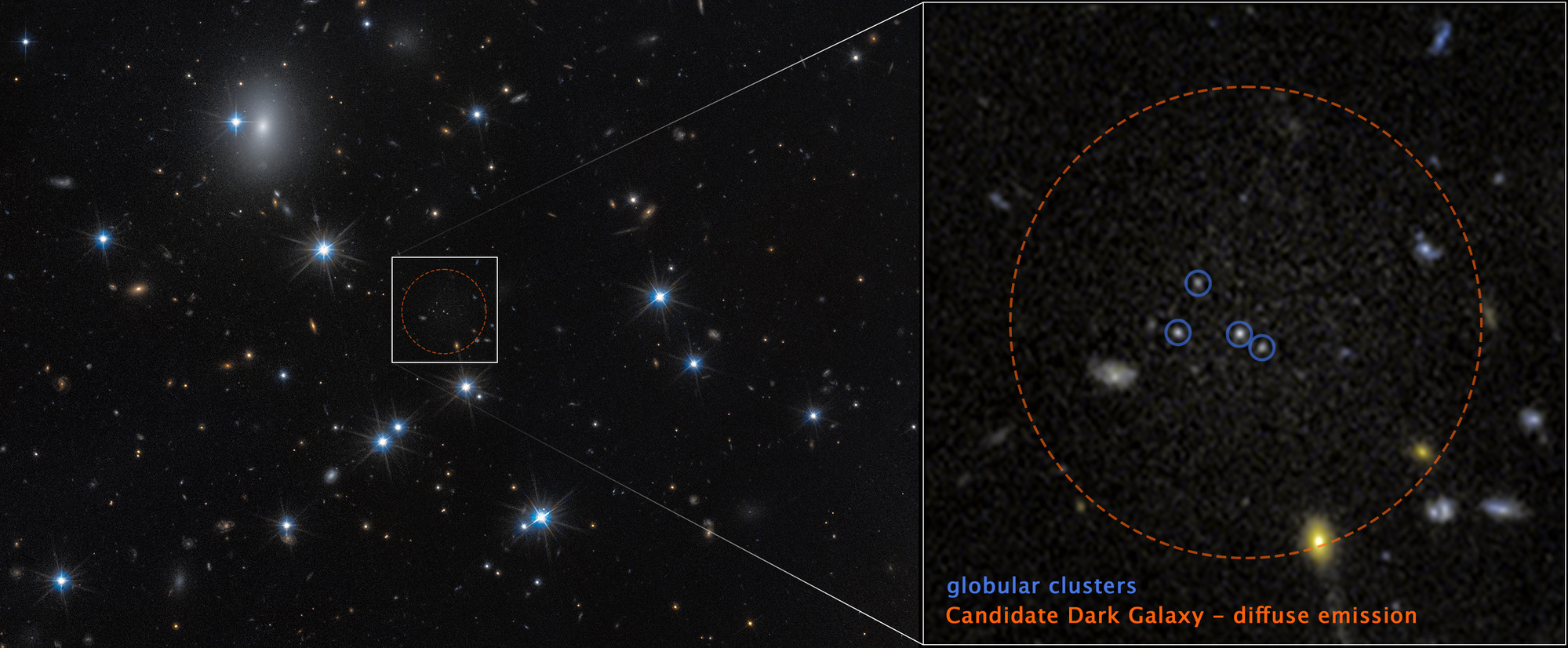
Galaxies are usually detected by their starlight, gas emissions, and structure. However, CDG-2 is a dark galaxy with extremely low visible light and very few stars, thus making it quite difficult to identify. It contains mostly dark matter, which is invisible, does not absorb, reflect, or emit light, and is detectable only through its gravitational effects. 99% of CDG-2’s mass appears to be dark matter, and it is classified as a low-surface-brightness galaxy because of its faint light. It was detected solely through the tight grouping of its globular clusters, making it scientifically significant.
CDG-2 is located in the Perseus Cluster, a gigantic galaxy cluster about 300 million light-years away. This cluster experiences intense gravitational interactions that strip gases like hydrogen away. Ram-pressure stripping also occurs, disrupting smaller galaxies and impeding star formation. Hydrogen is really important for star formation, and this harsh environment may be responsible for the lack of stars in CDG-2.
In confirming CDG-2, astronomers used three observatories. The first was the Hubble Space Telescope, which provided clear identification of four globular clusters with high-resolution imaging. The second was Euclid, which is particularly good at detecting low-surface-brightness galaxies. It confirmed the faint diffuse light using wide-field imaging. The last was the Subaru Telescope, which provided supplementary confirmation data using ground-based deep imaging.
Together, these observatories confirmed that the globular clusters were embedded in a faint diffuse glow—evidence of an underlying galaxy. Dark matter is one of physics’ greatest mysteries, and this discovery represents a step in solving and understanding what goes on behind that curtain.
Source(s)
Image source: NASA, ESA, Dayi Li (UToronto); Image Processing: Joseph DePasquale (STScI)
 Add as a preferred source on Google


