




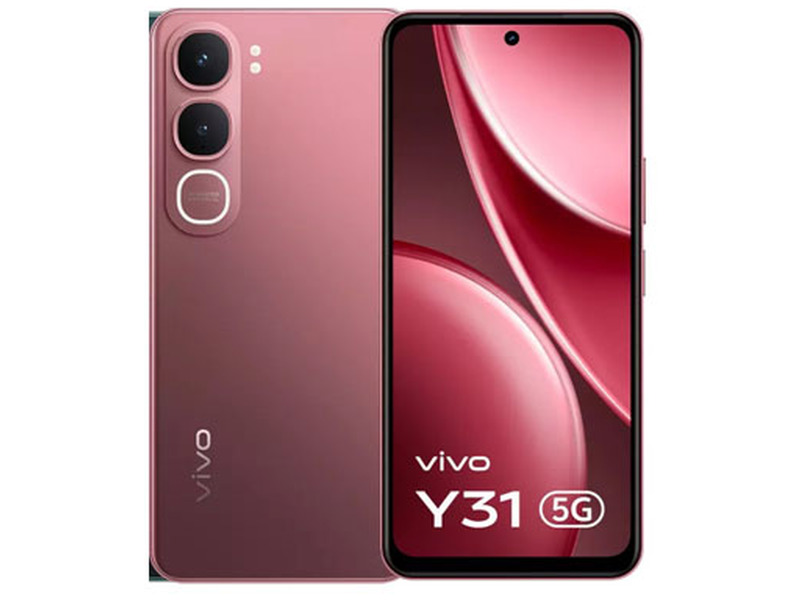
Vivo Y31 5G (2025)
Specifications
Secondary Camera: 8 MPix
Price comparison
Reviews for the Vivo Y31 5G (2025)
Source: OI Spice Tech News

The vivo Y31 (2025), announced and released on September 15, enters the budget 5G segment with a rugged design and a focus on long-lasting battery life. It carries IP68/IP69 ratings and MIL-STD-810H compliance, which is rare at this price. The phone feels large and slightly heavy at 209 g, but the build quality is solid, and the Guardian Glass protection adds extra confidence. On the front, it uses a 6.68-inch IPS LCD with a smooth 120Hz refresh rate. The screen reaches 1000 nits in HBM, but the 720p resolution and 264 ppi density keep it on the softer side. Still, for everyday use and media, the display looks decent and bright enough outdoors. Powering the phone is the Snapdragon 4 Gen 2 chipset built on a 4 nm process, paired with Adreno 613 GPU.
Single Review, online available, Very Short, Date: 12/12/2025
Comment
Qualcomm Adreno 613: Graphics chip for smartphones and tablets, integrated in the Qualcomm Snapdragon 4 Gen 2 SoC. Although it is the successor to the Adreno 619 in the SD 4 Gen 1, its performance is significantly lower in the entry-level class.
Only some 3D games with very low demands are playable with these cards.
» Further information can be found in our Comparison of Mobile Graphics Cards and the corresponding Benchmark List.
SD 4 Gen 2: Entry-level SoC with 8 Kryo cores (two ARM Cortex-A78 based cores with up to 2.2 GHz and 6 ARM Cortex-A55 with up to 2 GHz) and an X61 5G modem. Manufactured in 4nm at Samsung.» Further information can be found in our Comparison of Mobile Processsors.
Devices from a different Manufacturer and/or with a different CPU
Devices with Same Screen Size and/or Weight
 Add as a preferred source on Google


