




Valve jokes about memory shortage at GDC, with Steam Machine release date and price in doubt

Many buyers are anxious to learn how the memory shortage will impact the Steam Machine release date and price. Even so, at GDC 2026, Valve thought it was a good idea to joke about the crisis. Journalist and gamer Hayden Dingman shared some comments the company made at the conference:
If you have a line on a bunch of RAM, we are in the market and would like to buy it.
Some fans don’t see the humor in making light of record-high memory prices. Not only has it delayed the Steam Machine, but building or buying PCs has become unaffordable. In some cases, the cost of the DDR5 RAM that Valve’s mini PC will rely on has quadrupled since late 2025.
In early February, the manufacturer provided an update on its upcoming hardware. Fans had expected the new controller, Steam Frame VR headset, and Steam Machine release date in early 2026. However, Valve explained that due to rising component costs, that timeline had shifted to the first half of the year.
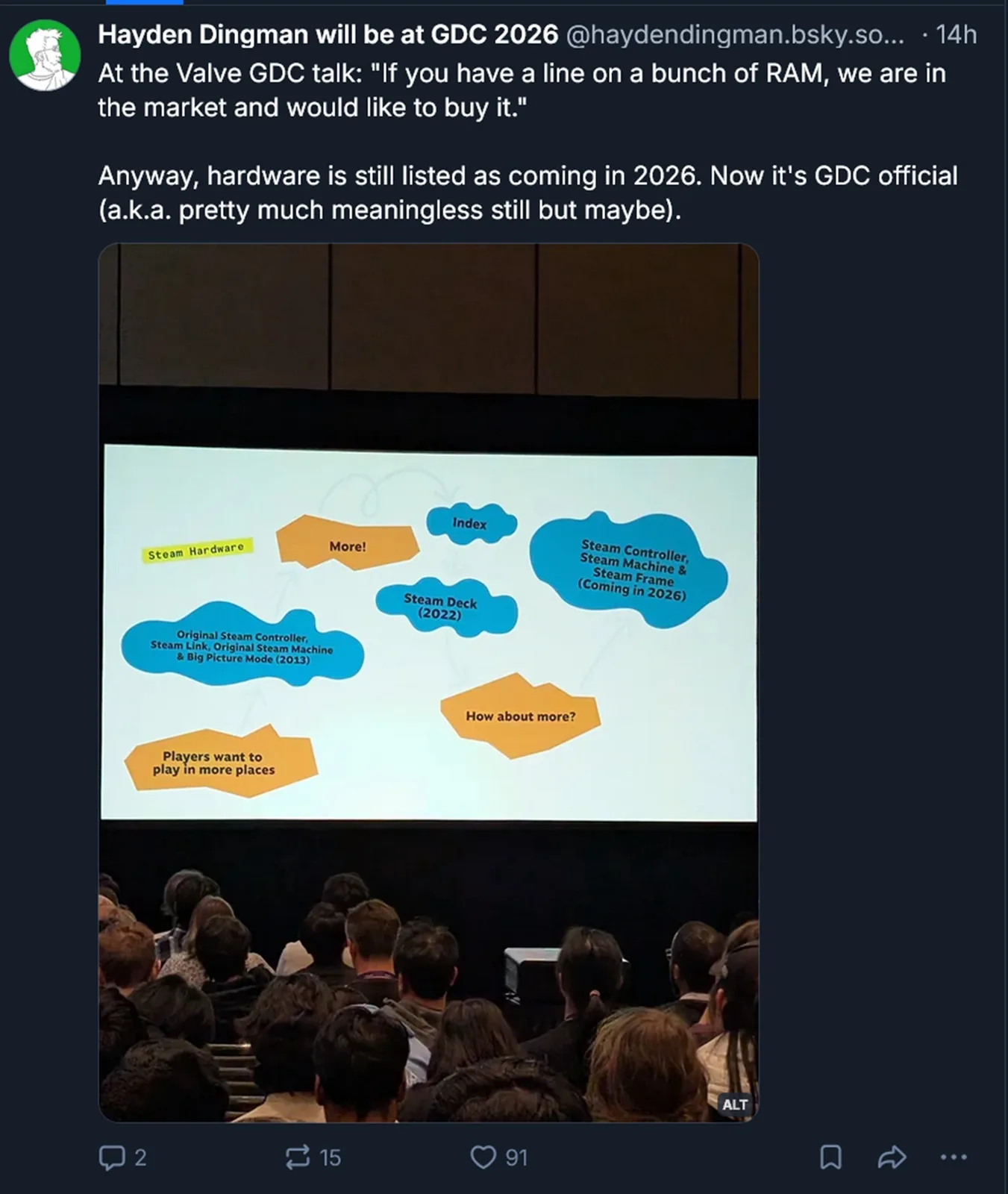
More recently, listings at SteamDB changed the arrival time for the products to “coming soon.” Sadly, that didn’t signal an imminent announcement, with a new official blog post only committing to a general 2026 estimate. That date matches a slide shown at the GDC presentation.
How expensive will the Steam Machine be?
Another concern for buyers is that the Steam Machine price was already projected to be higher than the PS5. The memory shortage could further inflate its MSRP, with some insiders guessing $800-1000. Considering the meager 8GB of GDDR6 VRAM on its RDNA 3 GPU will likely struggle to support 4K graphics in some titles, that may limit its appeal.
YouTuber and leaker MLID earlier suggested that Valve sell a barebones version of the SteamOS cube. That approach would make the compact PC much kinder on wallets. On the other hand, it’s become increasingly difficult for buyers to find reasonably priced DDR5 RAM. Storage prices are also an issue, with NVMe SSDs challenging budgets.
Some followers found the idea far-fetched at the time, but the manufacturer may now be desperate for any solution.
Source(s)
 Add as a preferred source on Google


