




Sony unveils ECM-AX10 microphone for recording spatial audio on smartphones
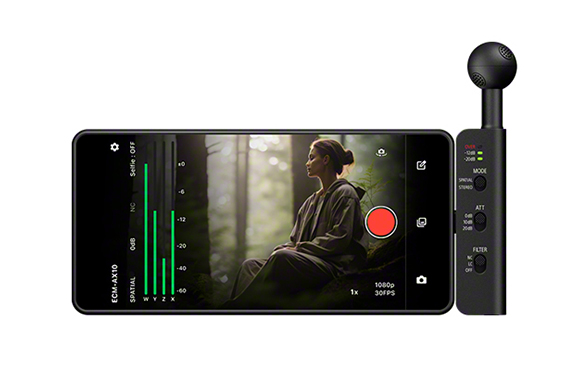
Sony has unveiled the ECM-AX10, a small dongle for smartphones that contains four microphones arranged for recording ambisonic (spatial or 360-degree audio), binaural, and stereo audio. The unit comes with the Spatial Audio Video Tool, which allows creators to record videos with spatial audio for publication to YouTube and for other uses.
Mono to spatial audio overview
Mono audio is simply the reproduction of sound recordings from one speaker, while stereo audio is from two speakers. Music producers can choose where to place each unique singer, instrument, or sound as they see fit in a stereo recording. This enables the creation of absurd sound events, such as a drum magically shifting from left ear to right ear as it is playing.
Spatial and binaural recordings attempt to recreate the experience of being at an event, scene, or performance realistically. Binaural recordings typically use only two microphones, each placed approximately where the human ears of a participant are. They record from the position of those two microphones, so there is no way to 'turn around' while listening to a binaural recording to focus on specific sounds.
Spatial (ambisonic or 360-degree) recordings record sounds from all directions using four or more microphones. These recordings allow listeners to focus on specific sounds when turning their heads during playback. However, it is only with headphones, earphones, or VR goggles with earphones that have head tracking technology do 360-degree recordings become fully utilized.
Google and Samsung Eclipsa Audio effort
Google and Samsung partnered in 2025 to try and carve out their share of the spatial audio market targeting consumers with Eclipsa Audio. Nowadays, consumers commonly experience surround sound audio while watching movies with Dolby Atmos audio, listening to spatial music recorded in Sony 360 Reality Audio or Apple Spatial Music formats, professional and hobbyist binaural recordings, and VR media recorded with 360-degree visuals and audio in mind.
Sony ECM-AX10 microphone
The ECM-AX10 incorporates four electret microphones arranged in a small capsule to record ambisonic, binaural, and stereo audio at up to 48 kHz, 32-bit float, with a maximum SPL over 120 dB and a frequency response of 20 Hz to 20 kHz.
Ambisonic recordings from the ECM-AX10 are compatible with Eclipsa Audio. They can also be used to master audio in the Sony 360 Reality Audio format. Binaural and regular stereo recordings can also be made.
Videos can be recorded in the Spatial Audio Video Tool app for smartphones at the same time. Position information is also recorded, which includes data from a 3-axis gyro and 3-axis accelerometer.
The 24 g (0.85 oz.) dongle connects to smartphones using the USB-C port, drawing 100 mA at 5 V.
Price and availability
Sony has not yet revealed its price, but the ECM-AX10 microphone will be available in Japan starting October 23, 2026.
Readers outside Japan might consider the larger 4-mic Zoon H3-HR 360-degree sound recorder (sold here on Amazon), which does not require a connected smartphone to make recordings.
Source(s)
 Add as a preferred source on Google


