




Panther Lake to space: Intel's new Starfire processor is built to survive in space
Intel has announced its Starfire processor, a chip designed for space systems. The new chip features eight CPU cores, a 64 execution unit graphics engine, and up to 75 TOPS of AI performance, all in a 35W thermal design power envelope. The company says the chip is designed to survive in space and to handle advanced AI performance while meeting tough size, weight, and power constraints.
The CPU side of Starfire uses four performance cores and four low-power efficiency cores, manufactured on Intel's 18A process. The chip's three-tile NPU also uses Intel 18A, while the integrated GPU is built on Intel 3 and includes four Xe cores with 64 execution units. This design is based on Intel's Panther Lake 4Xe3 configuration.
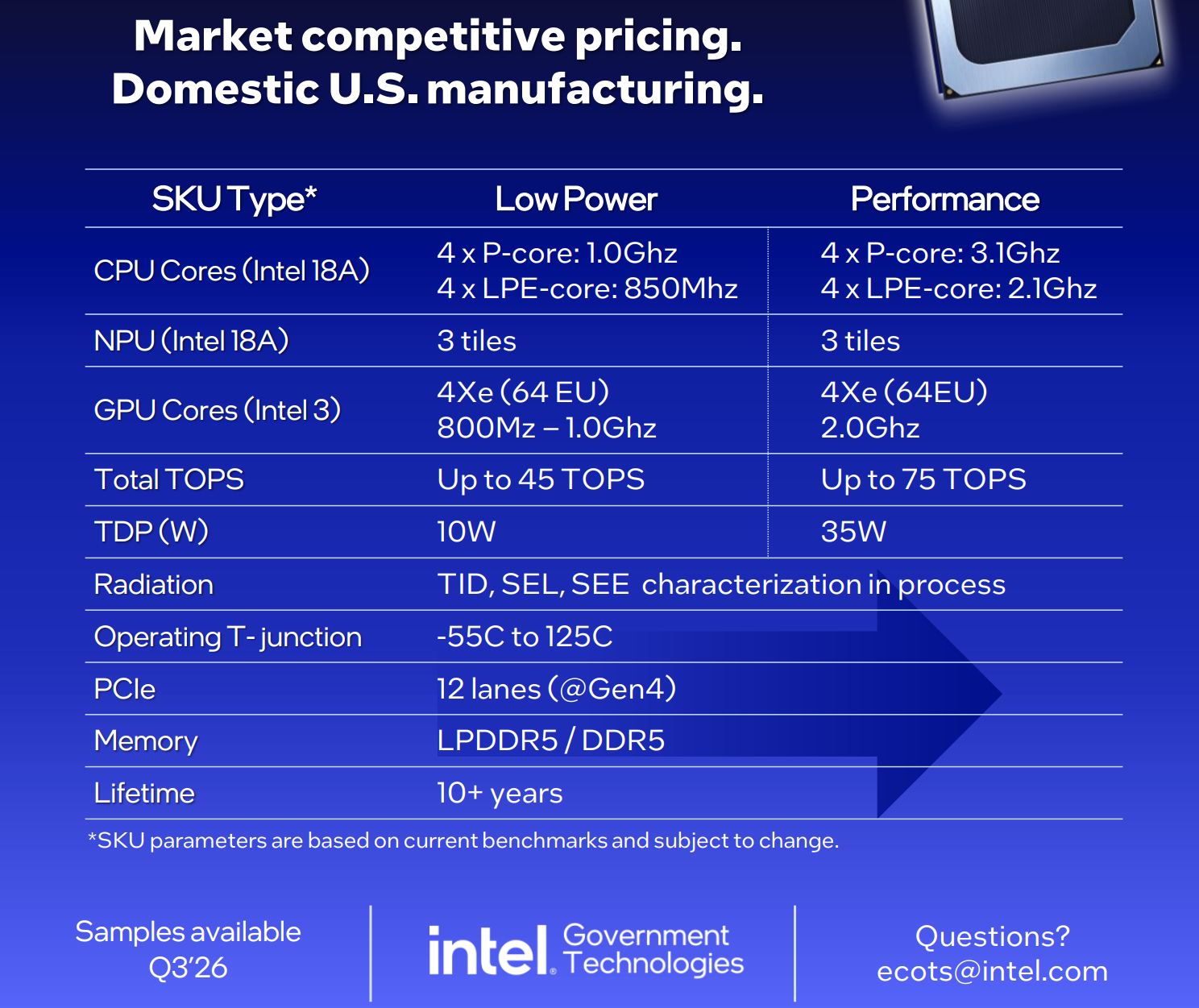
Starfire is available in two configurations. The low-power model has its P-cores running at 1.0GHz and its LPE-cores at 850MHz, with the GPU running at between 800MHz and 1.0GHz. Total AI performance on this setup reaches up to 45 TOPS within a 10W TDP.
The performance configuration boosts the P-cores to run at 3.1GHz, the LPE-cores at 2.1GHz and the GPU at 2.0GHz. This brings total AI performance to 75 TOPS, with TDP rising to 35W. Both configurations support LPDDR5 and DDR5 memory and include 12 PCIe 4.0 lanes. Starfire's operating junction temperature range is -55°C to 125°C, and Intel's expected product lifetime is over 10 years.
The company says radiation testing for total ionizing dose, single-event latch-up, and other single-event effects is still in progress. Starfire will be manufactured in the US, and the company plans to make samples available in the third quarter of 2026, though the company notes that the specifications listed so far remain subject to change.
Source(s)
 Add as a preferred source on Google


