




New ultra-compact light-based chip processes data at the speed of light, demonstrating high accuracy
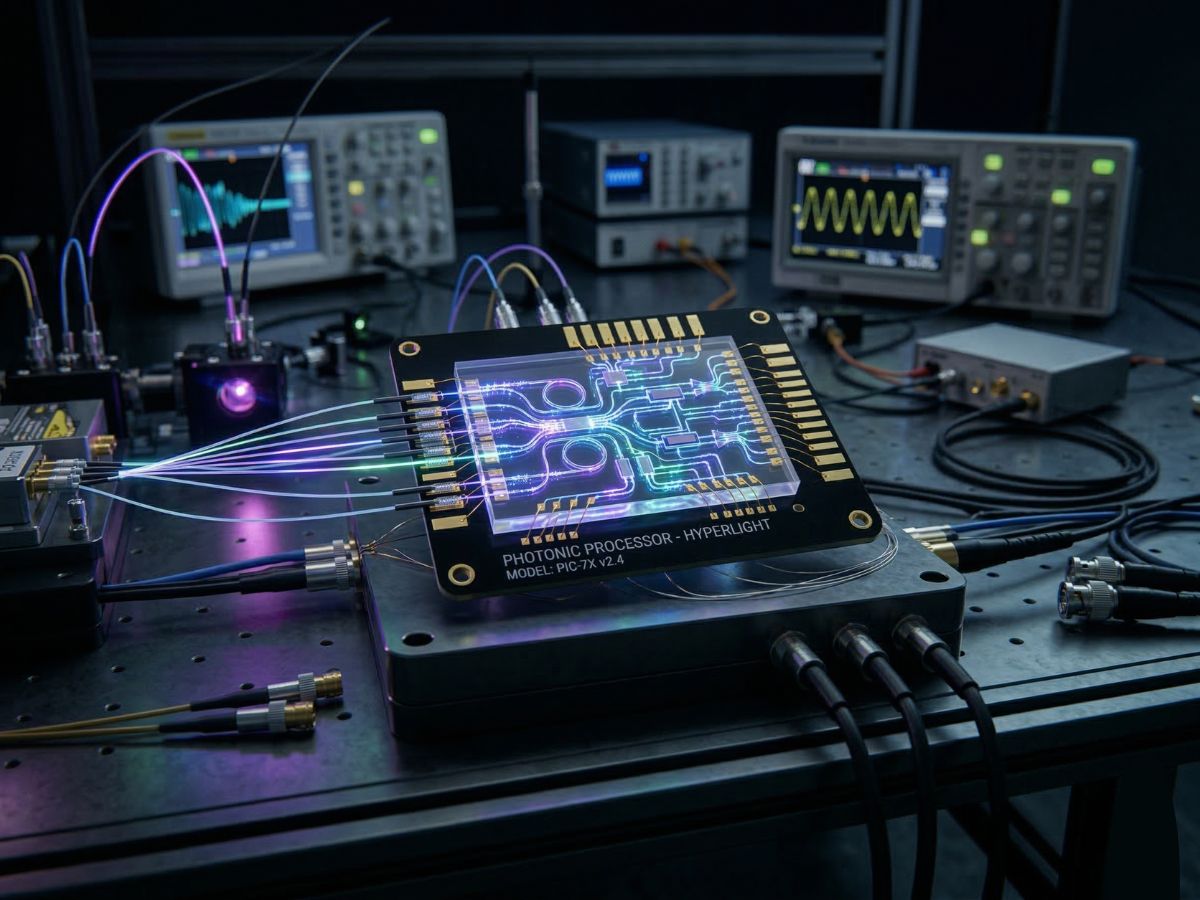
As artificial intelligence models grow increasingly complex, traditional electronic hardware struggles to meet computing speed and energy demands. Conventional computer chips process information by pushing electrically charged particles around, a process that inherently generates significant heat and requires massive amounts of power. To overcome this computing bottleneck, researchers at the University of Sydney have engineered an ultra-compact photonic chip that performs mathematical calculations using light.
The researchers engineered this processor using advanced computer simulations that precisely map out how light waves interact within three-dimensional spaces. This design method allows them to use tiny, physical building blocks — each smaller than a wavelength of light — as adjustable data points. This specific approach yields an astonishing computational density of roughly 400 million parameters per square millimeter. The resulting nanostructures are incredibly small, measuring just tens of micrometers across, which is roughly comparable to the width of a human hair.
As light passes through these intricate nanostructures, the physical geometry of the chip automatically performs the mathematical operations required for machine learning. Because the entire system operates based on the movement of photons, computations are completed in trillionths of a second.
To validate the prototype, the research team tasked the photonic neural network with classifying over 10,000 biomedical images, including chest, breast, and abdomen scans. The system achieved a classification accuracy of approximately 90% in physical experiments and up to 99% in simulations. By embedding artificial intelligence capabilities directly into nanoscale structures, the researchers have established a highly scalable, energy-efficient platform that could drastically reduce the massive environmental footprint of future computing infrastructure.
Source(s)
 Add as a preferred source on Google


