




Linux gets Nvidia Reflex and AMD Anti-Lag on any GPU

Big news for Linux gamers, especially eSports players: Nvidia Reflex 2 and AMD Anti-Lag 2 can now be used in a hardware-agnostic manner, meaning that these proprietary technologies can now be used on GPUs from opposing vendors, including Intel GPUs, thanks to Korthos Software's low_latency_layer. Even better, some benchmarks reflect these technologies actually working better than the native Windows versions, taking a pain point of Linux gaming and turning it into a genuine strength. Setting it up does require some basic knowledge of how to use a Linux terminal, including installing packages and making a build directory, but the instructions on Korthos' GitHub page for the project should make that process a simple matter.
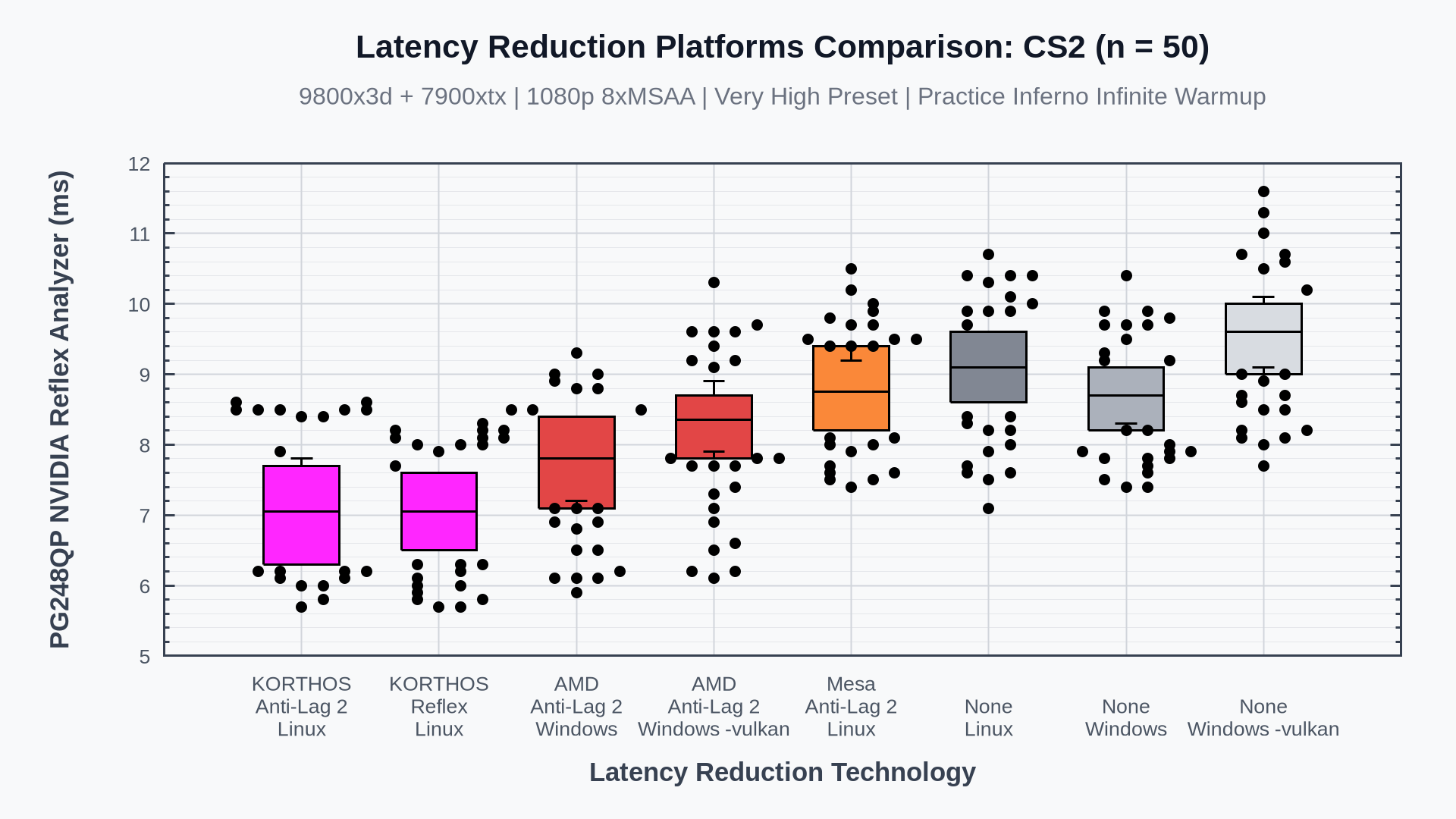
It's a truly impressive feat from Korthos Software—or specifically, Nicolas James, the only known developer of low_latency_layer. In a statement made to Phoronix, Nicolas James stated that the project was started earlier this year "because I was frustrated with the state of Anti-Lag 2 on Linux. If you're not aware, the Mesa AL2 implementation had some issues with stability and was disabled by default. On top of this, I tested the latency improvement of the Mesa implementation and found that it wasn't doing as much as the proprietary version on Windows. I like my FPS games and my AMD machine but I love Linux, and it seemed like they weren't compatible."
He continues, "After AL2 was working, I noticed there was nothing stopping a similar implementation of the Nvidia equivalent [...] They are just device extensions that any Vulkan layer can intercept. [...] My testing was done using a 540 Hz monitor which has Nvidia Reflex Analyzer. It involved me clicking a button and writing down the values I get into a spreadsheet, which can get pretty tedious. I have tested The Finals, Counter-Strike 2, Cyberpunk 2077, Resident Evil Requiem, Marvel Rivals and Overwatch 2."
All told, it's a pretty genius solution from Nicolas James, and a truly admirable achievement for FOSS gaming at large. This also means, of course, that Steam Machine and Steam Deck should be able to utilize low_latency_layer if users manually install it, making it possible to use an improved AMD Anti-Lag 2 or Nvidia Reflex on any supported game under SteamOS.
Source(s)
Korthos Software's low_latency_layer on GitHub, via Phoronix (thanks, Mike)
 Add as a preferred source on Google


