




Humanoid robots beat Usain Bolt’s 100m record — then crash into the barrier
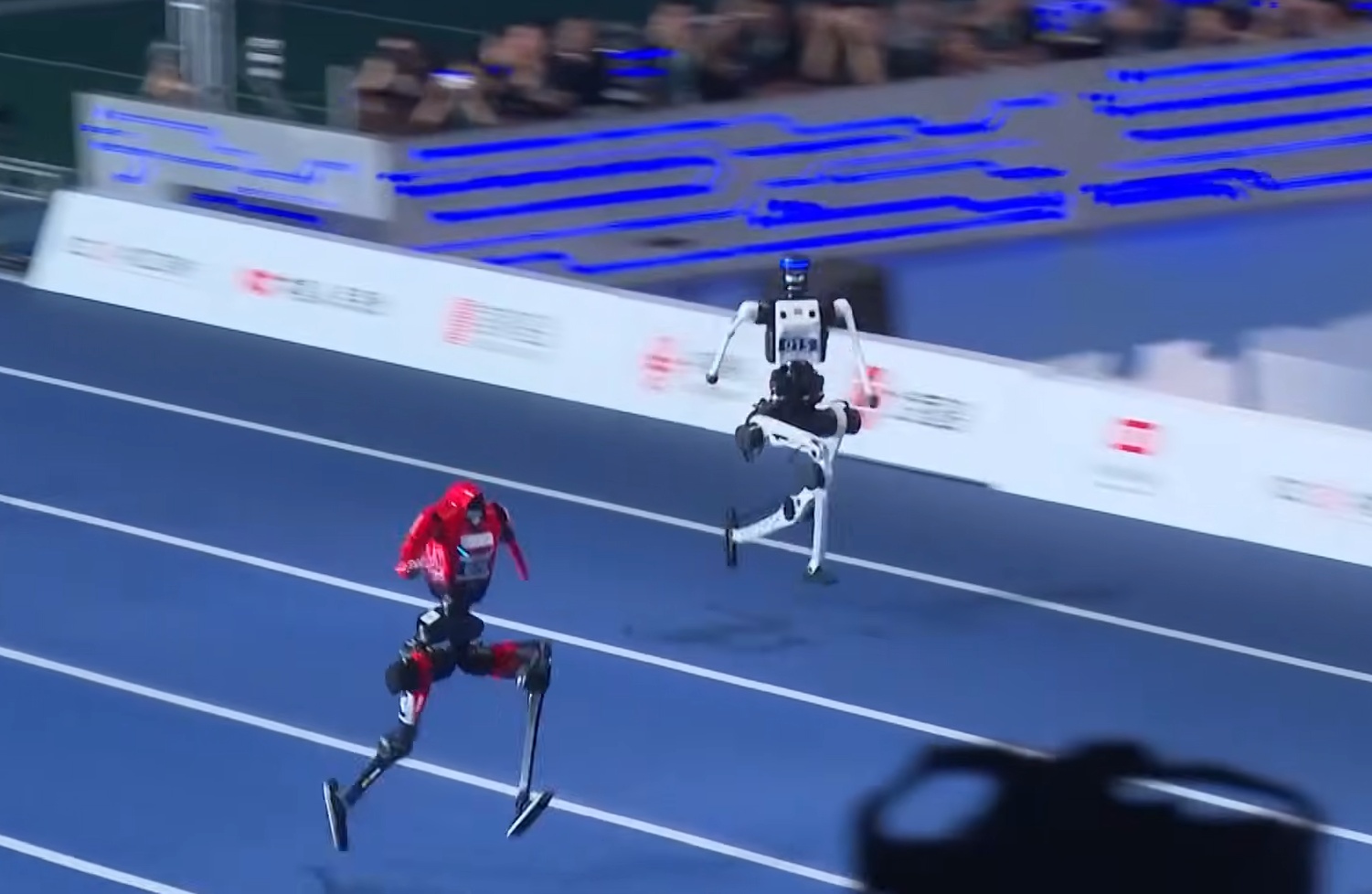
A Chinese humanoid robot has run 100 meters in 9.39 seconds, beating Usain Bolt’s 9.58-second world record set in 2009. The Tiangong Ultra robot achieved the result in a preliminary heat at the World Humanoid Robot Games in Beijing, showing just how quickly the physical capabilities of humanoid machines are improving.
Tiangong Ultra, developed by the Beijing Humanoid Robot Innovation Center, initially fell behind Honor Lightning (the red one) but overtook it near the finish. Lightning crossed the line in 9.47 seconds, also faster than Bolt’s record.
Neither robot had a particularly smooth finish. Tiangong Ultra stumbled and veered toward the sidelines, while Lightning collapsed and had to be carried away on a stretcher. Organizers had placed a thick mat beyond the finish line to help the robots stop, braking remained a clear problem.
The results nevertheless mark significant improvements in humanoid robot performance over the past year. At the inaugural games in 2025, Tiangong Ultra won the 100-meter race in 21.50 seconds. The robot has cut its time by more than half in just one year. This year, another humanoid robot also managed to complete 400 meters in 39.7 seconds, beating the human world record of 43.03 seconds set by South African sprinter Wayde van Niekerk.
Honor’s Lightning had already shown impressive speed before the competition. Chinese state media reported that the robot completed a 100-meter test run in 9.32 seconds, reaching a peak speed of 14.5 meters per second. Earlier this year, it also won a humanoid robot half-marathon in Beijing in 50 minutes and 26 seconds, faster than the pace of the human men’s world-record run.
But running fast is only part of what the organizers of the World Humanoid Robot Games want to test. The five-day competition includes 51 events, with 30 based on traditional sports and 21 designed to simulate real-world work. More than 40 % of the events require robots to operate fully autonomously, according to Huawei, a technology partner of the games.
In addition to sports competitions, robots have to perform tasks such as industrial assembly, material handling, EV charging, restaurant work and emergency response. One challenge requires a robot to connect a cable correctly — a seemingly simple task that tests its ability to recognize an object, position its hands precisely, apply the right amount of force and recover if something goes wrong. A cable may be at the wrong angle, a package may shift or an object may be slightly out of reach. Unlike a controlled sprint, such situations require the robot to understand what is happening and adapt without human assistance.
China is heavily promoting humanoid robots as a strategic emerging industry, with companies hoping to bring them into factories, logistics and consumer applications. The Beijing games are designed to demonstrate both their physical abilities and their potential to perform useful work.
The event has grown considerably since its first edition. This year, 2,056 robots from 666 teams representing 16 countries and six continents are taking part, compared with 280 teams at last year’s games. The competition includes everything from tug-of-war, weightlifting and Tai Chi to warehouse operations and industrial tasks.
Source(s)
 Add as a preferred source on Google


