




Fenix LD30: New EDC flashlight with 222 yards of range and USB-C battery announced
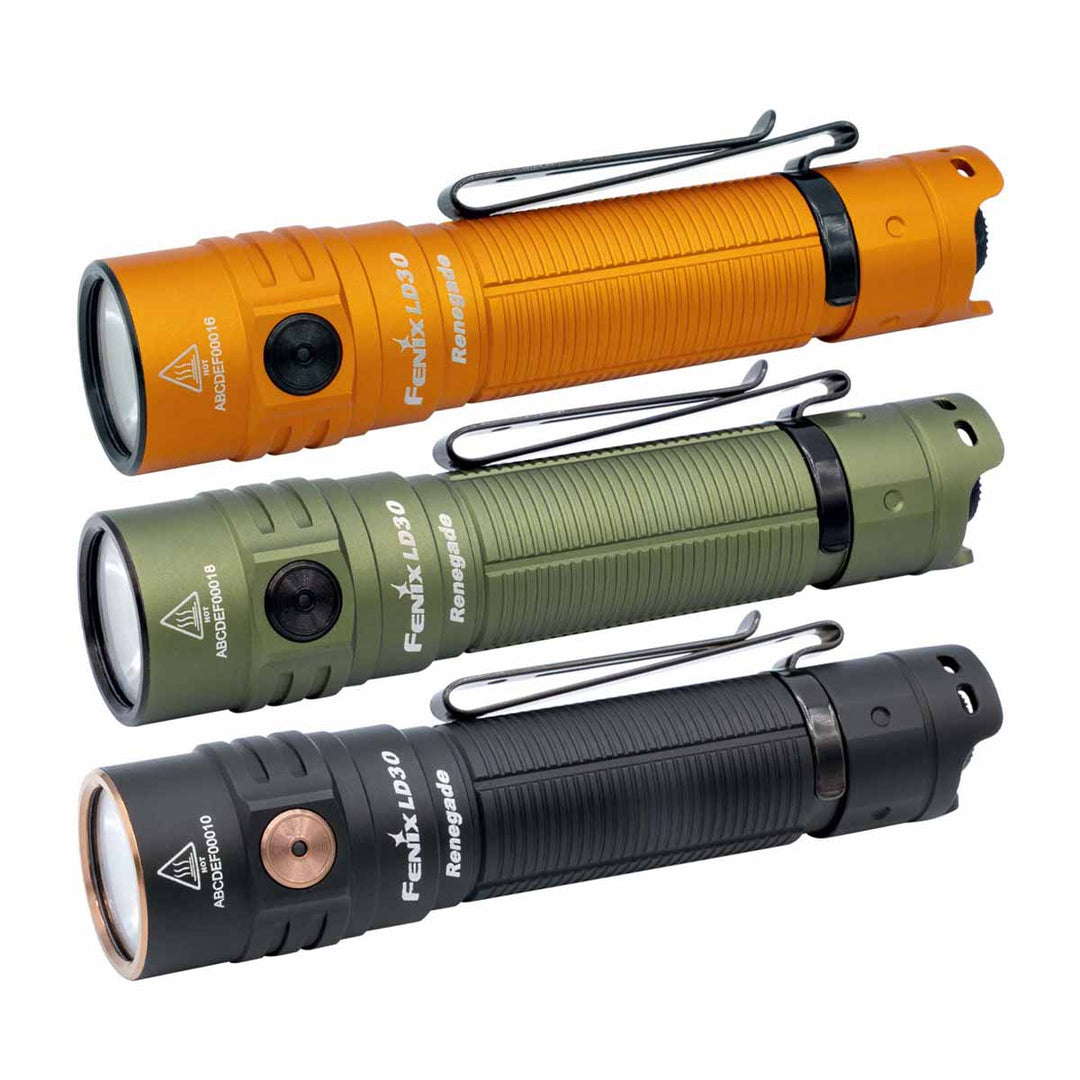
Fenix has introduced the new Renegade series. At launch, there will be two flashlights with a classic round form factor and a headlamp in this series. The first model is the Fenix LD30, which should not be confused with the older LD30R. In the US, this new EDC flashlight will cost around $80 and is offered in orange, green and black.
The Fenix LD30 is powered by an 18650 battery, which makes it fairly compact and keeps the weight low at 4.2 oz. This EDC flashlight also has a clip that can be used to attach it to a cap. The 14.4Wh battery is replaceable and has to be removed in order to charge it, since the USB-C port is found directly on the battery, and not the flashlight.
In terms of performance, the flashlight offers a turbo mode with 1,800 lumens and a beam distance of around 220 yards. Fenix also mentions a somewhat unusual runtime of 3 hours and 4 minutes. However, the footnotes clarify that the flashlight cannot sustain the 1,800 lumens continuously.
This is also evident in the 1,000-lumen mode, which supposedly lasts for 3 hours and 45 minutes and offers range of 164 yards. Additional modes for 600, 200, 50 and 5 lumens are available. The lowest mode lasts almost 11 days according to Fenix, and the 50-lumen mode can run for 45 hours.
The flashlight is also compatible with an optional diffuser, so the Fenix LD30 can be used as a lantern. There are also traffic wands that can be attached. This new Fenix EDC flashlight is about 4.7 inches long and has a rugged design. Among other things, it’s IP68 rated and can spend some time in water that’s up to 6.5 ft deep. Anyhow, this flashlight is not made for diving. The LD30 further offers a mechanical lock slider that should prevent accidental activation. And although one of the switches is located on the rear, the flashlight can still be set upright.
After the LD30, Fenix plans to launch the slightly more powerful LD31. An exact release date has not been set thus far, and technical specifications for that higher-end model are also still missing. On pictures, it appears somewhat bulkier and is probably based on a 21700 battery, which would offer longer runtimes or more output thanks to the higher capacity.
Source(s)
 Add as a preferred source on Google


