




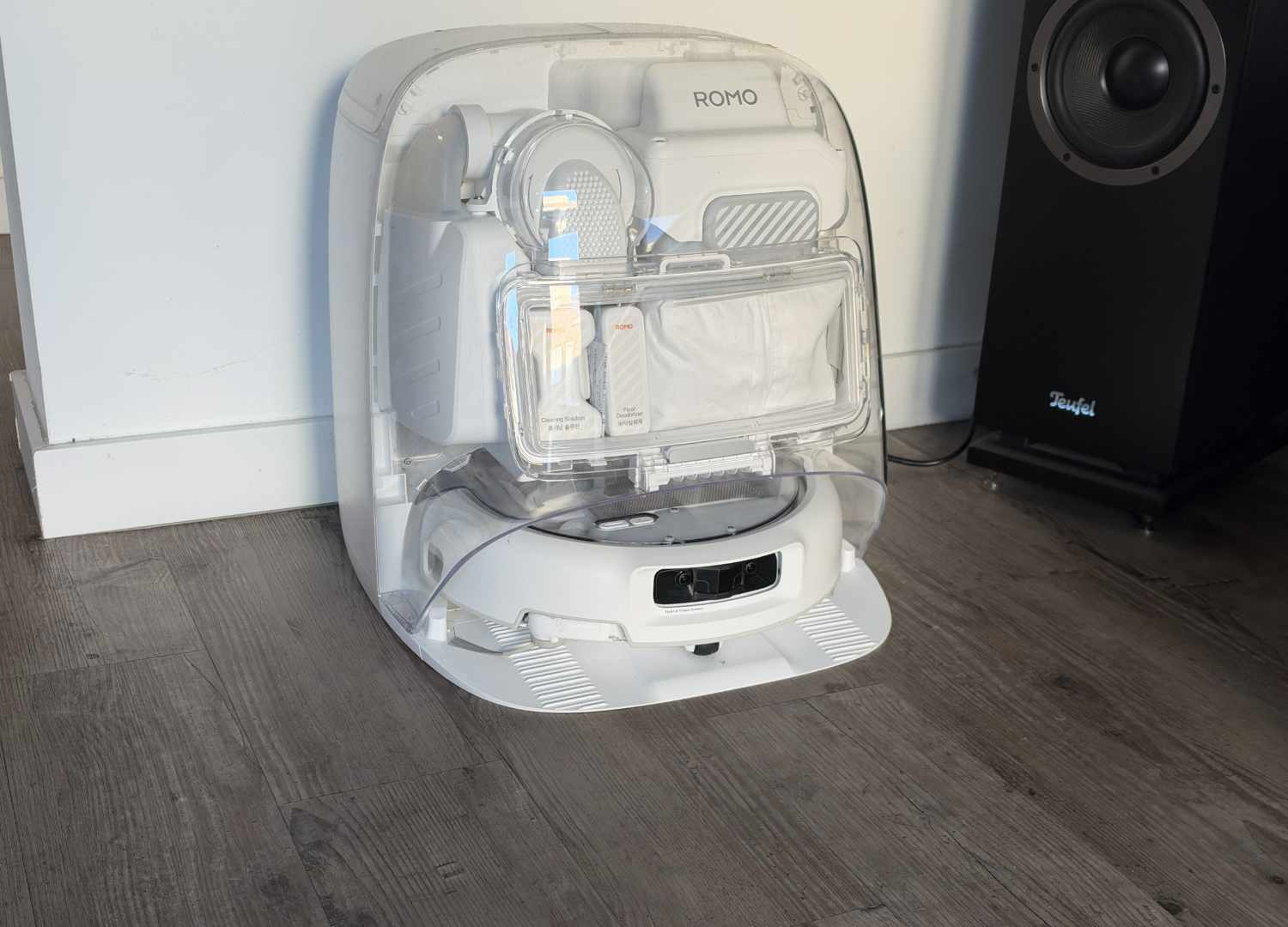
DJI has done it again: DJI Romo 2 robot vacuum review
Transparent floor cleaning.
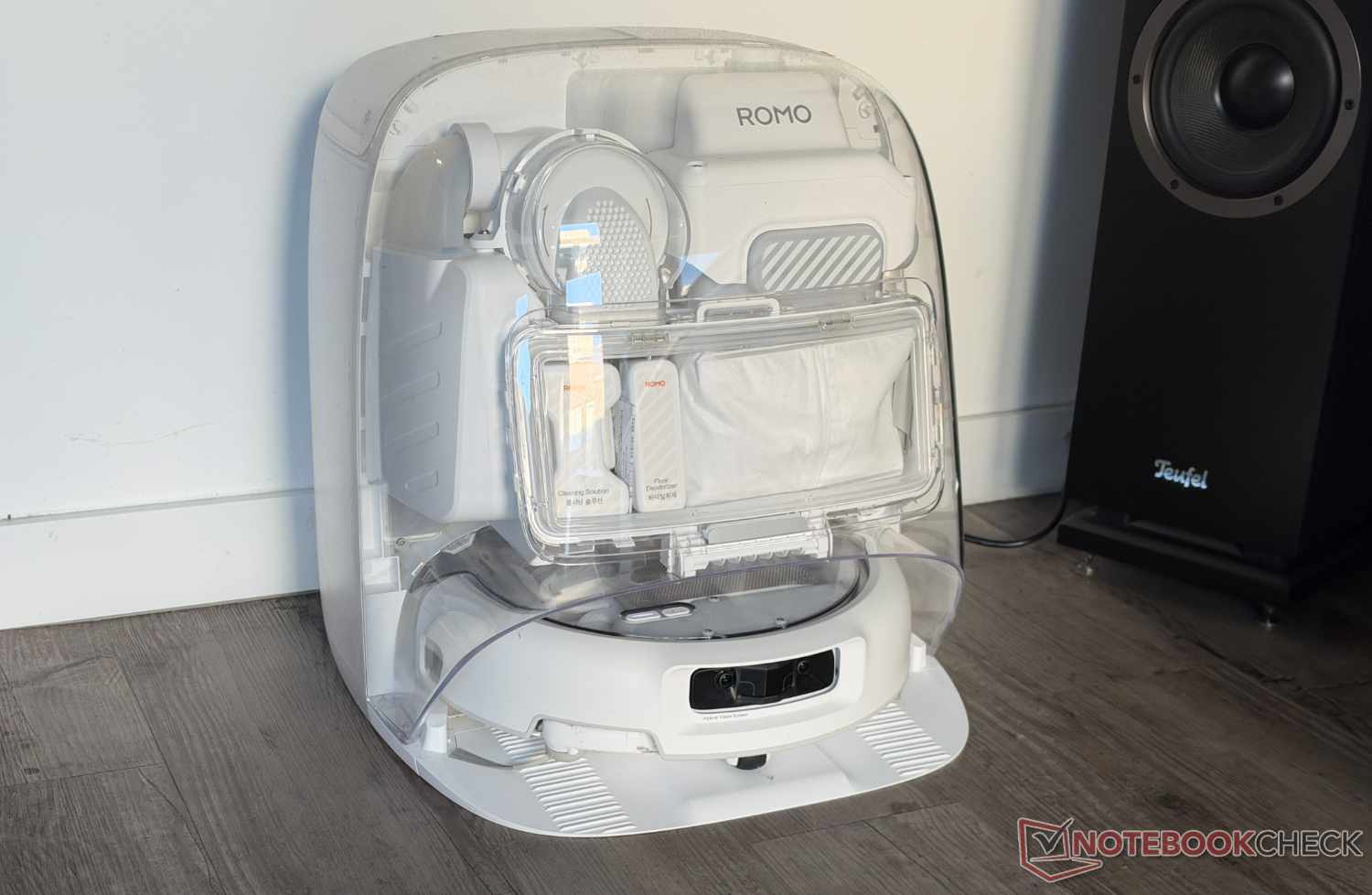
With the Romo 2, DJI is bringing its vacuuming and mopping robot into its second generation. Alongside exciting and useful improvements, however, the manufacturer is doubling down on the biggest point of contention: its distinctive design.Marcus Schwarten (translated by Marcus Schwarten (translation supported by DeepL)) Published 🇩🇪
DJI Romo P2 review verdict: Meaningful improvements, but...
Overall, the DJI Romo P2 made a very good impression in our review, with useful new features and improvements over the first generation. In practice, it cleaned well, navigated thoroughly, and reliably detected obstacles, while also being quieter than many competitors. The app also offers plenty of settings to adapt its behavior to the conditions and your preferences.
However, the Romo 2 still drew a few criticisms in our review, aside from its fairly high MSRP. For many, the biggest issue is probably the design. The Romo P2 in particular, with its completely transparent look, is likely to be difficult for many to imagine fitting into their living space. The Romo A2, with its white, round plastic housing, is not exactly inconspicuous either. Many other robot vacuum docking stations "blend in" much better at home, especially since there is no successor to the Romo S with its all-white design.
Pros
Cons
Price and availability
The DJI Romo 2 is currently not officially available in the USA. In Europe, the recommended retail price for the DJI Romo P2 is 1,299 euros and for the DJI Romo A2 1,199 euros (both in the water tank version). They are already available for less at some retailers, for example directly from DJI or from Amazon.
Last year, DJI released its first robot vacuum and mop with the Romo series. This year, its successor, the Romo 2, has now hit the market.
Nothing has changed in 2026 about the spectacular transparent design, which certainly takes some getting used to - quite the opposite: it has become even more pronounced. Nevertheless, DJI has given it a few improvements. Our DJI Romo 2 review reveals what these are and whether it once again offers the same strengths, such as excellent obstacle detection.
DJI Romo 2 datasheet & differences from the DJI Romo
| Feature/Model | DJI Romo P2/A2 | DJI Romo P/A/S |
|---|---|---|
| Navigation | 3D-ToF-LiDAR | LiDAR |
| Obstacle avoidance | Dual fisheye image sensors | Dual fisheye image sensors |
| Suction power | 36,000 Pa | 25,000 Pa |
| Anti-hair tangling | yes | yes |
| Extendable side brush | yes | yes |
| Mopping Technology | 2 mop pads | 2 mop pads |
| Mop extendable/liftable/detachable | yes/yes/no | yes/yes/no |
| Overcoming obstacles | 8.5 cm | - |
| Robot height | 98 mm | 98 mm |
| Auto-empty station | yes | yes |
| Freshwater/Wastewater Tanks | 4 / 3.2 l | 4 / 3.2 l |
| Mop washing | 80°C | 60°C |
| Mop drying | yes | yes |
| Cleaning agents | yes, 2/1 tanks | yes, 2/1/1 tanks |
| Voice assistant | yes | yes |
| Live video | Yes | Yes |
| Matter | no | no |
| Special feature | transparent design (P2 & A2) | transparent design (P & A) |
| RRP | 1,299 euros / 1,199 euros | 1,899 euros / 1,599 euros / 1,299 euros |
Features: Three key improvements
The DJI Romo was launched last year in three variants: the fully transparent Romo P, the partly transparent Romo A and the all-white Romo S, each priced 300 euros apart at RRP, but differing technically in only a few details.
In 2026, DJI has streamlined the range somewhat and brought the price down to more realistic levels. The fully transparent DJI Romo P2 (which we tested) now has an RRP of 1,299 euros, while the DJI Romo A2 comes in at an RRP of 1,199 euros. Here, only the top of the robot vacuum, rather than the entire station, has a transparent design, making it a little more understated overall. There is currently no Romo S2 in an all-white design.
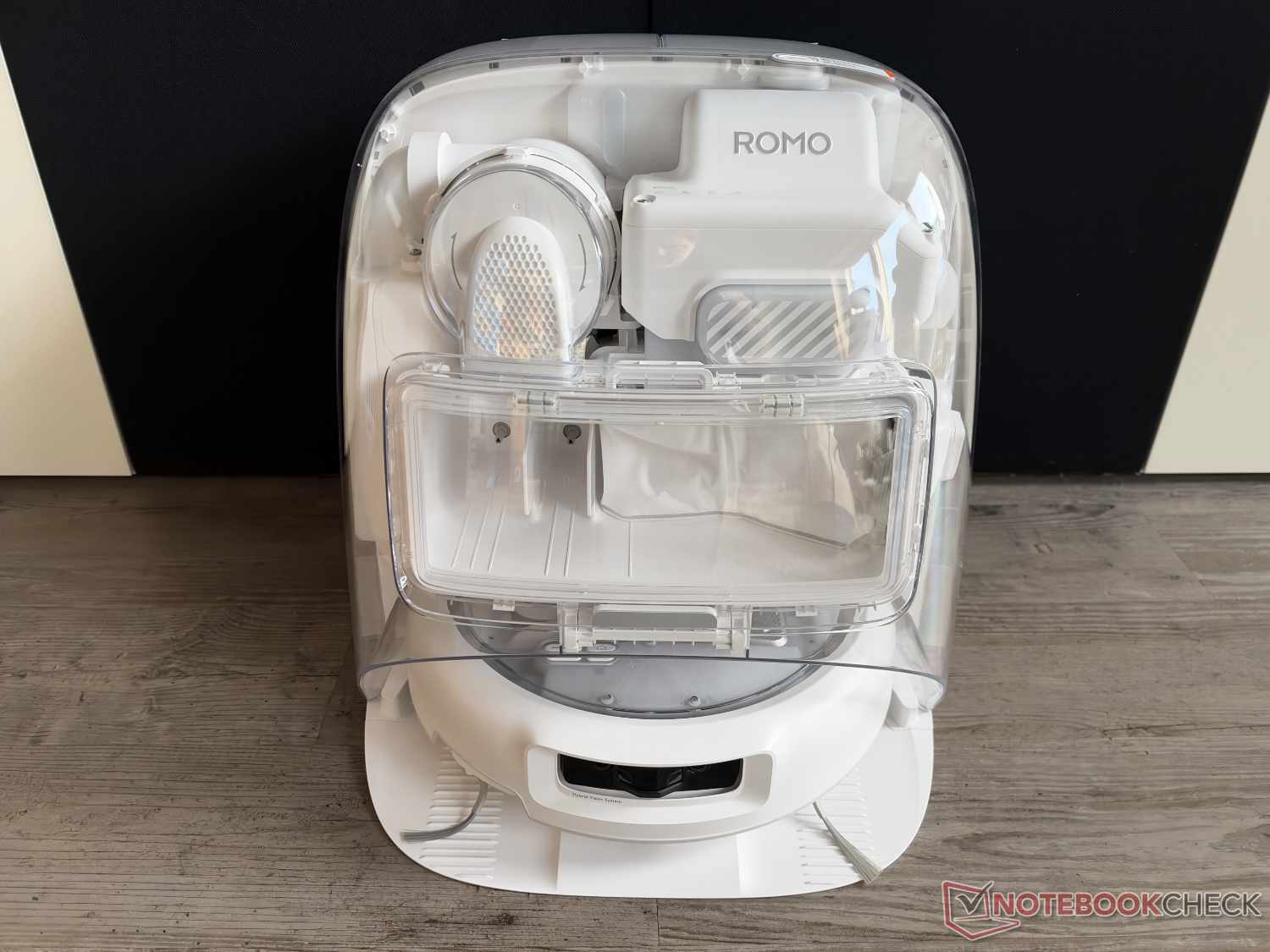
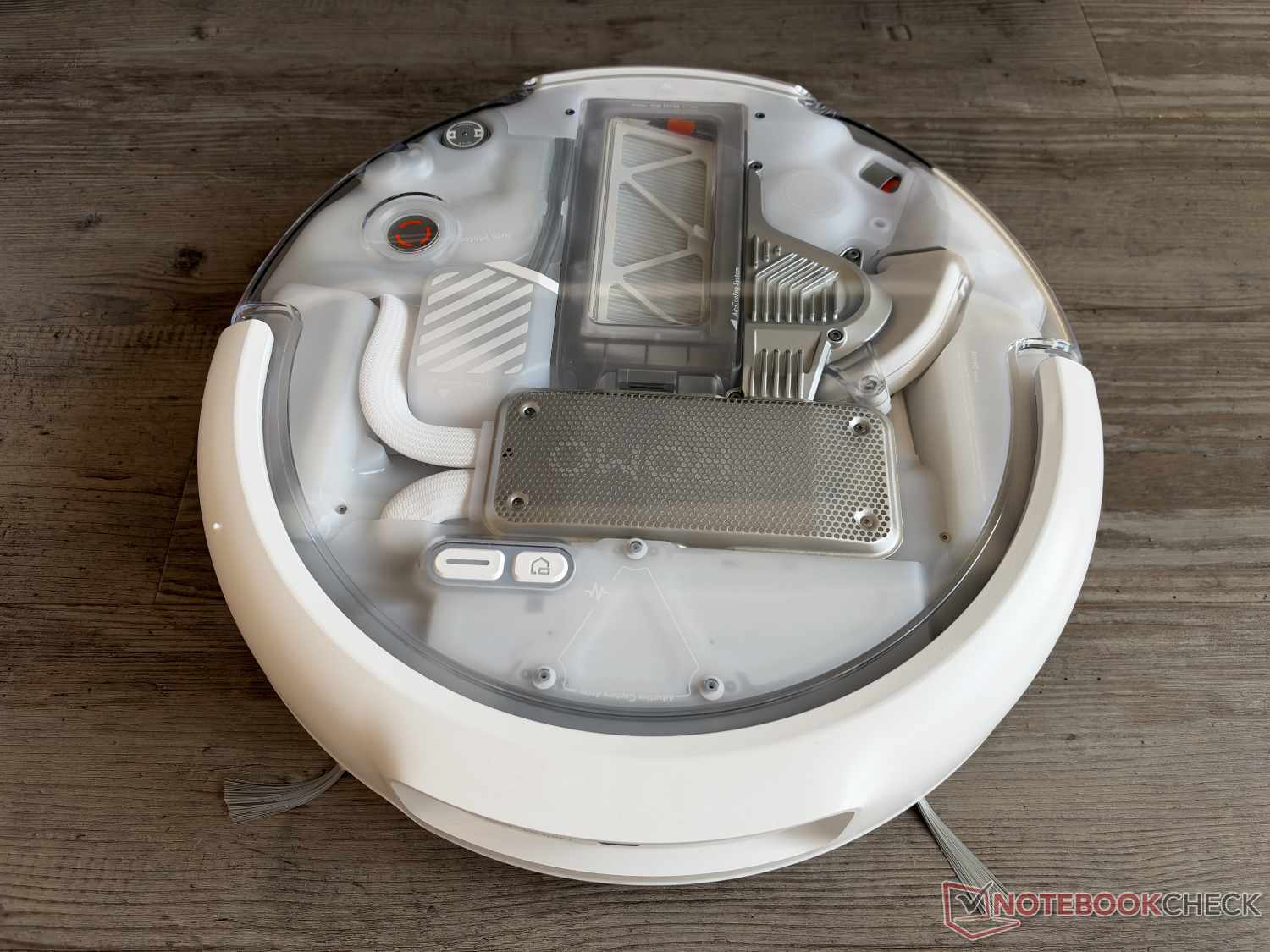
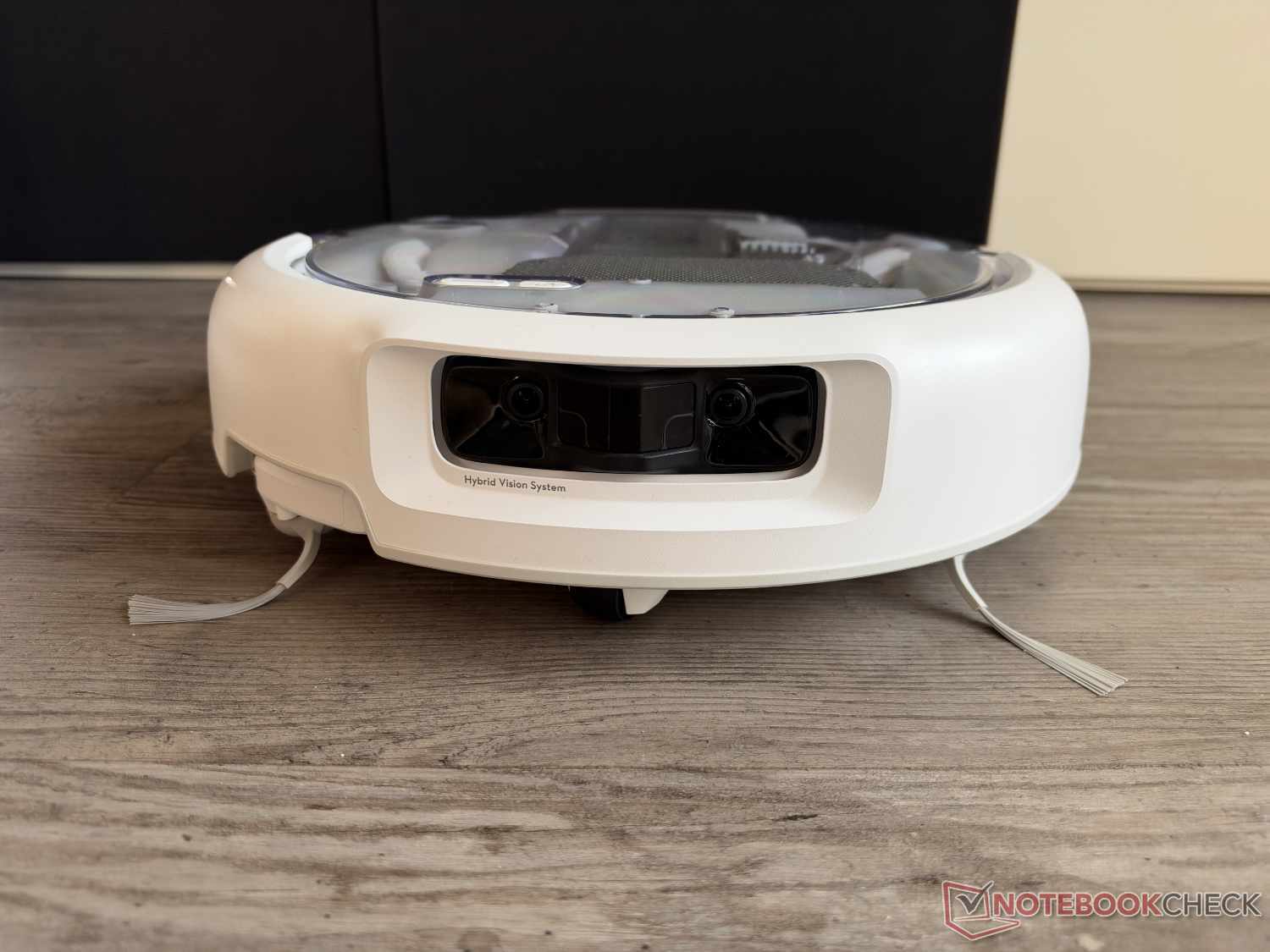
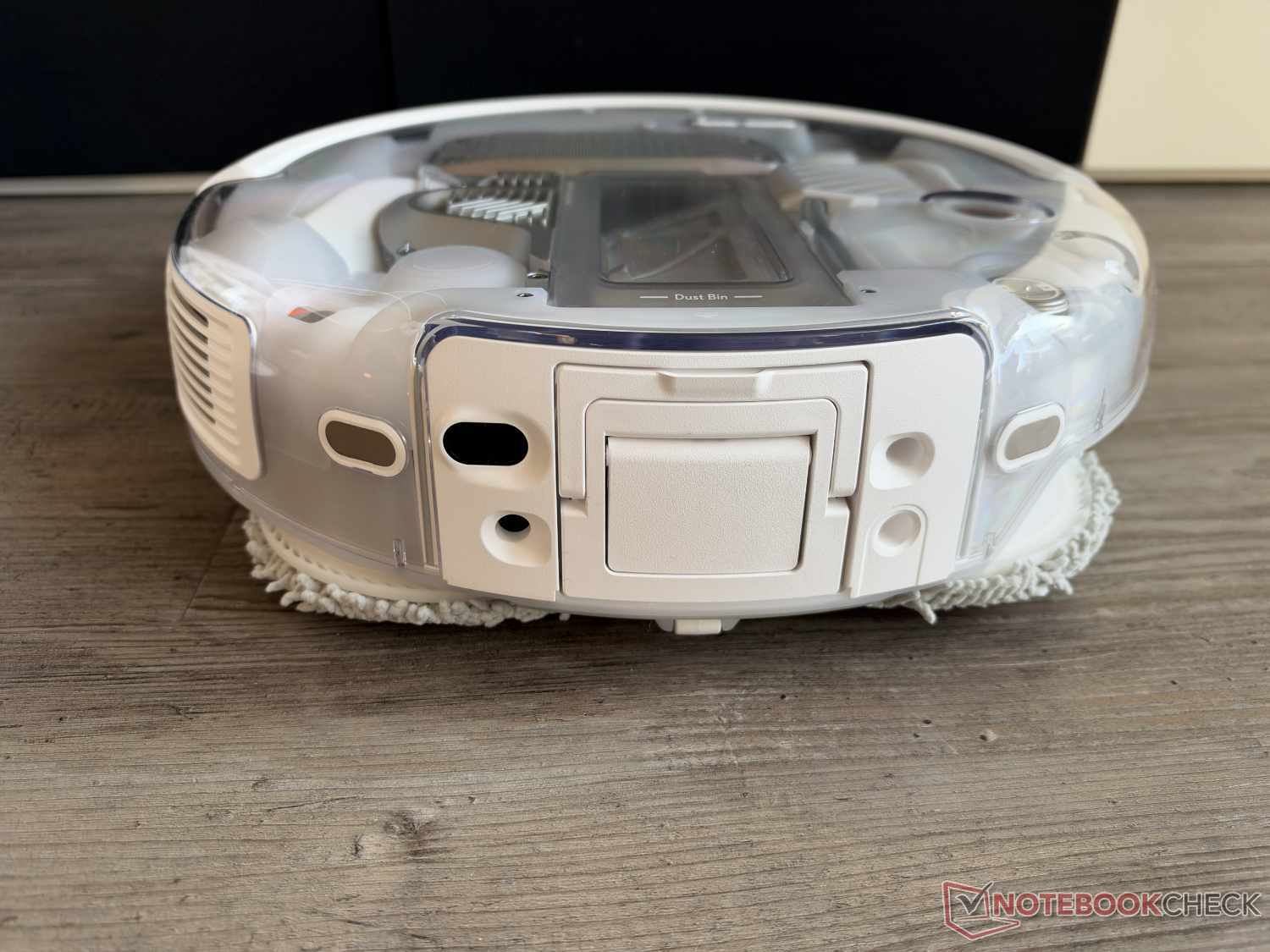
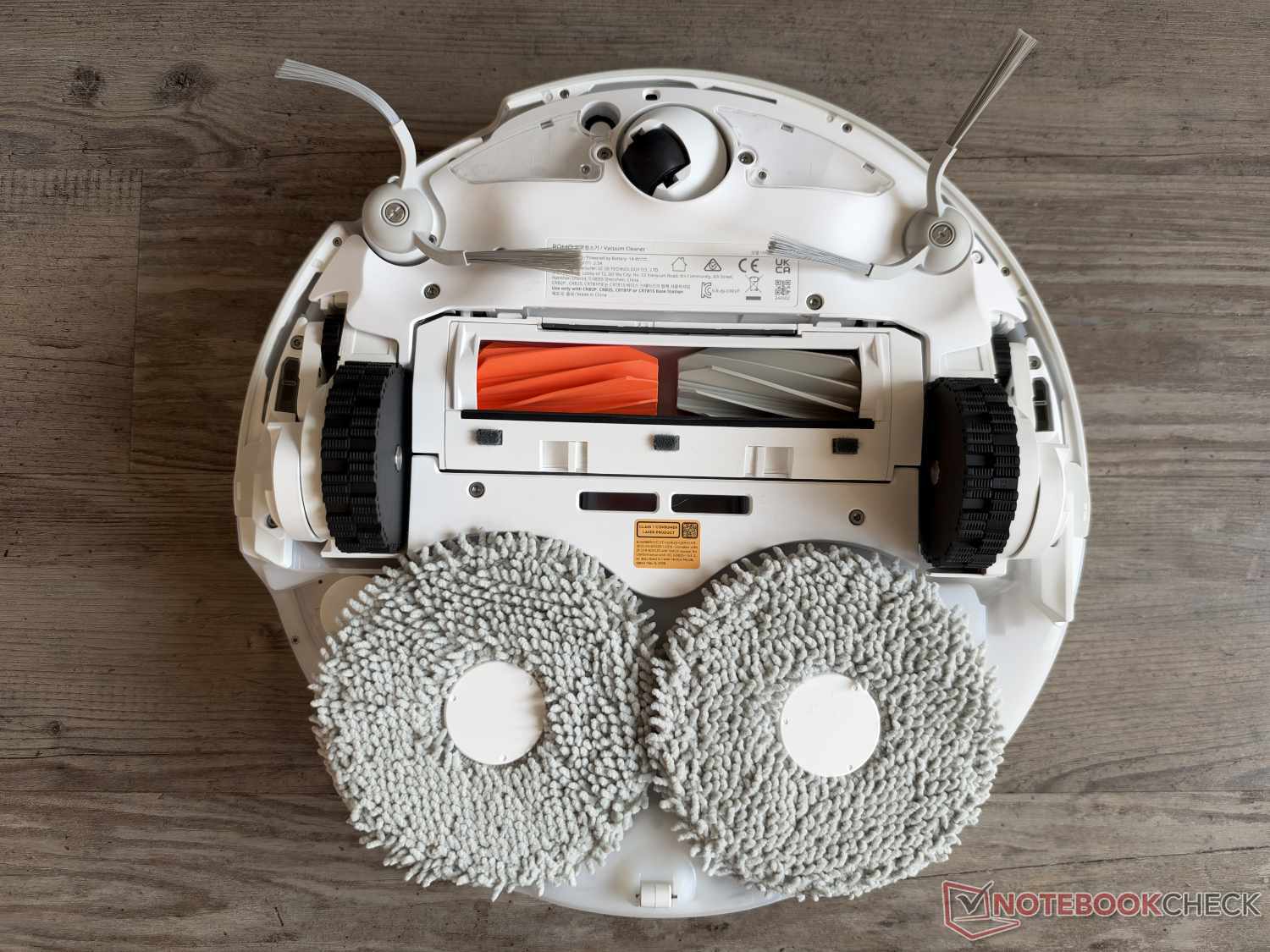
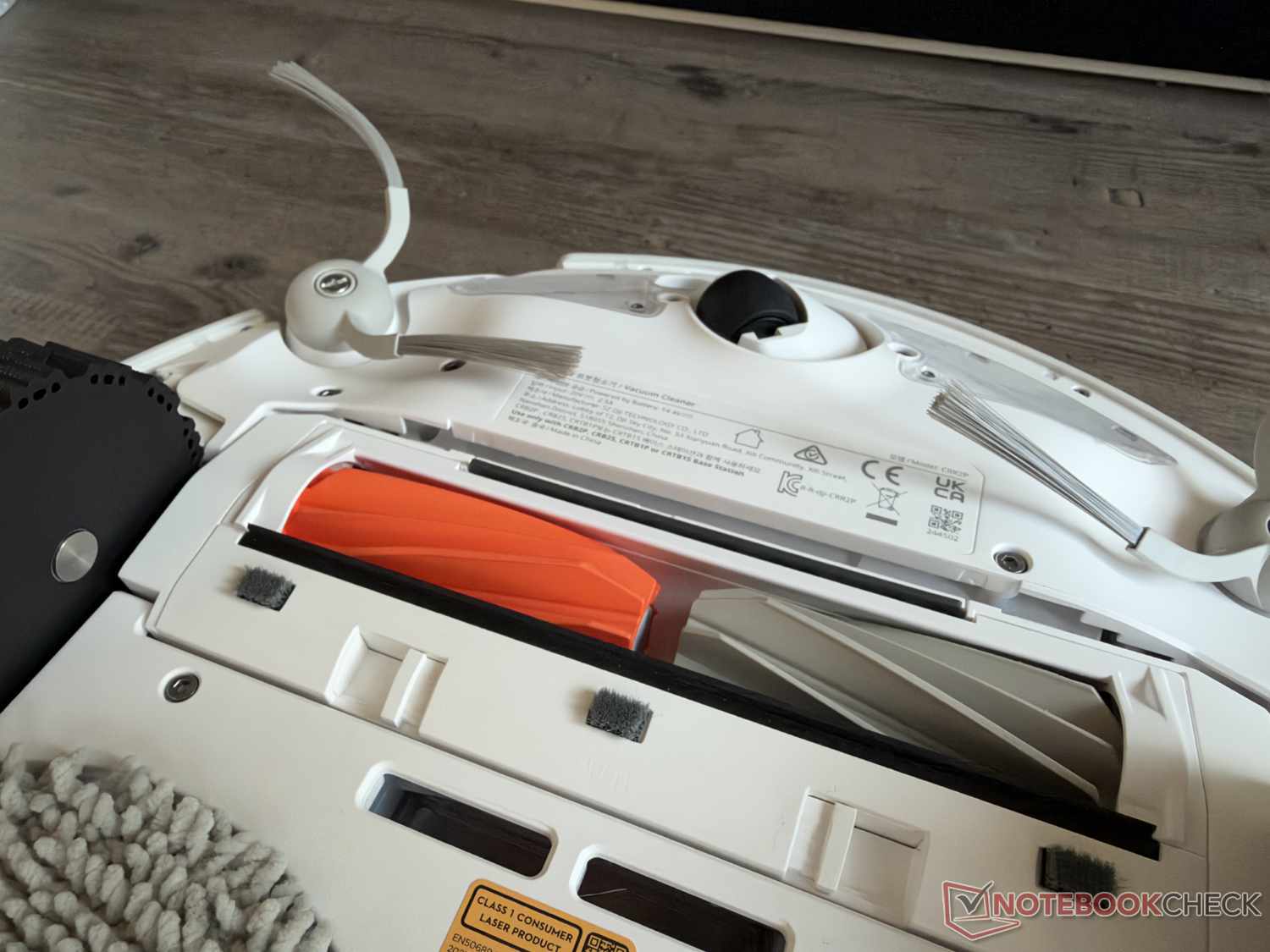
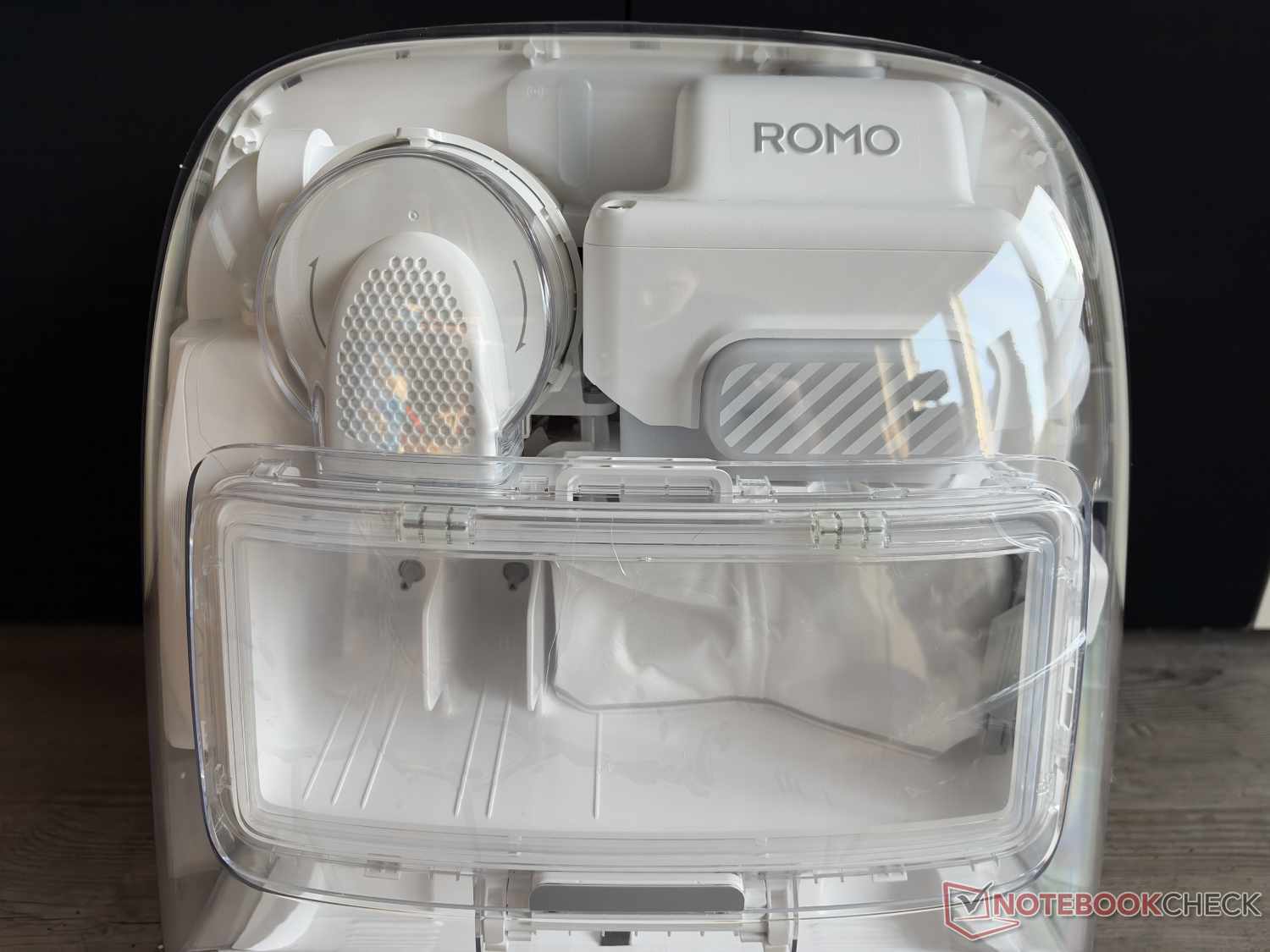
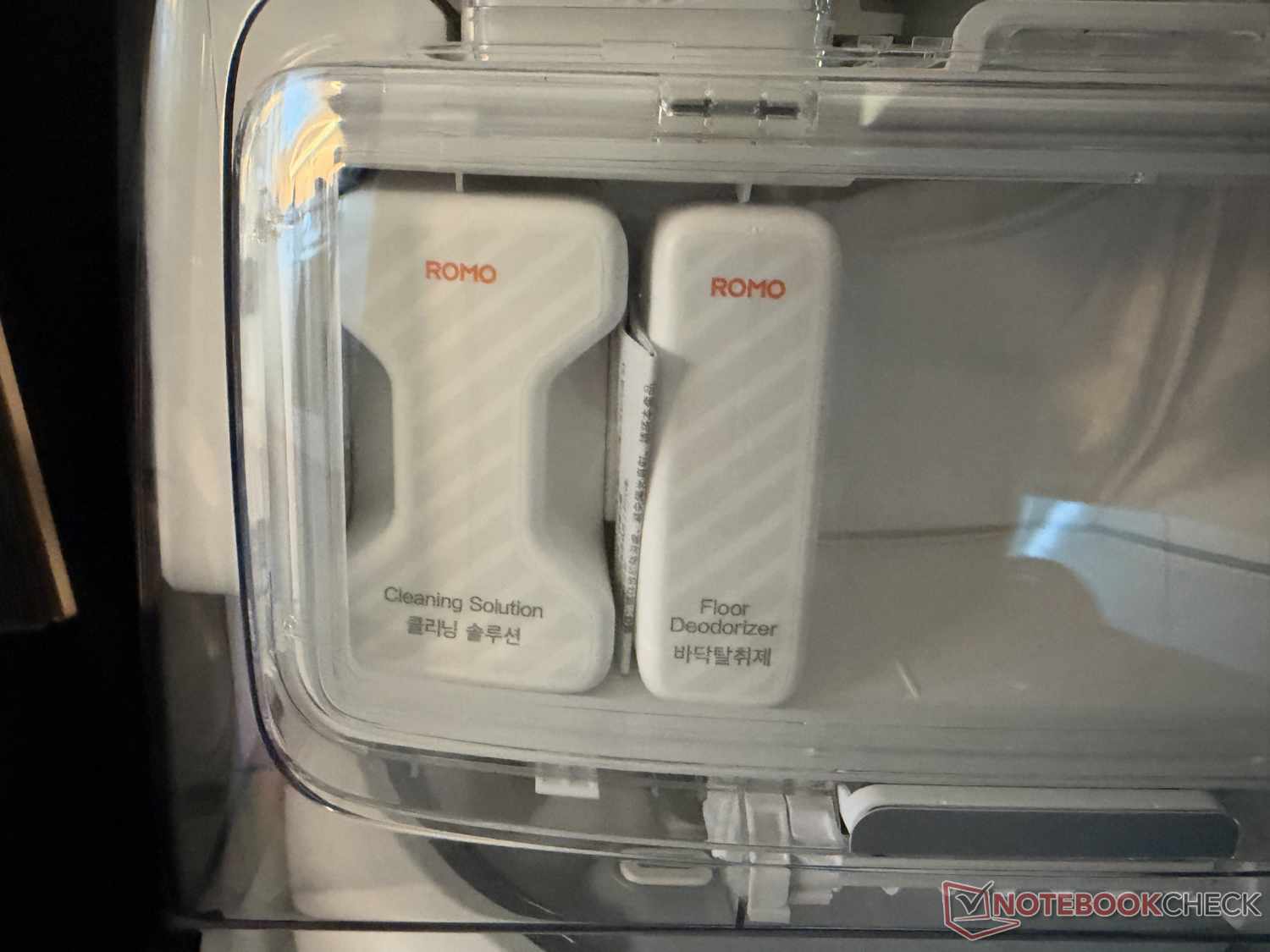
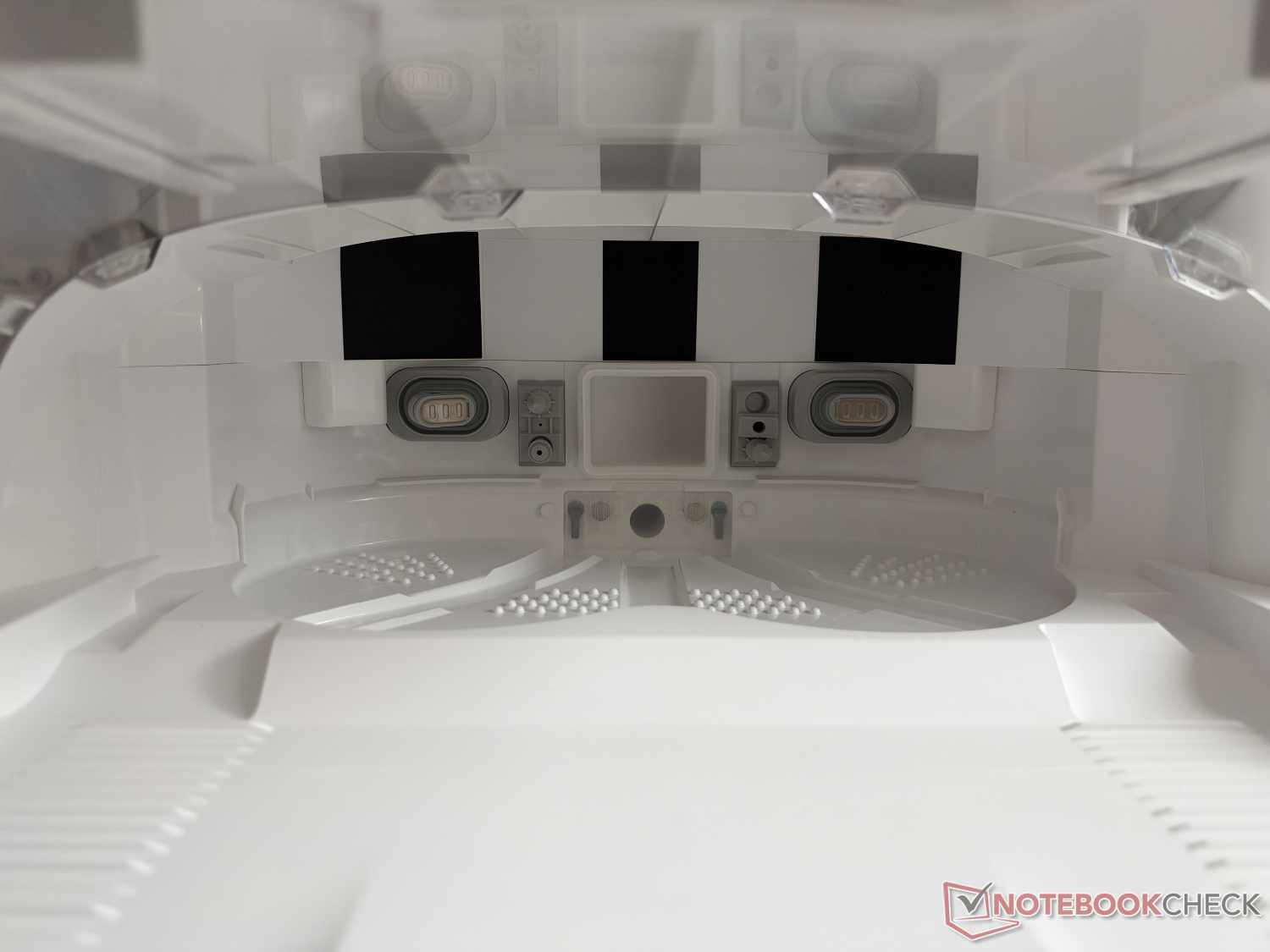
DJI has stayed true to the fact that, apart from the design, there are only minor differences between the two models. Strictly speaking, these are found in the station. Like last year's DJI Romo P, the DJI Romo P2 offers a compartment for a floor deodorizer in addition to the cleaning solution. The Romo P2 also once again has a UV lamp for disinfecting the dust bag and a drying function for the robot's dustbin, both of which the Romo A2 lacks.
Let's move on to the new features and improvements compared with the first generation. The DJI Romo 2 offers 36,000 Pa of suction power, almost 50 percent more than before. It also has a mopping arm that now extends 7.8 cm farther out, while one of the two side brushes can now also extend for corner cleaning. This feature was still missing last year. Other improvements include further sensor optimizations, mop washing at 80°C (previously 60°C), and the ability to overcome obstacles in two steps up to a height of 8.5 cm (a single step up to 4 cm).
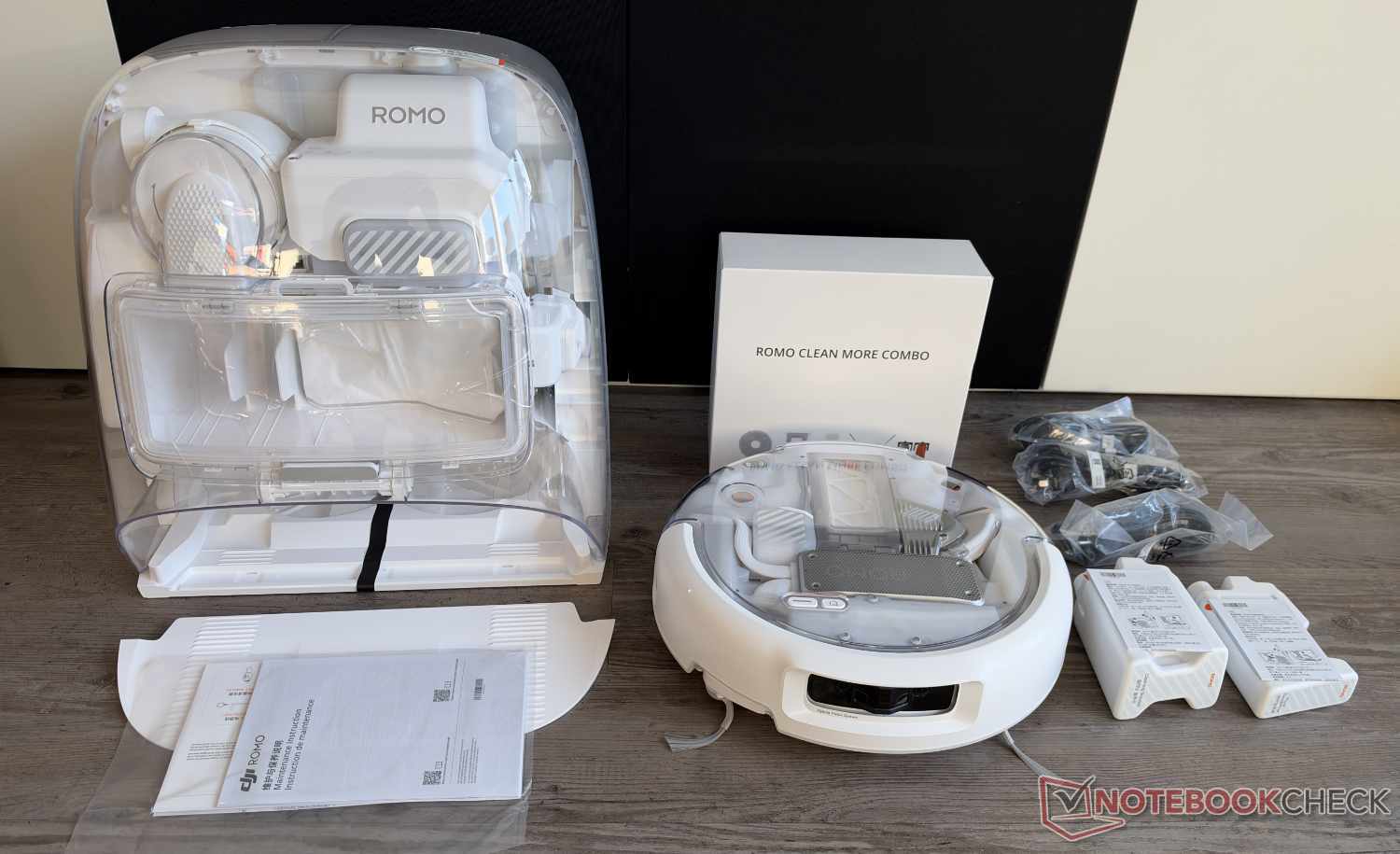
To conclude this section, a few words about what is included. In addition to the robot vacuum and the station, the box contains a roller brush for carpets and heavy dirt, a rubber roller brush with an anti-tangle function for people with long hair and pet owners (pre-installed), and one bottle each of cleaning solution and floor deodorizer. Unfortunately, the cleaning products are not refillable.
The review sample also came with three power cables (one with an EU plug), all of which are black. For a white and transparent robot vacuum, we would have found a white or at least light gray cable more visually appropriate. The "Clean More Combo" we received also includes a spare parts package with a rubber roller, eight mop pads, two side brushes, and two replacement filters.
Setup & App: Numerous Options
Setting up the DJI Romo 2 follows the familiar process. First - assuming the DJI Home app is installed and an account has been created - a connection is established via Bluetooth to then enable access to the Wi-Fi network (2.4 and 5 GHz). A locally stored password is then created to protect sensitive data - and the robot vacuum and mop is ready for mapping.
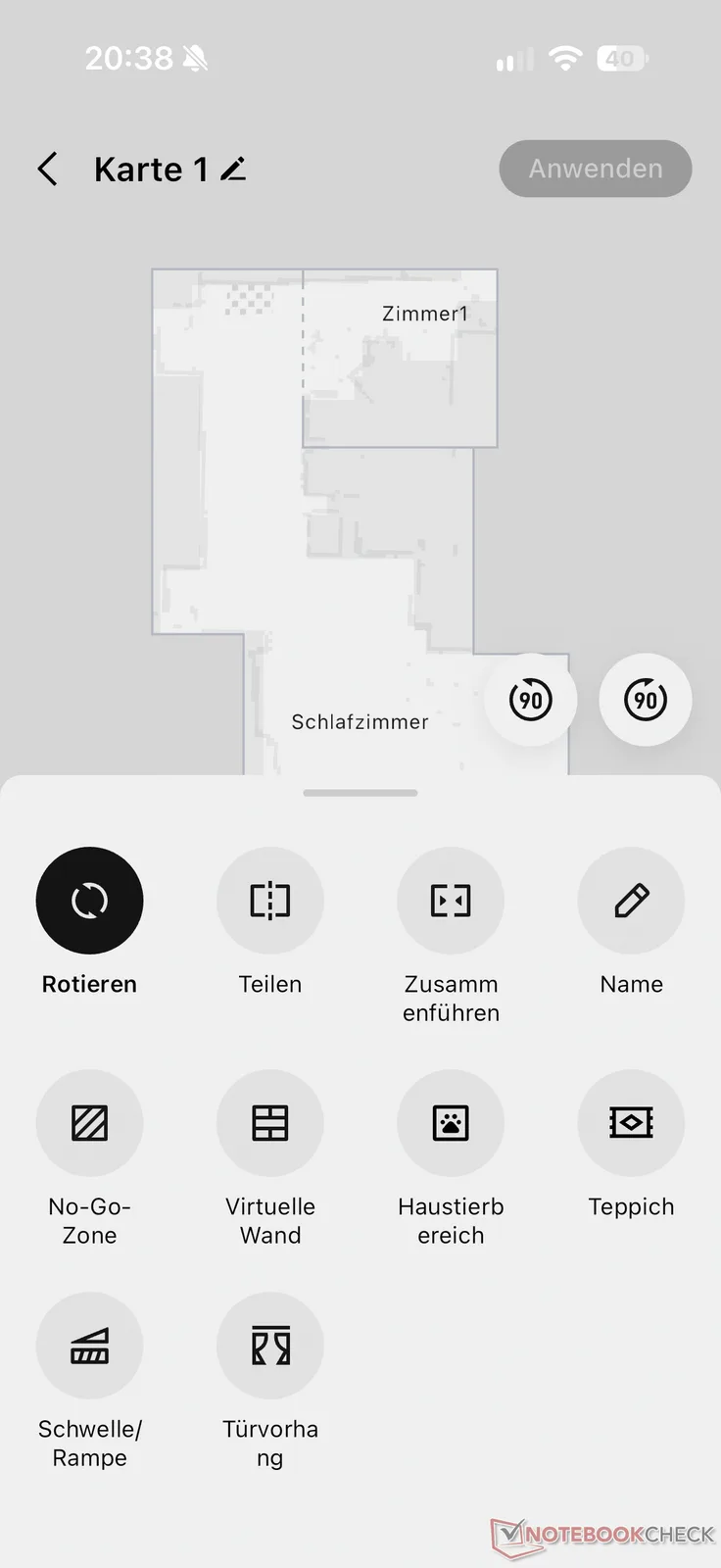
During this process, the Romo 2 navigates its new surroundings in the usual manner, creating a virtual map within just a few minutes. Room division worked reliably in our test environment, and the level of detail is high. Numerous adjustments can be made if needed. In addition to editing and naming rooms, these include creating no-go zones, pet areas and thresholds, as well as defining how the robot behaves on carpets. After that, cleaning can get properly underway.
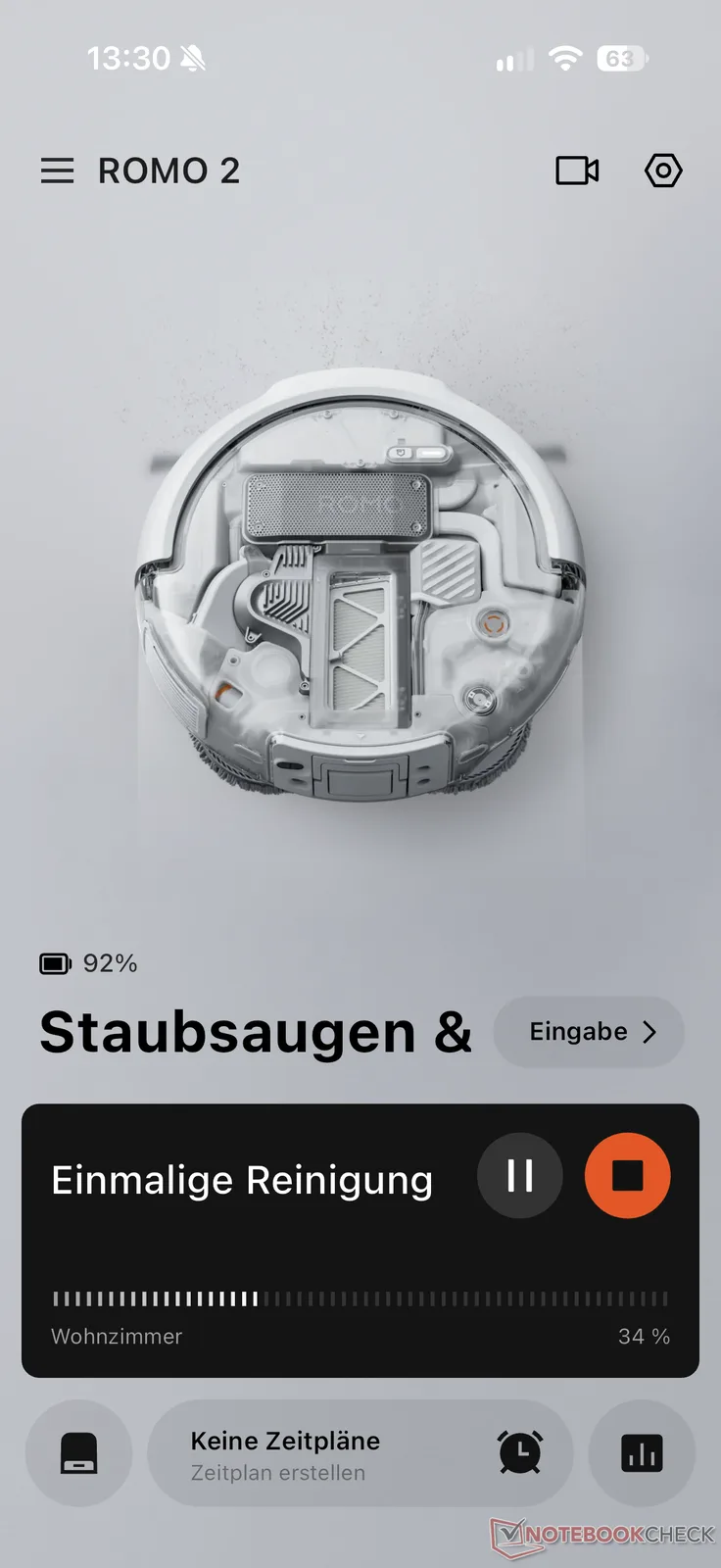
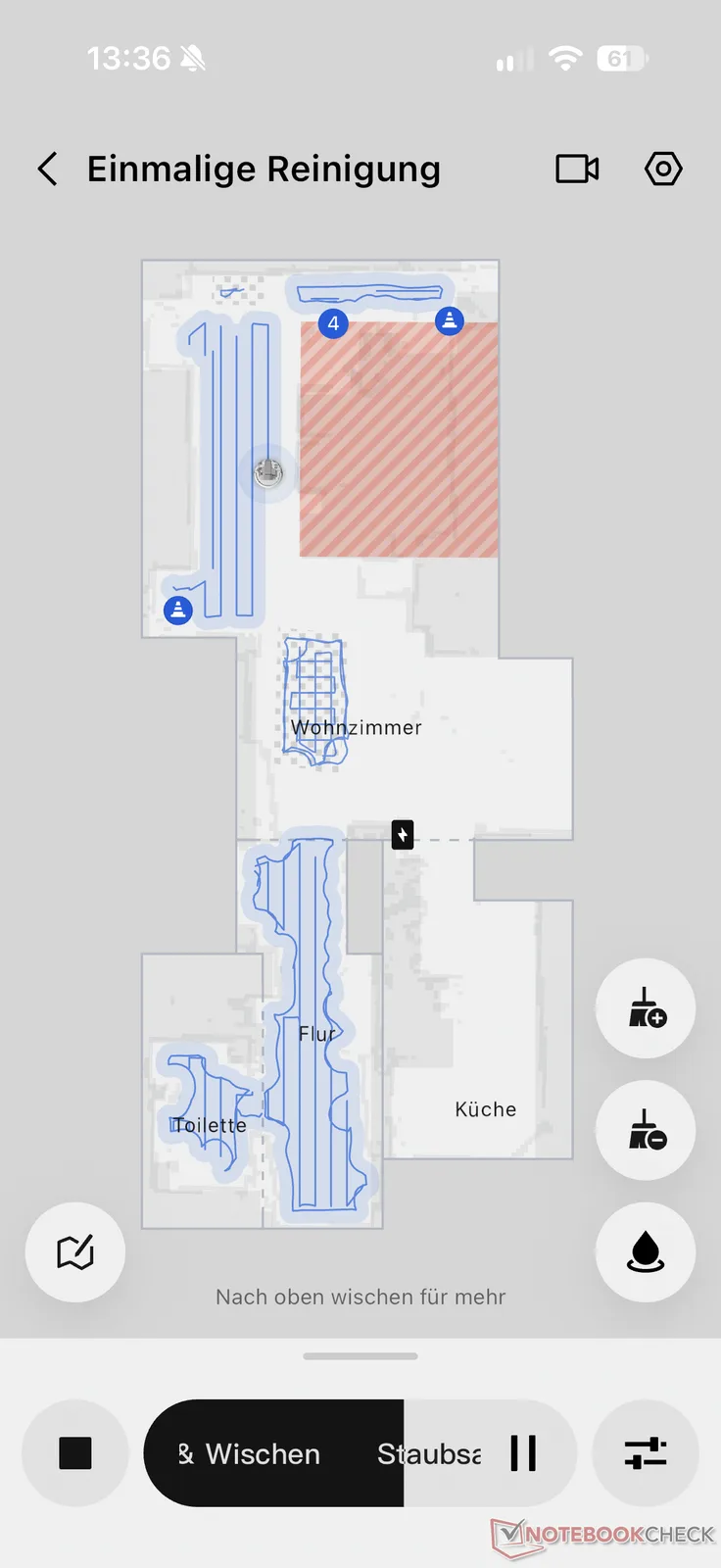
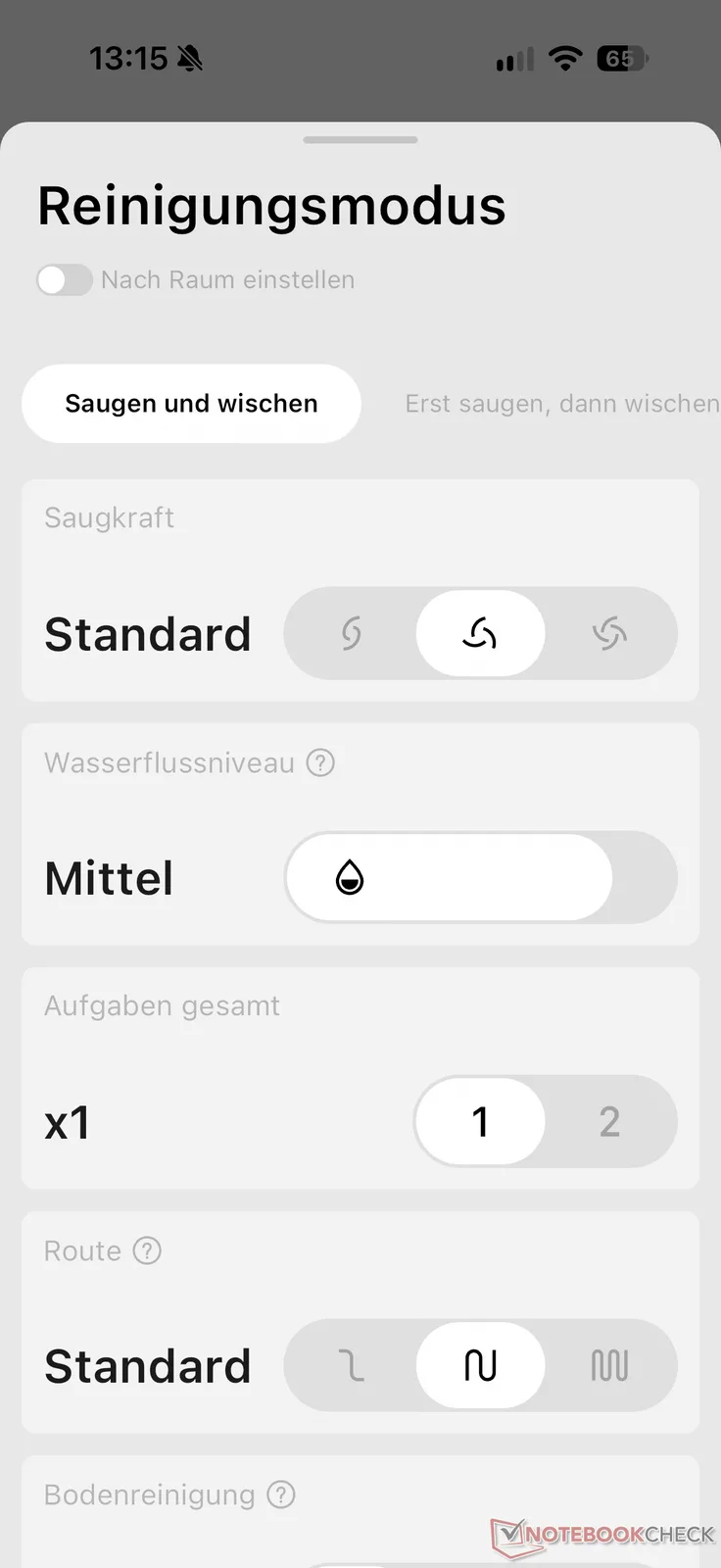
There are four cleaning modes to choose from: "Vacuum and Mop", "Vacuum First, Then Mop", "Vacuum" and "Mop". Depending on the selected mode, the suction power (three levels), water flow level (five levels), route (Quick, Standard, Fine) and use of the two cleaning solutions can be adjusted. The DJI Romo 2 is then sent to work, and it can clean individual rooms or selected areas as well as the entire map.
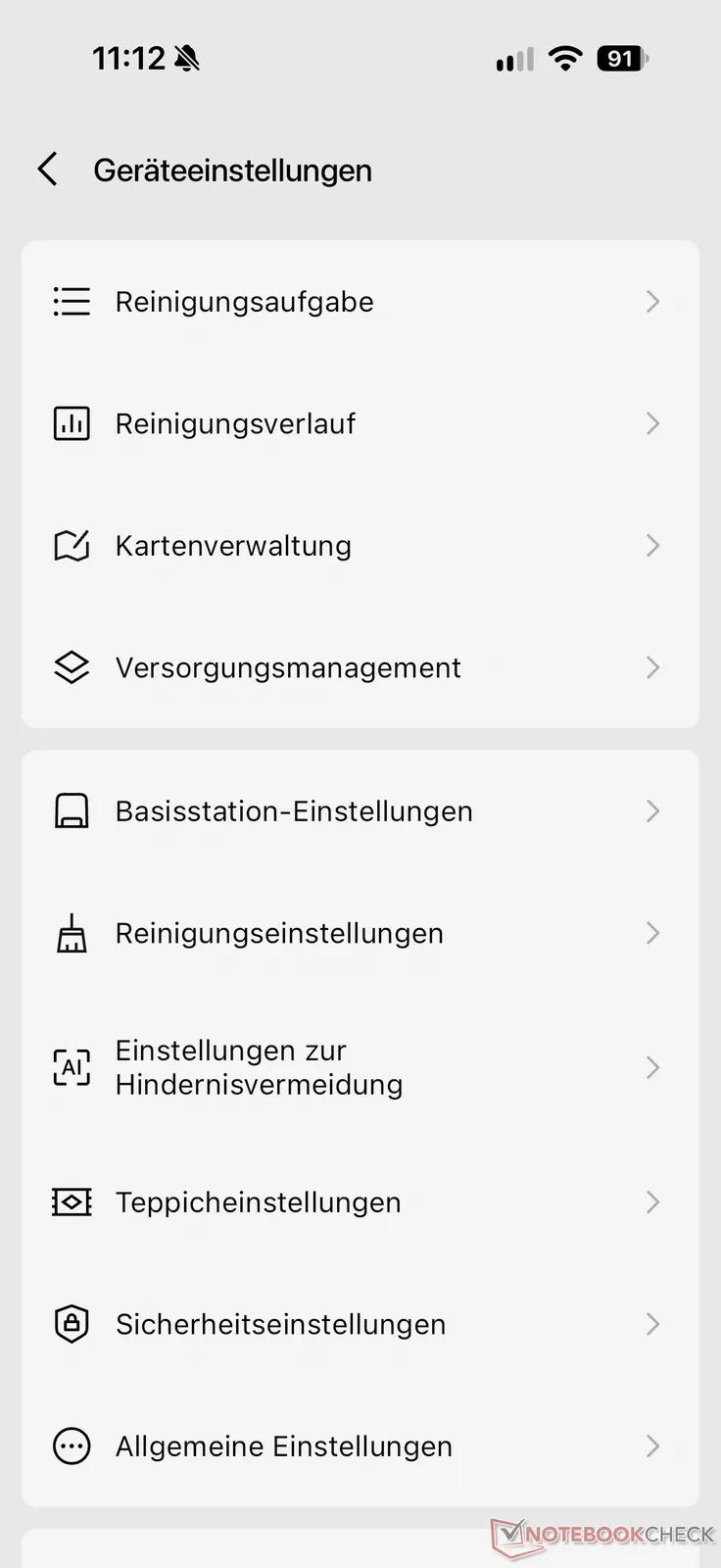
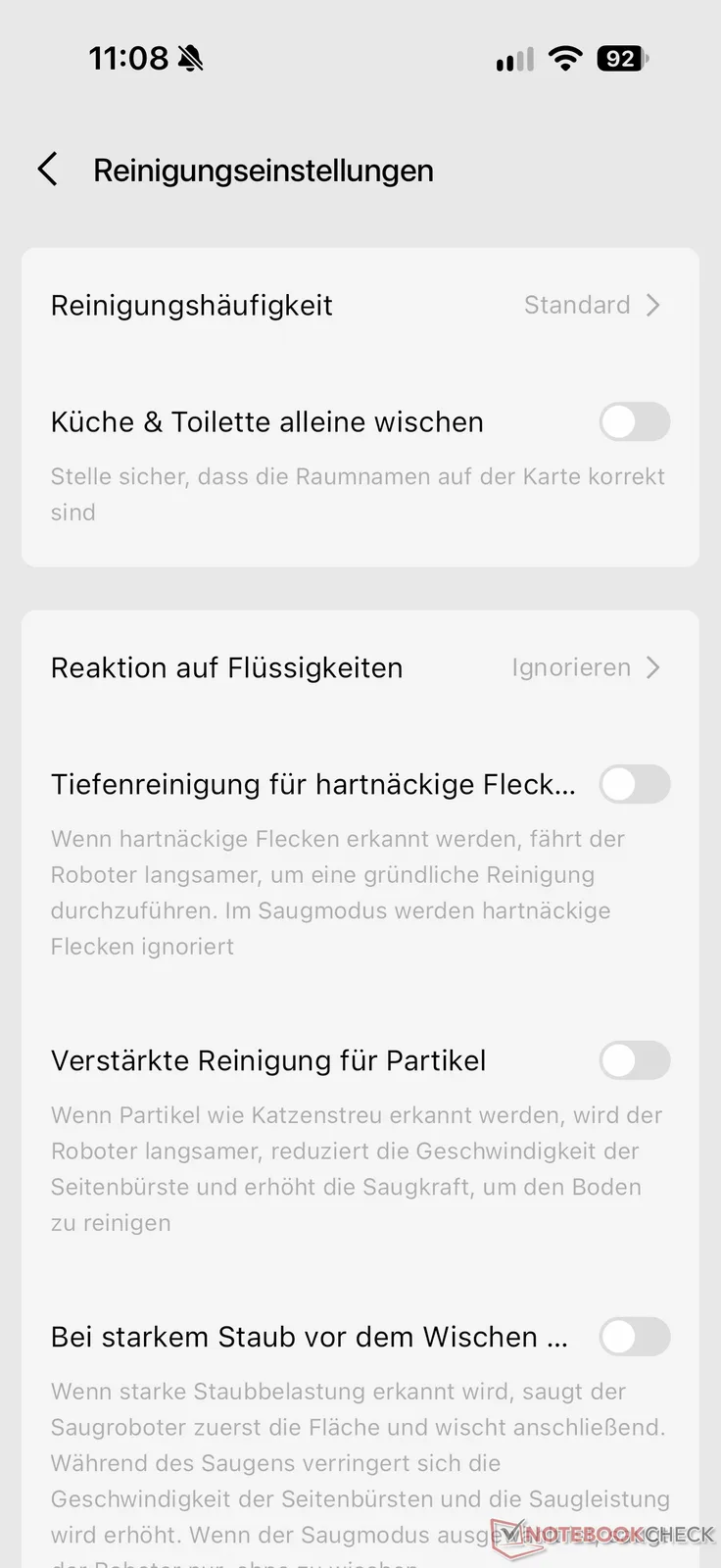
In the overview, the DJI Home App shows the progress of an ongoing cleaning cycle as a percentage, while also displaying areas already cleaned on the map. The app also offers a wide range of settings, including for cleaning and obstacle detection, station behavior and more. The DJI Home App also provides live video over an encrypted connection with password protection.
Navigation & obstacle detection: Really good again
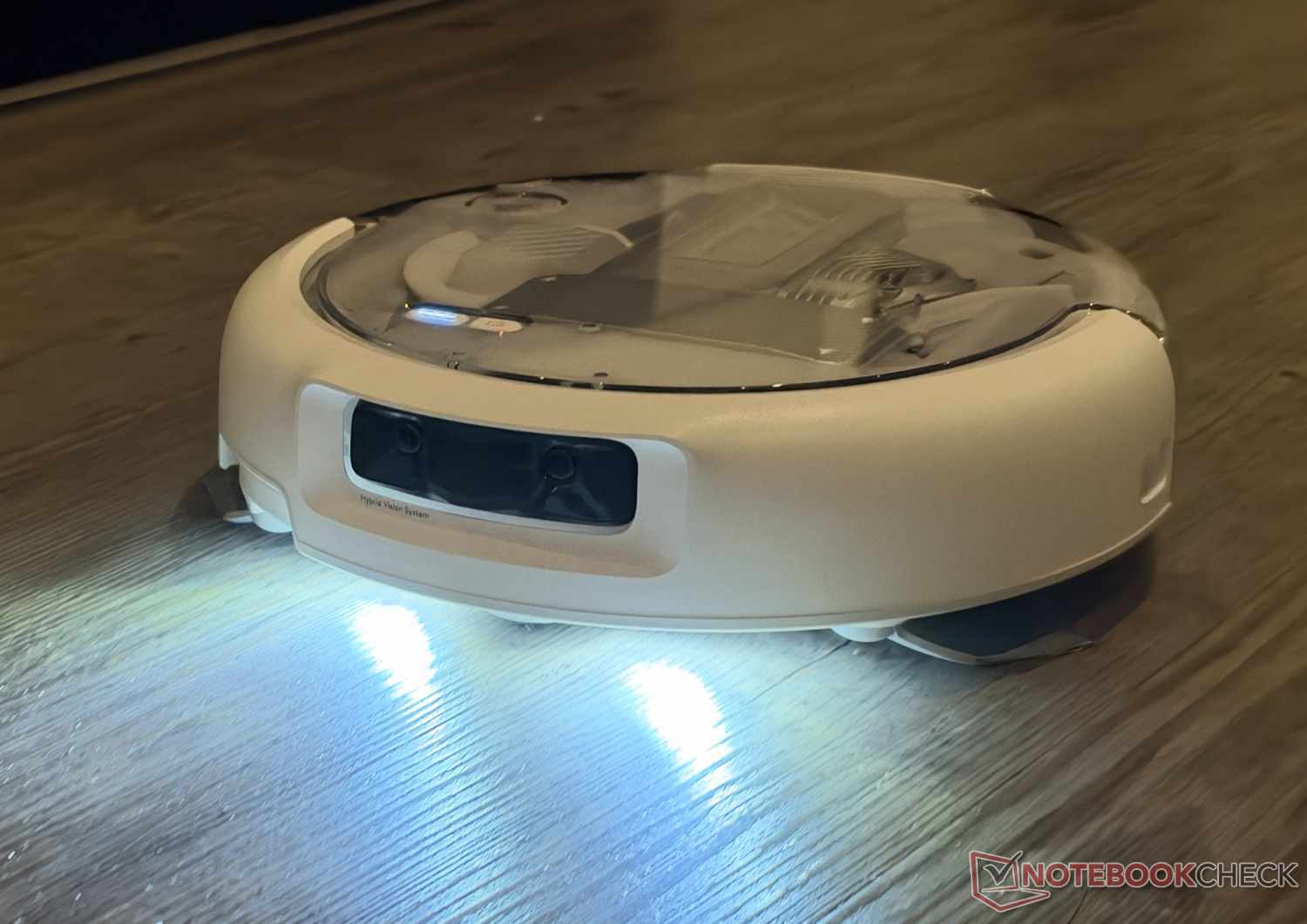
As it did last year, DJI has opted to forgo the traditional laser turret on the Romo 2. Instead, it senses its surroundings using 3D-ToF-LiDAR and dual fisheye vision sensors at the front. Overall, this works very well, even if the navigation does not always seem quite as efficient and systematic as on some other models. That said, this is nitpicking at a very high level. Ultimately, what matters is that it covers all accessible areas, which the DJI Romo P2 did in our test.
The absence of a laser turret generally results in a lower profile. However, DJI has not made the most of this opportunity here. At 9.8 cm, the Romo 2 is almost two centimeters taller than, for example, the Roborock Saros 20. This occasionally proves a disadvantage for the test unit when cleaning under furniture with legs. If it does manage to get under a cabinet or passes through other dark areas, such as an unlit room, its two LEDs help. These are installed like underbody lighting rather than near the cameras, as is usually the case.
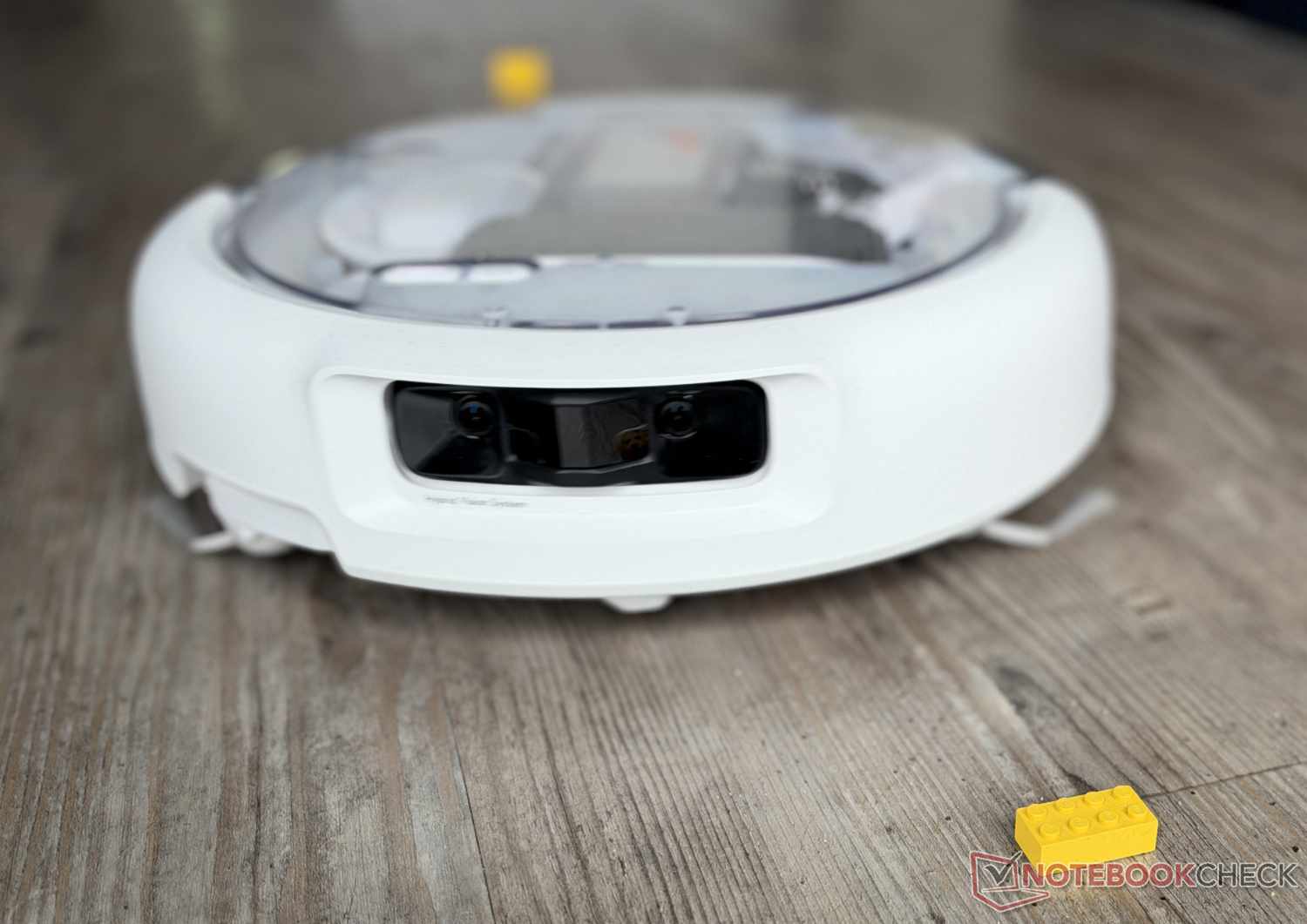
The DJI Romo P impressed in our review last year with its excellent obstacle detection, even recognizing and navigating around a playing card lying flat on the floor. The second generation is every bit as good in this regard. In our review, the DJI Romo 2 also reliably avoided all obstacles, such as interlocking building blocks, shoelaces, and the like. The only exception was a small puddle of water on anthracite-colored tiles (admittedly difficult to detect), which the Romo 2 failed to recognize and vacuumed up despite the settings in the app. A patch of spilled milk, on the other hand, was cleaned up by mopping only (as specified).
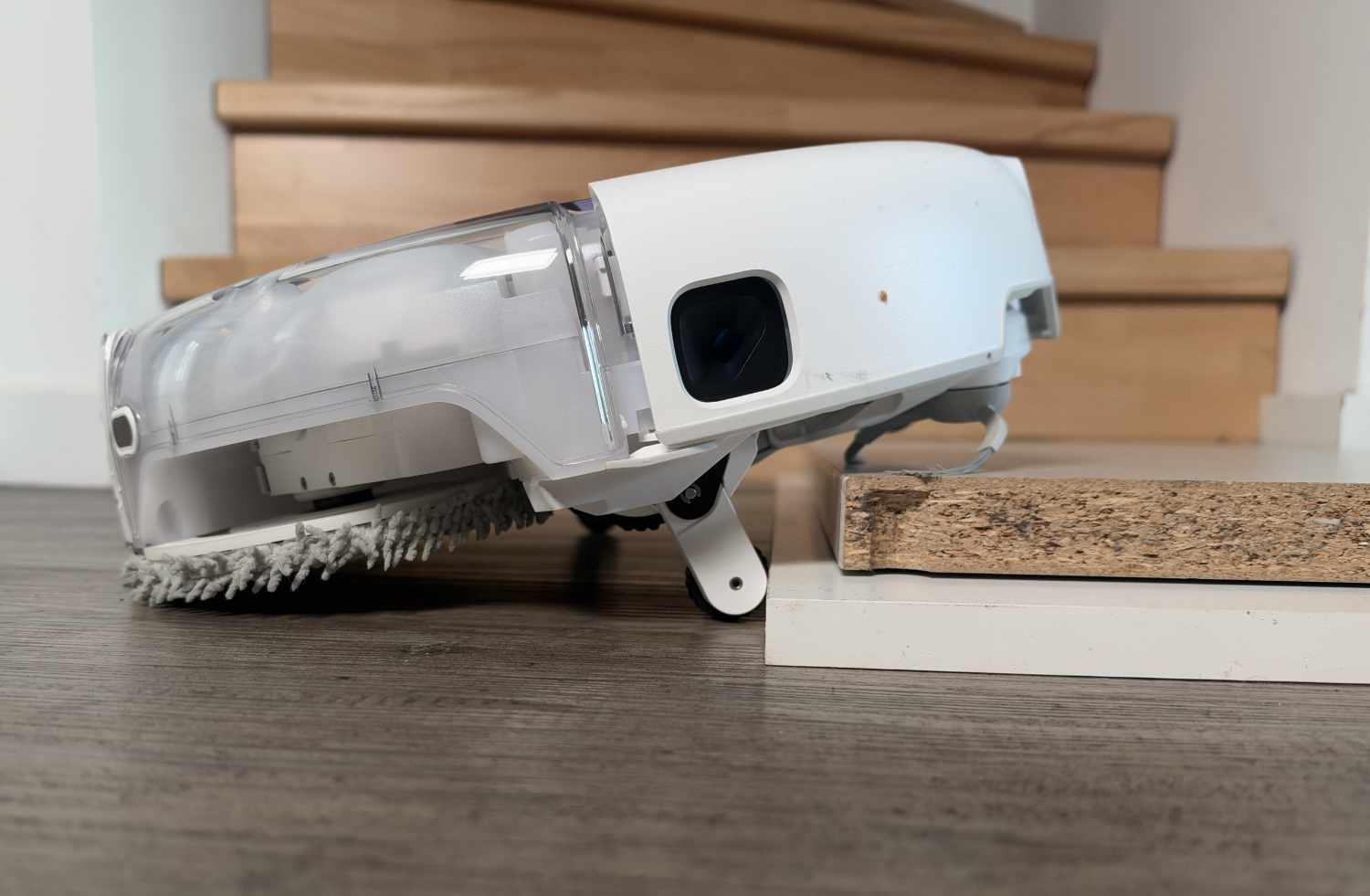
One new feature is the climbing function. The DJI Romo 2 can overcome a single step of up to 4 cm or two steps totaling a maximum of 8.5 cm. In the test, the robot vacuum and mop climbed a double step just under 5 cm high. The process was not particularly graceful (as is also the case with various other robot vacuums), but it was ultimately successful. On durable flooring, the new climbing capability allows access to areas that were inaccessible to its predecessor, e.g. in older apartments with high door thresholds.
Cleaning performance: Even greater reach
As described at the outset, DJI has made two main improvements to cleaning performance. The DJI Romo P2 now has even higher suction power, which is particularly beneficial when cleaning carpets. Here, the robot vacuum reliably removed the vast majority of the test dirt from the carpet fibers, although the result is not quite as perfect as with some of the models tested in the past.
The second new feature is that one of the two mop pads can now extend even farther. Instead of moving it only to the edge of the housing, the Romo 2 can extend the mop up to 4.5 cm beyond it. We have recently seen similar capabilities in the Mova V70 and the Dreame X60, among others, and together with the extendable side brush, this allows for more thorough cleaning under furniture overhangs, in recesses, and in other places that are difficult or impossible to reach. In our view, the DJI Romo 2 could have made somewhat more extensive use of this new capability during testing. But it is a useful improvement that provides even greater coverage.
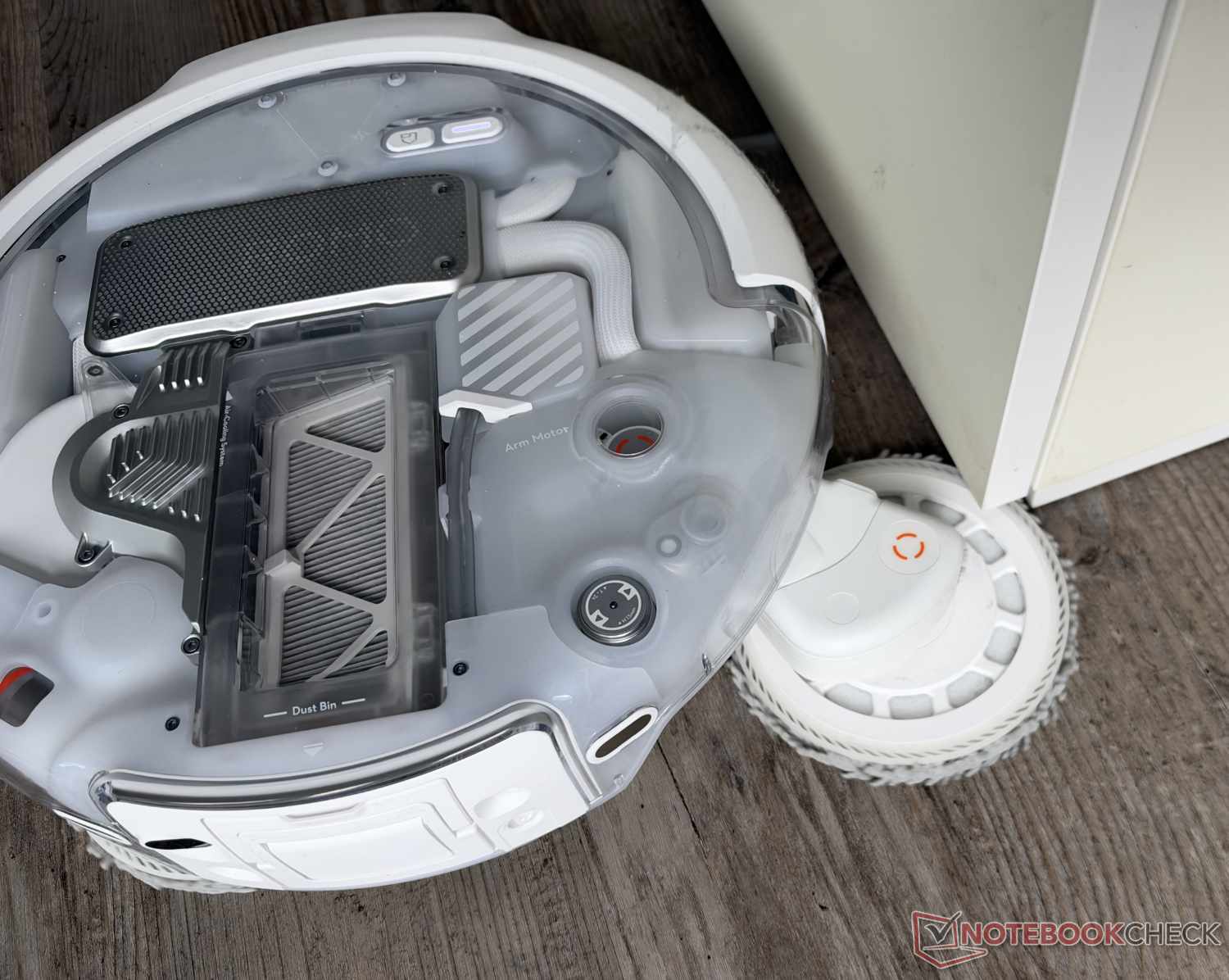
Mopping technology with two rotating mop pads is inferior to a mop roller that is constantly rinsed with fresh water. If the robot picks up damp or sticky dirt, it continues to spread it around to some extent until the next cleaning cycle at the station. In addition, robot vacuums with two mop pads often leave circular marks on tiles and similar surfaces - as was sometimes the case here too. Overall, however, the Romo P2's mopping function made a good impression in the test despite these limitations and generally dealt well with even more stubborn dirt - albeit sometimes only after multiple passes.
The station's work also contributes to the cleaning performance. It cleans the mop pads with water heated to up to 80°C and did a good job in the test. It then dries the mops within three hours by default using air heated to 60°C, making a quiet humming noise as it does so. In addition to dust extraction, the station also dries and UV-treats the dust bag to prevent odors. The anti-tangle function of the two-part rubber brush worked well in the test. However, the dust extraction sometimes struggled a little with long hairs - with the result that, during the next cleaning run, these hung out of the extraction opening and were dragged behind the robot like a little tail.
Battery life & power consumption: Efficient and quiet
DJI equips the DJI Romo 2 with a 5,000 mAh (72 Wh) battery. According to our findings, it can clean a good 80 square meters on a single charge using the default settings, although this naturally also depends on the layout of the space. The manufacturer specifies a charging time of three hours, which also matches our observations during testing.
To compare energy consumption, we have the robot vacuum and mops in our tests clean 50 square meters in a typical home environment using the default settings. The DJI Romo P2 took approximately 80 minutes to do this and used around 55 percent of its battery. The complete cleaning and charging cycle consumed just over 240 Wh. Together with standby power consumption of under 2 W, this results in a calculated, modest monthly electricity consumption of just over 8 kWh if the DJI Romo 2 is to clean 50 square meters every day.
Another positive observation during testing was that the DJI Romo P2 operates pleasantly quietly. At the standard suction setting (the second of three levels), we measured only around 55 dB from a distance of approximately 1 m. This naturally makes it clearly audible, but less obtrusive than some other robot vacuums in our tests.
Transparency
The selection of devices to be reviewed is made by our editorial team. The test sample was given to the author by the manufacturer free of charge for the purposes of review. There was no third-party influence on this review, nor did the manufacturer receive a copy of this review before publication. There was no obligation to publish this review. As an independent media company, Notebookcheck is not subjected to the authority of manufacturers, retailers or publishers.
 Add as a preferred source on Google


