


ChatGPT, Gemini, Meta AI: What parents can control in AI chatbots

Most teenagers already use AI chatbots. In a forsa survey for Germany's Federation of Consumer Organisations (vzbv), carried out in October, 93% of 14- to 25-year-olds said they had used one in the past 12 months. Some 28% also use them for personal conversations. When the consumer group analyzed chats with ChatGPT, Meta AI and Snapchat's My AI, it found that the bots create a sense of human closeness in sensitive conversations and sometimes give dangerous advice. Providers have responded in very different ways. Some have built detailed parental controls, while others set an age limit and keep minors out. Almost everywhere, parents get settings and alerts but no access to the chats themselves.
ChatGPT offers the most settings
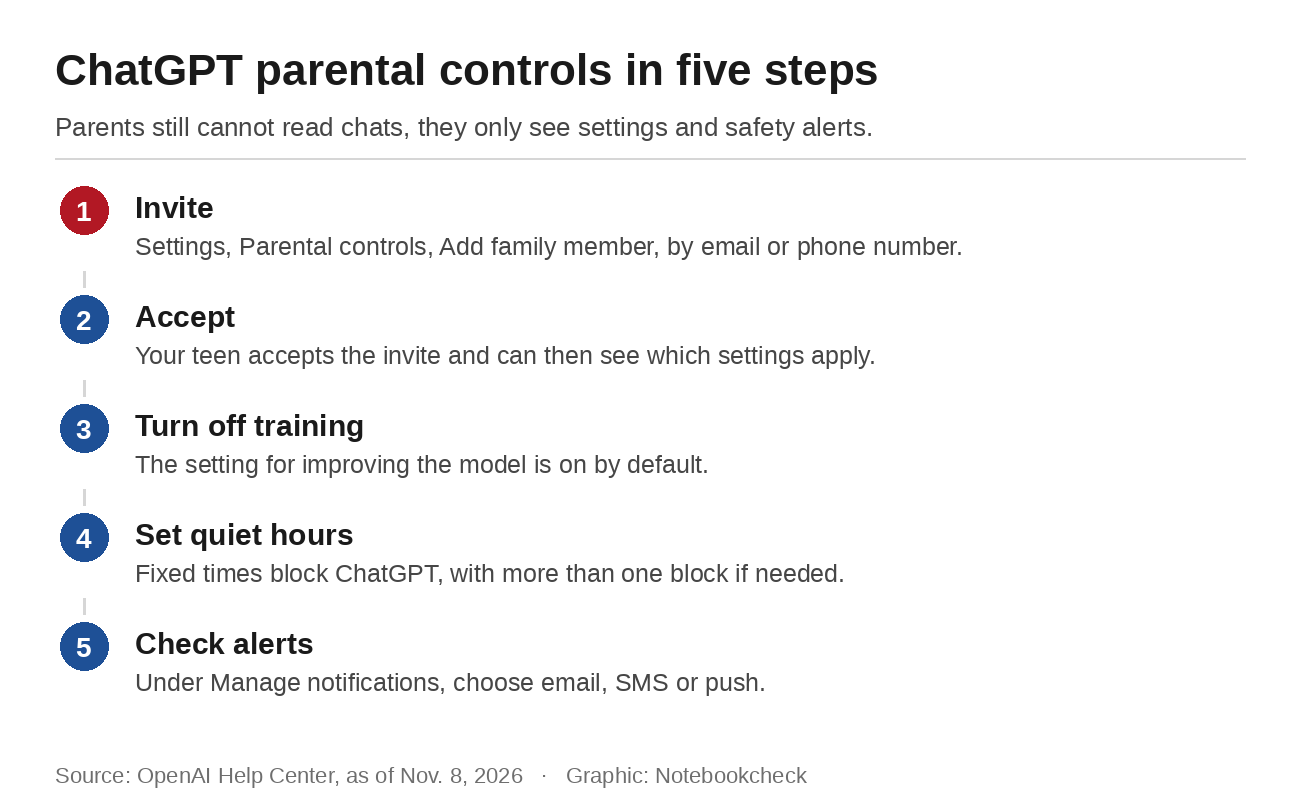
In ChatGPT, parents link their account to their teen's account. According to OpenAI's help article on parental controls, the invite is sent from Settings and Parental controls to an email address or phone number, and the teen can send it as well. One parent can link several teens, but each teen can link to only one parent at a time. Parents can then turn off features such as Voice Mode, image generation, saved memories and Health. Quiet hours block ChatGPT at set times, with more than one time block if needed. Study hours start new chats in study mode but do not block anything. Linking also adds safeguards that, in OpenAI's words, "help reduce graphic content, viral challenges, sexual or romantic roleplay, violent roleplay, and extreme beauty ideals." Turning off Health also deletes the health data synced there.
One setting is easy to miss. The option to use conversations to improve the models is on by default, even for linked teen accounts. Parents who don't want that can switch it off in the parental controls. Our guide to opting out of AI training explains how the same setting works for adults.
Parents cannot read the chats. OpenAI says parental controls "do not let parents or guardians read or monitor a teen's conversations." ChatGPT only sends a safety notification by email, text or push in specific cases, for example when trained reviewers identify a serious self-harm concern or signs of disordered eating. Parents are also told when ChatGPT ends a conversation or suspends the account over threats of violence. OpenAI stresses that this is not real-time monitoring and may not catch every concern. ChatGPT also estimates from usage patterns whether an account belongs to a teen, and when in doubt, the teen experience applies. If the system later decides the user is 18 or older, parental controls end automatically. The US group Common Sense Media still rates ChatGPT for Teens as an unacceptable risk. In its tests, a teen could talk about self-harm for an hour without a single parent alert, as our report on the gaps in ChatGPT for Teens shows.
Gemini, Meta AI and Copilot: Fewer settings, different rules
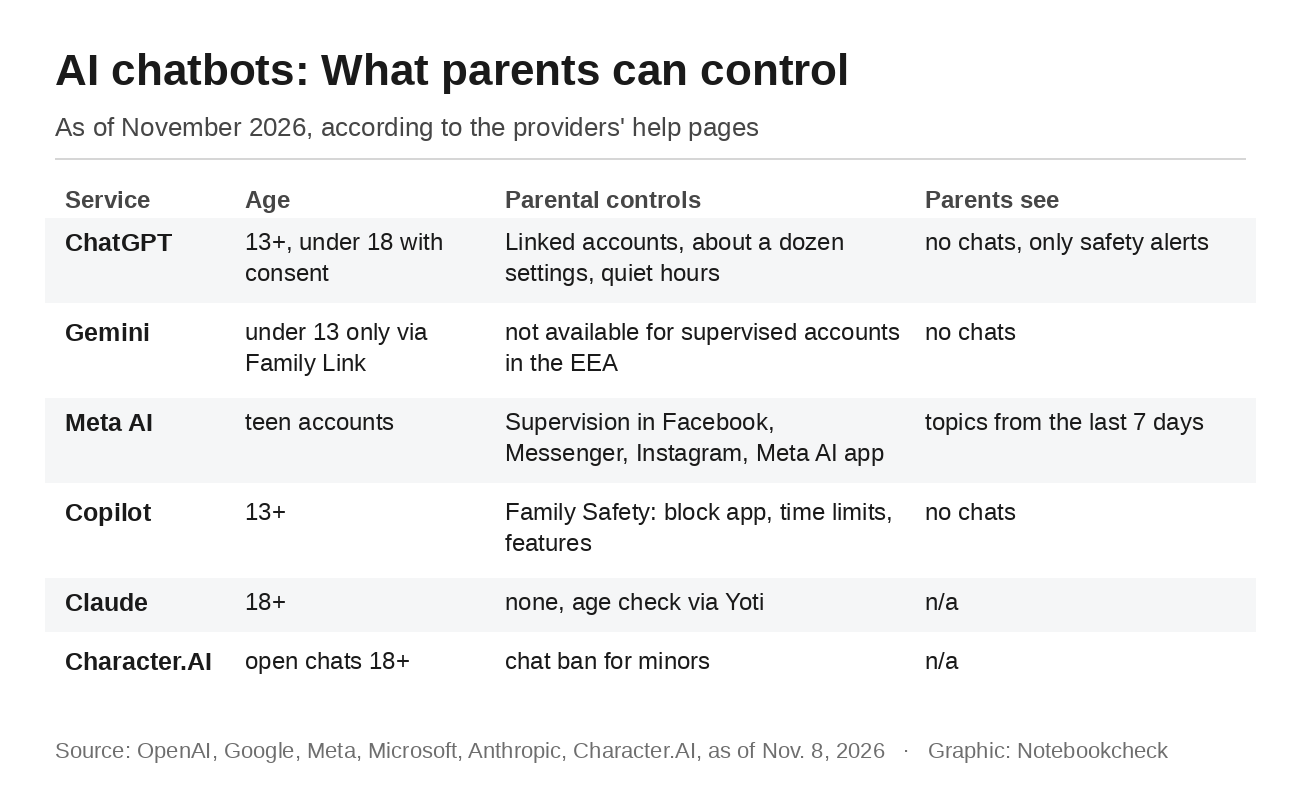
Google only lets children under 13 use Gemini if a parent turns it on in Family Link. That option does not exist in Europe. According to Google's family help page, "Gemini Apps are not available for supervised accounts in the European Economic Area, Switzerland, and the United Kingdom." For school accounts, Google will switch Gemini off by default until the school turns it on, as we reported on AI search for students.
Since April, Meta has shown parents what their teen talks about with Meta AI, but only in broad terms. According to Meta, parents using supervision on Facebook, Messenger and Instagram can see the topics from the past seven days, and since October this also covers the Meta AI app. They do not see the conversations themselves. The Meta AI app starts teens on a 13+ content setting, and parents can make it stricter. Meta paused teen access to its AI characters in January, and its new agent app Muse is for adults only.
Microsoft allows Copilot from age 13. According to Microsoft's help page for young people, data from young users is not used to train models or to build advertising profiles. Through Microsoft Family Safety or the parental controls from Apple and Google, parents can block the app, set time limits and turn off individual features such as image generation, voice and group chats.
Claude and Character.AI rely on age limits
Anthropic keeps things simpler, since Claude is only for adults. According to Anthropic's help article on age assurance, accounts that show signs of use by a minor are disabled. Adults blocked by mistake can verify their age with the provider Yoti using a selfie or an ID document, and Anthropic only receives the result. There are no parental controls. Character.AI removed open-ended chats with AI characters for users under 18 back in November 2025, according to Character.AI first in the US and then in other markets. Teens can still browse content and use creative tools there.
Phones and tablets have no AI-specific switches. Screen Time on iOS 27 and Family Link on Android treat AI apps like any other app, with time limits or a block. That is the only option when a provider offers no parental controls, and it does not cover the browser unless the browser is restricted too.
The vzbv is calling for legal rules on safe design, and 80% of those surveyed support a minimum age of 13 for AI chatbots. The European Commission proposed rules for AI companions in September, but the process is still at an early stage. Until then, it is up to parents. Setting up the controls together with the child works best. In ChatGPT, the teen can see which settings are active anyway and can unlink the accounts at any time, in which case the parent is notified.
Source(s)
vzbv: AI as a risky adviser for young people (German)
OpenAI Help Center: Managing parental controls in ChatGPT
OpenAI Help Center: Age prediction in ChatGPT
Common Sense Media: ChatGPT for Teens Poses Unacceptable Risk to Kids
Google For Families Help: Guide your child's Gemini Apps experience
Meta: Helping Parents Understand the Conversations Their Teens Are Having With AI
Microsoft Support: Microsoft Copilot for Young People
Claude Help Center: Age assurance on Claude
Character.AI: An Update on Changes to Our Under-18 Experience
 Add as a preferred source on Google


